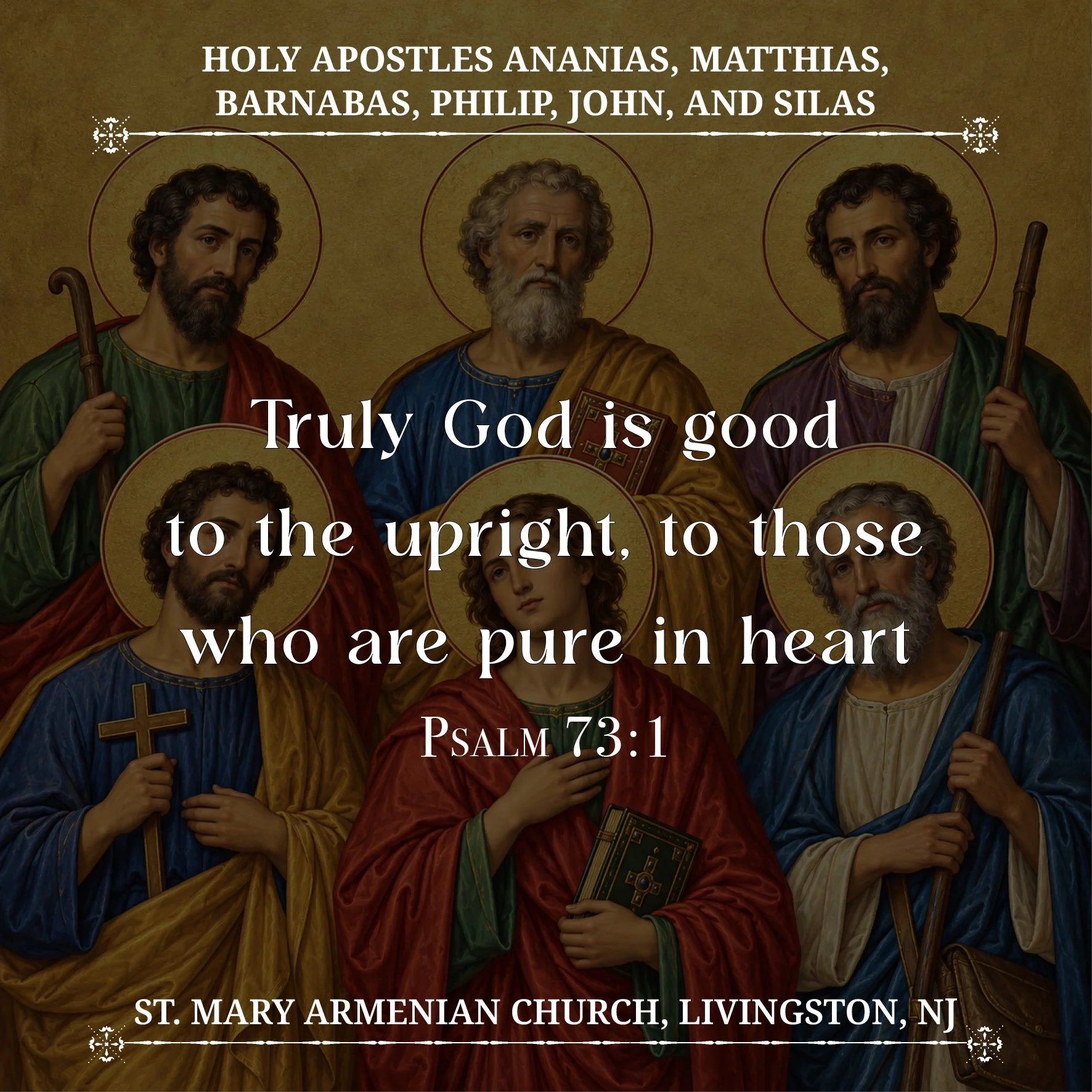
Commemoration Day of
the Holy Apostles Ananias,
Matthias, Barnabas, Philip,
John, and Silas (Silvanus)
Ananias
The one who baptized the Apostle Paul in Damascus.
After the brilliant vision he experienced on the road to Damascus, Paul entered the city almost completely blind. For three days, he neither ate nor drank, but spent his time in prayer and meditation. On the third day, God instructed Ananias to go to Paul and speak with him as necessary.
Nothing is said about when or under what circumstances Ananias became a Christian. Nor is there any information about whether he was a native of Damascus or had come there from Judea. What is certain is that, a few years after the Ascension of the Savior, there were already a considerable number of Christians in Damascus—so many that Saul, the persecutor, considered it necessary to extend his campaign of persecution from Jerusalem to Damascus.
Although Ananias knew that Saul was a persecutor, he obeyed the divine command and went to the house where Saul was staying. He laid his hands upon him and said:
“Brother Saul, the Lord Jesus, who appeared to you on the road as you were coming here, has sent me so that you may regain your sight and be filled with the Holy Spirit.”
When Ananias placed his hands upon Saul's head, “something like scales fell from his eyes, and he regained his sight and was baptized” (Acts 9:15–19).
This is all that we know about Ananias from the New Testament. However, the Yaysmavurk (Armenian Synaxarion, or Lives of the Saints) adds that he was arrested for being a Christian and brought before a judge, who said to him:
“I see that you appear to be a wise and venerable man. Therefore, do not needlessly bring destruction upon yourself through torture, but offer sacrifice to our gods.”
Ananias replied:
“I neither sacrifice to nor worship deaf, mute, and unfeeling gods. Rather, I worship Jesus Christ, my true God, who became for us the Light of Knowledge, whom we saw with our own eyes and touched with our own hands, and who delivered us from the error of idolatry.”
He was subjected to severe tortures and ultimately ended his life as a martyr by stoning.
We commemorate his memory on the Tuesday following the fifth Sunday of the Holy Cross.
Matthias
Matthias was chosen by the apostles to replace Judas the betrayer after Judas's death, because he had followed Christ from His baptism until His Ascension.
He is believed to have preached in Ethiopia.
His memory is commemorated on the Tuesday of the fifth week following the Feast of the Holy Cross.
Barnabas
Barnabas was one of the leading figures of the early Christian Church and served as a guide to Paul during his missionary journey.
He was born in Cyprus, but first appears in Christian history in Jerusalem, where he had a brother or sister and a nephew, Mark the Evangelist. He was a Levite, meaning that he belonged to the priestly tribe.
He owned a field, which he sold, bringing the proceeds to the apostles to be used for the common needs of the Church.
His original name was Joseph, but the apostles changed it to Barnabas, meaning “Son of Consolation” or “Son of Encouragement.”
This change was probably made in recognition of his character, for he was sincere, warmhearted, cheerful, and sociable. These qualities are evident in his earliest activities recorded in the Acts of the Apostles.
When the apostles learned that Gentiles in Antioch had also converted to Christianity, they sent Barnabas there as their representative to obtain reliable information about what had happened.
“When Barnabas arrived in Antioch and saw that God's grace had also been granted to the Gentiles, he rejoiced and encouraged them all to remain faithful to the Lord with steadfast hearts, for Barnabas was a cheerful man, full of the Holy Spirit and faith” (Acts 11:22).
It was Barnabas who introduced the converted Saul to the apostles, who feared him because he had formerly been a persecutor and could not believe that he had truly converted.
“But Barnabas took him and brought him to the apostles, and told them how Saul had seen the Lord, how the Lord had spoken to him, and how he had boldly preached in the name of Jesus in Damascus” (Acts 9:26–27).
When Paul returned from Jerusalem to his homeland, Barnabas again took the initiative. He traveled as far as Tarsus, found Paul, and brought him to Antioch.
There they carried out missionary work for an entire year in Antioch, one of the great cities of the Roman Empire. It was there that the followers of Christ were first called “Christians” (Acts 11:25–26).
A new chapter in Christian evangelization began when the leading spiritual and intellectual figures of Antioch, known as “prophets and teachers,” among whom Barnabas was the leader and Saul the junior member, were inspired by the Holy Spirit to organize a missionary expedition to distant lands.
Barnabas and Saul were entrusted with this mission and responsibility. The members of the group, “after fasting and praying, laid their hands upon Barnabas and Saul and sent them away.”
Thus began the Apostle Paul's first missionary journey, in which Barnabas was officially the principal leader and guide.
From Antioch, they sailed to Barnabas's homeland, Cyprus. They preached throughout the length of the island, from east to west, until they reached Paphos, the administrative center of the Roman governors of the island.
Here they achieved their greatest success.
First, they overcame Elymas the magician, a deceiver and false teacher, by striking him with blindness. Then they converted Sergius Paulus, the Roman proconsul of the island, described as “an intelligent man.”
From this point onward, Saul is called Paul, perhaps having adopted the name from the Roman governor.
From Cyprus they traveled to Asia Minor by way of Perga, near present-day Antalya.
Throughout this journey, they were accompanied by Barnabas's relative, Mark the Evangelist, who, either because he became uneasy or could not endure the hardships of travel, returned to Jerusalem.
Barnabas and Paul continued preaching as far as the region near present-day Konya.
There, after healing a man who was lame, the local people were astonished and thought that “the gods have come down to us in human form.”
They called Barnabas Zeus, or Aramazd, probably because of his dignified and imposing appearance (Acts 14:11–12).
After preaching the Gospel in the surrounding cities, they returned to Antioch by way of Antalya.
Barnabas, together with Paul, attended the Apostolic Council of Jerusalem. There, because of their missionary activities among the Gentiles and the successes they had achieved, they served as the principal speakers and witnesses.
Barnabas and Paul were also entrusted with bringing the council's decisions to the Church of Antioch, accompanied by two other representatives appointed by the council, named Silas and Judas.
Some time later, Paul proposed to Barnabas that they undertake a second missionary journey.
Barnabas wished to take Mark with them again, but Paul did not agree, arguing that Mark had abandoned their work and returned home during the first journey.
Because of this disagreement, Barnabas took Mark and returned to Cyprus.
From this point onward, Barnabas is no longer mentioned in the Acts of the Apostles.
Tradition holds that he became the first bishop of the Church of Cyprus, which, on the basis of his apostolic authority, remains an autocephalous, or independent, Church to this day.
He is believed to have been martyred in the city of Salamis in Cyprus.
He is commemorated together with the other apostles on the Tuesday following the fifth Sunday of the Holy Cross.
Philip
Philip was among the first apostles to be called by Christ.
When Jesus, following His baptism and temptation, decided to return to Galilee, “He found Philip and said to him, ‘Follow Me.’ Philip was from Bethsaida, the city of Peter” (John 1:43–44).
It is probable that Philip had previously been a disciple of John the Baptist and later became a follower of Jesus.
Philip is mentioned in the Gospel of John in connection with several incidents, generally together with Andrew.
For example, during the miracle of the multiplication of the loaves, Jesus first asked Philip where they could obtain bread for the enormous crowd.
The Evangelist adds in explanation:
“Jesus asked this to test him, for He Himself already knew what He was going to do.”
Philip answered:
“Two hundred denarii worth of bread would not be enough for them, even if each one received only a little” (John 6:5–7).
Philip is also mentioned in connection with a group of Gentiles who wished to see Jesus.
They probably approached him because they were encouraged by his purely Greek name, which means “lover of horses,” or because he knew the Greek language.
Philip and Andrew—interestingly, Andrew is also a Greek name—introduced these visitors to Jesus.
During the Last Supper, when Jesus was delivering His final teachings to the disciples, they repeatedly interrupted Him with questions.
Philip was among those who questioned Him.
When Jesus said:
“If you have known Me, you have known the Father also. From now on you know Him and have seen Him,”
Philip interrupted:
“Lord, show us the Father, and that will be enough for us.”
Jesus replied:
“Have I been with you so long, Philip, and yet you have not known Me? Whoever has seen Me has seen the Father. How then can you say, ‘Show us the Father’?” (John 14:7–10).
According to tradition, Philip preached in Asia Minor and was martyred by crucifixion in the city of Hierapolis.
He is commemorated together with his inseparable companion, Andrew, on the Saturday following the ninth Sunday after the Feast of the Holy Cross.
John (Mark the Evangelist)
In our Church calendar, the names John and Mark have been assigned to two different individuals and have consequently entered the calendar as separate persons.
However, the individual known by these two names is first mentioned in the Acts of the Apostles when the Apostle Peter, after being released from prison, came to their house:
“And Peter ... came to the house of Mary, the mother of John, who was called Mark” (Acts 12:12).
From this passage, we learn that John and Mark are two names for the same person, one Hebrew and the other Greco-Roman in form.
Having two names was common among many of the leading figures of the early Christian Church.
The same passage also shows that his mother was a prominent person in the newly established Church.
More importantly, their home was one of the principal gathering places of the early Christians, as the passage continues:
“Where many were gathered together and were praying.”
Mark, therefore, was from Jerusalem and was a relative of the Apostle Barnabas.
This is confirmed by the Apostle Paul in the greeting of his Letter to the Colossians:
“Mark, the cousin of Barnabas” (Colossians 4:10).
When Barnabas and Paul came to Jerusalem, bringing the material contributions of the believers in Antioch to the impoverished Church in Jerusalem, they took with them on their return “John, who was also called Mark” (Acts 12:25).
Mark accompanied them on their first missionary journey as an attendant or assistant.
However, shortly after reaching Asia Minor, Mark caused Paul some displeasure and returned to Jerusalem.
For this reason, Paul did not wish to have Mark accompany them on their second journey.
This disagreement led Barnabas and Mark to return to Cyprus, where, in all likelihood, they continued the evangelistic work they had begun.
From Paul's letters, we learn that Paul and Mark were eventually reconciled.
As mentioned earlier, during Paul's imprisonment in Rome, Mark was with him.
Through Mark, Paul sent greetings to the Church of Colossae, where Mark was to be sent for missionary service.
In his Second Letter to Timothy, Paul instructed Timothy:
“Bring Mark with you, for he is a useful assistant to me” (2 Timothy 4:11).
What immortalized Mark's name, and what constitutes his lasting contribution to the Christian Church, is his Gospel.
Although it is the shortest of the four Gospels, it is also considered the oldest.
There is a tradition that it was written under the direction and guidance of the Apostle Peter, who refers to him in his First Epistle as:
“Mark, my son” (1 Peter 5:13).
The Gospel of Mark is believed to have been written for the Gentiles, particularly the Romans.
In it, Mark presents Christ as a powerful figure, both in word and in deed.
His writing style is simple, direct, and concise.
Silas, or Silvanus
These two names, belonging to one and the same person, have entered our Church calendar as though they referred to two separate individuals.
The same confusion also exists in the Greek Church calendar.
Nevertheless, we are firmly convinced that these two names belong to one person: Silas is his Hebrew name, while Silvanus is its Greek form.
Silas is first mentioned in the Acts of the Apostles when he and a companion were chosen by the Council of Jerusalem to serve as representatives and accompany Paul and Barnabas in delivering the council's decisions to Antioch.
Indeed, in Antioch, Silas and his companion “encouraged and strengthened the brothers with many words.”
They remained in Antioch for some time.
Later, his companion returned to Jerusalem, “but Silas decided to remain there.”
When Paul realized that Barnabas would not accompany him on his second missionary journey, he chose Silas as his companion.
Together they departed from Antioch toward the north, entering Cilicia and establishing Christian communities wherever they traveled.
They visited the churches previously founded by the Apostle Paul in the region of Konya.
Continuing onward, they traveled toward the region of present-day Ankara.
Then, turning westward, they passed through the areas of modern Eskişehir and Bilecik until they reached Troas.
From there, they crossed into the European continent, entering Macedonia and beginning their missionary preaching at Kavala, which at that time was called Neapolis, meaning “New City.”
In the Macedonian city of Philippi, Silas and Paul were imprisoned.
After being released, they continued their missionary work throughout Greece, traveling from north to south through Thessalonica, Athens, and Corinth.
From there, they crossed back into Asia Minor, arriving at Ephesus, and then departed directly for Jerusalem.
During this journey, Silas is mentioned for the last time in Thessalonica (Acts 17:4), after which we lose track of him.
However, the Apostle Paul mentions him in his Second Letter to the Corinthians (2 Corinthians 1:19), stating that the Gospel was preached in Corinth by Paul, Silas, and Timothy.
Silas's name also appears at the beginning of both of Paul's letters to the Thessalonians, giving the impression that the letters were written jointly.
Furthermore, from the following passage in Peter's First Epistle, it may be inferred that this letter too was written by Silas, undoubtedly under the Apostle's direction:
“Through Silvanus, whom I consider a faithful brother, I have written to you briefly, encouraging you...” (1 Peter 5:12).
An important detail is that in the Acts of the Apostles, he is referred to as Silas, while in the Epistles, he is called Silvanus.
We know almost nothing about his death.
There is a tradition that he became the first bishop of Philippi and died there.
We commemorate them memory on the Tuesday following the fifth Sunday of the Holy Cross.
SCRIPTURE READINGS
~ Zechariah 8:1-3 ~
The word of the Lord of hosts came to me, saying: Thus says the Lord of hosts: I am jealous for Zion with great jealousy, and I am jealous for her with great wrath. Thus says the Lord: I will return to Zion, and will dwell in the midst of Jerusalem; Jerusalem shall be called the faithful city, and the mountain of the Lord of hosts shall be called the holy mountain.
~ Book of Acts 9:1-22 ~
Meanwhile Saul, still breathing threats and murder against the disciples of the Lord, went to the high priest and asked him for letters to the synagogues at Damascus, so that if he found any who belonged to the Way, men or women, he might bring them bound to Jerusalem. Now as he was going along and approaching Damascus, suddenly a light from heaven flashed around him. He fell to the ground and heard a voice saying to him, "Saul, Saul, why do you persecute me?" He asked, "Who are you, Lord?" The reply came, "I am Jesus, whom you are persecuting. But get up and enter the city, and you will be told what you are to do." The men who were traveling with him stood speechless because they heard the voice but saw no one. Saul got up from the ground, and though his eyes were open, he could see nothing; so they led him by the hand and brought him into Damascus. For three days he was without sight, and neither ate nor drank. Now there was a disciple in Damascus named Ananias. The Lord said to him in a vision, "Ananias." He answered, "Here I am, Lord." The Lord said to him, "Get up and go to the street called Straight, and at the house of Judas look for a man of Tarsus named Saul. At this moment he is praying, and he has seen in a vision a man named Ananias come in and lay his hands on him so that he might regain his sight." But Ananias answered, "Lord, I have heard from many about this man, how much evil he has done to your saints in Jerusalem; and here he has authority from the chief priests to bind all who invoke your name." But the Lord said to him, "Go, for he is an instrument whom I have chosen to bring my name before Gentiles and kings and before the people of Israel; I myself will show him how much he must suffer for the sake of my name." So Ananias went and entered the house. He laid his hands on Saul and said, "Brother Saul, the Lord Jesus, who appeared to you on your way here, has sent me so that you may regain your sight and be filled with the Holy Spirit." And immediately something like scales fell from his eyes, and his sight was restored. Then he got up and was baptized, and after taking some food, he regained his strength. For several days he was with the disciples in Damascus, and immediately he began to proclaim Jesus in the synagogues, saying, "He is the Son of God." All who heard him were amazed and said, "Is not this the man who made havoc in Jerusalem among those who invoked this name? And has he not come here for the purpose of bringing them bound before the chief priests?" Saul became increasingly more powerful and confounded the Jews who lived in Damascus by proving that Jesus was the Messiah.
~ Holy Gospel of St. Luke 9:1-6 ~
Then Jesus called the twelve together and gave them power and authority over all demons and to cure diseases, and he sent them out to proclaim the kingdom of God and to heal. He said to them, "Take nothing for your journey, no staff, nor bag, nor bread, nor money—not even an extra tunic. Whatever house you enter, stay there, and leave from there. Wherever they do not welcome you, as you are leaving that town shake the dust off your feet as a testimony against them." They departed and went through the villages, bringing the good news and curing diseases everywhere.