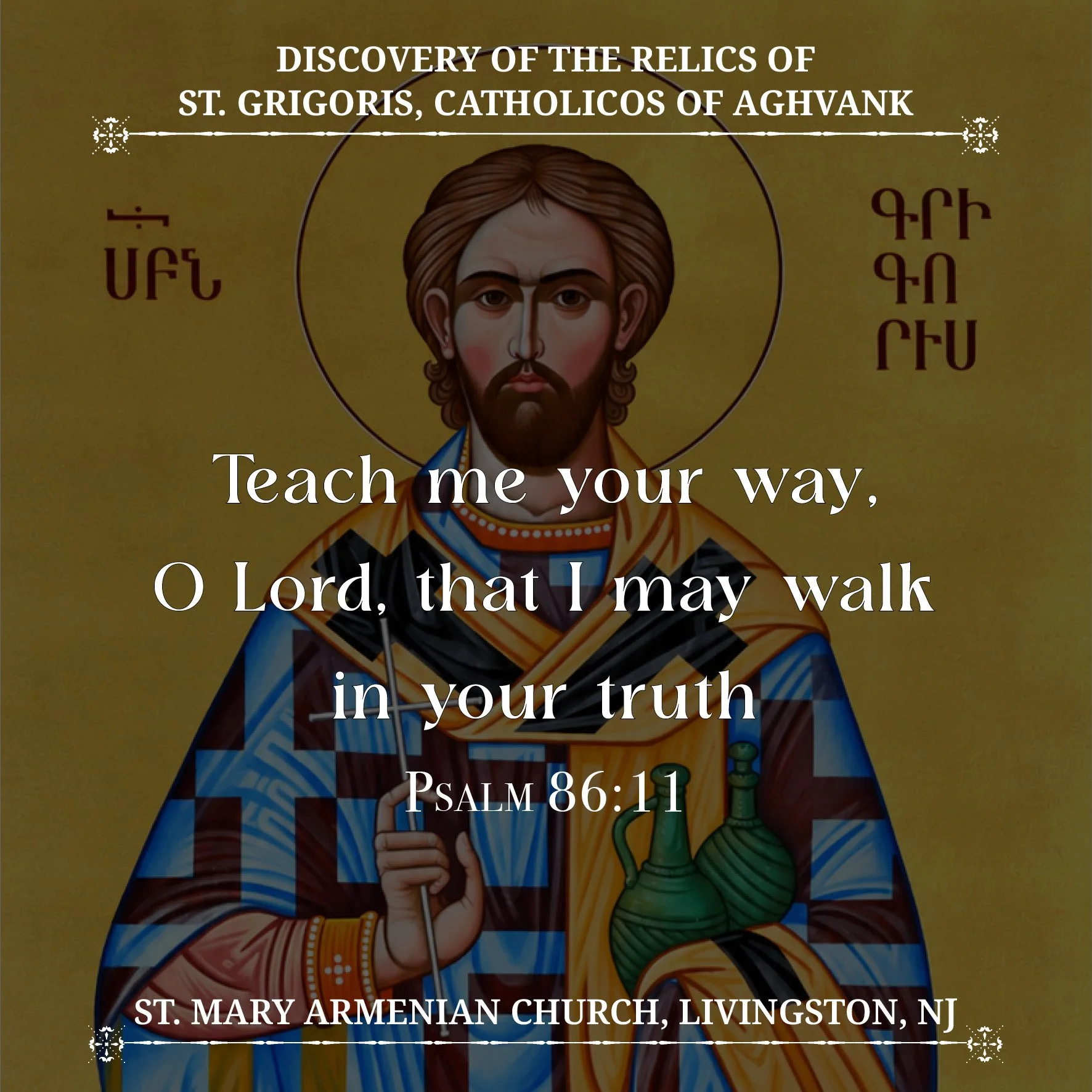
Commemoration Day of
the Discovery of the Relics
of St. Grigoris, Catholicos of Aghvank (Alans);
the Holy Fathers Tatul, Varos, Tumas,
Anton, and Kronides;
and the Seven Herb-Eating Ascetics
Martyred at the Monastery of Innak
St. Grigoris, Catholicos of Aghvank (Alans) (295–337)
Grigoris was the elder of the twin sons of Catholicos Vrtanes. He was born in Caesarea in 295 and came to Armenia in 310 with his father and his brother Husik.
Although he had lived and been educated at the Armenian royal court, he was filled with a desire for the celibate life. Under the guidance of his uncle Aristakes, by whom he was ordained to the celibate clergy at a young age, he entered ecclesiastical service, “because he bore within himself the fruits of Spirit-filled virtues, spiritual character and maturity, and the knowledge of God” (Faustus of Byzantium).
Although still very young, in view of his merit, ability, and spiritual richness, he was ordained bishop “for the regions of Aghvank (Alans) and Georgia, that is, for the territories bordering the Mazkuts.”
St. Gregory the Illuminator had previously preached among these Caucasian peoples, but it appears that the seeds of the Gospel had not yet taken firm root. In addition, a delegation of well-disposed people from those northern regions came to King Tiridates asking that someone from the family of the Illuminator be sent to them in order to strengthen Christianity there.
Thus, in the year 320, when Grigoris was barely twenty-five years old, though already an impressive and dignified young man in appearance, he was ordained bishop and sent to the Caucasus.
At first his work prospered. “He went and renewed the churches there with enlightened ordinances, in the manner of the first Gregory, his grandfather.” He extended his activity also into the borders of Atropatene. “He became a preacher of the true faith of Christ and left upon everyone a marvelous and astonishing impression.”
Nor did he neglect the strictness of his inner spiritual life, both for his own benefit and for that of others:
“With the most difficult, countless, and severe forms of self-discipline, with fasting and holiness, with sleepless nightly vigils and unwearied prayers and fervor, he continually turned to God on behalf of all. By the grace of God, he carried forward without interruption the evangelical ministry and the oversight of the Holy Church. With diligence and zeal he exhorted everyone courageously to embrace a good manner of life, and day and night, through prayers and supplications, he inspired spiritual fervor in those both far and near” (Faustus of Byzantium).
After having thus “set in order and renewed the Church” in the central and southern parts of the land, he turned northward and entered the army of the king of the Mazkuts, which was composed of various Caucasian tribes, and “began to preach and proclaim Christ to them.”
At first they listened and accepted his preaching and were willing to believe in the true God. But when he began to teach the law and commandments of Christ, they learned that before the true God “plundering, robbery, murder, greed, depriving others, consuming what belongs to others, coveting the possessions of others,” and similar acts were hateful.
Hearing these words, they became angry and said: “If we do not seize booty, if we do not plunder, if we do not take what belongs to others, how are we to maintain such a multitude of troops?”
Although Grigoris strove, “with many good words,” to win them over to a life of peaceful labor, “they no longer wished to hear anything further” and said among themselves:
“This man, by these words of his, wishes to deprive us of our valor… If we listen to him and become Christians, by what shall we live? We shall not even be able to ride horses according to our customary way of life.”
They concluded that this was a stratagem of the Armenian king intended “through this teaching to prevent our raids,” which they were accustomed to carry out against the neighboring Armenian lands.
They therefore decided to eliminate the blessed preacher.
They brought a fierce horse, tied Grigoris with ropes to its tail, and released the horse across the plain called Vatnean on the shore of the Caspian Sea. In this way, the virtuous preacher of Christ was martyred.
Those who had accompanied him gathered his relics and brought them to a village called Amaras, where they buried them in a church.
The historian concludes: “Every year, on the day of his feast, the people of that region come and commemorate his courage” (Faustus of Byzantium).
Thus, in the year 337, Grigoris suffered a cruel martyrdom while still barely forty years of age.
His tomb remains to this day in the village of Amaras in Karabakh, in the church that bears his name.
We commemorate him twice: first, on the feast of the sons and grandsons of St. Gregory the Illuminator; and second, on the feast of the finding of his relics, celebrated on the fifth Monday following the Feast of the Holy Cross, together with twelve other Armenian ascetics.
The stanza dedicated to him in the Mankunk hymn for the sons and grandsons of St. Gregory the Illuminator reads:
In pure virginity you were numbered among the bodiless angels,
True high priest and witness of Christ, St. Grigoris,
Intercede unceasingly for our souls.
Tatul, Varos, and Tumas
Tatul and Varos were brothers according to both the flesh and the spirit, while Tumas was their disciple.
The two brothers were among the disciples of Saints Sahak and Mesrop and had therefore been nourished and filled with the teaching and virtues they received from those great vardapets.
When their teachers died and the Vardanants movement began, they too became active participants in it, “assisting those faithful to the covenant and admonishing the unruly.”
After the martyrdom of the Vardanants, however, when the covenant-faithful sought refuge in strong fortresses, these men sought refuge in the natural and free strongholds of the Armenian land—that is, they ascended unknown and inaccessible mountains and for a time devoted themselves to severe asceticism.
They withdrew to the region belonging to the principality of Gabeghian, probably because they themselves were natives of that district. They settled in a place called Vishapadzor, near the present-day town of Kaghzvan.
Finding in the vicinity the herbs and wild fruits necessary for their nourishment and living on them, they regarded the place as one chosen for them by God. Through the prayer-filled life made possible by solitude, they advanced in spiritual perfection.
“Like spiritual angels, every day they sent their holy prayers to heaven as rational offerings, bodiless sacrifices, unburning holocausts, and unending oblations” (Liakatar, p. 642).
After living for some time “in this beautiful fellowship,” the two brothers saw that they were exceedingly happy in this state and therefore decided to separate from one another, so as to deprive themselves even of the consolation of seeing each other.
Varos, the elder brother, went away and withdrew to a place called the cave of Ditsamor.
“So that the struggle they waged against the hosts of demons might be more difficult, so that they might receive an even greater reward from Christ God, and so that God alone might be their consolation and support, they resolved to deprive themselves of the comfort they enjoyed through seeing one another.”
“So the virtues of the great and blessed Anthony shone in their persons. They continually fought and conquered the demons and received good recompense from Christ, among them ‘ineffable contemplation,’ that is, supernatural visions” (Liakatar).
Yet, according to the Gospel saying, “a city set on a hill cannot be hidden.” So it was with them.
Although “for a long time they lived unknown to men,” Tatul’s hermitage was eventually discovered by hunters. In a short time, throughout the entire region, “the fame of Tatul’s wondrous virtue” became known.
In those difficult times, people came to them in groups in order to be strengthened and consoled amid the hopeless conditions brought about by fire-worship and foreign domination.
Very many, having been “encouraged,” no longer wished to leave him and desired to become his disciples in the ascetic life.
“And soon, in a suitable place there, they laid foundations and built a church; they also prepared cells appropriate for ascetics and formed a monastic brotherhood for communal life, with Tatul as their superior. From him the place came to be called the ‘Monastery of Tatul.’ There, in the beautiful practice of piety, through the Spirit-inspired counsels of the Holy Father [Tatul] and through God-pleasing order, groups of virtuous persons were formed” (Liakatar, p. 643).
Thus, in a place once dominated by complete solitude, within a short time there blossomed a way of life proper to monasticism and communal brotherhood.
One of Tatul’s disciples was distinguished by unusual intelligence and advancement in perfection. His name was Tumas, “an inseparable servant,” that is, an inseparable assistant and supporter of his teacher.
He was “exceedingly devoted to goodness, God-fearing and reverent, meek and humble, peaceful and obedient, caring for all and fulfilling the wishes of all, while at the same time pursuing asceticism, observing the rules of the great Tatul, and carrying them out with cross-bearing severity.”
Blessed Tatul, who by then was advanced in age, rejoiced when he saw Tumas’ progress. He appointed this young and vigorous disciple as abbot in his place and himself withdrew to the hermitage of Mayratzor in order to spend the final years of his life in solitude.
“And there, like a bodiless angel, he completed his solitary life until, having reached extreme old age, he departed this world in that same hermitage of Mayratzor. From there they took the holy body of the Blessed One and, as was fitting, carried it away and buried it with great honor in his monastery” (Liakatar, p. 644).
Tatul’s elder brother Varos, after separating from his brother, lived in complete isolation for many years as an ascetic in the mountain cave of Ditsamor until certain people, “by the providence of God,” discovered him as well.
They rejoiced so greatly over this “finding” that, not even knowing his name, they began to call him Giwt, meaning “Finding.”
A new monastery was built at the place of his hermitage and was called after him the Monastery of Giwt.
There too, under the leadership of Father Varos and the divinely ordered monastic rules he established, monks and “praisers of God” soon gathered.
Finally, having reached deep old age and having completed a life rich in spiritual fruit, he departed from this passing world to the life that does not pass away.
Blessed Tumas, the worthy successor of Tatul, “walked in every kind of virtue according to the will of God and followed the teachings and life of the Holy Father Tatul. With every form of good order he adorned the monastic community and strengthened in his monastery the brethren united by the will of God. He lived for many years in an angelic manner, reached deep old age, and peacefully fell asleep in Christ and was buried beside Father Tatul.”
Although these three ascetics are commemorated in the Armenian Synaxarion on September 30, they are now invariably commemorated together with Anton and Kronides on the Monday following the fifth Sunday after the Feast of the Holy Cross.
They have no special hymn of their own.
Anton and Kronides (†355)
It is interesting to note that the first great figure of Armenian asceticism bore the same name and lived at the same time as Father Anthony, the founder of Christian monastic asceticism.
Although we began this section on Armenian ascetics with the Voskians and the Sukiasians, that was incidental. And although one group succeeded another in the ascetic life, it is not known whether there were later followers who continued their particular way of life.
Anton and Kronides, by contrast, who may be regarded as the founders of Armenian monastic asceticism, had a continuous succession of disciples and followers.
As Ormanian says, “they may be considered the prototypes of the religious life of our nation,” that is, of the ascetic way of life (Azg., p. 154).
Even before coming to Armenia, Anton and Kronides were already renowned ascetics in Caesarea of Cappadocia.
After his consecration, as St. Gregory the Illuminator was returning from Caesarea and gathering clergy for Armenia, he chose these two first, “so that they might become his fellow-workers in causing the solitary life to flourish in Armenia and, as experienced and trained men, might become spiritual instructors of those who would enter religious life in Armenia” (Liakatar, p. 645).
When St. Gregory the Illuminator founded the Monastery of St. Karapet in Taron, on the heights of Innak, on the site of the temple of Gisane, he left these two there.
They established a monastic community at the monastery and thus laid among us the foundations of organized communal religious life.
“And day by day the number of those who became disciples of the saints increased, not counting the forty-four monks who had come with St. Gregory the Illuminator and settled there” (Liakatar).
Epiphan, one of the disciples of Anton and Kronides, was appointed abbot over this group. At the same time, he served as assistant or deputy to Zenob of Glak, who in turn was the leader of the entire province of Taron and whose seat was at the same Monastery of St. Karapet.
After Zenob’s death, Epiphan became the second leader of Taron.
Thus it is a historical fact that the first center of Armenian monastic life was the Monastery of St. Karapet in Taron.
“Blessed Anton and Kronides devoted themselves solely to spiritual formation and oversight, as well as to daily prayer and worship in the house of God. They pursued labors and abstinence and instructed others in the ascetic life more by their own example than by words. From time to time they withdrew to cells in the nearby forest and practiced asceticism there” (Liakatar).
On one occasion Tiridates and Gregory visited the Monastery of St. Karapet.
Tiridates wished to see these holy men, but those at the monastery told him that they had not seen them for almost a year.
St. Gregory then instructed Bishop Albianos, one of his spiritual sons, together with two deacons, to search all the crevices of the nearby mountains.
After several days of searching, one early morning they heard voices chanting a psalm:
“Cause me to hear Your mercy in the morning, O Lord, for in You have I placed my hope.”
In response, Bishop Albianos continued with the next verse of the psalm:
“Your good Spirit shall lead me in the right way.”
They then found one another and continued the psalmody and the morning office on the Hill of the Sun, in the solitude of the mountains.
After the service, Albianos announced to them that Gregory and Tiridates had come to their monastery and wished to see them.
When they entered the monastery, they were received by Gregory and Tiridates.
“And they spoke at length with the king and his princes through many teachings, praising their zeal for the worship of God and exhorting them to grow ever more in the holiness of religion” (Liakatar).
Their ascetic life, which began in 302, continued for many years.
Ormanian considers them to have died in 342, while the Liakatar gives the year 355, which also corresponds to the year of the death of the great Abba Anthony.
The Liakatar reckons that they spent fifteen years at the Monastery of St. Karapet and the remaining forty years practicing asceticism in the surrounding forests.
Their tombs were believed to be “in the small chapel near the Monastery of St. Karapet” (Azg., p. 154).
Their memory is commemorated on the Monday following the fifth Sunday after the Feast of the Holy Cross, together with the other ascetics commemorated on that day.
The Armenian Synaxarion commemorates them on September 30.
Although they have no special hymn bearing their names, two stanzas of the Hambardzi hymn dedicated to the “Seven Herb-Eating Ascetics” are devoted to them. They are given here in the original:
Holy, blessed, heavenly celebrants,
Ascetics Anton and Kronides,
Born from an earthly race,
Yet surpassing nature.
Holy Ghevond gave you as a gift,
Heavenly angels to us upon earth;
Deliver us from wounds.From the midst of the land of the Greeks,
Given as a glorious gift to the Armenians,
Instructors in the rule of monastics,
Fathers of solitary ascetics,
Flowers among rational beings,
From these evil demonic powers
Deliver us from temptation.
The Seven Herb-Eating Ascetics (†604)
Toward the end of the sixth century, during the governorship of Smbat the Victorious Bagratuni, the Armenian land enjoyed a period of relative peace.
In the province of Taron, Mushegh Mamikonian ruled, with Gayl Vahan as his associate.
In their days, the Monastery of St. Karapet of Mush “greatly flourished,” especially under the abbot called Todik or Tadik, “a holy and ascetic man, the son of a wealthy family.”
He renovated and enlarged the monastery, and many outstanding men with spiritual inclinations began to gather there—389 in number, according to the Liakatar (p. 647).
The monastery became so renowned as a spiritual center that many came even from distant places in order to benefit from the good order established there.
Among these were the renowned “herb-eating” or vegetarian ascetics who came from Greek Armenia, together with three other “herb-eaters” who came from Persia. They were warmly received by Abbot Todik.
At first they greatly admired the order and discipline prevailing in the monastery. Then, regarding the surrounding region as especially suitable for asceticism, they came to love it as well.
The two groups united and formed a brotherhood devoted to the strictest asceticism.
They entered the nearby forest and, “with great asceticism and a life sustained by plants,” renounced every comfort of life and devoted themselves to the perfection of the ascetic way.
From time to time they came to the monastery to receive Holy Communion and to benefit from the spiritual counsels of Father Theodic.
At the same time, through their own spiritual words and example, they were of great benefit to the monastic brotherhood.
They would then return to their ascetic life.
In this manner they lived for about twenty years.
In the year 604, however, the Persian king declared war against the Greeks.
One division of his army was to pass through Taron, and “the Monastery of St. Karapet aroused the appetite of the plunderers.”
Foreseeing this, the monks hid the treasures of the monastery in distant places and themselves scattered in various directions.
So that the monastery would not appear completely abandoned and be destroyed, the seven herb-eating ascetics undertook to guard it, fully aware of the grave danger to which they were exposing themselves.
The Persian army did indeed arrive and, finding the monastery empty, vented the anger of its disappointment upon the ascetics.
First they beheaded their leader, named Polycarp, and afterward the other six, whose names history has preserved for us:
Theovnas, Simeon, Hovhannes, Epiphan, Demarios, and Narkisos.
Three days later, after the Persian army had departed, the monks returned and buried them with honor near the tombs of the ascetics Anton and Kronides.
Their relics were venerated there until the First World War.
They are commemorated in the Armenian Synaxaria on September 30, while today they are celebrated together with the five ascetics preceding them on the Monday following the fifth Sunday after the Feast of the Holy Cross.
Thus, a small group of ascetics belonging to three distinct groups is commemorated together, although it might have been more fitting for the three groups to be commemorated on three separate days.
The Herb-Eating Ascetics have a distinctive and lengthy hymn. When the first letters of its stanzas are placed together, they form the words “The Seventh Song of Hovhannes.”
The first six stanzas of the hymn are a metrical portrayal of the conversion of Armenia. The following two stanzas, as we saw, refer to Anton and Kronides. Only the final three stanzas concern the Herb-Eating Ascetics.
Two of these Sharagan's verses are given below:
Seven stars upon the vault of heaven,
Doers of the will of the Godhead,
Ascetics in body, herb-eaters,
Temples of light with pure souls,
Lofty towers of the Church,
Strong ramparts of the Armenian house,
We beseech you, holy ascetic fathers,
Be benefactors of our souls.We cry to you, holy martyrs,
Angels in bodies made of earth,
Holy martyrs and witnesses,
Who were perfected by death through the sword.
May the commemoration of your feast,
The stream of the shedding of your holy blood,
Be a holy offering before the Lord,
To preserve us always unharmed.
SCRIPTURE READINGS
~ Jeremiah 33:14-22 ~
The days are surely coming, says the Lord, when I will fulfill the promise I made to the house of Israel and the house of Judah. In those days and at that time I will cause a righteous Branch to spring up for David; and he shall execute justice and righteousness in the land. In those days Judah will be saved and Jerusalem will live in safety. And this is the name by which it will be called: "The Lord is our righteousness." For thus says the Lord: David shall never lack a man to sit on the throne of the house of Israel, and the levitical priests shall never lack a man in my presence to offer burnt offerings, to make grain offerings, and to make sacrifices for all time. The word of the Lord came to Jeremiah: Thus says the Lord: If any of you could break my covenant with the day and my covenant with the night, so that day and night would not come at their appointed time, only then could my covenant with my servant David be broken, so that he would not have a son to reign on his throne, and my covenant with my ministers the Levites. Just as the host of heaven cannot be numbered and the sands of the sea cannot be measured, so I will increase the offspring of my servant David, and the Levites who minister to me.
~ Isaiah 18:7 ~
At that time gifts will be brought to the Lord of hosts from a people tall and smooth, from a people feared near and far, a nation mighty and conquering, whose land the rivers divide, to Mount Zion, the place of the name of the Lord of hosts.
~ Hebrews 10:32-36 ~
But recall those earlier days when, after you had been enlightened, you endured a hard struggle with sufferings, sometimes being publicly exposed to abuse and persecution, and sometimes being partners with those so treated. For you had compassion for those who were in prison, and you cheerfully accepted the plundering of your possessions, knowing that you yourselves possessed something better and more lasting. Do not, therefore, abandon that confidence of yours; it brings a great reward. For you need endurance, so that when you have done the will of God, you may receive what was promised.
~ Holy Gospel of St. Luke 10:21-24 ~
At that same hour Jesus rejoiced in the Holy Spirit and said, "I thank you, Father, Lord of heaven and earth, because you have hidden these things from the wise and the intelligent and have revealed them to infants; yes, Father, for such was your gracious will. All things have been handed over to me by my Father; and no one knows who the Son is except the Father, or who the Father is except the Son and anyone to whom the Son chooses to reveal him." Then turning to the disciples, Jesus said to them privately, "Blessed are the eyes that see what you see! For I tell you that many prophets and kings desired to see what you see, but did not see it, and to hear what you hear, but did not hear it."