Commemoration Day of
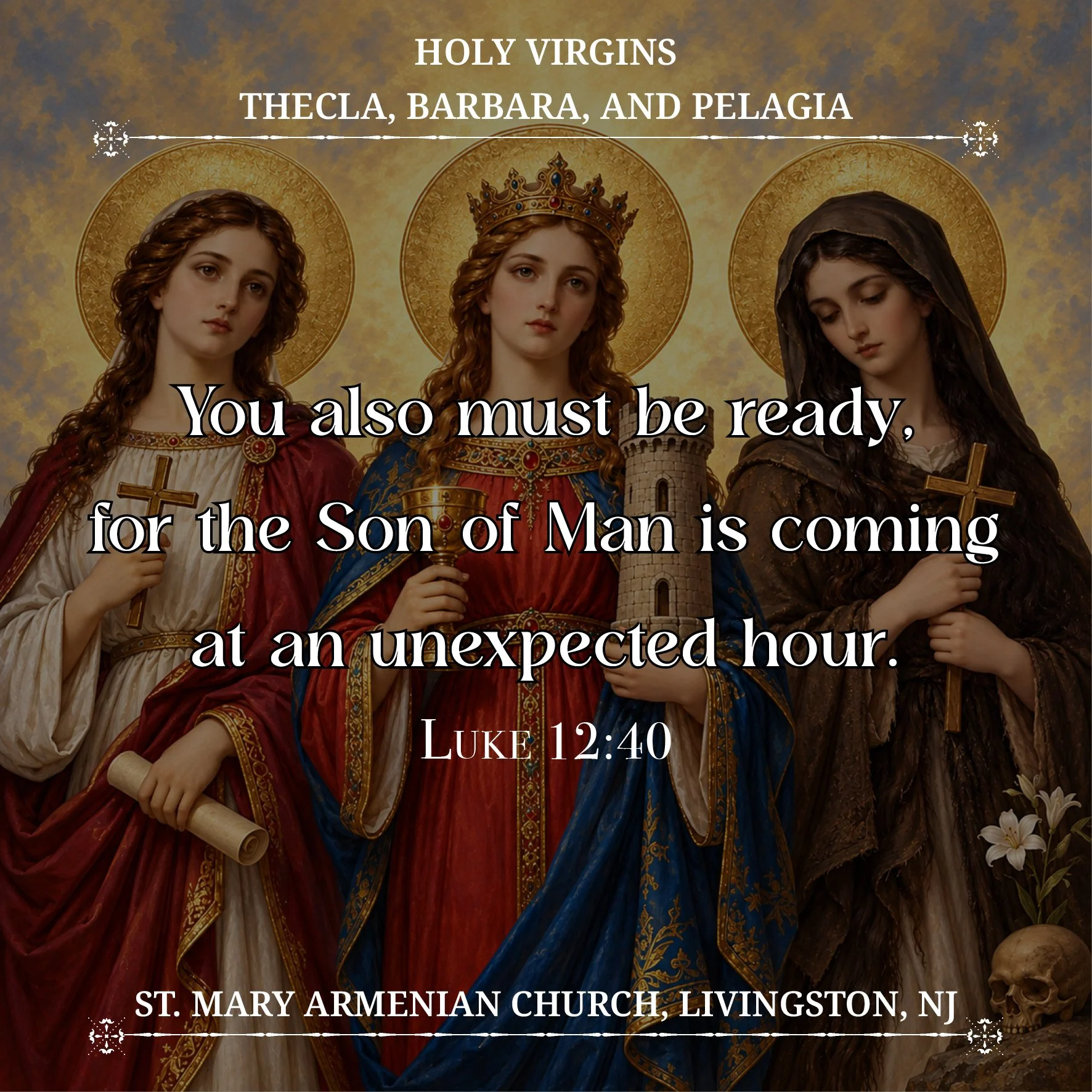
Holy Virgins Thecla,
Barbara, and Pelagia
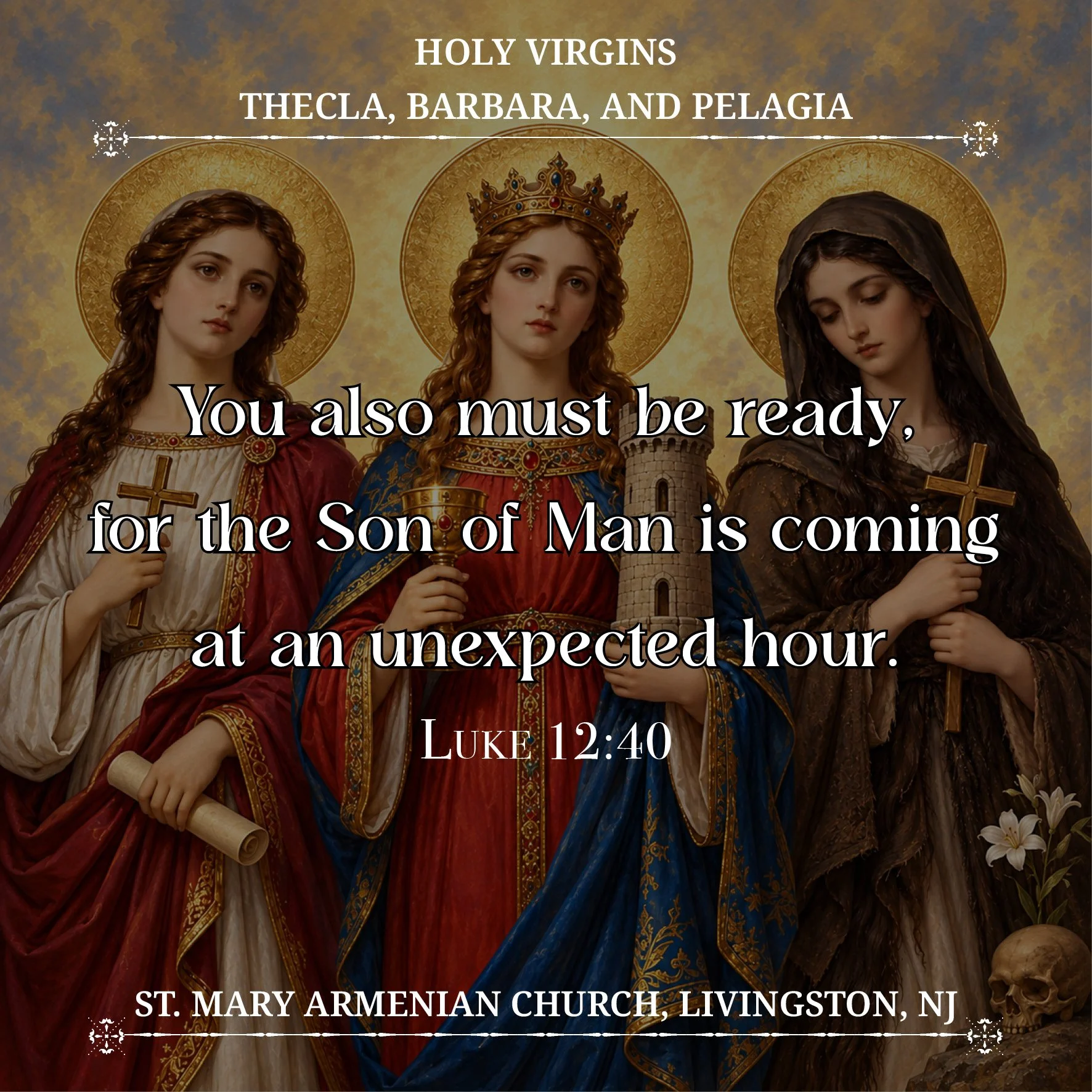
Thecla, or Thekli
For the Armenian Church, the first female saint of the Christian Church is St. Sandukht the Virgin. For the other churches, however, which do not commemorate St. Sandukht, the first female saint is Thekli, or more precisely, Thecla.
What we know about this saint comes from a work entitled The Acts of Paul and Thecla. This book enjoyed great popularity in the early Christian period. For that reason, like the Bible, it was translated from Greek into nearly all the major ancient languages, including Latin, Syriac, Arabic, Armenian, and others.
According to this work, Thecla was from Iconium and was converted through the preaching of the Apostle Paul when he came there with Barnabas during his first missionary journey (Acts 13:51).
The details of her conversion are related as follows. In Iconium, the Apostle Paul had made the home of his disciple and faithful friend Onesiphorus (2 Timothy 1:16) the center of his preaching. That house was near Thecla’s home. During Paul’s preaching, Thecla sat by the window of her house, listening attentively to everything he said. Deeply moved by his words, she converted and resolved to dedicate herself to a life of virginity.
Her mother, a wealthy widow, had intended to marry her to the son of one of the city’s noble families. When she learned of her daughter’s decision, she became deeply distressed and used all her maternal authority and rights in an effort to dissuade her. Yet her appeals, threats, and beatings were all unable to change Thecla’s mind.
Eventually, after learning that the Apostle Paul had inspired her daughter to make this irrevocable decision, the mother, being an influential woman, stirred up the city’s leading men against him. They punished Paul and expelled him from the city. Thecla, meanwhile, remained steadfast in her decision not to marry and was condemned to death by fire. Miraculously, however, she was delivered from the flames and went to Pisidian Antioch, not far from Iconium, where the Apostle Paul had gone after being expelled from Iconium (Acts 13:14).
Her family pursued her even there and handed her over to the local judicial authorities. It was decided that she should be thrown before wild beasts in order to kill her. Yet the animals did not harm her. Her life was therefore spared, and from that time onward she devoted her entire life to preaching the Gospel.
Because of her long and fruitful evangelistic ministry, she is known in the Greek Church by the title “Equal to the Apostles.” Indeed, our Armenian Synaxaria likewise affirm: “Through great miracles she enlightened countless multitudes from among the pagans… She had them baptized by the hands of their priests, healed the sick, and cast out demons in the name of Christ.”
Eventually, she settled in Seleucia in Cilicia, where she ended her life peacefully at the age of ninety.
The Virgin Barbara
The Latin and European form of her name is Barbara.
She lived toward the end of the second century, during the reign of Emperor Maximinus. Her father was a pagan, but she had somehow become a Christian.
Her father had built a bathhouse in their garden with two windows. While he was away, Barbara had a third window added, with bars arranged in the form of a cross. When her father noticed this, he demanded an explanation. Barbara told him that she had ordered it to be built in honor of the mystery of the Holy Trinity in which she believed, and that the cross was the instrument of salvation upon which Christ had shed His blood for the salvation of humankind.
Thus her Christianity became known. Her father became furious and subjected his daughter to torture. When she remained firm in her faith, he imprisoned her in the house. She was later brought before a court, where she was again urged to renounce Christianity and return to the worship of their gods. The virgin refused.
After many indescribable tortures, her hagiographer tells us, she was beheaded by the hand of her own father. He, in turn, was immediately struck by lightning and reduced to ashes.
The Virgin Pelagia
There are at least three virgin martyrs by this name, and it is difficult to determine which of them is the one commemorated by our Church. We therefore present all three briefly.
The first was from Tarsus, lived during the time of Diocletian (284–305), and was the daughter of a high-ranking family. Guided by a vision, she was baptized by the bishop of the city. She then sold her costly garments, distributed the proceeds to the poor, and returned home dressed in the clothing of a poor woman.
She was denounced as a Christian and brought before the tribunal of Diocletian. When she remained steadfast in her faith, she was shut inside a heated bronze furnace and, being burned to death, received the crown of martyrdom.
The second was a prostitute from Antioch. Coming to repentance, she repented sincerely, distributed her possessions among the poor, disguised herself as a man, and went to Jerusalem. There, on the Mount of Olives, she ended her life in ascetic devotion.
The third was also from Antioch. She became a Christian at a very young age and dedicated herself to a life of virginity. When soldiers searching for Christians entered their dwelling, she feared that they would come and violate her. She therefore threw herself from a window and died.
Although suicide is a grave sin, the Church took into consideration that the young Pelagia acted with the praiseworthy intention of preserving her innocence and virginity. For this reason, the Church regarded her act as equivalent to martyrdom and considered her worthy of commemoration.
We Armenians commemorate them on the Tuesday following the fourth Sunday after the Feast of the Holy Cross.
SCRIPTURE READINGS
~ Song of Solomon 8:14 ~
Make haste, my beloved, and be like a gazelle or a young stag upon the mountains of spices!
~ Isaiah 61:9-11 ~
The text states that the descendants of God's people will be widely recognized among the nations. Anyone who sees them will clearly acknowledge that they are a lineage explicitly blessed by the Lord. The speaker expresses immense joy and exultation in God, describing the experience as being dressed in garments of salvation and wrapped in a robe of righteousness. This spiritual preparation is compared to a bridegroom wearing a celebratory garland and a bride decorating herself with beautiful jewels. The passage concludes with an agricultural metaphor: just as the earth naturally sprouts new plant shoots and a garden grows from planted seeds, the Lord will cause justice and praise to flourish openly for all nations to witness.
~ 1 Peter 5:8-11 ~
Discipline yourselves, keep alert. Like a roaring lion your adversary the devil prowls around, looking for someone to devour. Resist him, steadfast in your faith, for you know that your brothers and sisters in all the world are undergoing the same kinds of suffering. And the God of all grace, who has called you to his eternal glory in Christ, will himself restore, support, strengthen, and establish you, after you have suffered a little while. To him be the power forever and ever. Amen.
~ Holy Gospel of St. Luke 12:32-40 ~
"Do not be afraid, little flock, for it is your Father’s good pleasure to give you the kingdom. Sell your possessions, and give alms. Make purses for yourselves that do not wear out, an unfailing treasure in heaven, where no thief comes near and no moth destroys. For where your treasure is, there your heart will be also. Be dressed for action and have your lamps burning; be like those who are waiting for their master to return from the wedding banquet, so that they may open the door for him as soon as he comes and knocks. Blessed are those slaves whom the master finds alert when he comes; truly I tell you, he will fasten his belt on them and have them sit down to eat, and he will come and serve them. If he comes during the middle of the night, or near dawn, and finds them so, blessed are those slaves. But know this: if the owner of the house had known at what hour the thief was coming, he would not have let his house be broken into. You also must be ready, for the Son of Man is coming at an unexpected hour."