Commemoration Day of
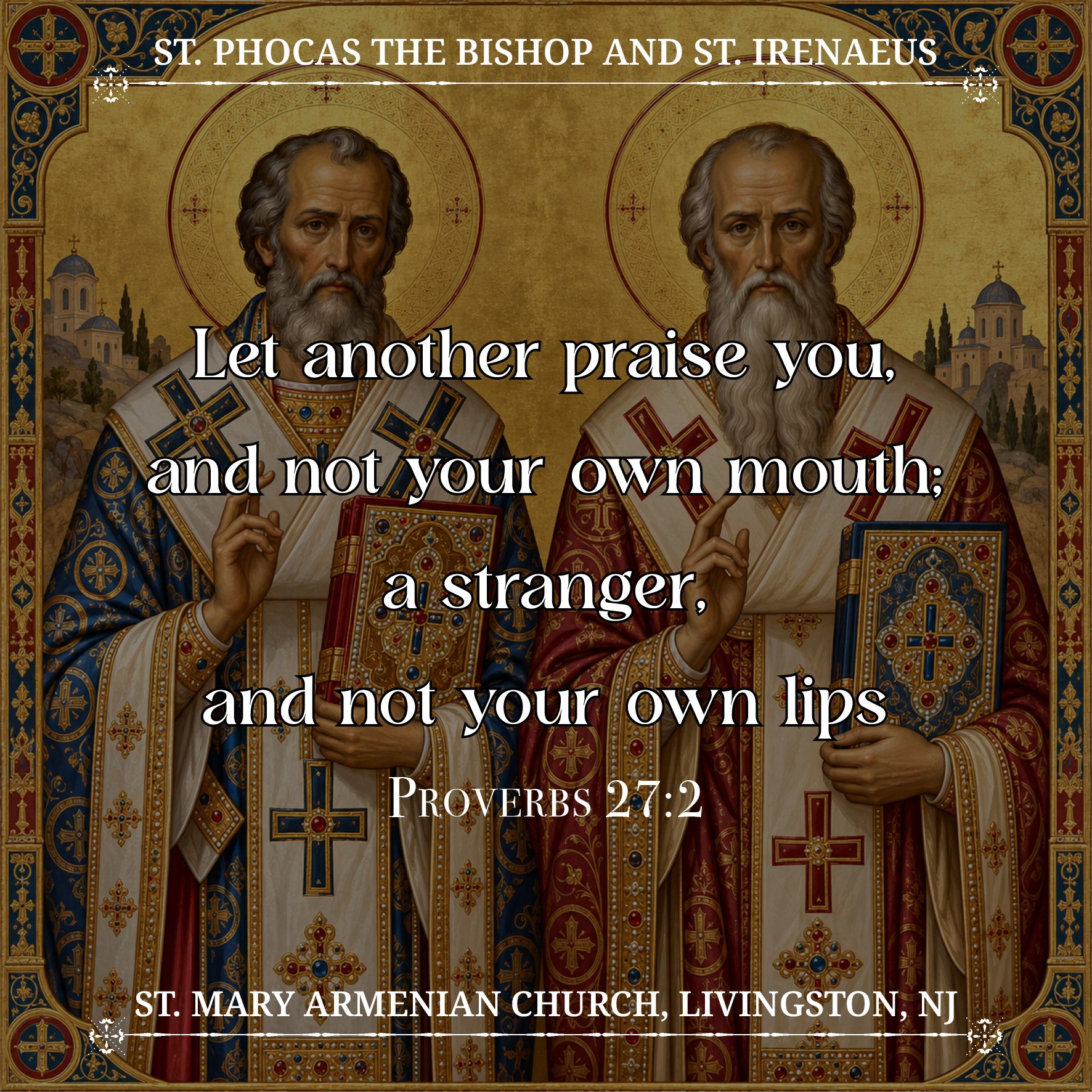
Saint Phocas the Bishop
and Saint Irenaeus,
Follower of the Apostles
St Phocas the Bishop
Saint Phocas was the bishop of Sinope, a city on the Black Sea. He was the son of a wealthy shipbuilder, or perhaps a ship captain. From his youth, he found favor with God and continually strengthened himself through fasting and prayer against every kind of temptation. Even at a young age, he became known as a wonderworker.
When he reached adulthood, he devoted himself to works of charity and to preaching. It is said that “he cast out demons, gave sight to the blind, and distributed his possessions to the poor.”
After becoming bishop of Sinope, he was taken to Amasia and brought before Emperor Trajan. When he refused to renounce Christianity, the emperor ordered that he be put to death by the sword. He was martyred in the year 117.
In the West, Saint Phocas became especially popular among seafarers, perhaps because he was the son of a shipbuilder, or because his name resembles the Greek word for the marine animal that we also call a seal.
We commemorate Saint Phocas together with Saint Irenaeus on the Monday following the fourth Sunday after the Feast of the Holy Cross.
St. Irenaeus, Bishop of Lyons
As a child, Irenaeus saw and heard Saint Polycarp the Bishop. From this it is generally inferred that he was born around the year 130 in Smyrna, or somewhere in the region of the Aegean.
He received his education in Rome, was ordained a priest of the city of Lyons, and later succeeded its bishop after the latter was martyred in the year 177.
Our Armenian Synaxaria describe him as “a great pillar of the faith of godliness, a God-knowing bishop, a doctor of the Church, and a conqueror of heretics.” Indeed, these titles fittingly describe his apostolic and evangelical ministry. Through his preaching, many pagans were brought to the faith, and through his writings he enlightened and enriched the Orthodox Church.
Saint Irenaeus wrote many works, but only one major work has come down to us substantially intact: Against Heresies, preserved through a Latin translation. Another important work, The Demonstration of the Apostolic Preaching, was saved from complete loss only through an Armenian translation. It later became known in religious and scholarly circles after being translated from Armenian into European languages. Of his other writings, only fragments are mentioned by later authors.
Irenaeus stands as one of the final links connecting the Fathers of the apostolic age with the great Fathers of later centuries. At the same time, he forms a bridge between East and West. By birth and outlook he was Eastern, while by education and ministry he belonged to the West. He wrote his works in Greek.
On two occasions, he interceded with the See of Rome on behalf of Christians in the East, at times when Rome was dealing harshly with those in the East whose views differed from its own. Irenaeus is regarded as the first great theologian of the Western Church.
Very little is known in the West about the circumstances of his death. Our Armenian Synaxaria, however, state that he ended his life in martyrdom.
While encouraging those who had been arrested for the sake of Christ to remain steadfast in their faith and to face death courageously, Irenaeus himself was arrested and imprisoned. When he was brought before the judge, he boldly confessed the divinity of Christ. Because of this, he was subjected to various tortures. When he refused to deny Christ or offer sacrifice to idols, he was put to death by the sword in the year 202.
We commemorate Saint Irenaeus together with Saint Phocas on the Monday following the fourth Sunday after the Feast of the Holy Cross.
SCRIPTURE READINGS
~ Proverbs 27:1-6 ~
Do not boast about tomorrow, for you do not know what a day may bring. Let another praise you, and not your own mouth; a stranger, and not your own lips. A stone is heavy, and sand is weighty, but a fool’s provocation is heavier than both. Wrath is cruel, anger is overwhelming, but who can stand before jealousy? Better is open rebuke than hidden love. Well-meant are the wounds a friend inflicts, but profuse are the kisses of an enemy.
~ Isaiah 43:16-21 ~
Thus says the Lord, who makes a way in the sea, a path in the mighty waters, who brings out chariot and horse, army and warrior; they lie down, they cannot rise, they are extinguished, quenched like a wick: Do not remember the former things, or consider the things of old. I am about to do a new thing; now it springs forth, do you not perceive it? I will make a way in the wilderness and rivers in the desert. The wild animals will honor me, the jackals and the ostriches; for I give water in the wilderness, rivers in the desert, to give drink to my chosen people, the people whom I formed for myself so that they might declare my praise.
~ 2 Corinthians 11:21-29 ~
To my shame I must say, we were too weak for that! But whatever anyone dares to boast of—I am speaking as a fool—I also dare to boast of that. Are they Hebrews? So am I. Are they Israelites? So am I. Are they descendants of Abraham? So am I. Are they ministers of Christ? I am talking like a madman—I am a better one: with far greater labors, far more imprisonments, with countless floggings, and often near death. Five times I have received from the Jews the forty lashes minus one. Three times I was beaten with rods. Once I received a stoning. Three times I was shipwrecked. A night and a day I was adrift at sea; on frequent journeys, in danger from rivers, danger from bandits, danger from my own people, danger from Gentiles, danger in the city, danger in the wilderness, danger at sea, danger from false brothers and sisters; in toil and hardship, through many a sleepless night, hungry and thirsty, often without food, cold and naked. And, besides other things, I am under daily pressure because of my anxiety for all the churches. Who is weak, and I am not weak? Who is made to stumble, and I am not indignant?
~ Holy Gospel of St. Mark 6:45-56 ~
Immediately he made his disciples get into the boat and go on ahead to the other side, to Bethsaida, while he dismissed the crowd. After saying farewell to them, he went up on the mountain to pray.
When evening came, the boat was out on the sea, and he was alone on the land. When he saw that they were straining at the oars because the wind was against them, early in the morning he came toward them, walking on the sea. He intended to pass them by. But when they saw him walking on the sea, they thought it was a ghost and cried out; for they all saw him and were terrified. But immediately he spoke to them and said, "Take heart, it is I; do not be afraid." Then he got into the boat with them and the wind ceased. And they were utterly astounded, for they did not understand about the loaves, but their hearts were hardened.
When they had crossed over, they came to land at Gennesaret and moored the boat. When they got out of the boat, people at once recognized him, and rushed about that whole region and began to bring the sick on mats to wherever they heard he was.