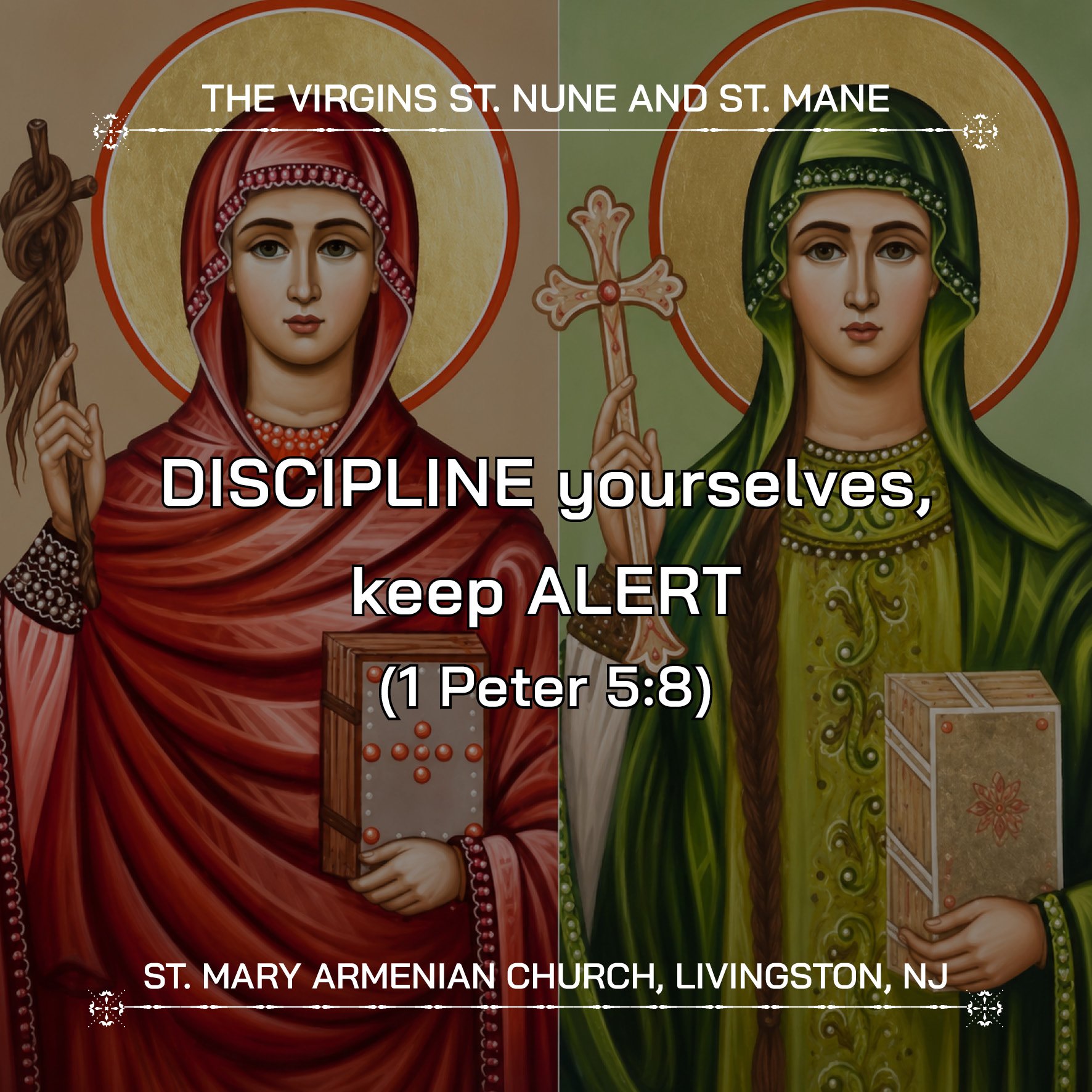
Commemoration Day of The Virgins
St. Nune and St. Mane
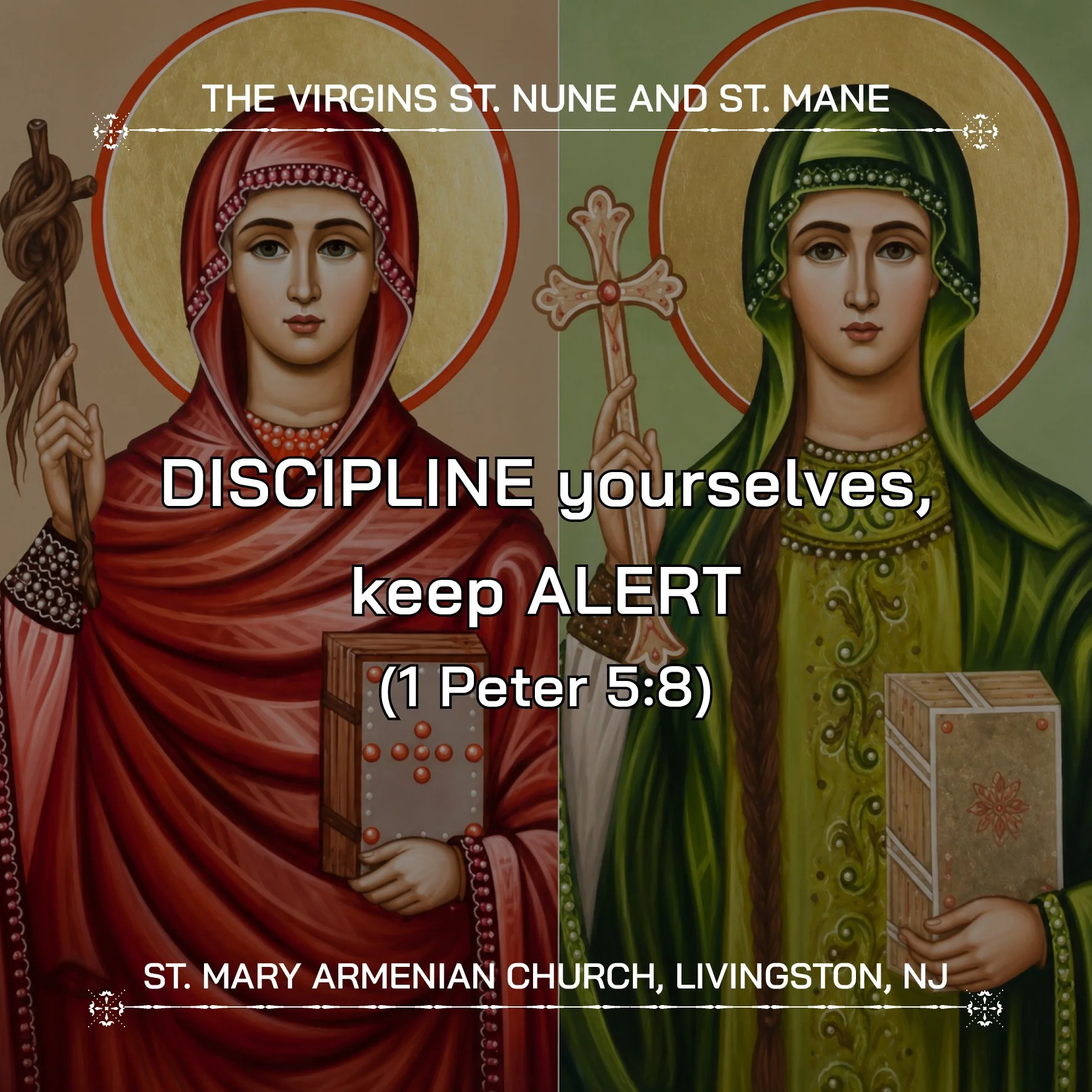
St. Nune the Virgin
Saint Nune is revered as the Enlightener of Georgia, where her name is commonly known in the form Nino. She is regarded as one of the virgins of Hripsime's company who miraculously escaped during their martyrdom. By divine guidance, she journeyed to Mtskheta, the capital of Georgia, where she continued the pious and ascetic life she had shared with her companions near the Armenian capital of Vagharshapat.
Nune presented herself as a woman belonging to the class of servants or slaves. Through her charitable deeds, she won the affection and respect of those around her.
Her reputation and missionary work began when a woman brought her gravely ill son, suffering from an incurable disease, hoping that Nune might know some remedy to heal him. Nune replied that she knew of no earthly medicine, but that Jesus Christ, the Son of the God whom she worshiped, had healed many such sufferers and would surely heal this child as well. She began to pray, and to the great joy of the mother and all who were gathered there, the boy was instantly cured.
News of this miracle reached Queen Nana of Georgia, who herself was suffering from a serious illness. The queen summoned the woman considered to be a slave, but Nune replied that she could not leave her hermitage to wander through luxurious places. Instead, the queen was brought to Nune, who healed her through prayer.
Filled with gratitude, Queen Nana attempted to reward her with costly gifts, but Nune refused them. Instead, she preached the Gospel, explaining that it was not she who had healed the queen, but Christ. She also proclaimed that Christ was ready to heal the queen's spiritual ailments if she would become a Christian. The queen agreed.
When Queen Nana's husband, King Mirian, returned to the palace, he rejoiced greatly at her recovery and ordered valuable gifts to be sent to the foreign woman. The queen stopped him, saying: "That woman accepts no gifts. We shall truly show our gratitude when both of us worship the God she preaches, by whose power, as she said, I was healed."
At first, the king did not take these words very seriously.
One day, however, while hunting, he and his companions became lost in a dense and terrifying fog. Confused and frightened, they wandered aimlessly. The king called upon his pagan gods, but nothing changed. Suddenly he remembered the God who had healed his queen. He prayed to Him and vowed that if He delivered him from the darkness, he would believe and follow Him.
Immediately, the impenetrable mist dispersed as suddenly as it had appeared, and the king safely returned to the palace.
He recounted the event to the queen, and together they went to Nune. The king asked her to tell him about her God and His Son, Jesus Christ. After hearing her teaching, he too declared his desire to become a Christian.
Returning to the palace, he gathered the nobles of the kingdom. After recounting both the miraculous healing of the queen and his own experience, he began preaching Christ himself. He declared that Christ was the true God and Christianity the true religion. Many of the nobles were convinced and came to believe.
Following Nune's counsel, envoys were sent—according to Georgian sources, to Emperor Constantine, and according to Armenian sources, to Saint Gregory the Illuminator and King Tiridates—to request clergy. Soon priests arrived and baptized the king, the queen, the royal court, and thousands of people in the River Kura, completing the work that Nune had begun.
After these events, Nune continued her mission throughout every corner of the country. Eventually she died peacefully, and a magnificent church was built over her tomb, which remains one of Georgia's great pilgrimage sites.
The Dictionary of Saints records that Nune died in 340 A.D. and commemorates her on December 15. Armenian Synaxaria provide the date October 28, while Georgian tradition celebrates her feast on January 14.
The Armenian Church commemorates her on the Tuesday following the Feast of the Holy Cathedral (Catholike Church) together with Saint Mane the Virgin.
St. Mane the Virgin
The account of Saint Mane's life is brief.
She belonged to the group of Hripsimean virgins who fled Rome. Originally numbering about seventy, some died or remained behind along the journey, and only thirty-seven eventually reached Vagharshapat, where they suffered martyrdom.
Of those who separated from the group, only two names have been preserved in history. One was Nune, who, by God's providence, was led to Georgia and became the apostle of that nation, bringing about its conversion to Christianity.
When the Hripsimean virgins arrived in Armenia, Mane, under divine inspiration, separated from her companions and journeyed to the district of Ekeghiats, whose center was Erznka (Erzincan). There she found a suitable cave on Mount Sepuh and resolved to live an ascetic life there.
According to ancient accounts: "She was enlightened in mind, well acquainted with the spiritual path, and strengthened by the gifts of the Holy Spirit."
Enduring the heat of summer and the cold of winter, she patiently and lovingly lived an angelic life of prayer and self-denial. The divine consolation that filled her heart caused her to forget the hardships imposed by nature. Thus she spent many years in prayer, asceticism, and communion with God.
Many years later, when Saint Gregory the Illuminator desired a life of solitude, he was led to the mountains of Daranaghik. There he noticed the cave on Mount Sepuh where Mane was dwelling. As he approached, the aged virgin called out from a distance: "Do not come near now; return after three days."
When Gregory returned three days later, he found that the saint had already reposed in the Lord.
With psalms and blessings, he buried her in the same cave, just as he had earlier buried her companions in the places of their martyrdom. Gregory then remained in the cave himself and continued his ascetic life there. In later times the cave became known as "Manya Ayr" ("Mane's Cave").
Saint Mane is commemorated together with Saint Nune on the Tuesday following the Feast of the Holy Cathedral (Catholike Church) in the Armenian Church.
SCRIPTURE READINGS
~ Song of Solomon 8:14 ~
Make haste, my beloved, and be like a gazelle or a young stag upon the mountains of spices!
~ Isaiah 27:11-13 ~
When its boughs are dry, they are broken; women come and make a fire of them. For this is a people without understanding; therefore he that made them will not have compassion on them, he that formed them will show them no favor. On that day the Lord will thresh from the channel of the Euphrates to the Wadi of Egypt, and you will be gathered one by one, O people of Israel. And on that day a great trumpet will be blown, and those who were lost in the land of Assyria and those who were driven out to the land of Egypt will come and worship the Lord on the holy mountain at Jerusalem.
~ 1 Peter 5:8-11~
Discipline yourselves, keep alert. Like a roaring lion your adversary the devil prowls around, looking for someone to devour. Resist him, steadfast in your faith, for you know that your brothers and sisters in all the world are undergoing the same kinds of suffering. And after you have suffered for a little while, the God of all grace, who has called you to his eternal glory in Christ, will himself restore, support, strengthen, and establish you. To him be the power forever and ever. Amen.
~ Holy Gospel of St. John 12:24-26~
Very truly, I tell you, unless a grain of wheat falls into the earth and dies, it remains just a single grain; but if it dies, it bears much fruit. Those who love their life lose it, and those who hate their life in this world will keep it for eternal life. Whoever serves me must follow me, and where I am, there will my servant be also. Whoever serves me, the Father will honor.