Commemoration Day of
the Bethlehem Infants,
the Martyr Acacius,
the Priest Movkima,
and the Soldier Kodratius
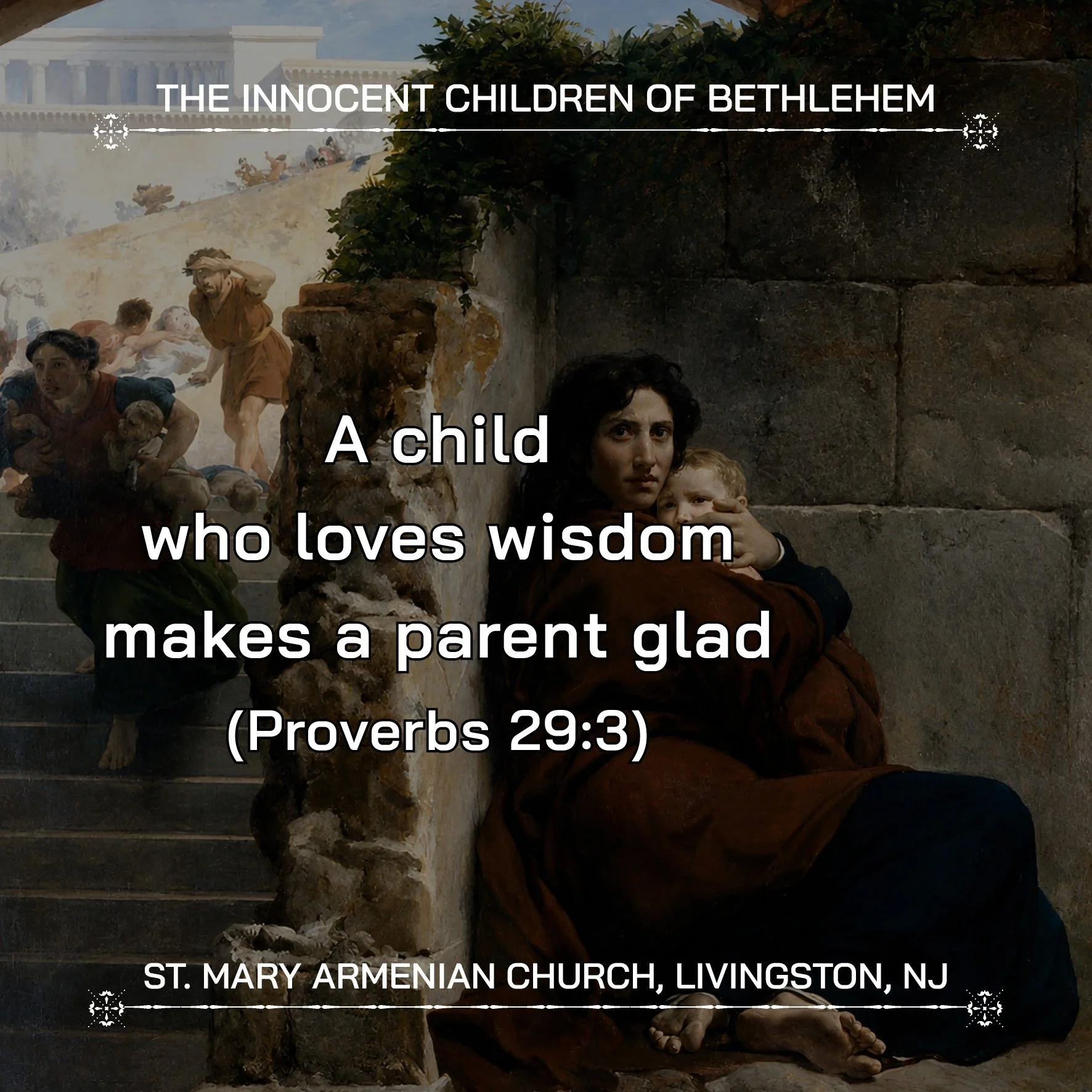
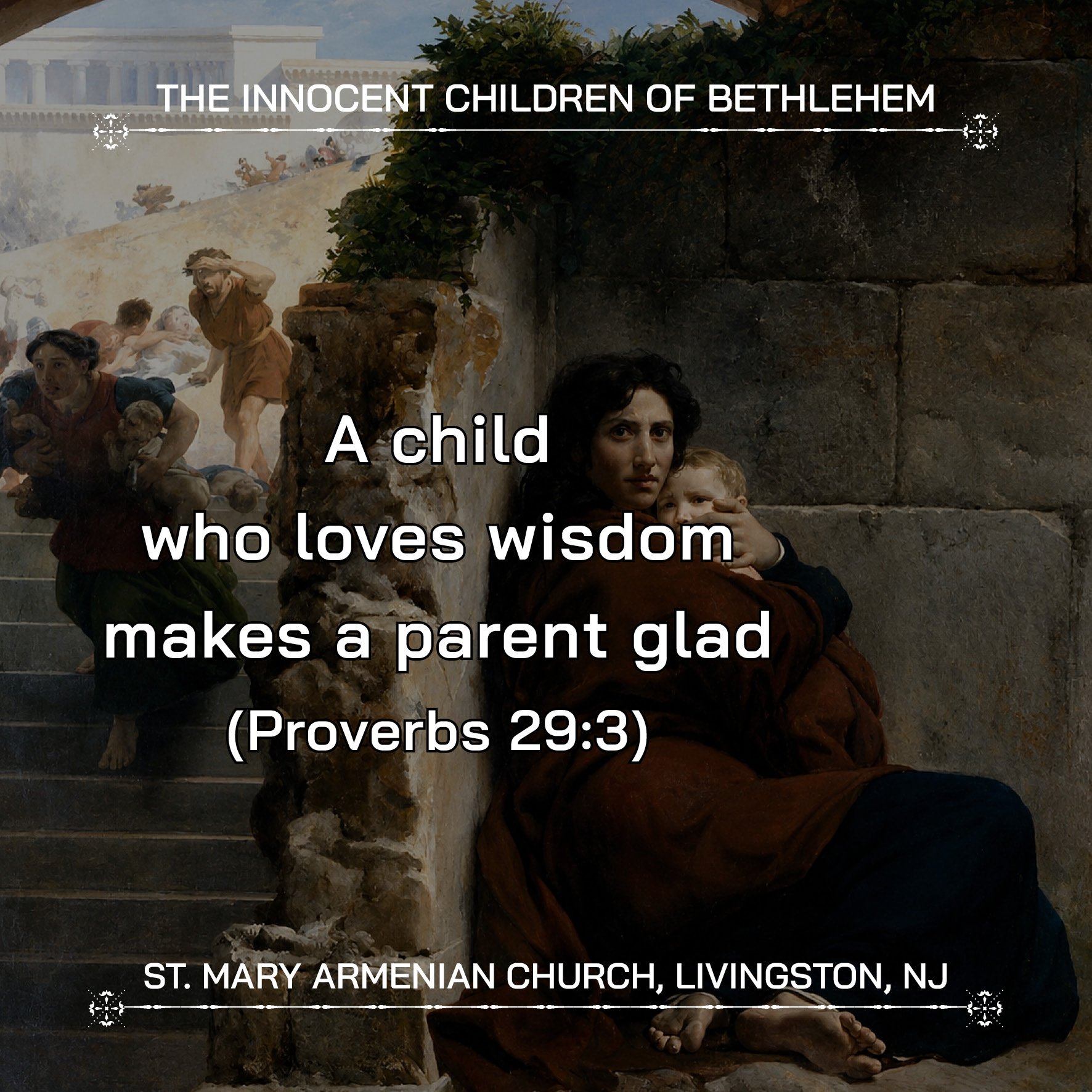
The Bethlehem Infants
The first innocents who shed their blood for Christ were the infants of Bethlehem. They differ from other martyrs in two ways: first, their martyrdom was not conscious or voluntary; second, they died so that the Son of God might physically live, whereas other martyrs died to preserve the eternal life granted by Christ.
When King Herod of Judea learned from the Magi that the “King of the Jews” had been born, he—and all Jerusalem with him—was greatly troubled.
The suspicious and bloodthirsty tyrant had already decided what he would do. Therefore, he deceitfully told the Magi: “Go and search diligently for the child, and when you have found him, bring me word, that I too may come and worship him.”
However, having been warned by God, the Magi did not return to Herod. Enraged, Herod ordered the slaughter of all boys two years old and under in Bethlehem and its surrounding region, believing that among them the “King of the Jews” would also be killed.
Only God knows how many young lives were cut short in this massacre. By faith, however, we know that they became the forerunners of the elect who, according to the Book of Revelation, bear the name of the Lamb on their foreheads and sing hymns before the throne of God. They remain forever with the Lamb; they were chosen as firstfruits from among humanity, and they were found blameless and without sin (cf. Revelation 14:1–5).
Acacius the Martyr
In the Latin Church, there is a priest named Acacius who is commemorated; there is also a soldier named Acathius who was martyred in Byzantium, along with several saints bearing similar names. The Greek Church likewise knows many saints named Acacius, making it difficult to determine exactly which one corresponds to the Armenian martyr Acacius.
One Acacius is commemorated together with Kodratius in the Greek tradition, although Greek martyrologies provide no details about him other than that his feast is celebrated on March 4.
According to Armenian tradition, Acacius was a young boy who lived during the reign of Emperor Licinius (307–323). After being severely beaten, he was handed over to the governor Terentius, who first threw him into a cauldron of boiling oil and fat. Miraculously surviving, Acacius was then taken to a pagan temple and forced to sacrifice to idols, which were destroyed through his prayers.
He was thrown before wild beasts, but they did not harm him. Eventually he was taken to the city of Melitene, where he was imprisoned with his feet fastened in stocks. Remaining steadfast in his faith and refusing to renounce Christianity, he was finally beheaded in the year 310.
Movkima the Priest
The Greek form of this name is Mokios, while the Latin form is Mucius.
He was of Byzantine origin and the son of a high-ranking military officer. Having received a strong Christian upbringing, he was ordained and appointed priest of the city of Amphipolis in Macedonia.
Known as a “priest of truth,” he devoted himself to preaching Christianity, especially exposing the folly of pagan idol worship. For this reason, he attracted the attention of the local governor and was brought before him.
When he boldly confessed that he was a Christian, he was subjected to torture and imprisoned. Eventually he was sent to Byzantium for trial, where he was sentenced to death by beheading and thus received the crown of martyrdom.
Later, Emperor Constantine ordered a great church to be built at the site of his burial.
His commemoration is observed on the second Monday after Pentecost.
Kodratius
Kodratius endured such terrible and horrifying tortures that any one of them alone would have been enough to kill an ordinary person.
He was from the city of Nicomedia and suffered during the persecutions of Emperor Decius. Along with several other Christians, he was brought before the judge. When asked their names, Kodratius stepped forward and answered on behalf of all: “Our names are written in heaven; our city is the Heavenly Jerusalem, and we are servants of the Heavenly King.”
He was beaten so severely that his entire body swelled and bled profusely. At this point, some Christians weakened in their faith and offered sacrifices to idols. In response, Kodratius cried out: “What answer will you give on the glorious day of Christ’s coming, O miserable ones?”
Through his exhortations, he brought them back to the true faith. Repenting with tears and lamentation for their weakness, they once again confessed Christ, and Kodratius prayed for them.
They were imprisoned again, and when they remained steadfast, they purified their earlier weakness through suffering. Despite his severe wounds, Kodratius was moved from place to place and subjected to stoning, yet “by God's providence the stones did not strike him.”
At another time, salt mixed with vinegar was poured into his wounds, and his sides were burned with red-hot irons. Whenever he was asked whether he would sacrifice to idols, he replied: “I have been a Christian since childhood. Apart from my Lord Jesus Christ, I have never known and do not know any other god.”
He was laid upon a blazing furnace, yet even then he recited psalms and felt no pain from the flames.
Finally, the judge ordered that he be beheaded.
His commemoration is also observed on the second Monday after Pentecost.
SCRIPTURE READINGS
~ Proverbs 29:2-7 ~
When the righteous are in authority, the people rejoice; but when the wicked rule, the people groan. A child who loves wisdom makes a parent glad, but to keep company with prostitutes is to squander one's substance. By justice a king gives stability to the land, but one who makes heavy exactions ruins it. Whoever flatters a neighbor is spreading a net for the neighbor's feet. In the transgression of the evil there is a snare, but the righteous sing and rejoice. The righteous know the rights of the poor; the wicked have no such understanding.
~ Isaiah 18:7 ~
At that time gifts will be brought to the Lord of hosts from a people tall and smooth, from a people feared near and far, a nation mighty and conquering, whose land the rivers divide, to Mount Zion, the place of the name of the Lord of hosts.
~ Hebrews 2:14-18~
Since, therefore, the children share flesh and blood, he himself likewise shared the same things, so that through death he might destroy the one who has the power of death, that is, the devil, and free those who all their lives were held in slavery by the fear of death. For it is clear that he did not come to help angels, but the descendants of Abraham. Therefore he had to become like his brothers and sisters in every respect, so that he might be a merciful and faithful high priest in the service of God, to make a sacrifice of atonement for the sins of the people. Because he himself was tested by what he suffered, he is able to help those who are being tested.
~ Holy Gospel of St. Matthew 2:16-18 ~
When Herod saw that he had been tricked by the wise men, he was infuriated, and he sent and killed all the children in and around Bethlehem who were two years old or under, according to the time that he had learned from the wise men. Then was fulfilled what had been spoken through the prophet Jeremiah: "A voice was heard in Ramah, wailing and loud lamentation, Rachel weeping for her children; she refused to be consoled, because they are no more."