Feast of the Cathedral of
HOLY Etchmiadzin
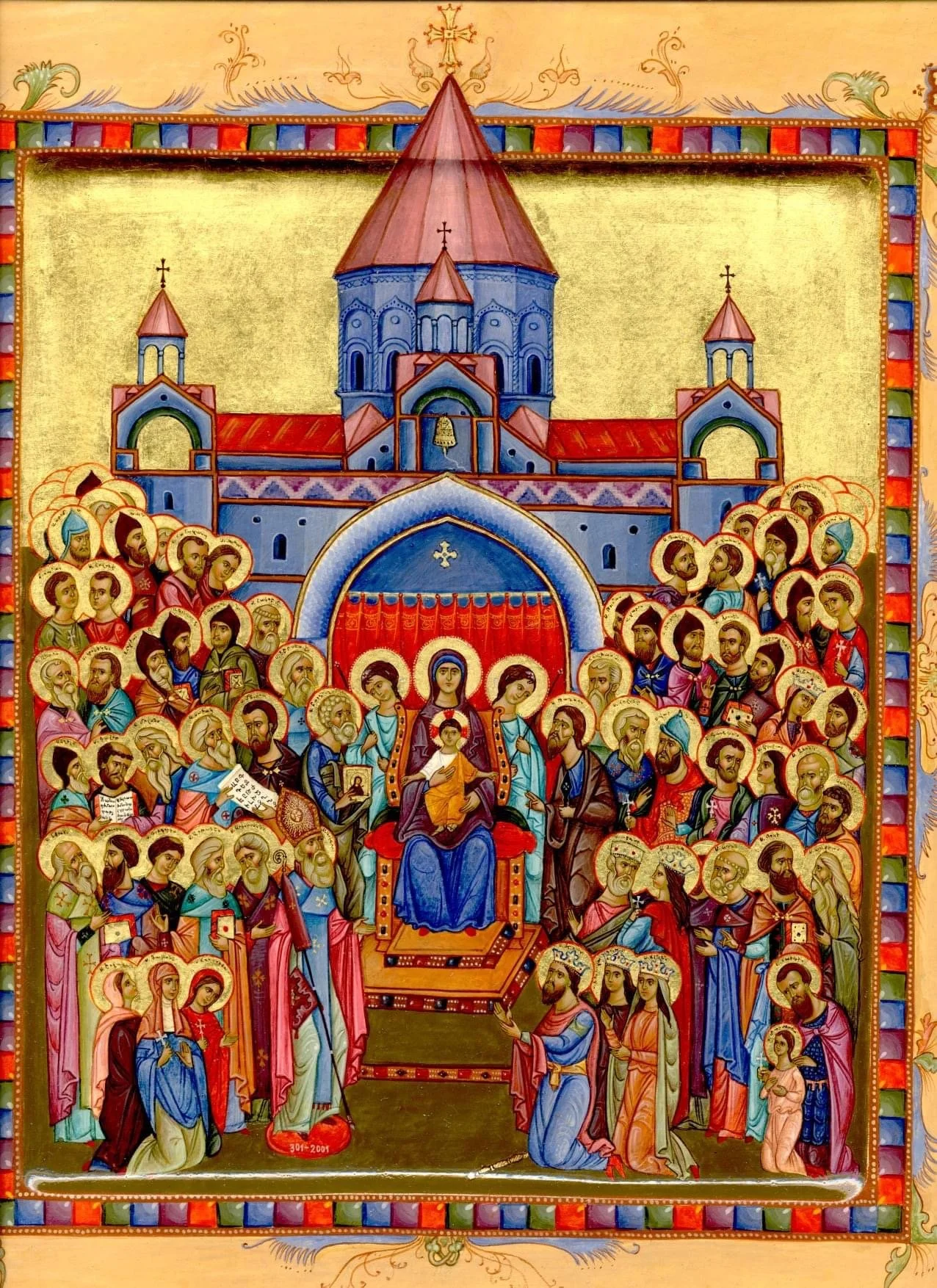
The Armenian Church celebrates the Feast of the Holy Mother Cathedral of Etchmiadzin two weeks after Pentecost, on the day following the Feast of the Deliverance of St. Gregory the Illuminator from the Pit (Khor Virap). This feast commemorates the vision that, according to Agathangelos, was seen by the father of our faith, St. Gregory the Illuminator, after his release from imprisonment.
Christ Himself, “lofty and majestic, was proceeding before a radiant host. In His hand He held a great golden hammer, and all followed behind Him. He descended to the very depths of the earth, to the center of the city, struck the broad ground, and mighty thunders resounded from the depths of the abyss.”
Thus St. Gregory the Illuminator began recounting his vision to King Tiridates III, Queen Ashkhen, and all those present: “I saw in the city, near the royal palace, a golden pedestal in the shape of a wheel, as large as a great hill. Upon it stood an exceedingly high fiery column, crowned by a cloud-like capital bearing a radiant cross. I also saw three other pedestals: one at the place where St. Gayane was martyred with her two companions; one where St. Hripsime was martyred with her thirty-two companions; and one near the winepress.”
After recounting the vision, St. Gregory urged the people to begin the work immediately. Accompanied by the king, queen, nobles, and all the people, he went to the place where the fiery column had appeared upon the golden pedestal and ordered it enclosed with a high stone wall.
The Patriarch determined that the site marked by the great cross should become the Mother Church of the Armenian nation. Construction was delayed temporarily because a pagan temple stood at the place struck by the Only-Begotten Son’s hammer and it first had to be sanctified according to Christian rites. The sites of the martyrdoms of the Hripsimian virgins, however, had already been sanctified by their blood. Therefore, three churches were immediately built, and within them St. Gregory placed the relics of the holy virgins.
The enthusiasm was immense. Men and women alike joined the labor—some brought stones, others bricks, and still others timber.
According to tradition, King Tiridates climbed Mount Ararat and brought back massive, rough-hewn stones. The giant king carried these stones on his own shoulders to Vagharshapat for the construction of the chapels.
One church was named after St. Hripsime, another after St. Gayane, and the third after St. Mariane, a sick virgin who had been unable to flee with the others. Later, this church became known as Shoghakat (“Drop of Light”), because in his vision Gregory had stood there watching the rays of heavenly light descend upon the earth.
King Tiridates not only sponsored the construction of the new Christian churches but also, by royal decree in 301 A.D., proclaimed Christianity the state religion. Enlightened in heart and soul, the people abandoned the vain worship of idols and turned to the true worship of the loving God. Fasting, prayer, reverence, and love filled the lives of all.
With the support and initiative of King Tiridates, Queen Ashkhen, Khosrovidukht (the king’s sister), the nobles, and the people, St. Gregory journeyed to Caesarea in Cappadocia—where he had previously received his Christian education—and was consecrated Catholicos of the Armenians.
After his ordination, he returned to Armenia bringing with him relics of St. John the Baptist and other sacred relics.
Under Gregory’s leadership, pagan temples throughout the country were demolished and converted into churches.
In the Aratsani River of Bagrevand Province, the newly ordained Catholicos baptized King Tiridates, Queen Ashkhen, Princess Khosrovidukht, members of the royal court, and soldiers. Thereafter they traveled together to Vagharshapat, the Armenian capital, where construction of the Mother Cathedral began.
First, the pagan shrine standing on the site where, according to Gregory’s vision, the Only-Begotten Son of God had descended and struck the earth with His fiery hammer was demolished.
Then St. Gregory solemnly consecrated the site through a sacred ecclesiastical ceremony. Within seven to eight months, the Mother Cathedral—the Kathoghike Church—was built. The king, queen, nobles, and princes contributed not only through donations but also through their personal labor.
The cathedral was consecrated on August 15, 303, on the Feast of the Assumption of the Holy Mother of God. Later it was renamed Holy Etchmiadzin, meaning “the Descent of the Only-Begotten,” referring to Jesus Christ.
St. Gregory also ordained hundreds of priests and bishops who were sent to serve throughout Armenia. He established schools for children, youth, and adults alike, recognizing that the mind must be enlightened so that the soul may also be enlightened.
However, the Mother Cathedral of Holy Etchmiadzin did not remain intact for long. In 380 A.D., the apostate Meruzhan Artsruni invaded Armenia with Persian forces and destroyed the Kathoghike Cathedral of Vagharshapat.
Although Holy Etchmiadzin remained the Mother Church, the Patriarchal See frequently changed its location throughout history.
The Armenian historian Lazar Parpetsi, in his “Letter to Vahan Mamikonian,” records that the seat was transferred to Dvin, where a monastic brotherhood was established under the patronage of both church leaders and civil authorities.
One hundred years after the cathedral’s destruction, Vahan Mamikonian, appointed governor by decree of the Persian king in 483 A.D., completely restored the Mother Cathedral. Later, Catholicos Komitas replaced the wooden structure with finely cut stone. From the time of Catholicos Nerses the Builder until modern times, the cathedral was repeatedly damaged, rebuilt, and restored. In 1441, the Patriarchal See was officially returned to its historic foundation at Holy Etchmiadzin, where it remains today.
In 1653, Catholicos Pilipos began constructing the magnificent three-story bell tower adorned with intricate carvings. Following his death, the work was completed by his successor, Catholicos Hakob Jughayetsi.
Holy Etchmiadzin preserves numerous sacred relics and treasures. Among them is the Holy Lance (Geghard), the spear with which a soldier pierced Christ’s side. Also preserved there are the holy right hands of St. Gregory the Illuminator, St. Jacob of Nisibis, and the Apostles St. Thaddeus and St. Bartholomew.
From the beginning of the fourth century, Holy Etchmiadzin became a center of Christianity. It was also here that St. Mesrop Mashtots and St. Sahak Partev carried out their spiritual and scholarly work.
Armenian literature, philosophy, theology, and astronomy flourished in Etchmiadzin. The monastery also preserves Armenian manuscripts of the 13th through 18th centuries, many of which are of immense artistic and historical value.
According to the vision revealed to St. Gregory the Illuminator, the supreme spiritual authority and seat of the Armenian Church were established at the Mother See of Holy Etchmiadzin.
Holy Etchmiadzin is the cradle of the Armenian faith and the “Holy of Holies” of the Armenian people—sacred in its religious devotion, profound in its historical significance, and invaluable in its national importance as a divine gift bestowed upon the world’s first Christian nation.
SCRIPTURE READINGS
~ Proverbs 9:1-6~
Wisdom has built her house, she has hewn her seven pillars. She has slaughtered her animals, she has mixed her wine, she has also set her table. She has sent out her servant-girls, she calls from the highest places in the town, "You that are simple, turn in here!" To those without sense she says, "Come, eat of my bread and drink of the wine I have mixed. Lay aside immaturity, and live, and walk in the way of insight."
~Zechariah 3:7-4:9~
"Thus says the Lord of hosts: If you will walk in my ways and keep my requirements, then you shall rule my house and have charge of my courts, and I will give you the right of access among those who are standing here. Now listen, Joshua, high priest, you and your colleagues who sit before you! For they are an omen of things to come: I am going to bring my servant the Branch. For on the stone that I have set before Joshua, on a single stone with seven facets, I will engrave its inscription, says the Lord of hosts, and I will remove the guilt of this land in a single day. On that day, says the Lord of hosts, you shall invite each other to come under your vine and fig tree."
The angel who talked with me came again, and wakened me, as one is wakened from sleep. He said to me, "What do you see?" And I said, "I see a lampstand all of gold, with a bowl on the top of it; there are seven lamps on it, with seven lips on each of the lamps that are on the top of it. And by it there are two olive trees, one on the right of the bowl and the other on its left." I said to the angel who talked with me, "What are these, my lord?" Then the angel who talked with me answered me, "Do you not know what these are?" I said, "No, my lord." He said to me, "This is the word of the Lord to Zerubbabel: Not by might, nor by power, but by my spirit, says the Lord of hosts. What are you, O great mountain? Before Zerubbabel you shall become a plain; and he shall bring out the top stone amid shouts of "Grace, grace to it!' " Moreover the word of the Lord came to me, saying, "The hands of Zerubbabel have laid the foundation of this house; his hands shall also complete it. Then you will know that the Lord of hosts has sent me to you.
~ Hebrews 9:1-10 ~
Now even the first covenant had regulations for worship and an earthly sanctuary. For a tent was constructed, the first one, in which were the lampstand, the table, and the bread of the Presence; this is called the Holy Place. Behind the second curtain was a tent called the Holy of Holies. In it stood the golden altar of incense and the ark of the covenant overlaid on all sides with gold, in which there were a golden urn holding the manna, and Aaron’s rod that budded, and the tablets of the covenant; above it were the cherubim of glory overshadowing the mercy seat. Of these things we cannot speak now in detail. Such preparations having been made, the priests go continually into the first tent to carry out their ritual duties; but only the high priest goes into the second, and he but once a year, and not without taking the blood that he offers for himself and for the sins committed unintentionally by the people. By this the Holy Spirit indicates that the way into the sanctuary has not yet been disclosed as long as the first tent is still standing. This is a symbol of the present time, during which gifts and sacrifices are offered that cannot perfect the conscience of the worshiper, but deal only with food and drink and various baptisms, regulations for the body imposed until the time comes to set things right.
~ Holy Gospel of St. John 10:22-30 ~
At that time the festival of the Dedication took place in Jerusalem. It was winter, and Jesus was walking in the temple, in the portico of Solomon. So the Jews gathered around him and said to him, “How long will you keep us in suspense? If you are the Messiah, tell us plainly.” Jesus answered, “I have told you, and you do not believe. The works that I do in my Father’s name testify to me; but you do not believe, because you do not belong to my sheep. My sheep hear my voice. I know them, and they follow me. I give them eternal life, and they will never perish. No one will snatch them out of my hand. What my Father has given me is greater than all else, and no one can snatch it out of the Father’s hand. The Father and I are one.”