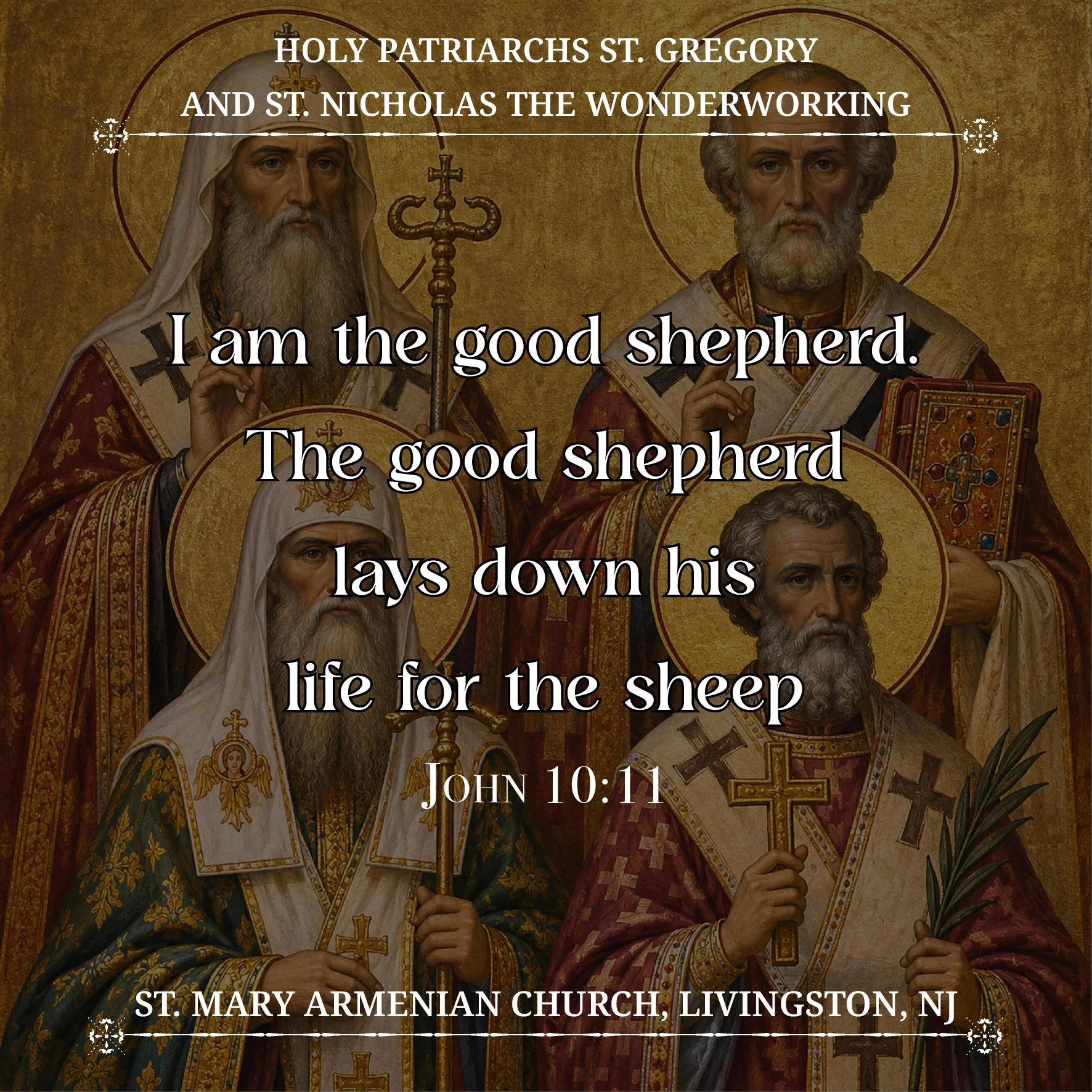
Commemoration Day of
Holy Patriarchs
Saints Gregory
and Nicholas the Wonderworking,
the Other Patriarch Nicholas,
and Bishop Myron
Saint Gregory the Wonderworker
Saint Gregory was born in 213 into a noble family in the city of Neocaesarea, in the region of Pontus, or Sebastia, now known as Niksar. After receiving an advanced education, he intended to specialize in law and rhetoric. Divine Providence, however, had destined him for a different vocation.
His sister’s husband was appointed governor of Palestine, and Gregory, together with his brother, accompanied their sister on her journey to Palestine. The administrative center of Palestine was Caesarea, which, to distinguish it from other cities bearing the same name, was called Caesarea of Palestine.
Origen, the most prominent Christian intellectual of that time, had transferred the renowned Christian school of higher learning from Alexandria to Caesarea. The two brothers, motivated by simple curiosity, decided to visit the school. They were so impressed by Origen’s profound knowledge and engaging teaching methods that they decided to continue their education under his guidance. Gregory was twenty years old at the time.
Origen also taught advanced Greek philosophy and rhetoric with remarkable ease and fluency. Eventually, he succeeded in converting these intelligent and well-mannered young men to Christianity. They remained with him for six or seven years, becoming thoroughly acquainted with his teachings and methods of instruction.
After returning to Neocaesarea, Gregory continued his studies for some time under Bishop Firmilian of Caesarea in Cappadocia, from whom he “learned all the ecclesiastical ordinances and doctrinal definitions.”
The Metropolitan of Amasea consecrated him Bishop of his native city, Neocaesarea. According to historical tradition, when Gregory was consecrated bishop, there were scarcely seventeen Christians in the city, whereas at the time of his death, scarcely seventeen pagans remained.
Numerous miracles are associated with his name, most of which are recorded in the Synaxaria. From these miraculous deeds, he received the title “Wonderworker,” a testimony to his widespread popularity and extraordinary character.
In 264, he participated in the Council of Antioch, which had been convened to condemn the heretic Paul of Samosata.
Despite his advanced education, Gregory distinguished himself more as an active ecclesiastical leader than as a theologian. He left behind numerous literary works, the most important of which is a panegyric in praise of Origen, which he delivered in the presence of the great philosopher and theologian before taking leave of him.
He also composed a useful work for converts to Christianity, containing the fundamental teachings of the Christian faith. His Canonical Epistle provides extensive information concerning the customs and practices of the early Church.
Finally, he wrote a commentary on the Book of Ecclesiastes and an epistle addressed to Bishop Theopompus, containing a philosophical discussion concerning the nature of God.
Saint Gregory of Nyssa wrote his biography. Gregory the Wonderworker passed away peacefully in 270. Approximately ten to twelve of his works have been translated into Classical Armenian.
We commemorate his feast on the Saturday preceding the tenth Sunday following the Feast of the Holy Cross.
Saint Nicholas of Myra
The lives of saints who enjoy widespread popularity are often so richly adorned with miraculous events that historical facts and dates are sometimes entirely overlooked, and the saint becomes an almost legendary figure. Saint Nicholas is among these saints.
In our liturgical calendar, there are two saints named Nicholas whose feasts are celebrated around the beginning of December, approximately two weeks apart. Occasionally, because of the Feast of the Conception of the Holy Mother of God, which is fixed and always celebrated on December 9, their commemorations are observed together, as occurred on November 25, 1972.
The Greek and Latin Churches recognize only one Saint Nicholas the Hierarch, the Bishop of Myra. They have no Nicholas known as the “Patriarch of Smyrna,” nor is such a saint mentioned in our Synaxaria. Therefore, we shall speak only of Saint Nicholas, Bishop of Myra.
He was born in Patara, a city in the ancient province of Lycia in Asia Minor, not far from the present-day city of Antalya. He was the son of a wealthy but deeply devout and charitable father. His mother was the sister of a bishop known as Nicholas the Elder.
Having lost his parents at a young age, Nicholas was raised in piety under the guardianship of his maternal uncle.
He regarded the Gospel commandment as being addressed personally to him:
“If you wish to be perfect, go, sell all your possessions and give to the poor.”
Accordingly, he began selling the property he had inherited from his parents and distributing the proceeds among the poor.
Upon learning that a certain father of three daughters was unable to provide dowries for them, Nicholas prepared three purses of money and secretly threw them into their courtyard during the night, thereby delivering the father from his difficult circumstances.
He was ordained a priest by his uncle. While traveling on a pilgrimage to the Holy Land, a violent storm arose at sea, but through Nicholas’ prayers, the sea became calm.
Following the death of the Bishop of Myra, Nicholas was consecrated bishop of that city. He devoted himself to his ministry with great zeal, extending his special care to the poor, the sick, prisoners, orphans, and widows.
When Emperor Licinius renewed the persecutions initiated by Diocletian, Nicholas was arrested and sent into exile. Even during his exile, he did not cease preaching the Gospel. As soon as peace was restored, he returned to his episcopal see.
In 325, he attended the Council of Nicaea. The following year, he concluded his earthly life with a peaceful and blessed death.
Saint Nicholas is regarded not only as the patron saint of sailors but especially as the patron saint of children, toward whom he had always demonstrated particular care and affection.
The name “Santa Claus,” which became popular in America and corresponds to our Armenian Gaghant Baba (Father Christmas), is a modified form of the name “Saint Nicholas.”
He is also regarded as the patron saint of all Russia.
His popularity in the West dates from the translation of his holy relics to the Italian city of Bari in 1087, where a magnificent basilica was built in his honor.
We commemorate his feast on the Saturday preceding the tenth Sunday following the Feast of the Holy Cross.
Saint Myron, Bishop of Crete
Saint Myron was born in the middle of the third century in the city of Raucia on the island of Crete, near the present-day city of Heraklion. He was the son of an honorable and wealthy Christian. He married and was distinguished by his generosity and charitable nature, as illustrated by several beautiful stories told about him.
On one occasion, thieves entered his field of chickpeas but became entangled among the thorns and were unable to escape. When Myron arrived the following morning, he freed them, loaded them with chickpeas, and sent each of them home.
On another occasion, thieves entered his threshing floor but were unable to carry away the sacks because of their weight. When Myron arrived in the morning, he placed the sacks upon their shoulders and sent them home, instructing them never to steal again.
He also performed numerous miracles. Through his prayers, he destroyed a dragon that had spread fear and terror among the people.
Once, while traveling on necessary business, he encountered a river that was impossible to cross because there was no shallow passage. After praying, he made the sign of the cross over the river and urged his horse forward. The waters parted into two, allowing him and his horse to pass through.
When Christians of his time were being martyred, Myron awaited his own turn. However, with the cessation of the persecutions, his desire to receive the crown of martyrdom remained unfulfilled.
Eventually, he became the bishop of his native city. Performing many wonders, he reached the venerable age of one hundred and peacefully concluded his devout and virtuous life.
We commemorate his feast on the Saturday preceding the tenth Sunday following the Feast of the Holy Cross, together with the other two wonderworking hierarchs, Saints Gregory and Nicholas.
SCRIPTURE READINGS
~ Ezekiel 3:16-19 ~
At the end of seven days, the word of the Lord came to me: Mortal, I have made you a sentinel for the house of Israel; whenever you hear a word from my mouth, you shall give them warning from me. If I say to the wicked, "You shall surely die," and you give them no warning, or speak to warn the wicked from their wicked way, in order to save their life, those wicked persons shall die for their iniquity; but their blood I will require at your hand. But if you warn the wicked, and they do not turn from their wickedness, or from their wicked way, they shall die for their iniquity; but you will have saved your life.
~ 2 Timothy 3:10-15 ~
Now you have observed my teaching, my conduct, my aim in life, my faith, my patience, my love, my steadfastness, my persecutions, and my suffering the things that happened to me in Antioch, Iconium, and Lystra. What persecutions I endured! Yet the Lord rescued me from all of them. Indeed, all who want to live a godly life in Christ Jesus will be persecuted. But wicked people and impostors will go from bad to worse, deceiving others and being deceived. But as for you, continue in what you have learned and firmly believed, knowing from whom you learned it, and how from childhood you have known the sacred writings that are able to instruct you for salvation through faith in Christ Jesus.
~ Holy Gospel of St. John 10:11-16 ~
"I am the good shepherd. The good shepherd lays down his life for the sheep. The hired hand, who is not the shepherd and does not own the sheep, sees the wolf coming and leaves the sheep and runs away—and the wolf snatches them and scatters them. The hired hand runs away because a hired hand does not care for the sheep. I am the good shepherd. I know my own and my own know me, just as the Father knows me and I know the Father. And I lay down my life for the sheep. I have other sheep that do not belong to this fold. I must bring them also, and they will listen to my voice. So there will be one flock, one shepherd.