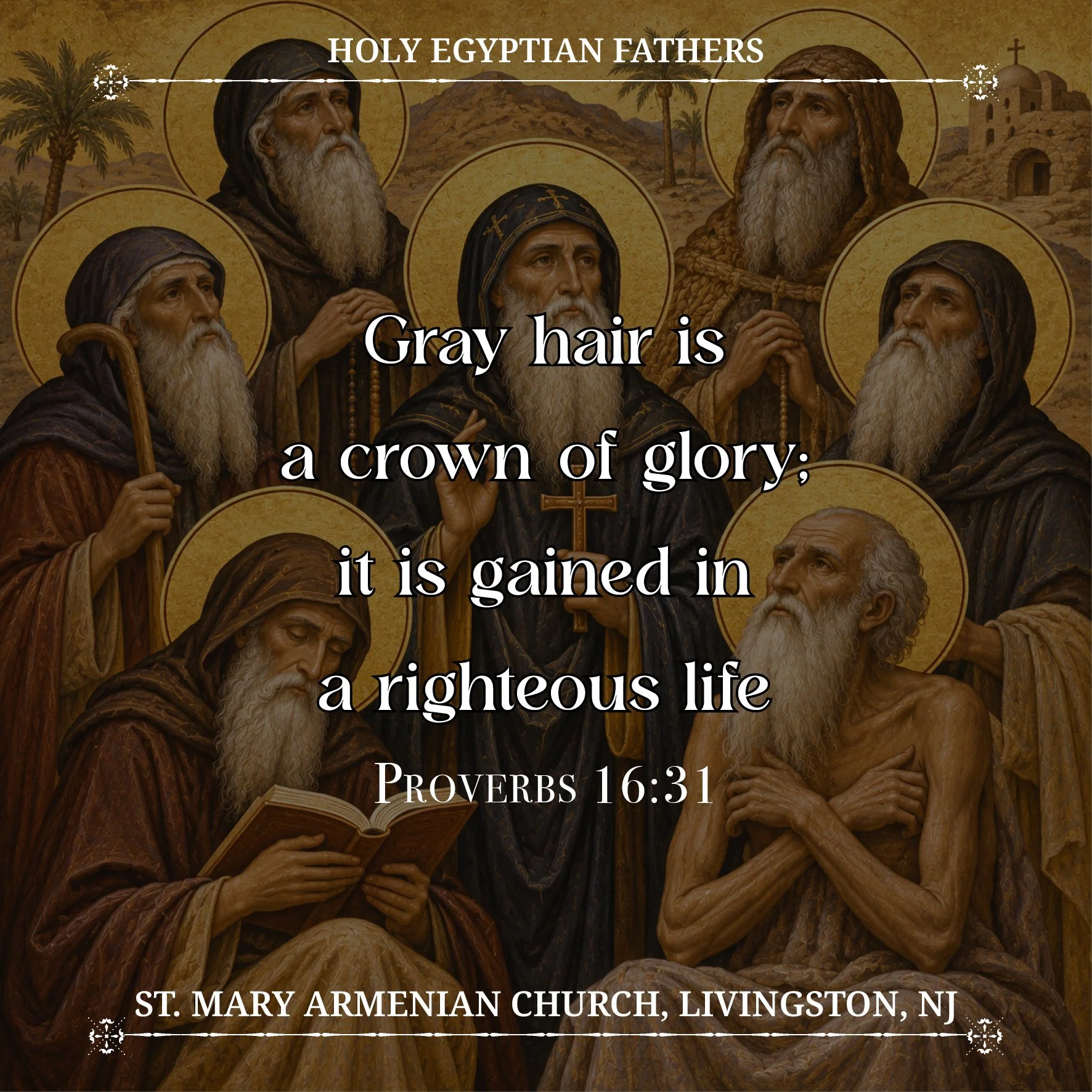
Commemoration Day of
Holy Egyptian Fathers
Saint Paul of Thebes the Hermit
We would have known nothing about him had Saint Anthony, guided by Divine Providence, not visited him. It is believed that at a young age, during the persecutions initiated by Emperor Decius (249–251), he renounced the world and took refuge in the desert, where he lived in a cave for nearly one hundred years in prayer and repentance.
It is said that Saint Anthony once fell into temptation by boasting that he was the first ascetic to dwell in a cave. However, God revealed to him in a vision that another man had already preceded him in this way of life, and that man was Paul. Saint Anthony therefore set out to find this hermit.
When he met Paul, the latter was already 113 years old. Saint Anthony barely had enough time to hear a brief account of his life before the saint passed away. He was buried by Saint Anthony himself.
We Armenians commemorate him on the second Thursday of the Fast of Hisnag, together with the group known as the “Egyptian Fathers.” The same applies to all the Egyptian hermits mentioned below.
Saint Paul the Hermit
He is also known as Paul the Simple. Paul was a humble farmer who discovered that his wife was involved in an adulterous relationship. Leaving his home and family behind, he joined Saint Anthony at the age of sixty.
He attained such virtue and spiritual strength that “the demons trembled at the name of Paul.” Whenever the sick or those possessed by demons came to Saint Anthony, he would send them to Paul, who healed them all by laying his hands upon them.
After living for more than one hundred years in great asceticism, performing miracles, and leading a virtuous life, he passed away peacefully. He is described as exceedingly humble, gentle, innocent, and simple-hearted.
Saint Macarius the Hermit
Our liturgical calendar mentions one hermit named Macarius, while the Greek and Latin calendars recognize two. Patriarch Torkom, in his book Saints and Feasts, also speaks of two or three saints named Macarius.
In the Synaxarion edited by Grigor Dpir Peshtimaljian, only a quarter of a column is devoted to a single Macarius, whose greatness is scarcely reflected. The Synaxarion published by Grigor Dpir Marzvanetsi devotes four columns to a Macarius whose biography combines the accounts of all the known saints bearing that name in an attempt to present a single, multifaceted figure. He is even identified with Macarius, Patriarch of Jerusalem (324–333), one of the distinguished Fathers of the Council of Nicaea.
Following Western sources, we shall speak of two saints named Macarius among the Egyptian Fathers.
Saint Macarius the Great of Egypt
The first Macarius was an Egyptian, surnamed Macarius the Great. He was born in Upper Egypt in 301 and lived until 391.
At a young age, he withdrew into the desert to devote himself to contemplation and asceticism. For a time, he was subjected to malicious gossip and slander, yet he made no effort to defend himself. When his innocence became known, people came to ask his forgiveness and began to honor him as a saint. To escape such attention, he withdrew deeper into the desert.
Ten years later, at the age of forty, he was ordained a celibate priest. He was endowed with the ability to heal almost every kind of illness. Fifty discourses containing excellent teachings and guidance concerning spiritual life are attributed to him.
He grieved and wept over even his smallest shortcomings. He never allowed anyone to serve him and was always ready to serve others. For twelve years, he labored particularly to attain true simplicity and raised those entrusted to his care in the same spirit.
He treated pagans with kindness and integrity, and consequently converted many of them.
It is said that, in order to preserve him in humility, a divine voice told him:
“Macarius, do not think that you have reached the summit of perfection. You have not yet attained the virtue of two women living in a nearby village.”
Macarius discovered that these two women were married to two brothers and lived peacefully under the same roof. They never quarreled or engaged in worldly conversations or interests. Instead, their lives consisted entirely of a continuous cycle of work and prayer.
Saint Macarius of Alexandria
The other Macarius is known as Macarius of Alexandria and, in comparison with the aforementioned Macarius, is called “the Younger.” He was also known as “the Decent” or “the Courteous” because of his noble character.
He endured terrible temptations, from which he emerged victorious. Once, while carrying two baskets filled with sand in the desert, he was asked why he was doing so. He replied:
“I torment that which torments me,” referring to his body.
To escape the honors bestowed upon him, he went to another distant monastery, where he presented himself as a laborer. Despite his advanced age, he performed the simplest tasks of the monastery.
Eventually, however, it became apparent that people benefited far more from his spiritual gifts and abilities than from his work as a laborer.
He lived in the desert for nearly sixty years and died in old age, adorned with virtue, at the beginning of the fifth century.
Saint Evagrius the Ascetic
We have not encountered an ascetic bearing this name in either the Greek or Latin lists of saints. Nor is he mentioned in the Synaxarion edited by Peshtimaljian. Our source, therefore, remains the Synaxarion of Marzvanetsi, in which his name and feast are recorded on February 11, accompanied by a truly legendary account of his life.
According to this source, Evagrius was first a disciple of Saint Basil of Caesarea, by whom he was ordained a deacon. He subsequently moved to Jerusalem, where a serious illness reminded him of his vow to withdraw into the desert.
He fulfilled his vow and practiced asceticism for nearly fifty years, struggling particularly to overcome lustful thoughts, to which he had been especially susceptible during his youth. Eventually, he mastered these temptations and spent the final three years of his life in peace.
The holy Father Evagrius, an ornament of the desert, left a blessed legacy through his virtuous conduct, hundreds of spiritually uplifting and consoling writings, and other beneficial teachings for the edification of his readers and listeners.
Saint John the Pit-Dweller
There are two accounts of his life: one Western and the other Eastern.
According to the Western tradition, he lived during the second quarter of the fifth century (426–450). He was a native of Constantinople and the son of noble parents. At a young age, he secretly withdrew into the desert without his parents’ knowledge.
After six years, seeing that he was wasting away from longing for his parents, his fellow monks sent him home. Upon his return, he did not reveal his identity to his parents but took up residence in a poor little hut near their home. For this reason, he is known in the West as “John the Hut-Dweller.”
After practicing asceticism there for seven or eight years, as his death approached, he summoned his parents. Showing them the Gospel book they had given him as a gift, he revealed his identity. According to his wishes, he was buried in the same hut, dressed in his humble garments.
According to Eastern sources, however, John was of Armenian or Syrian origin. He lived in Palestine with his widowed mother during the final period of the persecutions.
At a young age, he withdrew deep into the desert, where he discovered a dried-up well and made it his dwelling place. There he lived for ten years, overcoming his painful longing for his parents.
His biography recounts his inner experiences and struggles through miraculous and deeply moving episodes. At the age of twenty-four, he died in that same pit, from which he received the name “Pit-Dweller” in the Eastern tradition.
The Eastern Saint John the Pit-Dweller is commemorated on May 23, while the Greeks and Latins celebrate Saint John the Hut-Dweller on January 15.
Peshtimaljian presented the Western version in his edition of the Synaxarion, while Marzvanetsi combined both accounts in an extensive and narrative form.
Saint John the Dwarf
No hermit bearing this name is found in the editions of the Synaxarion available to us. The Greeks commemorate him on November 9, while in the Latin calendar, the saint who most closely resembles him appears to be John the Egyptian Hermit, commemorated on March 27.
The four-volume French Lives of the Saints available to us contains only four lines about him, stating:
“He was a man of great holiness who, among his other extraordinary virtues, was endowed with the gift of prophecy and foretold Emperor Theodosius’ victory over the tyrants Maximus and Eugenius in 394.”
It is possible, however, that this is another John, whose counterpart we have been unable to identify in either our own or the Greek sources.
Our information concerning John the Dwarf must therefore be drawn from The Complete Lives and Martyrdoms of the Saints, which also appears to have been Patriarch Torkom’s source.
At a young age, John entered the religious life in Egypt together with his elder brother. He first served as a novice under an elderly monk who, wishing to test his obedience, planted a dry branch and instructed him to water it every day.
To fetch water, John had to set out in the evening in order to return to the monastery by morning. Tradition relates that he faithfully carried out this instruction for three years. Then, miraculously, one day the branch became green and bore fruit.
The elderly monk brought some of its fruit to his fellow brothers and said:
“Come and eat the fruit of obedience.”
Many such beautiful stories are told about him, two of which are mentioned in Patriarch Torkom’s booklet Saints and Feasts. A third is as follows:
One day, John said to his brother:
“I wish to live like the angels, entirely free from sin and its assaults.”
Removing his ordinary monastic garments, he clothed himself in a hair shirt and withdrew to a more distant and desolate place. When he failed to find what he was seeking, he returned to his brother and knocked at the door.
“Who is it?” his brother asked from within.
“It is I, John.”
“John has become an angel and no longer dwells among human beings,” his brother replied mockingly.
After John continued knocking for a long time, his brother finally opened the door and said:
“I believe you now understand that you are human and that it is humanity’s duty on earth to struggle continually against the forces of evil.”
“Forgive me, brother, for I was mistaken. I thought it was easy and possible to become like the angels.”
Whenever conversations turned to earthly matters, John skillfully redirected them toward spiritual subjects.
For example, when some people joyfully exclaimed, “Glory to God! Rain has fallen this year, and we shall have an abundance of dates and vegetables,” John replied:
“The same happens when the Holy Spirit descends into human hearts. They become green, are renewed, and bear even more fruit in the fear of God.”
Such were the words of the blessed saint, filled with wisdom and enriched with tangible examples, truly inspiring his listeners toward virtue, humility, and love.
Saint Abba Nilus
He is believed to have been born in Ancyra (present-day Ankara) into a noble family. Having a natural love for spiritual matters, he became a disciple of Saint John Chrysostom.
During the reign of Emperor Theodosius II (408–450), he served as the prefect of Constantinople, a high-ranking government official.
He subsequently renounced the world. After sending his wife and daughter to a convent, he departed with his son to Mount Sinai to pursue a life of asceticism.
In the silence and tranquility of the desert, this distinguished, learned, and noble man flourished even more, becoming a vessel of heavenly knowledge and spiritual wisdom.
His fame spread everywhere, and countless people came to drink from the abundant stream that flowed from him, to learn from his clear and upright teachings, and to receive moral healing, encouragement, and spiritual fulfillment.
Through his numerous spiritually beneficial writings and exhortatory letters, in which his wisdom, orthodoxy, and sweet-flowing teachings shine forth, he also provided a spiritual inheritance for future generations. His teachings were intended not only to instruct monks but also to guide laypeople who desired to grow in virtue.
Some of these writings were translated into Armenian as early as the Golden Age of Armenian literature.
Approximately fifteen to seventeen works attributed to Nilus and translated into Armenian are mentioned. These address various subjects, including the struggle against avarice, anger, sorrow, despondency, vainglory, and fornication.
They also include numerous spiritually beneficial instructions addressed to hermits, ascetics, spiritual overseers, children, and those aspiring to the religious life, as well as teachings on gentleness, prayer, and other positive spiritual virtues.
He is believed to have passed away in 430.
Saint Arsenius the Great
Arsenius was a Roman by birth, born into a noble family in 354. As much as he was endowed with material wealth, he was even more richly adorned with Greco-Roman learning and culture. To these outward advantages were added a reverent and pious character and virtuous conduct.
Emperor Theodosius the Great appointed him as tutor to his two sons, Arcadius and Honorius.
In 394, after serving at the imperial court for approximately ten years, Arsenius, described in the account as being fifty years old, felt within himself a powerful longing for the spiritual life. Renouncing the imperial glory and honors that he believed were leading his soul toward perdition, he entered the monastic life in Egypt.
He first became a disciple of Saint John the Dwarf, who wished to test his humility and the sincerity of his desire to become a monk.
One day, John prepared a lavish meal, while Arsenius stood at a distance watching. John threw him a piece of dry bread and said:
“Take it and eat.”
Arsenius approached on his hands and knees, picked up the bread, and ate it.
John then said to the brothers:
“Forgive me, brothers, for this lavish meal prepared for you. Do not be troubled by what has taken place. It was done to test our new brother, and we are now convinced that he is capable of living the solitary life.”
Indeed, Arsenius, this giant of faith and intellect, learned from John the Dwarf the practices and rules of the solitary life until his holiness and wisdom became known to everyone, and all regarded him with reverence.
He himself, however, avoided glory and devoted himself increasingly to solitude.
One of the brothers told him that he needlessly withdrew from their company. Arsenius replied:
“God knows that I love you, but I cannot be with both God and people. In heaven there are countless angels who are united in one will, whereas on earth everyone has his own will. I cannot leave God in order to be with people.”
Many other episodes are related about him, and numerous spiritually beneficial sayings are attributed to him, including:
“If we seek God, He will reveal Himself to us; if we receive Him, He will remain with us.”
“When obedience and prudence are united, they will subdue the demons.”
“Love everyone, but remain apart from everyone.”
“Whatever exceeds moderation is demonic.”
One day, he was told:
“There were once a monk and a layman. The monk decided to return to the world, while the layman decided to enter the spiritual life. Both died that same night. In what state did they enter the world to come?”
Arsenius replied:
“The monk entered as a monk, and the layman as a layman. An evil thought, when not carried out, is not an evil deed; likewise, a good intention, when not fulfilled, is not a good deed.”
The date of Arsenius’ death remains uncertain, ranging between 430 and 450. He is believed to have died around 445, at nearly one hundred years of age.
Saint Sisoes the Ascetic
We have not encountered a saint bearing this exact name in either the Greek or Latin liturgical calendars or in our own Synaxaria.
Among the Greeks, there is Sisoes the Righteous, whose commemoration is celebrated on July 6. There are also several saints named Sisinus in the Greek and Latin traditions, but none of them belongs to the group of Egyptian Fathers, among whom our Sisoes is commemorated.
We therefore identify him with Sisoes, or Sisionos, of the Greek calendar, who was a contemporary of Saint Anthony.
After Anthony’s death, Sisoes went to the distant desert where Saint Anthony had spent the final years of his life. There he lived for approximately seventy-two years, serving as a spiritual guide to those who sought his counsel.
As his death approached, his face began to radiate light, and he said:
“Behold, I see Saint Anthony.”
He then began to name the prophets one by one, followed by the apostles.
A short while later, his face became even more radiant, and he said:
“Behold, I see the angels who have come to receive my soul.”
Finally, he whispered:
“Look! I behold Jesus Himself, who says, ‘Bring Me that chosen vessel of the desert.’”
With these words, he surrendered his soul.
Saint Daniel the Hermit
The Synaxarion of Peshtimaljian does not mention a saint bearing this name. However, the Synaxarion published by Marzvanetsi contains the account of a certain Daniel, a strict ascetic who lived in Constantinople.
He dwelt in a hut so narrow that he could not even move within it. Instead, he lived with his knees bent, crouched like the stump of a tree.
The Greek and Latin liturgical calendars mention a certain Daniel the Stylite from Mesopotamia, who eventually came to Constantinople and may be identified with the aforementioned Daniel.
More than one Daniel is mentioned in the Lives of the Fathers. Among them is Daniel, the disciple of Arsenius, who recorded the life of his spiritual master.
There was also another Daniel, a deacon and disciple of Paphnutius, who, although compelled to become a priest, remained in profound humility and continued to fulfill the duties of a deacon until the end of his life.
Saint Serapion the Hermit
Serapion the Hermit is not mentioned in Peshtimaljian's Synaxarion, just as many of the other desert hermits are generally omitted, probably because their rightful place is in the Lives of the Fathers.
In the Synaxarion published by Marzvanetsi, however, Serapion recounts at considerable length, in seven columns, the story of the death of Abba Mark, whom he himself buried.
Neither the Greek nor the Latin liturgical calendars mention an ascetic bearing this name. Therefore, our information concerning him must be drawn from the Venetian publication of The Complete Lives and Martyrdoms of the Saints.
Serapion is believed to have been a contemporary of Saint Anthony and a disciple of Saint Macarius the Great.
Although he had previously been very wealthy, he embraced poverty for the love of Christ. Though he had little formal education, he knew the Holy Scriptures almost entirely by heart. Many stories are told about him.
In Alexandria, he sold himself into servitude to a pagan who was excessively fond of money. Eventually, he succeeded in converting him to Christianity, first freeing the man from the bondage of sin and then freeing himself from the man's bondage.
He did the same in Greece with a follower of the Manichaean heresy, whom he succeeded in bringing to Orthodoxy.
All his possessions consisted of the monastic garment he wore and a copy of the Holy Gospel.
When he returned to Alexandria and saw a poor, naked man, he removed his garment and gave it to him. When the brothers asked him who had stripped him of his clothing, he replied:
“The Gospel.”
On another occasion, he encountered a man who was deeply in debt and was suffering at the hands of his creditors. Serapion sold his Gospel book in order to free the unfortunate man from his debt.
When his disciples asked him, “Holy Father, where is your Gospel?” he replied:
“I fulfilled the commandment of Him who said, ‘Sell your possessions and give to the poor.’ I sold it for His sake.”
He lived in the desert for approximately sixty-seven years. It was he who, inspired by the Holy Spirit, traveled into the distant desert, embraced Abba Mark for the last time, and buried him.
He is believed to have passed away at the beginning of the fifth century.
Saint Poemen the Hermit
Although his name is Greek and means “shepherd,” he is mentioned neither in the Greek liturgical calendar nor in our own Synaxaria. The Latin Church commemorates him on August 27.
He was an Egyptian by birth. At a young age, he felt within himself a calling to the solitary life. His five brothers, inspired by his words and example, also withdrew into the desert.
To his exceptional humility, he united remarkable gentleness of conduct and patience.
On one occasion, when his mother came to visit him, he asked her:
“Which would you prefer: to be with me eternally in heaven, or to see me for a brief moment on earth?”
His mother vowed to resist her desire to see her son so that she might be with him in eternity.
He is believed to have passed away in 451.
The Other Holy Egyptian Fathers
After commemorating the aforementioned hermits, our liturgical calendar adds the words, “and the other Egyptian Fathers.”
Their number reaches into the thousands. History has preserved the names of some of them, but the names of the great majority are known to God alone.
These were the men who caused the deserts of Egypt to blossom with the countless and diverse flowers of spiritual life and moral virtue, particularly during the fourth and fifth centuries.
SCRIPTURE READINGS
~ Proverbs 21:15-24 ~
When justice is done, it is a joy to the righteous, but dismay to evildoers. Whoever wanders from the way of understanding will rest in the assembly of the dead. Whoever loves pleasure will suffer want; whoever loves wine and oil will not be rich. The wicked is a ransom for the righteous, and the faithless for the upright. It is better to live in a desert land than with a contentious and fretful wife. Precious treasure remains in the house of the wise, but the fool devours it. Whoever pursues righteousness and kindness will find life and honor. One wise person went up against a city of warriors and brought down the stronghold in which they trusted. To watch over mouth and tongue is to keep out of trouble. The proud, haughty person, named "Scoffer," acts with arrogant pride.
~ Isaiah 19:19-21 ~
On that day there will be an altar to the Lord in the center of the land of Egypt, and a pillar to the Lord at its border. It will be a sign and a witness to the Lord of hosts in the land of Egypt; when they cry to the Lord because of oppressors, he will send them a savior, and will defend and deliver them. The Lord will make himself known to the Egyptians; and the Egyptians will know the Lord on that day, and will worship with sacrifice and burnt offering, and they will make vows to the Lord and perform them.
~ Hebrews 11:32-40 ~
And what more should I say? For time would fail me to tell of Gideon, Barak, Samson, Jephthah, of David and Samuel and the prophets— who through faith conquered kingdoms, administered justice, obtained promises, shut the mouths of lions, quenched raging fire, escaped the edge of the sword, won strength out of weakness, became mighty in war, put foreign armies to flight. Women received their dead by resurrection. Others were tortured, refusing to accept release, in order to obtain a better resurrection. Others suffered mocking and flogging, and even chains and imprisonment. They were stoned to death, they were sawn in two, they were killed by the sword; they went about in skins of sheep and goats, destitute, persecuted, tormented— of whom the world was not worthy. They wandered in deserts and mountains, and in caves and holes in the ground. Yet all these, though they were commended for their faith, did not receive what was promised, since God had provided something better so that they would not, apart from us, be made perfect.
~ Holy Gospel of St. Matthew 10:37-42 ~
Whoever loves father or mother more than me is not worthy of me; and whoever loves son or daughter more than me is not worthy of me; and whoever does not take up the cross and follow me is not worthy of me. Those who find their life will lose it, and those who lose their life for my sake will find it. "Whoever welcomes you welcomes me, and whoever welcomes me welcomes the one who sent me. Whoever welcomes a prophet in the name of a prophet will receive a prophet's reward; and whoever welcomes a righteous person in the name of a righteous person will receive the reward of the righteous; and whoever gives even a cup of cold water to one of these little ones in the name of a disciple—truly I tell you, none of these will lose their reward."