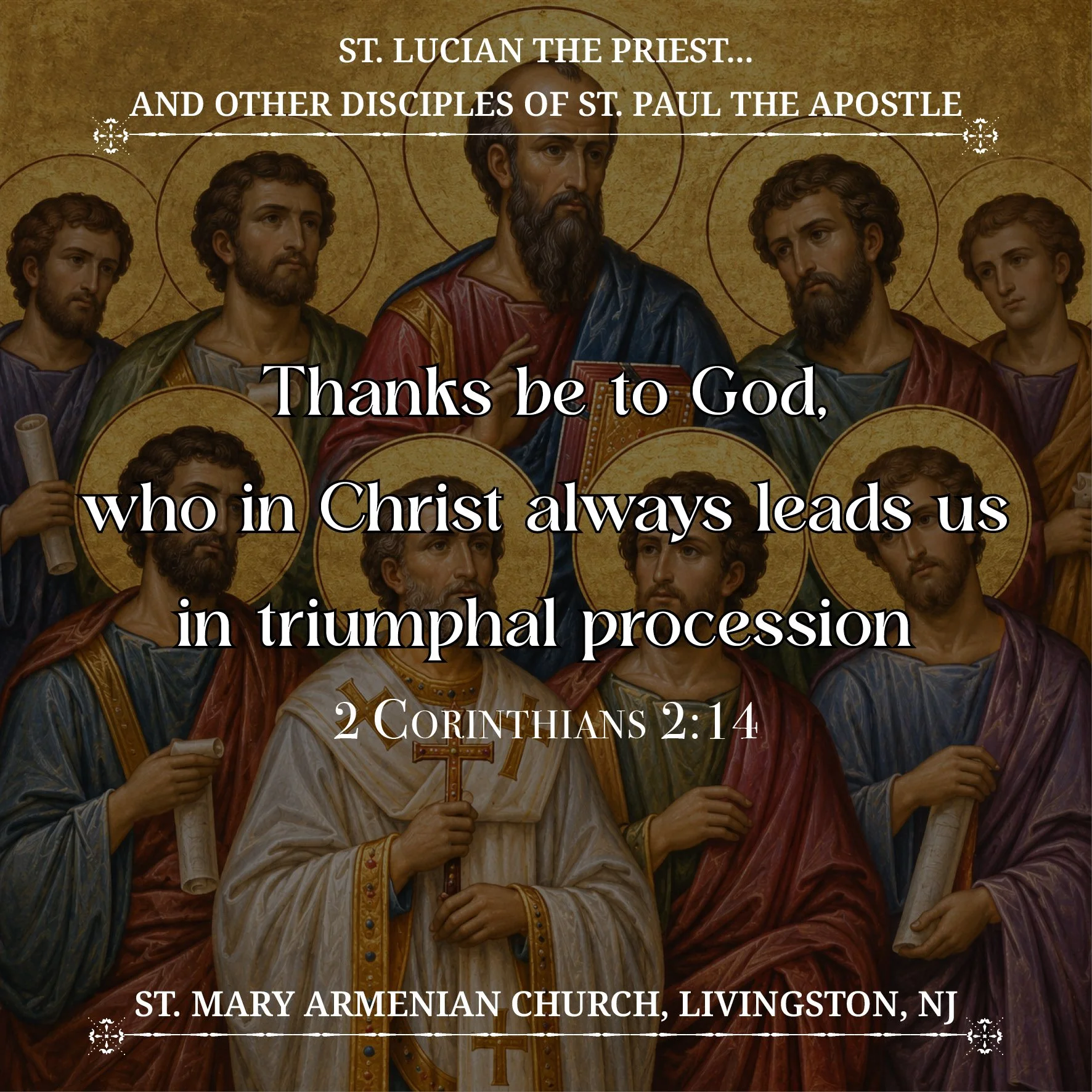
Commemoration Day of
St. Lucian the Priest,
Tarachus, Probus,
Andronicus, Onesimus,
and the Other Disciples of
St. Paul the Apostle
St. Lucian the Priest
There are two priests named Lucian in our ecclesiastical calendar, one of whom is recorded as Luncian. One is commemorated on the fifth Monday following Pentecost, and the other on the first Tuesday of the Fast of Hisnag (the Fifty-Day Fast). In the Armenian Synaxaria, however, only one priest named Lucian is mentioned. Patriarch Torkom likewise mentions only one Lucian in his book Saints and Feasts. Similarly, there is only one priest named Lucian in the Greek ecclesiastical calendar.
Although there are two priests named Lucian in the Latin tradition, one of them is so little known, having been martyred in Galatia, that we do not believe he was included in our ecclesiastical calendar, just as he was not included in that of the Greeks. Considering all this, we recognize only one priest named Lucian. Since we do not believe that he was commemorated twice in our Church, one of these commemorations should therefore be removed from the calendar.
The well-known priest Lucian was born in Samosata. He grew up and was active toward the end of the third century and the beginning of the fourth century. He was the head of his theological school in Antioch, where Arius and Eusebius of Nicomedia, the latter also an Arian, were among his disciples. Thus, whether rightly or mistakenly, Lucian is regarded as the forefather of the theological doctrines that subsequently manifested themselves among the Arians.
However, despite these theological views attributed to him, which were condemned along with Arius at the Ecumenical Council of Nicaea, Lucian was a virtuous man and a clergyman of holy life. The Synaxarion says of him:
He was nurtured and trained in ascetic practices and in a manner of life pleasing to God. After losing his parents, he gave all his possessions to the poor and became a great scholar of Holy Scripture.
Although he held only the priestly rank, “by the command of his bishop, he became an accomplished doctor of theology.”
During the persecutions instigated by Maximinus the Cruel, he was arrested and taken to Nicomedia. There, after nine years of imprisonment, enduring numerous tortures and delivering a remarkable discourse in defense of his faith, he was beheaded in A.D. 312.
Lucian is also worthy of remembrance because he believed in the literal and historical interpretation of Holy Scripture rather than the allegorical interpretation favored at that time by the followers of the Alexandrian school. For this reason, he emphasized the textual accuracy of Holy Scripture. He therefore undertook the revision of the Septuagint translation by comparing it with the original Hebrew text. This revision came into widespread use during the fourth century.
By clarifying ambiguities and refining the language, he also made certain minor grammatical corrections to the New Testament. It is believed that the New Testament in common use today is derived from his revision. St. Jerome praises and highly esteems this revision, while St. John Chrysostom commends Lucian for his virtuous character and scholarly learning.
Tarachus, Probus, and Andronicus
These three like-minded Christian friends met in Tarsus during the persecutions of Emperor Diocletian. They were denounced as Christians before the city's judge and subjected to barbaric tortures both in Tarsus and in the city of Anazarbus. Finally, they were beheaded and deemed worthy of receiving the crowns of martyrdom.
We Armenians commemorate their memory on the first Tuesday of the Fast of Hisnag.
St. Onesimus
Although Onesimus is the last of the Gospel-era saints to be individually named in our ecclesiastical calendar, he is neither the last of the New Testament saints nor the last of the disciples of St. Paul the Apostle. There are still other names and individuals mentioned in the New Testament whom we believe to be numbered among the heavenly host of God's saints. We shall անդր address some of them below.
Onesimus was the humblest among Paul's disciples, for he was a slave who received Paul's care and fatherly attention. This slave had fled from his master, Philemon, who lived in Colossae, and had gone to Rome. There, upon meeting Paul, he experienced a twofold liberation. First, having been freed from the sting of slavery to sin, he became a Christian. Second, we believe that he also received forgiveness from his earthly master, Philemon.
Onesimus's escape and his encounter with St. Paul the Apostle not only became the means of his salvation, but also bestowed upon the Christian world perhaps the shortest and most personal, yet at the same time one of the most beautiful, of St. Paul's letters: the Epistle to Philemon.
Since this epistle is our only source of information concerning Onesimus, and considering both its brevity and its importance, we reproduce it here in its entirety.
The Epistle of St. Paul to Philemon
Paul, a prisoner of Jesus Christ, and Timothy our brother, to Philemon, our beloved friend and fellow worker, to our sister Apphia (Philemon's wife), to Archippus, our fellow soldier (probably the presbyter of Colossae), and to the Church in your house:
Grace to you and peace from God our Father and the Lord Jesus Christ.
I give thanks to my God, always remembering you in my prayers, when I hear of your faith and love toward the Lord Jesus and all the saints (Christians), so that your fellowship in the faith may become fruitful through the recognition of every good thing that is in you through Christ Jesus. I have received great joy and consolation upon hearing of your love, brother, because through you the faithful have found their peace.
Although I have great boldness in Christ to command you to do what is necessary, nevertheless, my love for you compels me rather to appeal to you—I, Paul, now an old man and also a prisoner of Jesus Christ.
I appeal to you on behalf of my son Onesimus, whose spiritual father I became while in chains (having brought him to conversion during my imprisonment). Yes, I appeal to you for Onesimus, who was once useless to you but is now useful both to you and to me.
I have sent him back to you; receive him as a part of my very heart. I wished to keep him with me so that, in your place, he might serve me during my imprisonment for the Gospel. But I did not wish to do anything without your consent, so that your good deed might be done not under compulsion, but willingly.
Perhaps he departed from you for a little while so that you might have him back forever, no longer as a slave, but as more than a slave—as a beloved brother. If he is dear to me, how much more dear will he be to you, both as a servant and as a brother in the Lord!
If, therefore, you regard me as your companion, receive him as you would receive me. If he has wronged you in any way or owes you anything, charge it to my account. I, Paul, have written this with my own hand: I will repay it—not to mention that you owe me your very self.
Yes, brother, let me rejoice because of you in the Lord. Refresh my heart in Christ. Trusting in your obedience, I have written to you, knowing that you will do even more than I ask.
At the same time, prepare a lodging for me, for I hope that through your prayers I shall be given back to you.
Epaphras, my fellow prisoner in Christ Jesus, greets you, as do Mark, Aristarchus, Demas, and Luke, my fellow workers.
The grace of our Lord Jesus Christ be with your spirit.
Together with this letter, Paul also wrote what we possess today as the Epistle to the Colossians. He entrusted both letters to one of his fellow workers, Tychicus, appointed Onesimus as his companion, and sent them both to Colossae, which was situated in the Aegean region of Asia Minor, not far from the present-day city of Denizli.
Toward the conclusion of that epistle, St. Paul the Apostle says:
You will receive news concerning us from Tychicus, our beloved brother, faithful minister, and fellow worker in the Lord. I have sent him to you so that you may learn about our circumstances and be comforted in your hearts. He will be accompanied by Onesimus, our faithful and beloved brother, who is one of you (a Colossian). They will tell you everything that has taken place here.
— Colossians 4:7–9
According to tradition, following the death of his master, Onesimus traveled to various countries to preach the Gospel. When he appeared before a Roman judge to stand trial and was asked who he was, Onesimus replied:
I was once the servant of a man, purchased with money; now I am a servant of God, purchased with the Blood of Christ and set free.
Amid grievous tortures, he surrendered his soul.
The Other Disciples of St. Paul
After Onesimus, our ecclesiastical calendar adds the words, “and the commemoration of the other disciples of Paul.” Indeed, there are numerous disciples of St. Paul the Apostle who are mentioned by name both in the Acts of the Apostles and, especially, in his epistles. Apart from those already mentioned, we have counted more than forty names. Let us briefly present at least the most prominent among them, who are mentioned in one way or another in the Acts of the Apostles or in the Epistles of St. Paul.
1. Tychicus
We have already encountered one of them, Tychicus, who generally served as Paul's messenger and bearer of his letters.
In addition to the aforementioned epistle, he also delivered the Epistle to the Ephesians (Ephesians 6:21–22) and the Epistle to Timothy (2 Timothy 4:12). He was probably a native of Ephesus who joined Paul in that very city and accompanied him on his journey to Macedonia, Corinth, and Jerusalem (Acts 20:4).
2. Aquila and Priscilla
Aquila and Priscilla, husband and wife, were honorable fellow workers originally from Pontus who lived in Rome. They were expelled from Rome when Emperor Claudius banished the Jews from the city in A.D. 49.
They came and settled in Corinth, where Paul met them during his first visit to that city. Since they too were tentmakers, Paul joined them, and they worked together (Acts 18:1–3).
Thereafter, they became Paul's devoted friends and fellow workers, of whom the Apostle always spoke with appreciation. For example, referring to them, he says:
They risked their own necks for my life, to whom not only I give thanks, but also all the churches of the Gentiles.
— Romans 16:3–4
Their home was a gathering place for the faithful, that is, a “house church.” They are worthy of being included together in our ecclesiastical calendar, as indeed other Churches have done.
3. Onesiphorus
Onesiphorus was another honorable friend and fellow worker of St. Paul the Apostle. They probably became acquainted in Ephesus.
When Paul was imprisoned in Rome for the second time, he wrote the following to Timothy:
Know this, that all those in Asia Minor have turned away from me… But may the Lord abundantly bestow His goodness upon the household of Onesiphorus, for he often refreshed me and was not ashamed of my chains. Rather, when he came to Rome, he searched diligently for me until he found me. May the Lord grant him mercy on the Day of Judgment. And you yourself know very well how much he assisted me in Ephesus.
— 2 Timothy 1:15–18; 4:19
4. Erastus
Erastus was also called the shahab (governor or mayor) of Corinth. This title is synonymous with the Arabic word sahab or sahib (master or gentleman), which also passed into the Turkish language.
The English translation of Holy Scripture renders this word as “treasurer.” Whatever the precise meaning of the word may be, one thing is clear: he was a man of high social standing who was not ashamed to be Paul's fellow worker or to be regarded as his disciple.
He was first sent to Macedonia, then accompanied Paul on his journey toward Ephesus, and afterward returned to Corinth, his own city (Acts 19:22; Romans 16:23; 2 Timothy 4:20).
5. Apollos
Apollos was a Jew from Alexandria, skilled in rhetoric and eloquent in speech, who was well versed in Holy Scripture.
Upon coming to Ephesus, he was “fervent in spirit” and spoke and taught accurately concerning Jesus, although he knew only “the baptism of John.”
Aquila and Priscilla received him into their home and instructed him more accurately in the truth.
From Ephesus, he went to Corinth, where he preached the Gospel with great ability, watering and expanding the work that Paul had begun (Acts 18:24–28).
6. Aristarchus
Aristarchus was a native of Thessalonica and a very faithful fellow worker whose life was endangered when fierce opposition arose against Paul in Ephesus (Acts 19:29).
Having been freed, however, he continued his collaboration with the Apostle and was among those who accompanied him on his journey to Rome (Colossians 4:10).
7. Epaphras
Epaphras was a native of Colossae and probably among the earliest members of that city's Christian community.
We encounter him in Rome as Paul's fellow prisoner or fellow worker (Colossians 1:7; 4:12).
8–11. Stephanas, Fortunatus, Crispus, and Gaius
All four were natives of Corinth and were baptized personally by St. Paul the Apostle, the first three together with their entire households.
They were regarded as the “firstfruits” of Achaia and had devoted themselves to the service of the faithful. Paul instructed the Corinthians to submit to such people, from which we may conclude that they occupied prominent positions within the Church.
The first two, together with other companions, visited Ephesus, concerning which the Apostle says:
I rejoiced, for they supplied what was lacking on your part, because they refreshed my spirit. Therefore, recognize the worth of such men.
— 1 Corinthians 16:15–18
He also sent the aforementioned epistle from Ephesus to Corinth through them.
Crispus was the ruler of the Jewish synagogue in Corinth, while Gaius was Paul's host. The latter was probably the same person to whom the Third Epistle of St. John the Apostle was addressed.
12–14. Linus and Claudia
Paul conveys greetings from them to Timothy (2 Timothy 4:21). This is all that is known about them from the Scriptures. Tradition, however, associates them with Rome and regards Linus as the succeeding Bishop of Rome after St. Peter, and Claudia as his mother.
15–16. Tryphosa and Tryphena
They are described as women who “labor in the Lord” (Romans 16:12).
We know perhaps nothing more about them, but they are presumed to have been twin sisters, and their names are translated as “Lovely and Tender.”
17–18. Andronicus and Junia
They are believed to have been either husband and wife or brother and sister.
St. Paul the Apostle calls them “my relatives and fellow prisoners.” They were well known in apostolic circles and had become Christians before Paul himself (Romans 16:7).
19. Phoebe
The Apostle calls her “our sister, who is a minister of the Church at Cenchreae,” and asks the faithful in Rome:
Receive her in the Lord in a manner worthy of the saints, and assist her in whatever matter she may require of you, for she has been a helper to many, including myself.
— Romans 16:1–2
It is probable that the Epistle to the Romans was delivered from Corinth to its intended recipients through this woman. The aforementioned city of Cenchreae was the seaport of Corinth.
20. Dionysius the Areopagite
Dionysius was an Athenian intellectual who became the principal convert during Paul's not particularly successful mission in Athens (Acts 17:34).
According to tradition, he subsequently became the first Bishop of Athens.
Based on the mistaken assumption that the mystical theological works handed down to us under the name of Dionysius—which occupied an important place in the literature of the ancient Church—were written by the Areopagite, we commemorate Dionysius on the Saturday preceding the seventh Sunday following the Feast of the Holy Cross, together with the Twelve Holy Doctors of the Church.
It has now been established that these writings belong to the fifth century. Were it not for this mistaken belief, Dionysius the Areopagite would be commemorated only together with the disciples of St. Paul, just as we commemorate Paul's principal disciples, Timothy and Titus, on the fifth Thursday following the Feast of the Holy Cross.
Other Disciples of St. Paul
There are still numerous disciples who are mentioned by name in the Epistles of St. Paul or in the Acts of the Apostles.
Among them are Zenas, Artemas, the “exemplary scribe,” Crescens, and Carpus, with whom Paul had left his phelonion, or winter cloak, in Troas. Paul instructed Timothy to bring that same cloak to him.
There were also Sosthenes, the ruler of the Jewish synagogue in Corinth; Trophimus, whom Paul had left sick in Miletus; Eubulus and Pudens; Jesus, who was surnamed Justus; Nymphas; and Archippus.
Furthermore, in the Epistle to the Romans alone, approximately twenty other individuals are mentioned by name, to whom Paul sends his greetings as personal acquaintances (Romans 16:5–16).
Among them, for example, is Rufus, the “chosen one,” one of the sons of Simon of Cyrene, who carried the Cross of Jesus. His other son, Alexander, is mentioned in the Gospel of Mark (Mark 15:21). Reference is also made to their mother, whom Paul regards as his own mother (Romans 16:13).
There is also Sosipater, Paul's “relative,” and Tertius, who, acting as Paul's secretary, wrote down the Epistle to the Romans.
Very many of these individuals are commemorated by name in the Greek and Latin ecclesiastical calendars, as well as in our Armenian Synaxaria.
We Armenians commemorate their memory collectively on the first Tuesday of the Fast of Advent.
SCRIPTURE READINGS
~ Wisdom of Solomon 9:9–12 ~
With you is wisdom, she who knows your works and was present when you made the world; she understands what is pleasing in your sight and what is right according to your commandments. Send her forth from the holy heavens, and from the throne of your glory send her, that she may labor at my side, and that I may learn what is pleasing to you. For she knows and understands all things, and she will guide me wisely in my actions and guard me with her glory. Then my works will be acceptable, and I shall judge your people justly, and shall be worthy of the throne of my father.
~ Isaiah 41:15-19 ~
Now, I will make of you a threshing sledge, sharp, new, and having teeth; you shall thresh the mountains and crush them, and you shall make the hills like chaff. You shall winnow them and the wind shall carry them away, and the tempest shall scatter them. Then you shall rejoice in the Lord; in the Holy One of Israel you shall glory. When the poor and needy seek water, and there is none, and their tongue is parched with thirst, I the Lord will answer them, I the God of Israel will not forsake them. I will open rivers on the bare heights, and fountains in the midst of the valleys; I will make the wilderness a pool of water, and the dry land springs of water. I will put in the wilderness the cedar, the acacia, the myrtle, and the olive.
~ 2 Corinthians 2:14-17 ~
But thanks be to God, who in Christ always leads us in triumphal procession, and through us spreads in every place the fragrance that comes from knowing him. For we are the aroma of Christ to God among those who are being saved and among those who are perishing; to the one a fragrance from death to death, to the other a fragrance from life to life. Who is sufficient for these things? For we are not peddlers of God's word like so many; but in Christ we speak as persons of sincerity, as persons sent from God and standing in his presence.
~ Holy Gospel of St. Luke 6:13-20 ~
And when day came, he called his disciples and chose twelve of them, whom he also named apostles: Simon, whom he named Peter, and his brother Andrew, and James, and John, and Philip, and Bartholomew, and Matthew, and Thomas, and James son of Alphaeus, and Simon, who was called the Zealot, and Judas son of James, and Judas Iscariot, who became a traitor. He came down with them and stood on a level place, with a great crowd of his disciples and a great multitude of people from all Judea, Jerusalem, and the coast of Tyre and Sidon. They had come to hear him and to be healed of their diseases; and those who were troubled with unclean spirits were cured. And all in the crowd were trying to touch him, for power came out from him and healed all of them. Then he looked up at his disciples and said: "Blessed are you who are poor, for yours is the kingdom of God.