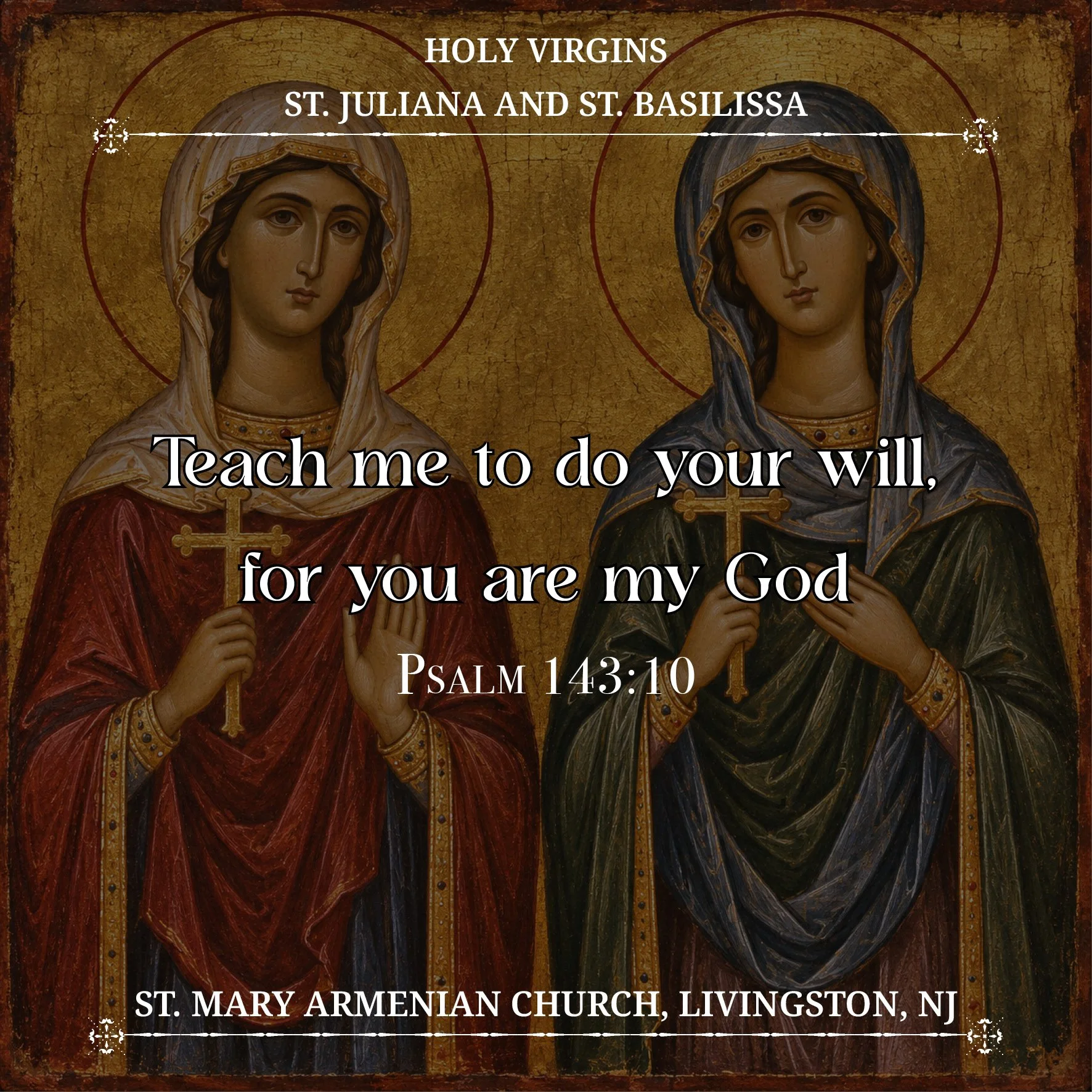
Commemoration Day of
The Holy Virgins
St. Juliana and St. Basilissa
St. Juliana The virgin
There are many saints bearing the name Juliana in both the Latin and Greek Churches. In the Armenian Synaxarion (Haysmavoork), we find at least two female saints with this name.
We believe that the Juliana included in the Armenian Church calendar is Saint Juliana of Nicomedia, who lived and suffered martyrdom at the beginning of the fourth century, during the persecutions of Emperor Diocletian.
Juliana became a Christian at a young age and dedicated herself to a life of virginity and chastity. Consequently, she rejected the marriage proposal of a pagan young man.
Because of her refusal, she was denounced to the judge and subjected to terrible tortures before eventually being imprisoned.
While in prison, she faced yet another spiritual trial. An evil spirit appeared to her in the form of an angel, claiming that God no longer wished for her to suffer. The spirit urged her to obey the emperor's command and not hesitate to offer sacrifices to the idols.
However, Juliana remained steadfast in her faith and emerged victorious from all these trials and temptations.
When she was brought out of prison to be thrown into the fire, the flames were miraculously extinguished.
Upon witnessing this miracle, many people converted to Christianity and were martyred on that very occasion.
Finally, in the year 311, at the age of nineteen, Juliana received the crown of martyrdom through beheading.
The Armenian Apostolic Church commemorates her feast on the first Monday of the Fast of Advent (Hisnag).
St. Basilissa the Virgin
There are also numerous female martyrs bearing the name Basilissa in the liturgical calendars of the Greek and Latin Churches.
We believe that the Saint Basilissa commemorated in the Armenian Church calendar was from Nicomedia and had been a Christian since early childhood.
Because of her Christian faith, she was subjected to severe tortures by order of a judge appointed by the emperor.
Despite the many cruel torments inflicted upon her, Basilissa miraculously remained unharmed and was eventually released.
She then devoted herself to a life of asceticism, living in purity, holiness, and complete dedication to God.
In the year 309, having lived a life of sanctity, she peacefully departed this earthly life and surrendered her soul to God.
The Armenian Apostolic Church commemorates her feast on the first Monday of the Fast of Advent (Hisnag).
SCRIPTURE READINGS
~ Song of Solomon 8:14 ~
Make haste, my beloved, and be like a gazelle or a young stag upon the mountains of spices!
~ Hosea 14:5-7 ~
I will be like the dew to Israel; he shall blossom like the lily, he shall strike root like the forests of Lebanon. His shoots shall spread out; his beauty shall be like the olive tree, and his fragrance like that of Lebanon. They shall again live beneath my shadow, they shall flourish as a garden; they shall blossom like the vine
~ 2 Corinthians 6:16-7:1 ~
What agreement has the temple of God with idols? For we are the temple of the living God; as God said, "I will live in them and walk among them, and I will be their God, and they shall be my people. Therefore come out from them, and be separate from them, says the Lord, and touch nothing unclean; then I will welcome you, and I will be your father, and you shall be my sons and daughters, says the Lord Almighty."
Since we have these promises, beloved, let us cleanse ourselves from every defilement of body and of spirit, making holiness perfect in the fear of God.
~ Holy Gospel of St. Luke 8:1-3 ~
Soon afterwards he went on through cities and villages, proclaiming and bringing the good news of the kingdom of God. The twelve were with him, as well as some women who had been cured of evil spirits and infirmities: Mary, called Magdalene, from whom seven demons had gone out, and Joanna, the wife of Herod's steward Chuza, and Susanna, and many others, who provided for them out of their resources.