FEAST OF the Holy Cross
Memorial Day for the Departed — Merelots
According to the Church calendar, the day following each of the five Tabernacle Feasts is called Merelots, the Commemoration of the Departed. On this day, the Divine Liturgy is celebrated in churches for the repose and peace of the souls of the departed, followed by a requiem service.
The day is dedicated to the memory of those who have fallen asleep in Christ in true and holy faith. People remember their departed loved ones and give alms to those in need.
In the Old Testament, in the Second Book of Maccabees, Judas Maccabeus, believing in the resurrection of those who had fallen in battle, took a wise course of action. He believed that those who had died courageously could receive forgiveness of their sins. Judas Maccabeus collected silver and sent it to Jerusalem so that an offering might be made for the sins of the departed (2 Maccabees 12:43–46).
Even today, on Merelots, the faithful of the Armenian Church submit the names of their departed loved ones in writing so that they may be commemorated during the Divine Liturgy.
During the requiem service, the following passage is read:
“Truly, truly, I say to you, unless a grain of wheat falls into the ground and dies, it remains alone; but if it dies, it bears much fruit” (John 12:24).
This passage once again bears witness to the words of the Apostle Paul:
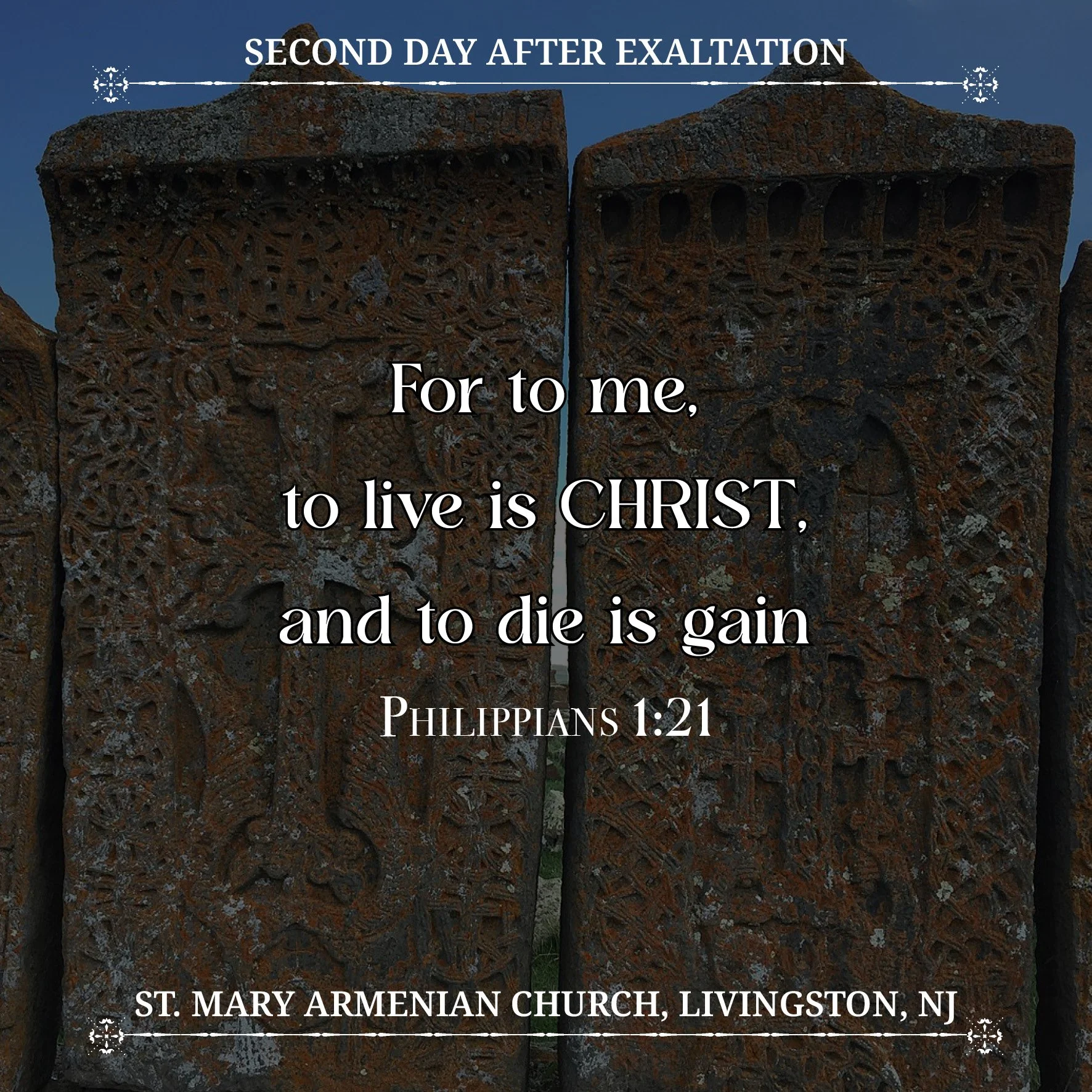
“For to me, to live is Christ, and to die is gain” (Philippians 1:21).
The one who buries the departed is compared to a farmer. After laboring diligently for a long time, the farmer gathers seed. Then, when the time for sowing comes, he casts into the ground the very seed he worked so hard to gather. More than this, after placing the seed in the earth, he repeatedly raises his eyes toward heaven and prays for rain, so that the seeds obtained through his hard labor may decay in the soil and ultimately produce a far greater harvest and reward.
Those who do not act in this way soon consume their stores and fall into hunger, poverty, and ruin. In the same manner, when a person’s earthly life comes to an end, the body is committed to the earth so that the person may ultimately receive a far greater gain. According to the Apostle Paul, that gain is that the corruptible body committed to the earth will rise again incorruptible, spiritual, and perfect (1 Corinthians 15:53).
At the request of the relatives of the departed, their graves are also blessed. Through the blessing of graves, we proclaim our hope in the Second Coming of the Lord and the resurrection of the dead: that at the Last Judgment the dead will rise and each person will see his or her loved ones again.
When visiting graves, the faithful burn incense and pray for the repose of the souls of the departed. In praying for the departed, the Church asks that, at the Last Judgment, the Lord in His abundant mercy forgive their sins and make them worthy of the Kingdom of Heaven.
Holy Scripture teaches that many among the departed may find mercy at the Last Judgment and receive forgiveness for sins for which they were unable to seek atonement during their earthly lives (Matthew 12:31–32). There is, however, a distinction between sinners who have remained unrepentant and arrogant and sinners who have fallen asleep in Christ.
In the Bible we read:
“Therefore I tell you: however many sins or blasphemies people may commit, God will forgive them all; but He will not forgive the one who blasphemes the Holy Spirit. Whoever speaks a word against the Son of Man will be forgiven, but whoever speaks against the Holy Spirit will not be forgiven, either in this world or in the world to come” (Matthew 12:31–32).
These words of Jesus teach us that sins arising from human weakness may be forgiven through remorse and repentance, whereas sins committed against the Holy Spirit through obstinacy and pride will not receive forgiveness either in this world or in the world to come.
Nevertheless, we must never forget that God’s love and mercy are immeasurable and limitless, surpassing all human standards:
“Great is Your mercy, higher than the heavens, and Your truth reaches to the clouds” (Psalm 107:5).
The burial service for the departed, prayers offered on their behalf, the requiem service, and the blessing of graves all inspire and strengthen the hope of the Last Judgment and the resurrection, while reinforcing the faith of the living.
The observance of Merelots is an expression of gratitude and respect on the part of the living toward the departed, so that they may not be forgotten but continue to be remembered. The observance expresses both reverence for those who have fallen asleep and the hope of the resurrection of all.
Every Christian who loses someone near and dear has a need for spiritual consolation. The source of that consolation is the Christian faith, because God Himself is the One who gives life to us all:
“He Himself gives to all life and breath and all things.… In Him we live and move and have our being” (Acts 17:25, 28).
And it is the Lord Himself who:
“Brings down to the grave and raises up from it” (1 Samuel 2:6),
and,
“Not even a sparrow falls to the ground without your Father’s knowledge” (Matthew 10:29).
The Christian faith consoles us with the assurance that our separation from one another is not eternal. Rather, according to the Word and promise of God, we live in the hope that we shall meet again:
“Do not marvel at this, for the hour is coming when all who are in the graves will hear His voice and come forth: those who have done good will rise to the resurrection of life, and those who have done evil to the resurrection of judgment” (John 5:28–29).
SCRIPTURE READINGS
~ Isaiah 65:22-25 ~
They shall not build and another inhabit; they shall not plant and another eat; for like the days of a tree shall the days of my people be, and my chosen shall long enjoy the work of their hands. They shall not labor in vain, or bear children for calamity; for they shall be offspring blessed by the Lord— and their descendants as well. Before they call I will answer, while they are yet speaking I will hear. The wolf and the lamb shall feed together, the lion shall eat straw like the ox; but the serpent—its food shall be dust! They shall not hurt or destroy on all my holy mountain, says the Lord.
~ 1 Corinthians 2:6-10 ~
Yet among the mature we do speak wisdom, though it is not a wisdom of this age or of the rulers of this age, who are doomed to perish. But we speak God's wisdom, secret and hidden, which God decreed before the ages for our glory. None of the rulers of this age understood this; for if they had, they would not have crucified the Lord of glory. But, as it is written, "What no eye has seen, nor ear heard, nor the human heart conceived, what God has prepared for those who love him"— these things God has revealed to us through the Spirit; for the Spirit searches everything, even the depths of God.
~ Holy Gospel of St. John 3:22-36 ~
After this Jesus and his disciples went into the Judean countryside, and he spent some time there with them and baptized. John also was baptizing at Aenon near Salim because water was abundant there; and people kept coming and were being baptized —John, of course, had not yet been thrown into prison. Now a discussion about purification arose between John's disciples and a Jew. They came to John and said to him, "Rabbi, the one who was with you across the Jordan, to whom you testified, here he is baptizing, and all are going to him." John answered, "No one can receive anything except what has been given from heaven. You yourselves are my witnesses that I said, "I am not the Messiah, but I have been sent ahead of him.' He who has the bride is the bridegroom. The friend of the bridegroom, who stands and hears him, rejoices greatly at the bridegroom's voice. For this reason my joy has been fulfilled. He must increase, but I must decrease." The one who comes from above is above all; the one who is of the earth belongs to the earth and speaks about earthly things. The one who comes from heaven is above all. He testifies to what he has seen and heard, yet no one accepts his testimony. Whoever has accepted his testimony has certified this, that God is true. He whom God has sent speaks the words of God, for he gives the Spirit without measure. The Father loves the Son and has placed all things in his hands. Whoever believes in the Son has eternal life; whoever disobeys the Son will not see life, but must endure God's wrath.