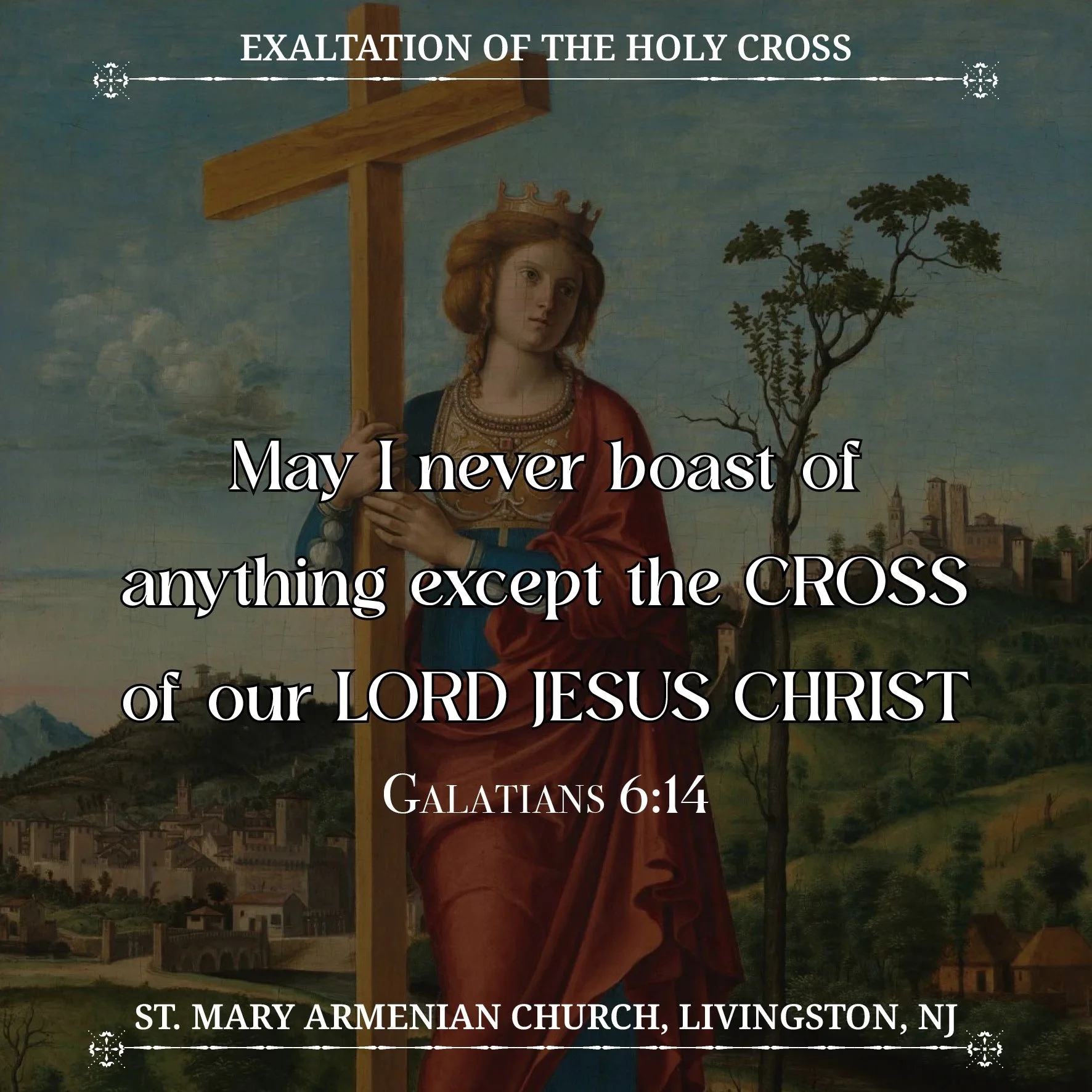
FEAST OF Exaltation of
the Holy Cross
The Feast of the Exaltation of the Holy Cross is the principal feast dedicated to the Holy Cross and one of the five Tabernacle Feasts of the Church. All Christian Churches celebrate it on September 14, while the Armenian Church celebrates it on the Sunday falling between September 11 and 17.
Khachveratz, the Armenian name for the feast, means the exaltation or elevation of the Cross. According to Church tradition, the Cross of Christ was solemnly elevated before the people on three occasions.
First, as we learn from Torgom Gushakian, the Apostle James, the first Bishop of Jerusalem, displayed a representation of the Cross of Christ to the people as a sign of protection and warning during a period when persecution against Christians had intensified. On that occasion, he sang for the first time the hymn, “Khachi Ko, Krisdos, yergirbakanemk”—“Before Your Cross, O Christ, we bow down.”
The second elevation took place on Golgotha in A.D. 326 through St. Helena, the mother of Emperor Constantine the Great, and Bishop Cyril.
The third occasion was the return of the Cross from Persian captivity, after which the Feast of the Exaltation of the Holy Cross became firmly established.
In A.D. 610, the impious Persian king Khosrow II Parvez (590–628), while waging war against the Roman Emperor Heraclius, was victorious, captured Jerusalem, seized the Cross of the Savior, and carried it away to Persia. The population was put to the sword, while many others were taken captive. Fifty-seven thousand people were killed and thirty-five thousand were taken prisoner. Patriarch Zacharias was also taken into captivity.
When the Holy Cross of the Lord arrived in Persia, it was accorded great honor. The arrival of the Wood of Christ’s Cross in that idolatrous land was accompanied by wondrous signs, so much so that people everywhere began saying, “The God of the Christians has come to Persia.”
King Khosrow himself approached the sacred relic with great reverence. He kept it with great honor in his treasury, maintained a lamp burning continually before it, and did not even dare to remove the Wood of the Cross. Although the Persians were pagans, they did not dare to harm it. Many people approached the local Christians, heard the message of the Gospel from them, and converted to Christianity. For approximately fourteen years, the Holy Cross remained unharmed in captivity.
Finally, in A.D. 628, Emperor Heraclius invaded Persia with a vast army. A sacred war was waged for the recovery of the Cross. An Armenian contingent was also present in the army under the command of the Armenian prince Mjej Gnuni.
The emperor was victorious in the war, and a peace treaty was concluded between the two sides. One of its important provisions was the return of the Wood of the Cross.
Thus, the Holy Cross was carried back from Persia to Jerusalem in a solemn procession. On its return journey, it passed from city to city, spreading joy and enthusiasm everywhere. The Cross also passed through Armenia, where the people greeted with great rejoicing the liberation of the Lord’s “wonder-working and mighty Wood of the Cross.”
According to tradition, while the Holy Cross was being carried through Armenia, the Persians again attempted to seize it. The Armenians left the Cross in the plain of Karin and went out to confront the enemy, successfully repelling their attack. When they returned victorious, they discovered a newly flowing spring of clear water at the place where the Cross had rested. The site later became a place of pilgrimage.
To this day, the great summit of the mountains rising to the east of Karin-Erzurum is called Khachapait (“Wood of the Cross”). The Khachka Monastery was also built at the foot of these mountains.
Throughout the journey, the Wood of the Cross brought indescribable consolation and inspiration to the devout faithful. These events became the basis for the establishment of the Feast of the Exaltation of the Holy Cross.
The Holy Cross was returned from captivity on September 14, A.D. 628.
From that time onward, the Feast of the Exaltation of the Holy Cross has been celebrated by Churches throughout the Christian world. In Byzantium, the feast became almost a state celebration, while the Cross, as a symbol of the Empire, appeared on the walls of government buildings and as an ornament on the garments of officials. On the feast day, bishops and priests publicly elevated the Cross.
This solemn ceremony of the elevation of the Cross continues to be performed in churches to this day.
In the Armenian Church, the Khachveratz procession is celebrated with great solemnity on Sunday evening. The Cross is decorated in the church with colorful flowers and basil. It is then carried outside in procession around the church, recalling the journey of the Wood of the Cross through the flower-covered lands of the Armenian Highlands on its return from captivity to Jerusalem.
The Andastan, or Blessing of the Four Corners of the World, is then performed. The priest makes the sign of the Cross and blesses the four directions of the world, asking God to grant peace, and sprinkles the faithful with rose water. Following this ceremony, the Evening Service begins.
St. John Chrysostom says:
“Let us glorify the precious and life-giving Cross of the Lord, for the Cross is the sign of our salvation; the Cross is the hope of Christians; the Cross is the foundation of the Church; the Cross is the defeat of Satan; the Cross is a father to orphans; the Cross is the judge of the impious; the Cross is the physician of the sick; the Cross is our weapon by day and our guardian by night; the Cross is a fountain for the thirsty; the Cross is light for those who sit in darkness and liberation for captives; the Cross is the overthrow of lawlessness.”
As the Holy Fathers of the Church teach, whenever we make upon ourselves the sign of the saving Cross of our Lord Jesus Christ, we should do so with steadfast and living faith.
St. Ephrem the Syrian says:
“We must always and everywhere carry with us this victorious weapon, the Cross of Christ, and never put it aside—neither while sleeping nor while awake, neither at work nor while traveling. We must always surround ourselves with the sign of the Lord’s saving and life-giving Cross. Then we shall fear nothing—neither darkness nor bodily wounds.”
St. John Chrysostom says:
“See how the Heavenly King has armed the soldier who follows Him. He has given him neither shield nor helmet, neither bow nor armor, nor anything of that kind, but has bestowed upon him the power of the Cross, the sign that conquers demons.”
And again:
“If we imprint this sign upon ourselves with great faith, no unclean spirit will approach us.”
SCRIPTURE READINGS
~ Isaiah 49:13-23 ~
Sing for joy, O heavens, and exult, O earth; break forth, O mountains, into singing! For the Lord has comforted his people, and will have compassion on his suffering ones. But Zion said, "The Lord has forsaken me, my Lord has forgotten me." Can a woman forget her nursing child, or show no compassion for the child of her womb? Even these may forget, yet I will not forget you. See, I have inscribed you on the palms of my hands; your walls are continually before me. Your builders outdo your destroyers, and those who laid you waste go away from you. Lift up your eyes all around and see; they all gather, they come to you. As I live, says the Lord, you shall put all of them on like an ornament, and like a bride you shall bind them on. Surely your waste and your desolate places and your devastated land— surely now you will be too crowded for your inhabitants, and those who swallowed you up will be far away. The children born in the time of your bereavement will yet say in your hearing: "The place is too crowded for me; make room for me to settle." Then you will say in your heart, "Who has borne me these? I was bereaved and barren, exiled and put away— so who has reared these? I was left all alone— where then have these come from?" Thus says the Lord God: I will soon lift up my hand to the nations, and raise my signal to the peoples; and they shall bring your sons in their bosom, and your daughters shall be carried on their shoulders. Kings shall be your foster fathers, and their queens your nursing mothers. With their faces to the ground they shall bow down to you, and lick the dust of your feet. Then you will know that I am the Lord; those who wait for me shall not be put to shame.
~ Galatians 6:14-18 ~
May I never boast of anything except the cross of our Lord Jesus Christ, by which the world has been crucified to me, and I to the world. For neither circumcision nor uncircumcision is anything; but a new creation is everything! As for those who will follow this rule—peace be upon them, and mercy, and upon the Israel of God. From now on, let no one make trouble for me; for I carry the marks of Jesus branded on my body. May the grace of our Lord Jesus Christ be with your spirit, brothers and sisters. Amen.
~ Holy Gospel of St. John 3:13-21 ~
No one has ascended into heaven except the one who descended from heaven, the Son of Man. And just as Moses lifted up the serpent in the wilderness, so must the Son of Man be lifted up, that whoever believes in him may have eternal life. "For God so loved the world that he gave his only Son, so that everyone who believes in him may not perish but may have eternal life. "Indeed, God did not send the Son into the world to condemn the world, but in order that the world might be saved through him. Those who believe in him are not condemned; but those who do not believe are condemned already, because they have not believed in the name of the only Son of God. And this is the judgment, that the light has come into the world, and people loved darkness rather than light because their deeds were evil. For all who do evil hate the light and do not come to the light, so that their deeds may not be exposed. But those who do what is true come to the light, so that it may be clearly seen that their deeds have been done in God."