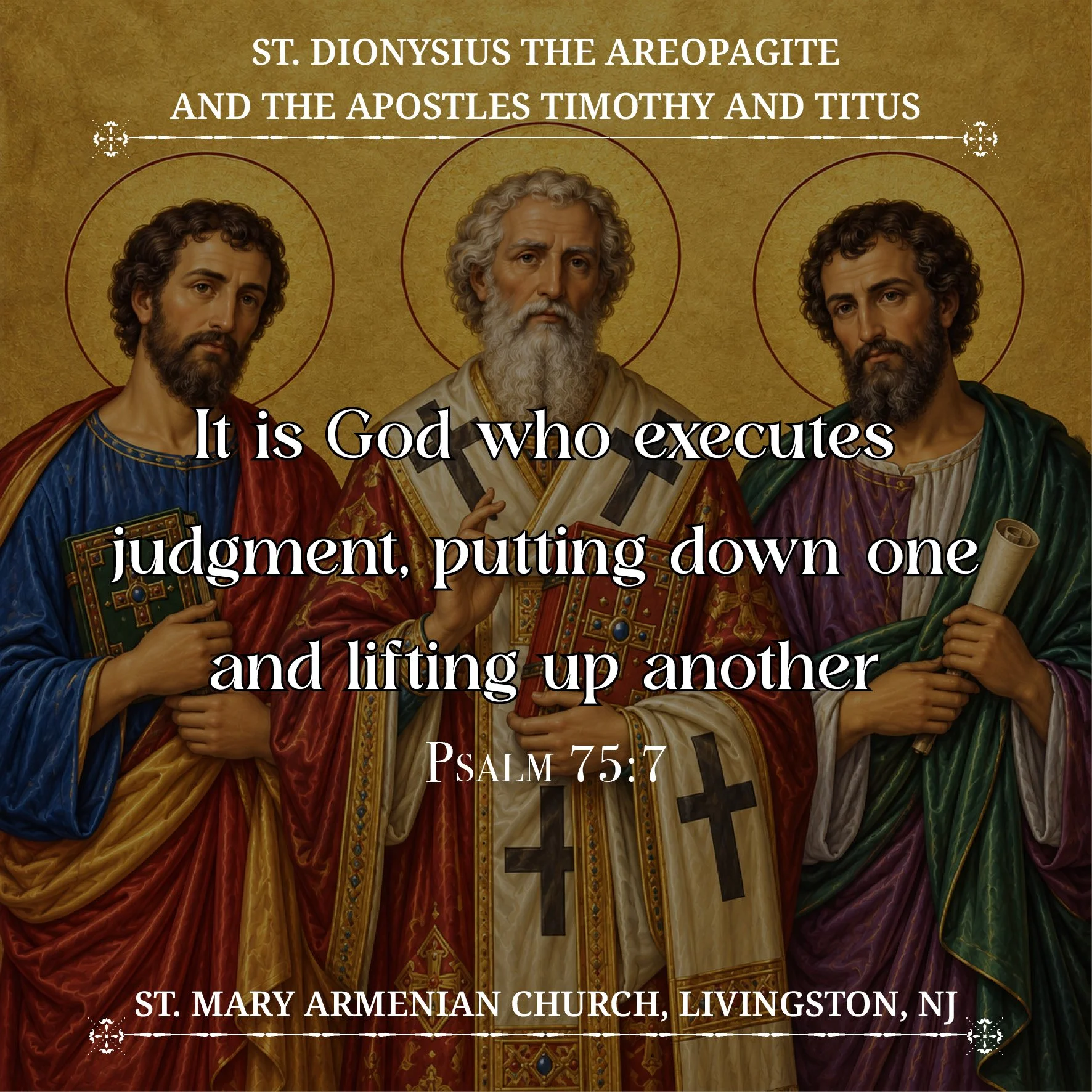
Commemoration Day of
St. Dionysius the Areopagite
and the Apostles Timothy and Titus
Dionysius the Areopagite and Hierotheos of Athens
These two are the principal figures among the distinguished group of Church Fathers whom we commemorate under the title of the “Twelve Doctors of the Church,” on the Saturday preceding the seventh Sunday of the Holy Cross, the Feast of the Discovery of the Holy Cross, toward the end of October.
These two figures are inseparably connected, because the first, Dionysius, is presented as a disciple of the second, Hierotheos, in the books attributed to Dionysius, which we shall discuss below.
Dionysius serves as a link between the saints of the New Testament and the saints of later Church history, since he is mentioned in the Acts of the Apostles as one of the first converts resulting from the Apostle Paul's preaching in Athens.
When the Apostle Paul concluded his address before the Areopagus, the supreme academic council of Athens, the author of the Acts of the Apostles concludes:
“So Paul departed from among them. But some people joined him and believed, among whom was Dionysius the Areopagite” (Acts 17:32–34).
The Greek word Areopagus means “Hill of Ares.” This name was given to one of the hills of Athens, where, from ancient times, the city's aristocratic council assembled. This council also dealt with religious matters.
The name Areopagus eventually passed from the hill itself to the council that met there, and the council continued to be known by that name even when it assembled elsewhere.
Thus, the designation “Areopagite” does not mean someone who was born or lived on the hill known by that name. Rather, it means a member of the council called the Areopagus, just as the terms “Pharisee” and “Sadducee” refer to members of the groups known by those names.
Apart from the Acts of the Apostles, the only information we possess about Dionysius comes from Eusebius's Ecclesiastical History, which confirms that Dionysius was the first bishop of Athens and was ordained by the Apostle Paul.
However, his fame and the great authority and standing he enjoyed as a Doctor of the Church are based upon a series of books attributed to him. These writings held great authority during the Middle Ages and profoundly influenced the theological thought of that period and subsequent centuries, both in the East and in the West.
These books are:
On the Celestial Hierarchy — Concerning the various orders and ranks of angels.
On the Ecclesiastical Hierarchy — Concerning the hierarchy of the Church, which is presented as a reflection or likeness of the heavenly hierarchy.
On the Divine Names — Concerning the attributes and qualities of God.
Mystical Theology — Concerning the Christian life of spiritual perfection.
These works attributed to Dionysius were also translated into Armenian, first by the scholar Stepanos of Syunik in the eighth century, and later by Stepanos Lehatsi (Stephen the Pole) in the seventeenth century.
Although these writings are extremely important from a theological standpoint, it has now been established that they are not the works of Dionysius, who lived in the first century, but rather those of a great intellectual who lived toward the end of the fifth century or the beginning of the sixth century and presented his writings under the name of Dionysius the Areopagite.
Therefore, once we accept that these books were not written by Dionysius of Athens, the disciple of the Apostle Paul, his status as one of the “Doctors of the Church” can no longer be maintained. He then retains the more modest distinction of being the first bishop of Athens.
Consequently, his only proper place in our Church calendar remains the Thursday following the fifth Sunday of the Holy Cross, when his memory is indeed commemorated together with two other great disciples of the Apostle Paul, Timothy and Titus.
Western tradition carries Dionysius as far as Paris, regarding him as one of the first enlighteners of that city and its first bishop.
According to this tradition, he was arrested and beheaded at a place still known today as Montmartre, meaning “Hill of the Martyrs.”
Tradition further relates that his headless body rose to its feet, picked up its severed head, held it in its hands, and walked to the place now known by his name, Saint-Denis.
There, a magnificent basilica was later built, where many kings and princes of France are buried, including our unfortunate King Levon VI of Cilician Armenia.
However, the presently accepted view is that this bishop of Paris was an entirely different person, who lived during the middle of the third century and was indeed martyred in Paris in A.D. 258.
He was confused with Dionysius of the apostolic age, probably because the two shared the same name.
As for Hierotheos (also called Heretheos, from which the affectionate form Heretik is derived), his historical identity becomes doubtful because he appears only in the writings attributed to Dionysius, where he is presented as Dionysius's teacher and spiritual guide.
Apart from these writings, nowhere else do we find mention of a great thinker or saint named Hierotheos of Athens who would have been worthy of heading the glorious group of the Church's “Twelve Doctors.”
Timothy
Timothy was the Apostle Paul's most devoted disciple and fellow worker.
Paul met him during his second missionary journey in the city of Lystra, not far from Konya.
At the time he met Paul, Timothy was already a Christian, being “the son of a Christian mother and a pagan father.”
As a virtuous and trustworthy individual, “he was well spoken of by the believers in Lystra and Iconium.”
Paul wished to take him along on his journey, and therefore “circumcised him because of the Jews who were in those places, since everyone knew that his father was a Gentile” (Acts 16:1–3).
We also know the names of Timothy's grandmother, Lois, and his mother, Eunice, both of whom had become Christians before him. Under their maternal care, Timothy was raised and grew in the Christian faith (2 Timothy 1:5).
Because of his dual connection with paganism and Christianity, together with the sound religious upbringing he had received, Timothy proved to be an exceptionally suitable young man for Paul's missionary work.
Paul took special care in guiding and educating him, forming this young disciple into one of his finest coworkers and one of the most virtuous and devoted servants of Christianity.
Paul was bound to him by deep paternal affection, which he expresses in his letters. In them, he calls Timothy not only his “beloved son,” but also his brother and fellow worker in his ministry.
Apart from Luke and Timothy, Paul had found no one so close to him (cf. Romans 16:21; 1 Corinthians 7:17).
Some of Paul's letters were composed with Timothy's assistance, and for this reason Timothy's name appears alongside Paul's at the beginning of these letters (2 Corinthians 1:1; Colossians 1:1).
Two of Paul's letters are addressed directly to Timothy.
These letters contain much valuable counsel for every believer in general, but especially for the ministers and clergy of the Church.
For this reason, together with the Letter to Titus, they are known as the Pastoral Epistles.
Among the missions entrusted to Timothy by the Apostle Paul were, for example, encouraging the Thessalonians during times of persecution (1 Thessalonians 3:3) and strengthening the newly converted Christians of Corinth in their faith (1 Corinthians 4:17).
Finally, Paul left Timothy in Ephesus to continue his work.
Timothy is considered the first bishop of Ephesus, where he was also martyred.
We commemorate his memory together with the other disciples of Paul on the Thursday following the fifth Sunday of the Holy Cross.
Titus
Titus was another distinguished fellow worker of the Apostle Paul, who called him “his beloved son in the common faith” (Titus 1:1).
Elsewhere, Paul refers to him as a “brother, equal, and fellow worker” (2 Corinthians 2:13; 8:23).
Paul sent Titus as his representative to Corinth to collect contributions for the Church of Jerusalem (2 Corinthians 8:16–18).
Titus was an important and trustworthy individual (2 Corinthians 12:18).
When Paul traveled with Barnabas to Jerusalem to participate in the council, Titus also accompanied them.
He served as an outstanding example of a Gentile who had converted to Christianity, demonstrating that, although he had not been circumcised, he was in no way inferior to a circumcised Christian (Galatians 2:1–5).
Eventually, the Apostle Paul sent Titus to Crete to assume responsibility for overseeing the newly established Church there and to expand the work that had already begun (Titus 1:5).
During the final years of Paul's life, Titus was already in Rome, and Paul sent him on certain missions to Dalmatia, along the shores of the Adriatic Sea.
Eventually, Titus returned to Crete and is regarded as the first bishop of that island.
One of the Apostle Paul's letters is addressed to Titus.
Although this letter contains special exhortations for all believers, it is particularly concerned with instructions and guidance for the ministers of the Church.
According to the teaching of this epistle, the fundamental duty of a church minister should be to “set right what remains unfinished” in the Church.
Furthermore, a clergyman should be:
“Blameless ... not arrogant, not quick-tempered, not abusive, not violent, not greedy for gain, but hospitable, a lover of goodness, humble, just, holy, self-controlled, and faithful to sound doctrine, so that he may be able both to encourage those who listen through sound teaching and to rebuke those who oppose it” (Titus 1:7–9).
This letter places strong emphasis on good works, but without teaching that a person can be saved through good works alone.
On the contrary, the Apostle says:
“It is not through good works that you will be justified, but through the mercy of God, through the washing of rebirth and the renewing power of the Holy Spirit ... so that, having been justified through the grace of Jesus Christ our Savior, we may become heirs of eternal life” (Titus 3:5–8).
We commemorate the memory of Titus together with Timothy on the aforementioned date, the Thursday following the fifth Sunday of the Holy Cross.
SCRIPTURE READINGS
~ Isaiah 33:2-6 ~
O Lord, be gracious to us; we wait for you. Be our arm every morning, our salvation in the time of trouble. At the sound of tumult, peoples fled; before your majesty, nations scattered. Spoil was gathered as the caterpillar gathers; as locusts leap, they leaped upon it. The Lord is exalted, he dwells on high; he filled Zion with justice and righteousness; he will be the stability of your times, abundance of salvation, wisdom, and knowledge; the fear of the Lord is Zion's treasure.
~ Book of Acts 17:16-34 ~
While Paul was waiting for them in Athens, he was deeply distressed to see that the city was full of idols. So he argued in the synagogue with the Jews and the devout persons, and also in the marketplace every day with those who happened to be there. Also some Epicurean and Stoic philosophers debated with him. Some said, "What does this babbler want to say?" Others said, "He seems to be a proclaimer of foreign divinities." (This was because he was telling the good news about Jesus and the resurrection.) So they took him and brought him to the Areopagus and asked him, "May we know what this new teaching is that you are presenting? It sounds rather strange to us, so we would like to know what it means." Now all the Athenians and the foreigners living there would spend their time in nothing but telling or hearing something new. Then Paul stood in front of the Areopagus and said, "Athenians, I see how extremely religious you are in every way. For as I went through the city and looked carefully at the objects of your worship, I found among them an altar with the inscription, "To an unknown god.' What therefore you worship as unknown, this I proclaim to you. The God who made the world and everything in it, he who is Lord of heaven and earth, does not live in shrines made by human hands, nor is he served by human hands, as though he needed anything, since he himself gives to all mortals life and breath and all things. From one ancestor he made all nations to inhabit the whole earth, and he allotted the times of their existence and the boundaries of the places where they would live, so that they would search for God and perhaps grope for him and find him—though indeed he is not far from each one of us. For "In him we live and move and have our being'; as even some of your own poets have said, "For we too are his offspring.' Since we are God's offspring, we ought not to think that the deity is like gold, or silver, or stone, an image formed by the art and imagination of mortals. While God has overlooked the times of human ignorance, now he commands all people everywhere to repent, because he has fixed a day on which he will have the world judged in righteousness by a man whom he has appointed, and of this he has given assurance to all by raising him from the dead." When they heard of the resurrection of the dead, some scoffed; but others said, "We will hear you again about this." At that point Paul left them. But some of them joined him and became believers, including Dionysius the Areopagite and a woman named Damaris, and others with them.
~ 2 Thessalonians 1:1-12 ~
Paul, Silvanus, and Timothy, To the church of the Thessalonians in God our Father and the Lord Jesus Christ: Grace to you and peace from God our Father and the Lord Jesus Christ. We must always give thanks to God for you, brothers and sisters, as is right, because your faith is growing abundantly, and the love of everyone of you for one another is increasing. Therefore we ourselves boast of you among the churches of God for your steadfastness and faith during all your persecutions and the afflictions that you are enduring. This is evidence of the righteous judgment of God, and is intended to make you worthy of the kingdom of God, for which you are also suffering. For it is indeed just of God to repay with affliction those who afflict you, and to give relief to the afflicted as well as to us, when the Lord Jesus is revealed from heaven with his mighty angels in flaming fire, inflicting vengeance on those who do not know God and on those who do not obey the gospel of our Lord Jesus. These will suffer the punishment of eternal destruction, separated from the presence of the Lord and from the glory of his might, when he comes to be glorified by his saints and to be marveled at on that day among all who have believed, because our testimony to you was believed. To this end we always pray for you, asking that our God will make you worthy of his call and will fulfill by his power every good resolve and work of faith, so that the name of our Lord Jesus may be glorified in you, and you in him, according to the grace of our God and the Lord Jesus Christ.
~ Holy Gospel of St. Luke 10:1-7 ~
After this the Lord appointed seventy others and sent them on ahead of him in pairs to every town and place where he himself intended to go. He said to them, "The harvest is plentiful, but the laborers are few; therefore ask the Lord of the harvest to send out laborers into his harvest. Go on your way. See, I am sending you out like lambs into the midst of wolves. Carry no purse, no bag, no sandals; and greet no one on the road. Whatever house you enter, first say, "Peace to this house!' And if anyone is there who shares in peace, your peace will rest on that person; but if not, it will return to you. Remain in the same house, eating and drinking whatever they provide, for the laborer deserves to be paid. Do not move about from house to house.