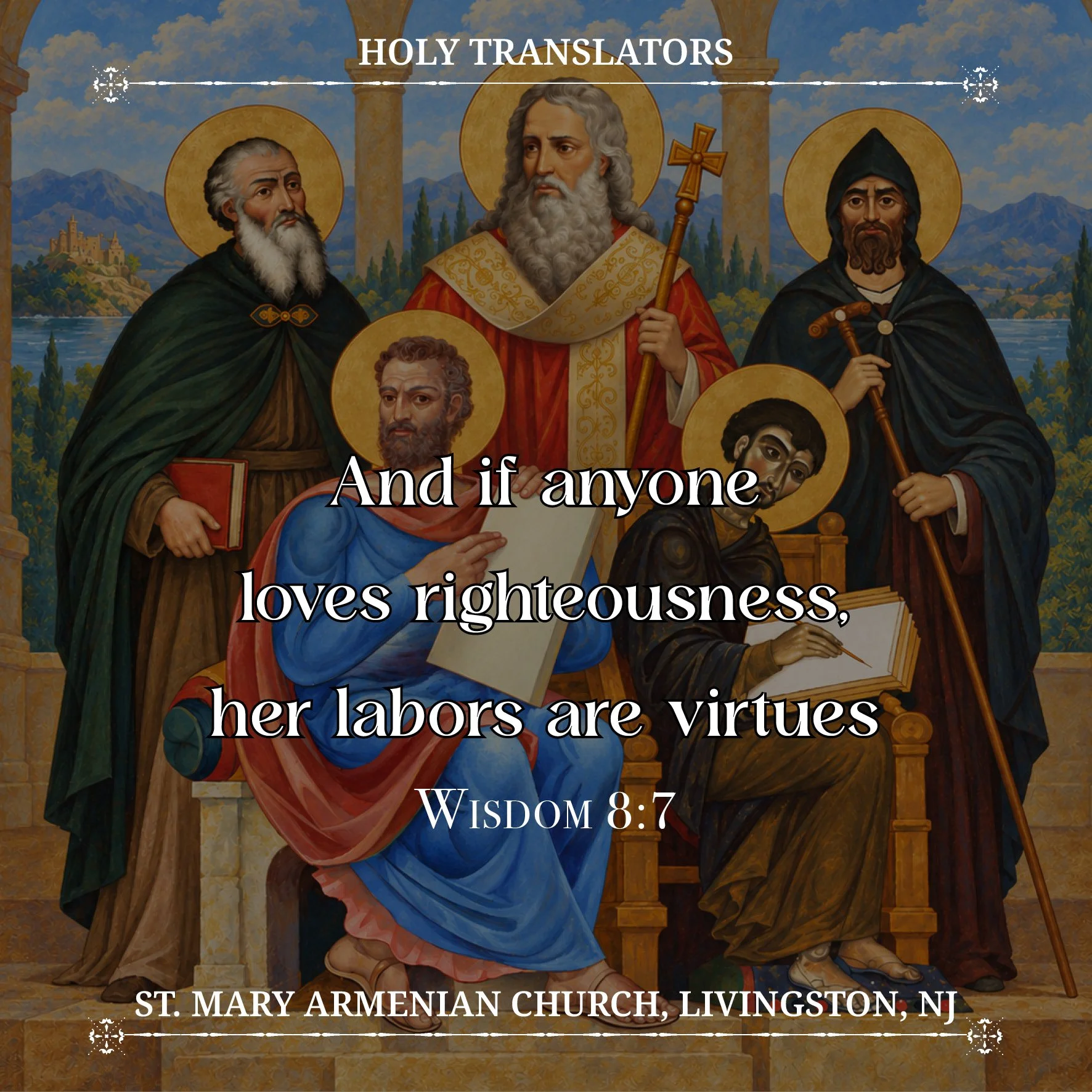
Commemoration Day of
Holy Translators:
Mesrop, Yeghishe,
Moses the Poet,
David the Invincible Philosopher,
Gregory of Narek,
and Nerses of Kla
Saint Mesrop Mashtots
Saint Mesrop Mashtots stands among the greatest figures in Armenian history. Born in the village of Hatsik in Taron around the middle of the fourth century, he received an excellent education and became proficient in Greek, Syriac, and Persian. His abilities earned him a position in the royal chancery of King Khosrov III, where he drafted official documents in the languages then used throughout the region.
Despite a successful public career, Mesrop felt called to a higher vocation. He left royal service, entered the clergy, and embraced an ascetic life devoted to prayer, fasting, study, and missionary work. His preaching in the province of Goghtn brought many pagans and heretics to the Christian faith. Yet his ministry revealed a major obstacle: Armenians lacked an alphabet capable of expressing their language, and Scripture and liturgical texts remained inaccessible to much of the population.
Determined to solve this problem, Mesrop undertook the creation of a national alphabet. Supported by Saint Sahak and King Vramshapuh, he consulted scholars and clergy throughout the region. Around 405–406 AD, his efforts culminated in the invention of the Armenian alphabet, consisting originally of thirty-six letters. This achievement marked the beginning of Armenian literature and became one of the defining moments in the nation's history.
The new alphabet transformed Armenian culture. Schools were founded across the country, and generations of students learned to read and write in their native tongue. Mesrop extended his educational mission beyond Armenia, helping to develop alphabets and educational systems for neighboring peoples, including the Georgians and Caucasian Albanians. Wherever he preached the Gospel, he established schools and appointed teachers to continue the work.
Under his leadership, Armenian scholars traveled to great centers of learning such as Edessa, Constantinople, Antioch, Athens, and Alexandria. They returned with manuscripts that were translated into Armenian. The Bible, liturgical texts, and numerous works of the Church Fathers became available in Armenian, creating a literary heritage of immense value. Some Greek originals have since been lost, making the Armenian translations indispensable witnesses to early Christian thought.
Mesrop's contemporaries remembered him not only for his scholarship but also for his extraordinary character. He was praised for his humility, gentleness, wisdom, perseverance, and unwavering devotion to Christ. His disciple Koryun described him as a man who tirelessly traveled through Armenia, Georgia, and Albania, preaching the Gospel, educating the young, freeing the oppressed, and bringing hope to the suffering.
In his final days, sensing that his earthly mission was ending, Mesrop gathered his disciples, blessed them, and entrusted them to God's care. Witnesses reported a radiant cross-shaped light appearing above his dwelling as he peacefully surrendered his soul to Christ. He died around 440–441 AD and was buried in the village of Oshakan, where his tomb remains a cherished pilgrimage site to this day.
The Armenian Church commemorates Saint Mesrop twice each year: together with Saint Sahak after Pentecost, and again with the Holy Translators in October. He is revered as the creator of the Armenian alphabet, the father of Armenian literature, and one of the greatest spiritual teachers in Armenian history.
St. Yeghishe Vardapet
Yeghishe is the inspired historian and epic chronicler of the Vardanants movement. According to the earliest calendars of saints, Yeghishe was the only saint commemorated together with St. Mesrop; the other companions were added later. “Even the manuscripts of the fourteenth century do not contain the names of David and Moses, which were added at a later time” (Azg., p. 435).
It is believed that he was born at the beginning of the fifth century, so that at the time of the invention of the Armenian alphabet he would have been only about four or five years old. He probably became a member of the circle of disciples of Saints Sahak and Mesrop in his early youth, and by the time his two great teachers died he would have been a mature man of about forty. It is also believed that in his youth he served either as a companion-in-arms or as secretary to Vardan Mamikonian.
“After completing his studies in Armenia, he went to Alexandria in Egypt together with Moses of Khoren and his companions. On this occasion he visited the holy sites of the Lord’s earthly ministry in Palestine, especially Mount Tabor, of which he gives a precise description in his homily on the Transfiguration” (Bishop Norayr Bogharian, Armenian Writers, p. 24).
At the Council of Shahapivan, convened in 444, an “Yeghishe, court priest” is mentioned, while at the council held at Ashtishat in 450 an “Yeghishe, Bishop of the Amatunis” is mentioned. Both are identified with Yeghishe the historian.
It is believed that, just as we saw in the case of the Ghevondians that the priest Mushe was the court priest of the Artsruni princely house, so Yeghishe was the court priest of the Mamikonian princely house. “Together with Armenian princes and soldiers, he also spent some time in Persia, during the years 442–449. Because of his office as court priest, he was acquainted with the wives of a number of princes and nobles” (ibid.).
The two Catholicoi of Manazkert who succeeded St. Hovsep of Hoghots followed a policy loyal to the ruling Persian state and opposed to the Vardanants movement. For this reason they did not encourage the generation of the Translators but, on the contrary, persecuted them. “As one who glorified Vardan and that movement, Yeghishe was among the foremost of those persecuted” (Azg., p. 437), and he devoted himself to asceticism and literary activity.
The places associated with his ascetic life are considered to have been the mountains of Mokk and Rshtunik, south of Lake Van. It was in this region that he died, in holiness and almost forgotten by all.
His tomb was preserved in the Monastery of the Holy Sign of Charahan, in the town called Vostan, at the southeastern corner of Lake Van. It is said that the prince of Mokk, in whose territory Yeghishe had also lived as an ascetic, came and took his head and right hand from the tomb and carried them away. He buried them in the cave in the land of Mokk where Yeghishe had practiced asceticism and built a “splendid church” over that cave. Thus Yeghishe came to have two tombs and two monasteries bearing his name.
As already noted, among the Holy Translators Yeghishe was the first to be granted the honor of being commemorated together with his great teacher, St. Mesrop, “as the glorifier of the Vardanants, as one persecuted, and as an ascetic” (Azg., p. 438).
According to Ormanian, he died in 461, while according to Bishop Bogharian, he died in 464.
At the end of the chapter devoted to Yeghishe in his book Armenian Writers, Bishop Bogharian gives, “in approximate chronological order,” the titles of Yeghishe’s literary works. Those that have generally been published are the following:
The Manifestation of the Lord on Mount Tabor, written in 445.
History of the War of the Vardanants. He wrote it at the request of David the Priest of the Mamikonians, who had been one of the participants in the Council of Artashat. The book consists of seven parts, to which an eighth chapter was added between 454 and 464. The History of the Vardanants, a work of great literary value, is Yeghishe’s masterpiece. It was written in 451.
A Word of Exhortation for Solitaries. Written in an elegant literary style in 455.
Teaching on the Passion, Crucifixion, Burial, and Resurrection of Christ, written in 456.
Commentary on the Books of Joshua and Judges. Written in an allegorical style in 460.
On the Souls of Men, written in 460.
Commentary on the Book of Genesis. This work has not yet been found, but numerous fragments of it have been preserved in Vardapet Vardan’s commentary on the same book.
Questions and Answers Concerning the Book of Genesis.
Yeghishe is mentioned in the Catholic Encyclopedia as a historian (Vol. V, p. 387). His history has been translated into English, Russian, Italian, and French. In the Armenian Synaxaria he is commemorated on February 27. He also has a distinctive hymn dedicated to him.
INTRODUCTION TO St. MOSES THE POET
AND FATHER OF ARMENIAN HISTORY
Before proceeding to the biography, we consider it necessary to make the following observation.
The saint included in the calendar under the name “Moses the Poet” is identified with the renowned fifth-century historian Moses of Khoren, an identification rightly accepted by such modern scholars familiar to the public as M. Ormanian, E. Durian, Patriarch T. Gushakian, and others. However, because the circumstances surrounding the life of Moses of Khoren and the composition of his world-famous work, History of the Armenians, are obscure, uncertain, and disputed, modern critics have variously dated both the author and his history from the sixth to the ninth centuries. It would seem that the identities of more than one Moses, living at different times, have been confused with one another. Moreover, “later interpolations made in his History created difficult philological problems and became the cause of passionate and prolonged scholarly debate” (Armenian Writers, p. 16).
The name of Moses the Poet, or Moses of Khoren, is not mentioned in the Armenian Synaxarion, but appears only in the Liakatar (p. 492). Nor is he mentioned by fifth-century authors. Ghazar Parpetsi, one of the principal historians of the fifth century, considers his own work, written after the histories of Agathangelos and Faustus, to be the “third history,” showing no awareness of the existence of the well-known history attributed to Moses of Khoren.
Yet the author of the history known under the name of Moses of Khoren presents himself as a fifth-century writer and as one of the disciples of Saints Sahak and Mesrop: “For this reason Sahak the Great and Mesrop took us and sent us to Alexandria” (Moses of Khoren, Book III, chapter 61; in the following chapter, 62, he describes his journey).
No fraudulent author or fictitious person could have passed into the ranks of the saints. In recent times, the Latin Church has removed a number of doubtful saints from its calendar.
Archbishop Norayr Bogharian, in his valuable work Armenian Writers, accepts the existence of two men named Moses, one living in the fifth century and the other in the sixth, and appears thereby to have found a solution to this difficult question. We adopt this solution and present brief biographies of both, for we are convinced that each of them—by his life, by the spirit expressed in his literary works, and especially by the valuable religious, theological, and philosophical literature he cultivated—is worthy of inclusion in the calendar of saints.
One of these two men named Moses is known to us by the title “Father of History,” and the other by the title “Father of Poets.” Although the “Father of History” is the better known of the two, we believe that the one commemorated liturgically is the “Father of Poets,” as is also indicated by the calendar, which applies to Moses the epithet “Poet.” Indeed, it is the “Poet” who cultivated religious literature of greater spiritual depth, literature that plays an important role in the sanctification of the individual.
In presenting these two men named Moses, we shall follow, sometimes word for word, the aforementioned work of Archbishop Norayr.
St. Moses of Khoren, Father of Armenian History
He is believed to have been born toward the end of the fourth century, probably around the year 390. According to some, he was born in the village of Khorni or Khoronk in the province of Taron; according to others, in the village of Khoryan in the province of Siunik. From this place-name he is said to have received the epithet “Khorenatsi.”
He received his elementary education under Catholicos Sahak and is therefore considered one of his sixty disciples. He was then sent to Alexandria to pursue higher studies, probably around the year 435.
On his journey, Moses of Khoren first entered Edessa, where he became acquainted with the city’s famous library. From there he traveled through Antioch to Palestine in order to venerate the holy places and undertake a brief period of study. He then went to Egypt, where he studied for several years and became proficient in Greek and philosophy.
Afterward, he set out for Hellas. On the way, however, storms drove their ship to the coast of Italy, where he visited the tombs of St. Paul and St. Peter. After a short stay in Rome, he traveled on to Hellas. He remained for some time in Athens and, at the end of winter, departed for Byzantium and from there returned to his homeland.
Upon returning home, he found that Sahak the Great and Mesrop had died in 440 and that the nation and the Church had fallen into a sorrowful condition.
Moses devoted himself to literary work and produced various translations, probably including some works of Philo:
On Providence
On Rational and Irrational Beings
On the Question of Exodus
He also translated writings of Irenaeus, homilies of Gregory of Nazianzus, and the History of Alexander the Great.
At that time, he was invited to serve as Bishop of Bagrevand in 446. His tenure, however, was brief, because the persecutions instigated by his opponents intensified. Soon afterward, death brought an end to his patriotic life of service.
Moses’ tomb is believed to have been located in the Monastery of the Holy Apostles in Taron, beside those of the other Translators.
The masterpiece of Moses of Khoren is the History of the Armenians, written at the request of the young and studious Prince Sahak Bagratuni, when Moses himself was already elderly and ill, around the year 482.
Because of this work, Moses of Khoren earned the glorious title “Father of Armenian History.” The work reveals not only learning worthy of great respect, but also an exalted patriotic spirit. In his love for his nation, he may serve as an example to all his compatriots.
The historical work The History of the Holy Hripsimian Virgins is also attributed to Moses of Khoren (Bishop Bogharian, Armenian Writers, pp. 14–15).
Some identify Moses of Khoren with the Moses the Philosopher mentioned by Ghazar Parpetsi in his letter to Vahan Mamikonian:
“Blessed Moses the Philosopher, while still truly in the body, was continually a citizen among the heavenly powers [the angels]. The [backward] Armenian monks persecuted him from place to place. His enlightening books, which dispelled ignorance, they ignorantly called fatalistic or heretical. They showed hostility toward him in many other ways as well, and finally, by shameful and deceitful means, removed him from the episcopal throne and, giving him poison to drink, put the saint to death” (Parpetsi, Letter Addressed to Vahan, p. 686).
Moses of Khoren is also mentioned in the Catholic Encyclopedia and the Oxford Dictionary. His history has been translated into numerous languages.
He is not mentioned in our Armenian Synaxaria. He does, however, receive an extensive notice in the Liakatar, where, among other things, it says:
“At that time, in perfect virtue and perfect wisdom, there shone brightly the man of God, St. Moses of Khoren, surnamed the Poet, or Father of Poets—that is, a composer of discourse and chief among those who create discourse. In his literary works he alone comes immediately after his teachers, Sahak and Mesrop… Likewise, he was marvelous in his holy manner of life and spiritual teaching” (p. 493).
Regarding his learning, it says:
“He mastered every kind of knowledge and became well acquainted with every branch of antiquity. He was powerful with the pen and mighty in speech, and in his holy manner of life he shone more brilliantly than many others.”
Of the praise he deserved, Sahak Artsruni, the distinguished Armenian prince of the province of Vaspurakan, speaks briefly but fittingly in his letter, calling him:
“Ambassador and minister of the glory of Christ; one who lived a heavenly life upon earth and became the enlightener of us who were in darkness… You were given to us as a second Sahak and Mesrop after they had departed to God.”
This eulogy may fittingly be applied to both men named Moses.
St. Moses the Father of Poets
There is no precise biographical information concerning Moses the Poet. We tentatively place his birth around the year 470 and his death around 530, both dates being conjectural.
According to the historian Asoghik, he was Bishop of the province of Bagrevand, as Moses of Khoren had also been.
Judging from his writings, Moses was highly proficient in Greek, and especially in the three branches of learning: grammar, rhetoric, and philosophy.
Among the known disciples of Moses the Poet were Theodoros the Poet, Petros the Poet (557), and Ezras of Andzegh, who distinguished himself during the second quarter of the sixth century (529–557) through his teaching of rhetoric and had many pupils.
Moses the Father of Poets, who was widely known as a philosopher and poet, was not only a successful teacher but also carried out important literary work. As translator and author, he left behind a rich literary heritage.
Among the works associated with him are the following:
The Grammar of Dionysius Thrax (second century B.C.), which he translated and adapted to the Armenian language.
A Commentary on the Grammar of Dionysius Thrax.
He was also probably the translator of certain works of Philo the Jew, including:
On the Contemplative Life, or On the Essenes
On the Allegory of the Divine Laws
The Lives of the Wise
On Samson Without Preparation
The Book of Chreia, which he composed as a textbook of rhetoric following the work of a Greek rhetorician named Aphthonius, who lived in the third century A.D.
On the One Nature of the Incarnate Word; On Becoming Perfect Man; and Why One Nature
Hymns dedicated to the Eve of Theophany, to the first through eighth days of the Nativity or Theophany, the Resurrection canons together with their Magnificat hymns in the modes A–D, and hymns for the first day of the Presentation of the Lord and the Assumption.
Some of the hymns of Moses the Poet rank among the finest Armenian sacred poems because of their beautiful and distinctive melodies.
In the Resurrection hymns we also encounter theological formulations that skillfully express and disseminate numerous doctrinal and theological teachings of the Armenian Church (Bishop N. Bogharian, Armenian Writers, pp. 39–41).
St. David the Invincible Philosopher
This distinguished author, too, has often been confused with other men named David—for example, with a certain David of the seventh century who was called “of Hark,” and who “advanced in philosophical and theological learning” (Armenian Writers, p. 86).
There is no mention of him among fifth-century authors. The circumstances of his death are unknown, nor is it certain where he lived. Tradition regards him as the son of the maternal uncle of Moses of Khoren, under whom he is also believed to have studied.
According to Bishop Bogharian, he is thought to have been born toward the end of the sixth century, around 590, and to have died around 660, though both dates are given with question marks. He was born in the village of Nergin in the province of Taron, and for this reason was called Nerginatsi, or Taronatsi.
“David received his philosophical education in Alexandria and was a disciple of the Neoplatonist philosopher David (ca. 550?–620?). Through his extraordinary gifts in rhetoric and philosophy, David Nerginatsi earned the epithet ‘Invincible’” (Armenian Writers, p. 73).
Ormanian writes concerning him: “He received the title ‘Invincible Philosopher,’ or simply the epithet ‘Invincible,’ especially because of his mastery of Greek philosophy” (Azg., p. 440).
Gushakian, in turn, writes: “The great proficiency he had attained in philosophical learning made him unconquerable; this explains his title ‘Invincible’” (Saints and Feasts, p. 219).
David “was one of our greatest translators” and “brought into existence the translation of an entire body of philosophical literature. His language, however, is excessively Hellenizing and loses the natural elegance and flavor of Armenian” (Armenian Writers, p. 73).
From the fact that he came to be commemorated as a saint, Ormanian infers that “he must have been persecuted.” There is, however, no direct record of this.
We may suppose instead that he came to be commemorated as “an eminent author and a pure believer who placed both his person and his pen at the service of the Gospel”—a view also supported by Patriarch Gushakian in his book Saints and Feasts (p. 219).
His tomb was believed to be “beneath the wall of the Monastery of the Holy Apostles at Terinkatar,” together with the other Translators. There is no information indicating that he held any ecclesiastical or administrative office.
Although he is not included in our Armenian Synaxaria, he is fully presented in the Liakatar, where his biography states: “He surpassed all others in Hellenic learning.”
He distinguished himself equally among Armenians and Greeks in both philosophy and theology. He was equally skilled in writing in Armenian and Greek.
He wrote a number of homilies in an elevated style, among which two panegyrics are mentioned: one on the Holy Nativity, and another on the Holy Cross, beginning with the words “Exalt…” The latter is believed to have been written at the request of Catholicos Giwt.
This final panegyric is his best-known and most celebrated work. Nerses Shnorhali later rendered it into metrical form.
Bishop Bogharian lists his translations in the following order:
A. Works translated from his teacher, David the Philosopher, in a moderately Hellenizing style:
Definitions of Philosophy
Analysis of Porphyry’s Introduction
Commentary on Aristotle’s Analytics
B. Works of Aristotle (384–321 B.C.):
Categories
On Interpretation — Peri Hermeneias
Both of these are translated in an extremely Hellenizing style.History of the World
On the Virtues
C. Works of Porphyry (233–304):
Introduction to Aristotle’s Categories
D. Works of Iamblichus (ca. 283–ca. 333):
Commentary on Aristotle’s Categories — incomplete
Commentary on Peri Hermeneias
Both of these were translated in an extremely Hellenizing style.
E. Works of Olympiodorus:
Commentary on Aristotle’s Categories
In addition to these, he also has the following works:
Commentary on the Grammar of Dionysius Thrax
St. Basil’s Homily on the Nativity of the Savior, translated in Damascus by order of Hamazasp Mamikonian the Curopalates (656–659), who, according to Sebeos, was “a lover of reading and learning.”
The Questions of St. Basil, translated by order of Hamazasp Mamikonian the Curopalates.
Panegyric to the Holy and Life-Giving Cross — “Exalt the Lord our God.”
Hymn of Praise to the Holy Catholic Church — “For this reason, having sought in our prayers…” (Armenian Writers, pp. 14–15).
St. Gregory of Narek
The angelic doctor of the Armenian Church and one of the most renowned and beloved saints of the Armenian people was born in the 950s in the district of Andzevatsik in the province of Vaspurakan, in the region of Van, southeast of Lake Van. At that time, the district formed a small kingdom.
Gregory was the younger son of Khosrov Andzevatsi, who, after the death of his wife, became a vardapet of the Church and later bishop of his region. Andzevatsi was one of our important and learned ecclesiastical authors and wrote commentaries on the Divine Liturgy and the daily offices.
Gregory also had two elder brothers, Martiros and Sahak, who likewise studied at the Monastery of Narek and entered ecclesiastical life. The first remained with Gregory at Narek and later became abbot of the monastery. The second assisted their father, especially by copying his numerous literary works.
Thus Gregory’s family offers a unique example in which all the members of the household—the father and his sons—entered the sacred garden of ecclesiastical service.
As a child, Gregory became a disciple of Vardapet Anania of Narek, a close relative of his deceased mother. At the beginning of the tenth century, Anania had become the great spiritual luminary of the Monastery of Narek and the founder of the Narek school.
At about the age of twenty-five, Gregory was ordained a celibate priest. There is no record of his having undertaken any ecclesiastical administrative or preaching office.
He spent his entire life at the Monastery of Narek, in prayer, in a virtuous and ascetic way of life, studying and teaching, and composing literary works, continually growing and advancing in holiness and wisdom. “Gregory was an avid reader and became deeply versed in Holy Scripture as well as in ancient Armenian literature” (Armenian Writers, p. 157).
Gregory of Narek’s universally known masterpiece is his prayer book, or, as he himself calls it, “A Composition of Beneficial Words of Heartfelt Supplication,” written “at the request of many solitary fathers and hermits.”
Ormanian expresses the following view concerning this book of prayers:
“A marvelous prayer book… On the one hand, through its poetic inspiration, it confirms his literary achievement and the sublimity of his devotional feelings; on the other, it reveals the reputation for holiness and spiritual power enjoyed by Gregory, the humble monk of Narek… Among the nation, this book has been accorded an honor almost equal to that of Holy Scripture, and each of its chapters has been attributed a particular miraculous power. Reflecting Gregory’s virtuous life, this prayer book became a major reason for numbering his name among the saints commemorated by the Church” (Azg., p. 1181).
Patriarch Torgom evaluates the person and genius of Gregory of Narek in these words:
“Narekatsi, as a thinker, is one of the universal geniuses, the first mystical thinker among us Armenians, and our greatest poet” (Saints and Feasts, p. 259).
Tender popular traditions grew up around him, confirming the purity of his heart and showing how deeply loved and respected he was by the people.
As generally happens with people of great worth, Gregory too did not remain free from the attacks of the envious and of slanderers. In the end, however, the truth was revealed through marvelous manifestations, raising still higher his reputation for holiness and greatness in the eyes of all.
“And through such miracles, through his truth-loving mind, his austere life, and his theological preaching, he shone like the sun in our land. According to a national tradition, on the island of Arter in Lake Van, opposite the Monastery of Narek, he was granted a vision of the Child God in the arms of the all-blessed Mother of God. A veiled allusion to this event appears in one of the chapters of his prayer book” (Liakatar, p. 496).
He is believed to have died in the year 1003, “and the earthly angel joined the heavenly angels.”
His body was buried at the Monastery of Narek, whose original name was the Monastery of St. Sandukht, and where the tomb of that saint is also believed to have been located.
In 1021, together with King Senekerim Artsruni, a large part of the population of Vaspurakan migrated to the region of Sebastia in Lesser Armenia. Among them were many members of the brotherhood of the Monastery of Narek, who took with them a portion of the saint’s relics.
They settled near the village of Akn, built a monastery, and named it Narek. In later times it became a major place of pilgrimage, and its name, through alteration, came to be known as the Monastery of “Areka” or “Araka.”
According to Archbishop Norayr, the known writings of Gregory of Narek, with their dates, are as follows:
977 – Commentary on the Song of Songs.
Written at the request of King Gurgen of Andzevatsik (968–1003).Panegyric to the Holy Apostles.
Written before the Book of Prayers.Ca. 1000 – History of the Cross of Aparan (Panegyric to the Holy Cross).
Written at the request of Bishop Stepanos of Mokk. Modern Armenian renderings of these, as well as of his other panegyrics and gandz hymns, were published in Constantinople in 1955.1002 – Book of Prayers: Narek.
It consists of 95 chapters divided into 367 sections. It was composed with the assistance of his elder brother Hovhannes, “a monk of the glorious and highly honored holy community of Narek.”Elsewhere Gregory says of him: “He is a learned and brilliant philosopher, superior to me in every respect.”
The Narek is regarded as the summit of Armenian spiritual literature. By international standards, it is a prayer book of the highest order and without equal.
The Narek has had numerous translations into modern Armenian, including those by Kasim, Archbishop Torgom Gushakian, and Archbishop Garegin of Trebizond. Among these, the version published by Archbishop Torgom Gushakian is considered the finest.
It has also been rendered into Eastern Armenian. The best-known of these is the version by Vazgen Gevorgian, published in Yerevan in 1979.
Panegyric to St. James, Patriarch of Nisibis.
Letter Written to the Illustrious and Eminent Community of Kchav.
Concerning the sect of the Tondrakians.Three Gandz Hymns:
A. On the Descent of the Holy Spirit
B. On the Holy Church
C. On the Holy and Life-Giving CrossNearly twenty odes and melodies.
Several of these were composed in the style of popular songs and are works of high poetic value. They were rendered into Eastern Armenian by Arshavir Mkhitaryan and published in 1957 in Armenian Writers (pp. 158–159).
We commemorate St. Gregory of Narek together with the Holy Translating Vardapets on the second Saturday of October.
In the Armenian Synaxaria, he is commemorated on February 27.
St. Nerses the Graceful
St. Nerses the Graceful is one of the most spiritually profound and greatest literary figures of our Church. He came from the noble family known as the New Pahlavunis and considered himself a descendant of St. Gregory the Illuminator.
This noble house, which appears on the stage of Armenian history in the tenth and eleventh centuries, gave seven Catholicoi to our Church, with Catholicos Nerses the Graceful occupying the central place among them.
The first of these Catholicoi, Gregory II the Martyrophile (1065–1105), had the good fortune to witness the dawn of the final period of Armenian statehood, when in 1080 Prince Ruben established a principality on the heights of the Taurus Mountains. The last, Gregory VI Apirat (1119–1203), had the privilege in 1198 of personally anointing, at Sis, the first king of that principality, Leo the Magnificent. Sis thereafter became the capital of the Armenian Kingdom of Cilicia and later the center of the Armenian Catholicosate.
About one hundred years after the repose of Gregory of Narek, Nerses was born in 1102 at the fortress of Tsovk in northeastern Cilicia, the center of his family’s small principality.
His father, Prince Apirat, was killed in battle while Nerses was still a child or a very young boy.
He had three brothers. Two of them, Vasil and Shahan, also called the General, entered secular or military service. His elder brother Gregory, together with Nerses himself, was prepared for ecclesiastical life under the care and spiritual fatherhood of the first two Pahlavuni Catholicoi, Gregory the Martyrophile and his successor, Basil of Ani (1105–1113).
The two brothers received their education at the Red Monastery in the Taurus Mountains under the learned vardapet known as Stepanos Manuk.
After the accidental death of Catholicos Basil, Nerses’ elder brother Gregory became Catholicos while still very young, at only twenty years of age, and went on to have the longest reign of any Armenian Catholicos (1113–1166).
Nerses received all the ranks of his ecclesiastical ministry from his brother the Catholicos: he was ordained deacon and priest at the age of eighteen and bishop at the age of thirty. He became his brother’s strongest assistant and, in many matters, his substitute in the affairs of the Catholicosate.
His first journey outside the ancestral fortress took place in 1141, when he accompanied his brother to Antioch to attend one of the councils of the Latin Church, to which the Catholicos had been officially invited.
From there Catholicos Gregory continued on to Jerusalem, while Nerses returned to Tsovk in order to continue overseeing the general affairs of the patriarchal see.
In 1150, by providential circumstances, the strong fortress of Hromkla came into the possession of their family. It stood on the Cilician Euphrates, not far from Edessa to the east and Aintab to the west.
The name of Nerses became closely associated with this fortress, and for that reason he is also remembered in history as Nerses of Kla.
After moving there, Nerses became gravely ill, but by the mercy of God he recovered. He spent the remainder of his life, nearly a quarter of a century, in this hot and difficult fortress.
Only once did he have occasion to leave this “fortress-prison,” and then for an important mission.
In 1164, two great Armenian princes of Cilicia—Toros Rubenian, son of Leo, and Oshin, lord of the fortress of Lambron—had taken up arms against one another. Nerses went to reconcile them, for their families were related to one another by bonds of kinship, whether near or distant.
His mission was crowned with success: the two princes were reconciled and brought their fratricidal conflict to an end.
On his return journey, in the city of Mamistra, Nerses met Alexius Duke, the son-in-law and representative of the Byzantine emperor. Alexius inquired about the faith of the Armenians and the causes of the division between the two Churches. Nerses explained these matters to him in writing.
From this encounter there began, through correspondence and through envoys sent by the emperor, a series of negotiations for union between the Armenian Catholicosate on the one side and the Byzantine emperor and Greek patriarch on the other.
These negotiations continued throughout the remainder of Nerses’ life. The correspondence connected with them has been preserved both among the Armenians and the Greeks. The Armenian portion was published in the second part of Nerses’ work known as the General Epistles in 1871 at the Armenian press in Jerusalem.
Catholicos Gregory, feeling himself weakened by old age, consecrated Nerses as Catholicos in his place in 1166 and died shortly afterward.
Nerses had seven or eight peaceful years of patriarchal ministry. He died in 1173 and was buried beside his brother in the fortress of Hromkla. His tomb remained a major place of pilgrimage until the First World War.
Nerses the Graceful, however, is known above all for his abundant literary production, which is imbued with a noble religious spirit and a deeply popular sensibility.
As great a theologian as Nerses was, he was equally an accomplished poet. As numerous and substantial as his prose writings are, so too are his poetic works abundant and marvelous.
St. Nerses the Graceful was one of the greatest enrichers of both our Book of Hours and our Hymnal.
He contributed more hymns to the Armenian Hymnal than any other author, numbering more than thirty pieces. Nearly all the hymns in the Armenian Book of Hours, more than fifteen in number, are also attributed to his pen.
Even more famous is the collection of twenty-four prayers beginning with the words “I Confess with Faith.” It was incorporated into our Book of Hours as part of the Vigil service and, through the efforts of the Armenian Fathers of Venice, was translated into thirty-six languages.
Also famous is the prayer book Jesus, Son, which has gone through many editions and has been translated into English, French, and, by us, into Modern Armenian in 1974.
His General Epistle, which was his first patriarchal encyclical, and his other Epistles are inexhaustible treasuries of Armenian doctrine and wise counsel.
Also notable is his Oration, which he delivered before the bishops gathered in council on the occasion of his election as Catholicos.
He also began a commentary on the Gospel of Matthew, but was able to complete only the first five chapters.
In addition to these works, Nerses the Graceful authored many others, always in a religiously inspired style though not necessarily on explicitly religious subjects.
Among these is the Historical Poem, his earliest literary work, which is a poetic history of his own family.
His Lament for Edessa was written in response to the massacre of the Christians of that city by foreigners.
He also composed admonitions arranged according to the letters of the Armenian alphabet, riddles, and other pieces.
Other works include On the Heavens and Their Adornment, various Martyrdom Accounts, panegyrics, and additional writings.
In 1973, the eight-hundredth anniversary of the death of Nerses the Graceful was commemorated. Even the Vatican participated in this landmark celebration by issuing a series of postage stamps bearing his image.
The Armenian Patriarchate of Turkey also published an illustrated commemorative booklet presenting, in condensed form, nearly all the available information concerning his person and achievements.
We conclude this biography with three short passages from our own study of Nerses entitled “The Gentle Soul.”
“Nerses the Graceful bequeathed to us an immense religious, moral, and cultural inheritance. In our view, the most important and sacred part of that inheritance is his grace-filled person itself.
“Yes, persons too can remain as an inheritance for future generations, especially when they have become the embodiment of a noble and desirable ideal.
“Nerses became an unsurpassed example of human nobility, evangelical perfection, and complete self-sacrifice for his people. For these very reasons he has remained forever standing as an indestructible moral monument, both in the pages of our history and literature and in the feelings and gratitude of his people.
“And the Armenian Church and our people feel themselves richer, stronger, and prouder because of this immortal person—in the moral and noble sense of these words.”
“In the history of our Church, apart from St. Gregory the Illuminator, St. Sahak, St. Mesrop, and St. Gregory of Narek, no one has enjoyed as much honor and love from his contemporaries and from later generations as Catholicos Nerses the Graceful, both as a saint and as an author.
“His reputation for grace and holiness had spread even to the Byzantine imperial court. When news of his death reached there, the emperor of the day sighed and said:
‘A great and watchful sense has been taken away from the Church of God. The Armenians have been deprived of their second Illuminator. O blessed vardapet, how could you go to Christ leaving my longing unfulfilled? Yet we shall decree that your name be commemorated together with the foremost saints and celebrated with joy in Christ.’”
“We are grateful to God that, as his biographer affirms, in one of the most troubled periods of our history He gave us Nerses, who played a decisive role in our national life:
‘This blessed Patriarch of latter times, when the winter of sin ruled over our land and the fog of the misery of sword and captivity surrounded us, appeared with radiant teaching and luminous conduct. He scattered the storm of sin from the world and, from the death of winter, caused us once again to become green through spiritual growth and Christ-like maturity.’”
In the Synaxarion of Marzvantsi, Nerses the Graceful is commemorated twice, in nearly the same brief wording of slightly more than one column, on June 13 and August 5. In Peshtimaljian’s work he is commemorated on August 13.
Nerses is also mentioned in the Dictionary of Saints as “the Fénelon of Armenia and one of the foremost writers and poets of the twelfth century, who made serious efforts to bring his Church out of its isolated condition.”
He is also mentioned in the Catholic Encyclopedia.
We commemorate him together with the Holy Translators on the Saturday preceding the fifth Sunday after the Feast of the Holy Cross.
SCRIPTURE READINGS
~ Wisdom of Solomon 8:7-10 ~
And if anyone loves righteousness, her labors are virtues; for she teaches self-control and prudence, justice and courage; nothing in life is more profitable for mortals than these. And if anyone longs for wide experience, she knows the things of old, and infers the things to come; she understands turns of speech and the solutions of riddles; she has foreknowledge of signs and wonders and of the outcome of seasons and times. Therefore I determined to take her to live with me, knowing that she would give me good counsel and encouragement in cares and grief. Because of her I shall have glory among the multitudes and honor in the presence of the elders, though I am young.
~ Amos 5:10-14 ~
They hate the one who reproves in the gate, and they abhor the one who speaks the truth. Therefore because you trample on the poor and take from them levies of grain, you have built houses of hewn stone, but you shall not live in them; you have planted pleasant vineyards, but you shall not drink their wine. For I know how many are your transgressions, and how great are your sins— you who afflict the righteous, who take a bribe, and push aside the needy in the gate. Therefore the prudent will keep silent in such a time; for it is an evil time. Seek good and not evil, that you may live; and so the Lord, the God of hosts, will be with you, just as you have said.
~ 1 Corinthians 12:5-11 ~
And there are varieties of services, but the same Lord; and there are varieties of activities, but it is the same God who activates all of them in everyone. To each is given the manifestation of the Spirit for the common good. To one is given through the Spirit the utterance of wisdom, and to another the utterance of knowledge according to the same Spirit, to another faith by the same Spirit, to another gifts of healing by the one Spirit, to another the working of miracles, to another prophecy, to another the discernment of spirits, to another various kinds of tongues, to another the interpretation of tongues. All these are activated by one and the same Spirit, who allots to each one individually just as the Spirit chooses.
~ Holy Gospel of St. Matthew 7:6-12 ~
"Do not give what is holy to dogs; and do not throw your pearls before swine, or they will trample them under foot and turn and maul you.”
"Ask, and it will be given you; search, and you will find; knock, and the door will be opened for you. For everyone who asks receives, and everyone who searches finds, and for everyone who knocks, the door will be opened. Is there anyone among you who, if your child asks for bread, will give a stone? Or if the child asks for a fish, will give a snake? If you then, who are evil, know how to give good gifts to your children, how much more will your Father in heaven give good things to those who ask him!”
"In everything do to others as you would have them do to you; for this is the law and the prophets.”