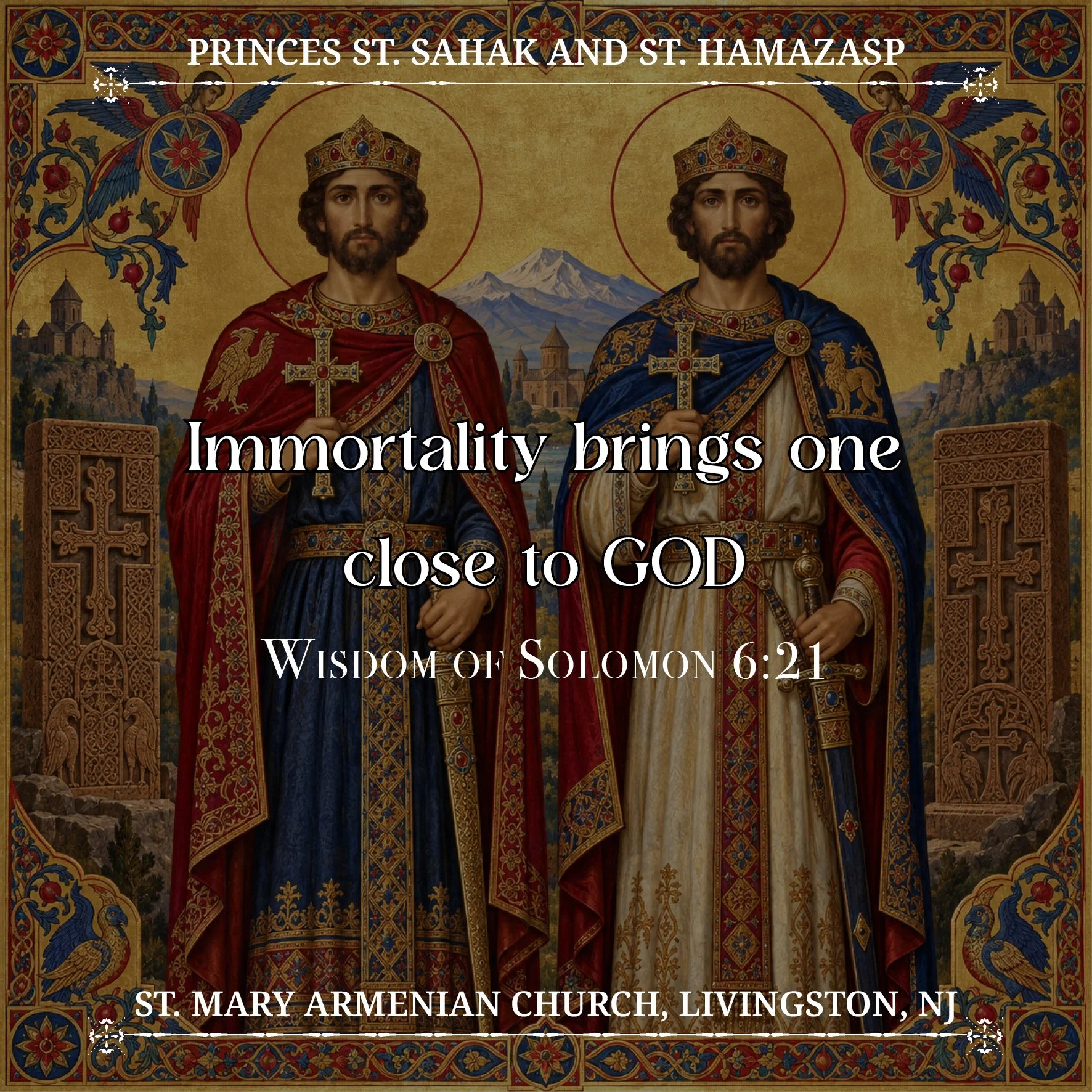
Commemoration Day of Princes
Saints Sahak and Hamazasp
Princes ST. Sahak and ST. Hamazasp
Sahak and Hamazasp were two brothers from the princely house of the Artsrunis, who lived and were martyred during the last quarter of the eighth century, when Armenia was under Arab rule.
Of the two, Hamazasp was the elder and may be said to have held one of the highest positions among the princes of his time. They also had a younger adult brother named Meruzhan. Together, the three governed the House of Artsruni, or the region of Vaspurakan, as hereditary lords. All three were not only brave and renowned warriors, but also devout princes who were deeply devoted to their faith.
In the year 785, the Caliph of the time appointed a man named Khazm as governor of Armenia. He was known for his harsh and cruel character.
As was customary, the Armenian princes paid a “welcome” visit to the newly appointed governor. The three Artsruni nobles also appeared before him, after entrusting the defense of the fortress of Van to David Mamikonian. The Arab governor arrested and imprisoned them on the accusation that, ten years earlier, they had played an important role in an uprising organized against the Arabs. He informed the Caliph of the matter and awaited instructions.
After three months of severe and painful imprisonment, an order arrived from the Caliph concerning their fate. Although the administrative center of the Arab governors at that time was the city of Dvin, the Synaxaria state that the governor had the three princes taken with him to the Armenian city of Partav.
Before carrying out the Caliph’s orders, the governor offered the three brothers a way to save their lives and return honorably to their homeland: they were to renounce Christianity and embrace Islam. Otherwise, they would be subjected to severe punishment and ultimately put to death.
Meruzhan, remembering the hardships of the three months in prison and seeing the instruments of torture and the executioners, understood what awaited him. He became afraid, accepted Islam, and was indeed sent back to Van with great honor and authority. David Mamikonian, however, having learned what had happened, went out to meet him and, before Meruzhan could enter the city, killed him as an apostate. Thus, the unfortunate man was deprived, as the account says, of both earthly and heavenly life.
The other two brothers remained faithful to their religion. Governor Khaz tried to break their resolve with persuasive words and promises. When these proved useless, he subjected them to unspeakable tortures. Yet the two princes, noble in both spirit and body, courageously endured everything until a sentence of death was pronounced upon them.
First, they prayed together. Then the elder brother, Hamazasp, wished to grant the younger brother the honor of being the first to suffer martyrdom, saying:
“Until now, I have been the elder. But now, in martyrdom, I give you the honor of going first. Do not be afraid. Go forward and receive the crown of martyrdom before me, and let the name of the Lord first be glorified through your sacrifice.”
Sahak gladly accepted this honor. Courageously he stepped forward, made the sign of the Cross, entrusted himself to God, and bowed his neck. The executioner’s sword mercilessly descended upon the virtuous prince.
Then Hamazasp raised his arms toward heaven and prayed:
“I thank You, Almighty God, that You have made us worthy to die for Your name and Your glory.”
The executioner’s sword then descended upon his neck as well.
The governor first ordered their bodies to be hung upon wooden structures. He then commanded that they be burned and reduced to ashes so that Christians would not gather their bones and preserve them as objects of veneration. Even their ashes were scattered to the four corners of the earth.
They were probably numbered among the saints whose feast was to be celebrated almost immediately after their deaths. In honoring Hamazasp’s wish, the liturgical calendar indeed gives precedence to Sahak when commemorating them.
Although the Synaxaria place their martyrdom on April 8, we commemorate them on the Thursday following the Feast of the Holy Cross of Varag. According to contemporary historians, however, they were martyred during the octave of the Nativity in the year 785.
SCRIPTURE READINGS
~ Wisdom of Solomon 6:11–21 ~
Keep holy things in holiness, and you will be made holy; those who learn these teachings will find defense and protection. Therefore, desire my words and long for them, and you will be instructed. Wisdom is radiant and unfading; she is easily recognized by those who love her and found by those who seek her. She hastens to make herself known to those who desire her. Whoever rises early to seek her will not labor in vain, for they will find her sitting right at their door. To fix one's thoughts on wisdom is perfection of understanding, and whoever keeps vigil for her sake will soon be free from care. For wisdom goes about searching for those who are worthy of her; she graciously appears to them along their paths and meets them in every thought. The true beginning of wisdom is the sincere desire for instruction. Desire for instruction leads to love for her; love for her means keeping her laws; adherence to her laws brings assurance of immortality. Immortality brings one close to God, and so the desire for wisdom leads to a kingdom.
~ Jeremiah 17:7–8 ~
Blessed is the person who trusts in the Lord, whose hope and confidence is in the Lord. They will be like a tree planted by flowing waters that sends out its roots toward the stream. It does not fear when heat comes, for its leaves remain green and abundant. It has no worry in a year of drought and never ceases to yield fruit.
~ Romans 8:18–26 ~
I consider that the sufferings of this present time are not worth comparing with the glory about to be revealed to us. For the creation waits with eager longing for the revealing of the children of God. For the creation was subjected to futility, not of its own will, but because of the One who subjected it, in hope that the creation itself will be set free from its bondage to decay and obtain the meed of freedom in the glory of the children of God. We know that the whole creation has been groaning in labor pains together until now; and not only the creation, but we ourselves, who have the first fruits of the Spirit, groan inwardly as we wait for adoption, the redemption of our bodies. For in hope we were saved. Now hope that is seen is not hope, for who hopes for what they already see? But if we hope for what we do not see, we wait for it with patience. Likewise, the Spirit comes to help us in our weakness; for we do not know how to pray as we ought, but the Spirit intercedes for us with sighs too deep for words.
~ Holy Gospel of St. John 16:1–4 ~
"I have said all these things to you to keep you from falling away. They will put you out of the synagogues; indeed, an hour is coming when those who kill you will think that by doing so they are offering worship to God. And they will do these things because they have not known the Father, nor me. But I have said these things to you so that when their hour comes, you may remember that I told you about them. I did not say these things to you from the beginning, because I was with you."