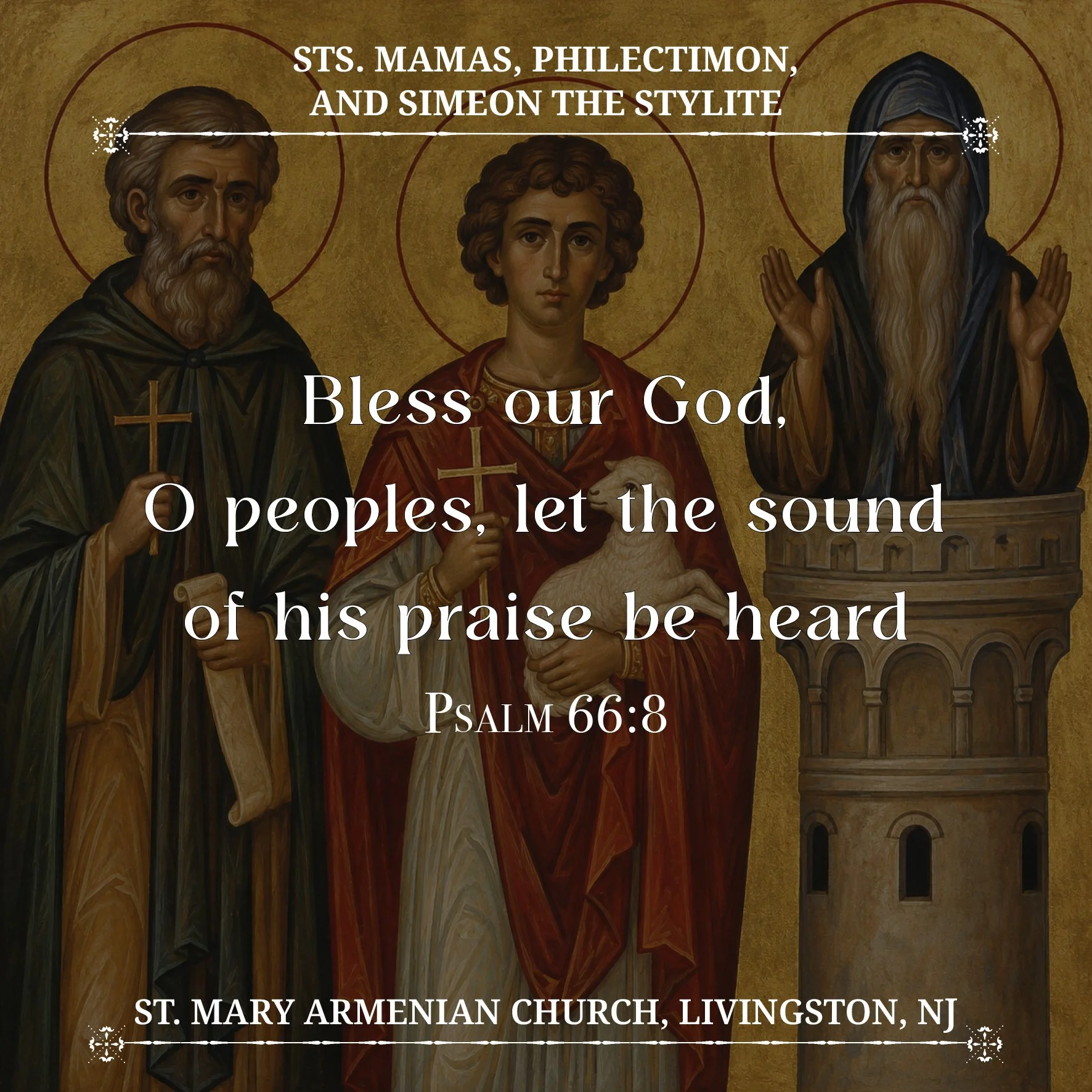
Commemoration DAY of
St. Mamas, St. Philectimon,
and St. Simeon the Stylite
St. Mamas
The parents of Mamas were from the town of Gangra (present-day Çankırı) in the province of Paphlagonia. They were poor and of humble standing, but they were devout Christians. Because of their faith, they were arrested, taken to Caesarea, and imprisoned.
His father died in prison, while his mother gave birth to Mamas there. A short time later, she too fell asleep in the Lord.
A Christian woman adopted Mamas, raised him, and provided for his education. By the age of fifteen, he was already a Christian of firm conviction who openly preached his faith. Because of this, he was arrested and subjected to torture. After escaping these sufferings, he took refuge on Mount Argaeus, where for some time he lived a virtuous and ascetic life.
In addition to his gift for preaching, Mamas possessed a gentle and pleasing voice that brought peace to the souls of those who heard him. He therefore naturally became the leader of other Christians who had sought refuge on the mountain.
Even harmless animals gathered around him, not only because the area was rich in water, but also because he protected them from wild beasts and hunters. Deer kept their young near his dwelling. He milked them, made cheese from their milk, and distributed it to the poor.
Mamas was eventually betrayed to the authorities once again and subjected to torture. Finally, the servant of God Mamas was pierced with a three-pronged iron instrument and was martyred in A.D. 273, during the reign of Emperor Aurelian.
The Armenian Church commemorates St. Mamas on the second Monday following the Feast of the Holy Cross.
St. Philectimon
In Greek and Latin martyrologies, Philectimon appears under the name Philomenos. He lived during the reign of Emperor Aurelian (270–275).
A merchant engaged in the grain trade, he was arrested while traveling to Ancyra (present-day Ankara). He was subjected to severe tortures and was eventually martyred in A.D. 274, his feet being nailed together and his hands fastened to his head.
The Armenian Church commemorates St. Philectimon on the second Monday following the Feast of the Holy Cross.
St. Simeon the Stylite
The ascetic life was carried to its most extreme form by the Stylites, or pillar-dwellers. History records many such ascetics, but the first and most renowned among them was Simeon the Syrian. Although he lived in the world, Simeon desired to sever his contact with it and conceived the idea of spending years living atop a pillar.
Simeon is believed to have been born around A.D. 390 in Cilicia. As a boy, he worked as a shepherd.
One day, while attending church, he was unable to understand the Gospel passage that had been read. He asked an elderly man beside him:
“What is today’s Gospel passage about?”
“Asceticism,” the old man replied.
“What is asceticism?” Simeon asked.
“Asceticism is the salvation of the soul, which leads to the Kingdom of Heaven.”
“How does a person become an ascetic?”
“Through fasting, prayer, fear and reverence of God, regularly attending the services of the Church without absence, and faithfully fulfilling all one’s duties. But all these things are practiced especially in monasteries,” the old man continued, “where people from time to time subject themselves to hunger and thirst, cold and heat, deprivation and self-discipline, repentance and sleeplessness. Above all, they train themselves in humility, obedience, freedom from attachment to possessions, and contentment with little—that is, being satisfied with the minimum necessary in food, drink, clothing, and shelter.”
After hearing this, Simeon entered a monastery in northwestern Syria, in the region of present-day Hatay, and became a monk, subjecting himself to the strictest forms of ascetic discipline.
Later, withdrawing to a deserted place, he built himself a miserable little cell. Following the principle that when the body is weakened the spirit becomes stronger, he spent three years practicing extraordinary austerities.
God granted him the gifts of preaching and healing. Thousands of people began coming to him, and he preached to them and healed the sick.
Seeing that the crowds were overwhelming him and that he was still too closely involved with the world, Simeon sought a way to distance himself, at least partially, from those who came to see him.
At first, therefore, he constructed an elevated enclosure with a small opening through which only his head could be seen. From there he preached, and there he lived. Gradually, this elevated structure was transformed until it eventually became a pillar sixty cubits high. At its summit he arranged a small circular space protected on all four sides.
There he spent his life either standing or kneeling, since there was not enough room to sit or lie down. There was no roof above his head, and consequently he was constantly exposed to heat and cold, wind and storms, and all the severity of the elements. A permanent ladder was kept against the pillar for ascending and descending. His customary nourishment was Holy Communion, which he received once a week.
As already noted, from the top of this pillar he preached to the people gathered below and prayed for the sick.
He strictly instructed those who were healed:
“If anyone asks you who healed you, say, ‘God,’ because that is the truth, for healing comes from God alone. Do not say, ‘Simeon healed me,’ for then you would be speaking falsely, and your illness might return to you.”
Through his simple words and holy manner of life, he brought thousands of sinners to repentance.
When Simeon was still young, he had left home for the monastery without informing his mother. As his fame spread throughout the world, his mother heard reports of the new wonder-worker and began to suspect that he was her long-lost son.
Twenty-seven years later, she joined a group of pilgrims and came to see her son Simeon. When he was told, “Your mother has come and wishes to see you,” he sent her this message:
“May my mother forgive me and not seek to see me. Let her strive instead to become worthy of eternal life, where we shall see one another.”
Many accounts are told of his miracles and his angelic way of life.
Standing upon his pillar, he once addressed the enormous crowd gathered below:
“God has placed me upon this pillar as a watchman so that I may preach repentance to you throughout your lives. Yet you do not listen to my words. You remain bound to your greed, your pleasures, and your lawlessness. Therefore, it is better for me to speak with God than with an unbelieving people such as you. You seek God whenever danger threatens you, but otherwise you forget Him. For this reason, your prayers are not heard by God, nor are the prayers that others offer on your behalf.”
When Simeon died, his body was carried with great solemnity to Antioch. There, a magnificent church was built in his name, which later became a renowned pilgrimage site associated with many miracles.
The place where he had practiced his ascetic life likewise became a pilgrimage site, and a church was eventually built there as well.
Simeon is believed to have died around A.D. 460 at approximately seventy years of age. According to tradition, he spent forty-seven years living as a Stylite.
The Armenian Church commemorates St. Simeon the Stylite, together with St. Mamas and St. Philectimon, on the second Monday following the Feast of the Holy Cross.
SCRIPTURE READINGS
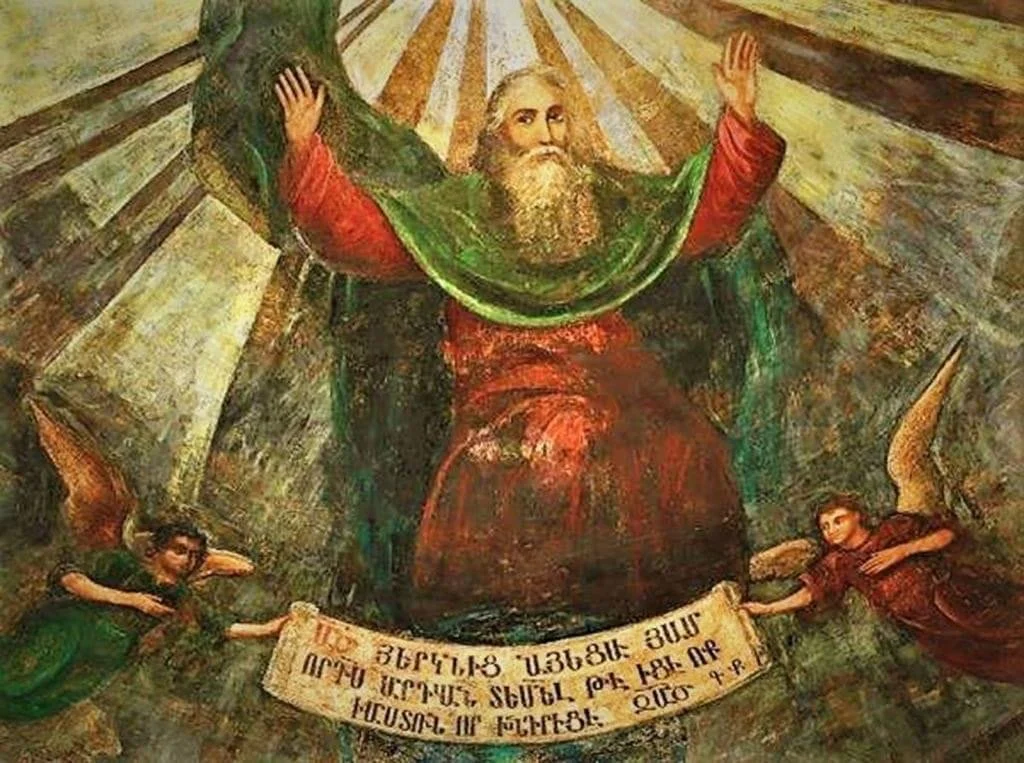
~ Proverbs 8:9-11 ~
They are all straight to one who understands and right to those who find knowledge. Take my instruction instead of silver, and knowledge rather than choice gold; for wisdom is better than jewels, and all that you may desire cannot compare with her.
~ Isaiah 55:10-13 ~
For as the rain and the snow come down from heaven, and do not return there until they have watered the earth, making it bring forth and sprout, giving seed to the sower and bread to the eater, so shall my word be that goes out from my mouth; it shall not return to me empty, but it shall accomplish that which I purpose, and succeed in the thing for which I sent it. For you shall go out in joy, and be led back in peace; the mountains and the hills before you shall burst into song, and all the trees of the field shall clap their hands. Instead of the thorn shall come up the cypress; instead of the brier shall come up the myrtle; and it shall be to the Lord for a memorial, for an everlasting sign that shall not be cut off.
~ 2 Corinthians 5:1-5 ~
For we know that if the earthly tent we live in is destroyed, we have a building from God, a house not made with hands, eternal in the heavens. For in this tent we groan, longing to be clothed with our heavenly dwelling— if indeed, when we have taken it off we will not be found naked. For while we are still in this tent, we groan under our burden, because we wish not to be unclothed but to be further clothed, so that what is mortal may be swallowed up by life. He who has prepared us for this very thing is God, who has given us the Spirit as a guarantee.
~ Holy Gospel of St. Luke 21:12-19 ~
"But before all this occurs, they will arrest you and persecute you; they will hand you over to synagogues and prisons, and you will be brought before kings and governors because of my name. This will give you an opportunity to testify. So make up your minds not to prepare your defense in advance; for I will give you words and a wisdom that none of your opponents will be able to withstand or contradict. You will be betrayed even by parents and brothers, by relatives and friends; and they will put some of you to death. You will be hated by all because of my name. But not a hair of your head will perish. By your endurance you will gain your souls.