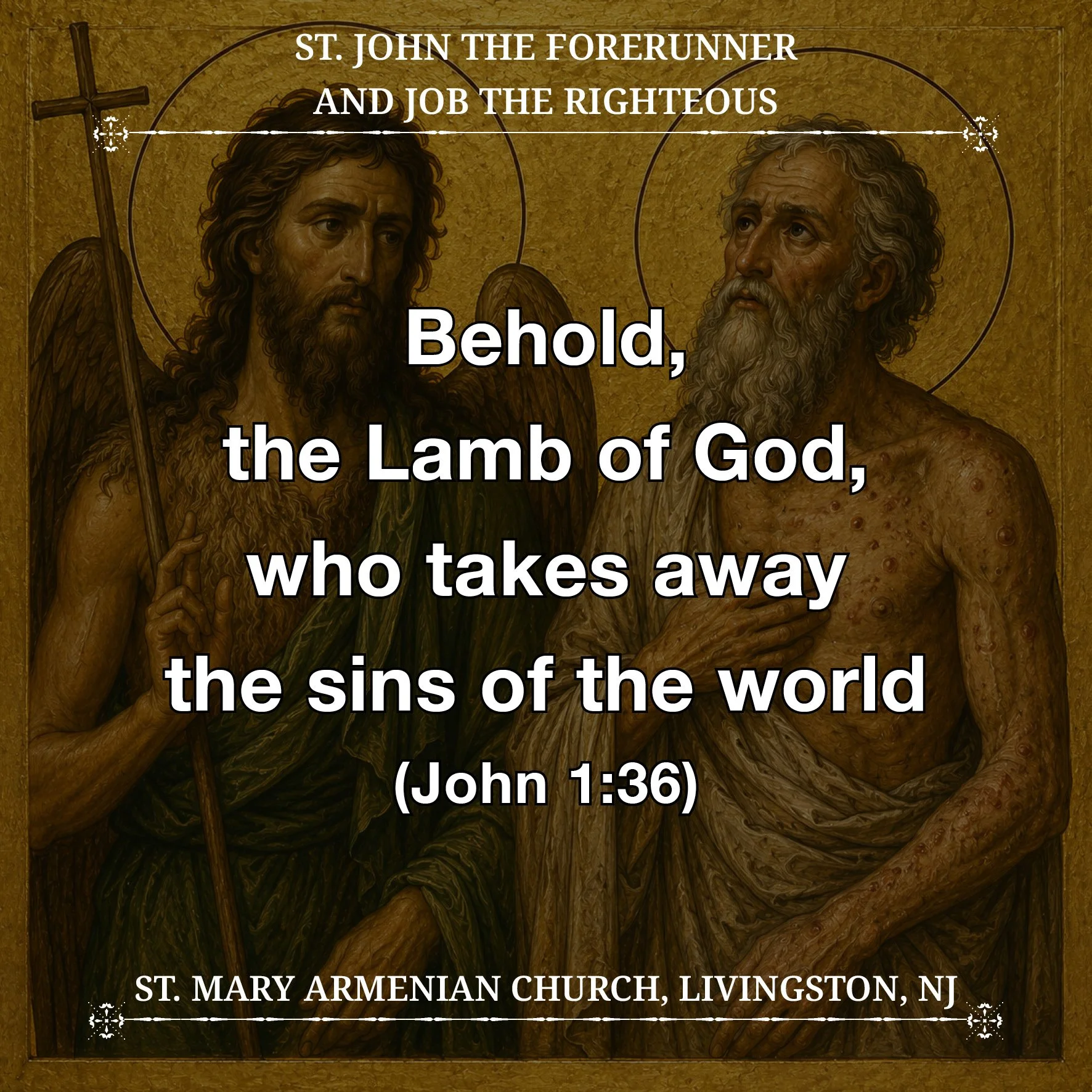
Commemoration DAY of
St. John the Forerunner
and Righteous Job
St. John the Forerunner
In the Gospels, after Jesus Christ, John is the next greatest figure and the principal character in the opening chapters of the New Testament. John was the one who formally inaugurated the “Kingdom of God,” that is, the Christian era.
As is well known, he was a child of promise, and his birth took place under miraculous circumstances. His future role is described in detail in the angel’s announcement to his father:
“For he will be great before the Lord; he shall drink neither wine nor strong drink, and he shall be filled with the Holy Spirit even from his mother’s womb. He shall turn many of the children of Israel to the Lord their God. He shall go before Him in the spirit and power of Elijah, to turn the hearts of the fathers to their children and the disobedient to the wisdom of the righteous, to prepare a people ready for the Lord” (Luke 1:15–17).
John’s childhood and youth were spent far from people, in solitude, under the protection of God’s presence and grace.
He appeared as a preacher at the age of thirty, “in the fifteenth year of the reign of Tiberius Caesar” (Luke 3:1). The place of his preaching was the Jordan Valley. In the Gospels, John is identified with the “voice of one crying in the wilderness” foretold by the Prophet Isaiah:
“The voice of one crying in the wilderness: Prepare the way of the Lord; make His paths straight. Every valley shall be filled, and every mountain and hill shall be brought low; the crooked ways shall become straight, and the rough ways smooth” (Luke 3:4–5).
John’s preaching was as simple and austere as his clothing and food, and as his spirit and way of life. It can be summed up in two words: repentance and righteousness.
“Repent, for the Kingdom of Heaven is at hand.… From now on, bear fruits worthy of repentance.… Behold, the axe is laid at the root of the trees. Every tree that does not bear good fruit is cut down and thrown into the fire” (Luke 3:8–9; Matt. 3:2).
And he adds:
“Whoever has two garments, let him give one to the person who has none; and whoever has food, let him do likewise” (Luke 3:11–14).
Seeing John’s powerful and fearless preaching and the great authority he possessed, some asked whether he might be the Messiah. John said no:
“I baptize you with water for repentance, but He who comes after me is mightier than I, and I am not worthy to remove His sandals. He will baptize you with the Holy Spirit and with fire” (Matt. 3:11).
The central point of John’s ministry was the baptism of Jesus and his proclamation of Him as the promised Messiah. When he saw Jesus coming for baptism, mingling with the crowd like everyone else, he recognized Him through his prophetic spirit and tried to prevent Him, saying:
“I need to be baptized by You, and are You coming to me?” (Matt. 3:14).
After Jesus insisted, John consented and baptized Him, proclaiming:
“Behold, the Lamb of God, who takes away the sins of the world” (John 1:36).
He thereby declared that Christ would sacrifice Himself on behalf of humanity and make atonement for their sins. John continued:
“This is He of whom I said, ‘After me comes One.…’ I saw the Spirit descending from heaven like a dove, and it remained upon Him. I did not know Him, but He who sent me to baptize with water said to me: ‘He upon whom you see the Spirit descend and remain is the One who baptizes with the Holy Spirit.’ And I have seen and testified that this is the Son of God” (John 1:30–34).
After baptizing Jesus and proclaiming Him as the promised Messiah, John’s mission was essentially complete. Indeed, after these events, King Herod first imprisoned John because John had rebuked him for taking his brother’s wife. A short time later, under the well-known tragic circumstances, Herod had John beheaded.
Christ held John in the highest regard. On one occasion He described him as “more than a prophet,” and identified him with the messenger of God foretold in the final verses of the Book of Malachi. He added:
“Truly I say to you, among those born of women there has not arisen anyone greater than John the Baptist; yet the least in the Kingdom of Heaven is greater than he.… For all the prophets and the Law prophesied until John. And if you are willing to accept it, he is Elijah who was to come” (Matt. 11:11–14).
John had disciples, as did all the great rabbis and preachers of that time.
John is also mentioned by the contemporary Jewish historian Josephus, who testifies that he was put to death by Herod.
In our Church, John is the greatest saint after the Mother of God. He is closely connected with our Church and with Armenian history. During the period of Armenia’s complete conversion to Christianity, when St. Gregory the Illuminator returned after being ordained in Caesarea, he brought with him relics of John the Baptist. These were placed near the city of Mush, at one of the earliest known places of worship established on Armenian soil. Later, the monastery of St. Karapet was built there, becoming one of the most celebrated pilgrimage sites of the Armenian Church.
The Armenian Church has established four annual feasts in his honor. The first commemorates his birth, eight days after the Feast of the Nativity. The second commemorates his beheading, on the Saturday following Holy Easter. The third is celebrated on the Thursday of the Feast of the Holy Cathedral, together with Bishop Athenogenes, whose relics St. Gregory the Illuminator brought from Sebastia together with those of the Baptist. The fourth is celebrated on the Thursday of the third week following the Feast of the Assumption, together with Job.
Many hymns and sacred odes have been composed in John’s honor. Among the most prominent are the hymns for the Blessing of the Waters, in which John the Baptist is the central figure.
Job
Job, unlike those commemorated before and after him, was not a prophet in the usual sense. Nevertheless, he has been regarded as such by both the Greeks and Latins, and even by Muslims. We therefore place him as a central link between the active and writing prophets.
Job is the central figure of the book that bears his name, a book that has always been highly praised by great thinkers. Luther called it “the most excellent book in the whole Bible.” Dennis regarded it as “the greatest poem of ancient and modern times.” Carlyle declared:
“It is a noble book, a book for all humanity.… I think there is no book, within the Bible or outside it, that equals it in literary value.”
Yet, in contrast to all this praise, although the story of Job is widely known, this magnificent book itself remains relatively unfamiliar.
The Islamic form of Job’s name, Ayyub, is closer to the original form. The form used in Armenian and European languages came through Greek rather than directly from Hebrew and, in the process of transliteration, became less similar to the original name.
The familiar story of Job is presented in the first two chapters of the book bearing his name and in the prose conclusion of the final chapter. The approximately forty chapters in between are a poetic and vividly expressive outpouring from the suffering heart of a righteous man. Job’s three friends join the discussion with their stinging accusations, while God responds with His own declarations.
From beginning to end, the book is a searching and sometimes revealing exploration of the fundamental questions of life and religion. Even there, however, these questions do not receive a complete solution and seem almost destined to remain eternal mysteries. Alongside the notes of pessimism and bitterness sounds the lyre proclaiming the greatness and glory of God. The author of the book finds the secret of life in the wisdom of submitting oneself to the will of God, much as the author of Ecclesiastes had done.
The Book of Job is the story of a man who undergoes terrible trials during his lifetime but ultimately emerges from them victorious and successful.
The curtain rises upon the scene of a happy family. The father of the family, Job, was not a Jew but, like the righteous men who lived before Abraham, was simply a member of the human race. According to a note given at the end of the Book of Job in our Bible, he was an Edomite, belonging to a people related to and neighboring the Jews who lived among the mountain ranges extending south of the Dead Sea.
Job is described as “a perfect and God-fearing man, far removed from every kind of sin and evil.” He has seven sons and three daughters—a complete family. He is exceedingly wealthy, possessing seven thousand sheep and goats, three thousand camels, five hundred yoke of oxen, five hundred female donkeys, and a great number of servants.
His wealth had not corrupted his character, as wealth so often does. He was generous and charitable. “Thus this man was the greatest among the nobles of the East.”
Job’s children continually held feasts together. Job, meanwhile, was meticulous in prayer and ritual purification, offering atonement for any possible transgressions committed by his children. This forms the prologue of the book (1:1–5).
The drama itself begins when the scene suddenly shifts to heaven.
One day the “angels of God”—or, according to the Hebrew text, the “sons of God”—come before the Lord. Satan is also among them, and God begins a conversation with Satan:
“Where have you come from?” God asks.
“From roaming throughout the earth,” Satan replies.
“Have you considered My servant Job? There is no one like him on earth. He is blameless, upright, and God-fearing, far removed from every kind of evil and sin.”
“Does Job worship his God for nothing?” Satan replies. “You protect him on every side. You have blessed the work of his hands and multiplied his wealth. But stretch out Your hand for a moment and strike everything he possesses, and see whether he will not curse You.”
“Very well,” God says. “I place everything he possesses at your disposal, but do not touch his person.”
Satan, like one who has found his prey, rushes down from the presence of God and mercilessly destroys Job’s possessions one after another and kills his children.
In the face of all this devastation, Job rises. As a sign of terrible grief and mourning, he tears his garments, cuts the hair from his head, falls to the ground, worships God, and says only:
“Naked I came from my mother’s womb,
And naked shall I return.
The Lord gave, and the Lord has taken away;
Blessed be the name of the Lord.”
And the book adds:
“In all this Job did not sin against the Lord or attribute anything foolish to God.”
Once again the scene shifts to heaven. The same setting appears, and the same initial conversation takes place between God and Satan. Finally God adds:
“Although you incited Me against him without cause, so that I destroyed everything he possessed, you have seen that Job has maintained his integrity.”
“Skin for skin,” Satan replies. “A man will give everything he possesses to preserve his life. But stretch out Your hand once and touch his bones and his flesh, and see whether he will not curse You.”
“Very well,” God says. “I place him in your hands, but you shall not touch his life.”
Satan therefore afflicts Job’s body from the soles of his feet to the crown of his head with festering sores. Job sits upon an ash heap and takes a piece of broken pottery with which to scrape away the pus.
No one even wishes to look upon his face—not even his wife, who had distanced herself from him. One day she comes to him only to say:
“How long will you continue to endure like this, hoping for deliverance? Curse God and die, and be free of this.”
“You speak like a foolish woman,” Job replies. “If we have received good things from the hand of the Lord, why should we not also endure evil?”
When Job’s three distinguished friends heard of the trials that had befallen him, they came to comfort him. When they saw him, they could not recognize him and raised their voices and wept.
Job’s condition was so hopeless that they could find no words of consolation. They sat beside him for “seven days and seven nights” and remained silent.
At last Job broke the silence and said:
“May the day of my birth perish,
And the night when it was said, ‘A boy is born.’
May that day be covered with darkness
And not be counted among the days;
May no light shine upon it…”
From this point onward, page after page unfolds the dramatic dialogue between Job and his three friends, until God Himself intervenes. He rebukes Job’s three friends, who had insisted that Job must have committed some grave sin and that the calamities that befell him were therefore punishment for it.
In the end, Job emerges from the trial vindicated, and God rewards him with blessings even greater than those he had possessed before.
“After his affliction, Job lived 170 years. The total number of Job’s years was 248. Job saw his grandchildren and their children. He died at an advanced age, having completed the fullness of his days. And in the future he shall rise again with those whom the Lord shall raise.”
Thus ended happily the life of a man who became the embodiment of patience. Without patience, no one can live a victorious life on earth and inherit eternity, as our Lord Himself affirmed: only “he who endures to the end” shall be worthy to inherit eternal life.
Job’s life teaches us two truths about life. First, behind the evils of the world there is always hidden the influence of the evil spirit—the hand of Satan. Second, the hardships and sufferings that Satan incites in order to make a person miserable ultimately contribute to that person’s perfection and increase his glory and blessedness—like gold in the refining furnace, or like coal which, it is said, under tremendous geological pressure is eventually transformed into beautiful white marble.
In the Armenian Church, the commemoration of Job is celebrated together with John the Baptist on the Thursday of the third week following the Feast of the Assumption.
SCRIPTURE READINGS
~ Proverbs 20:6-22 ~
Many proclaim themselves loyal, but who can find one worthy of trust? The righteous walk in integrity— happy are the children who follow them! A king who sits on the throne of judgment winnows all evil with his eyes. Who can say, "I have made my heart clean; I am pure from my sin"? Diverse weights and diverse measures are both alike an abomination to the Lord. Even children make themselves known by their acts, by whether what they do is pure and right. The hearing ear and the seeing eye— the Lord has made them both. Do not love sleep, or else you will come to poverty; open your eyes, and you will have plenty of bread. "Bad, bad," says the buyer, then goes away and boasts. There is gold, and abundance of costly stones; but the lips informed by knowledge are a precious jewel. Take the garment of one who has given surety for a stranger; seize the pledge given as surety for foreigners. Bread gained by deceit is sweet, but afterward the mouth will be full of gravel. Plans are established by taking advice; wage war by following wise guidance. A gossip reveals secrets; therefore do not associate with a babbler. If you curse father or mother, your lamp will go out in utter darkness. An estate quickly acquired in the beginning will not be blessed in the end. Do not say, "I will repay evil"; wait for the Lord, and he will help you.
~ Job 42:12-17 ~
The Lord blessed the latter days of Job more than his beginning; and he had fourteen thousand sheep, six thousand camels, a thousand yoke of oxen, and a thousand donkeys. He also had seven sons and three daughters. He named the first Jemimah, the second Keziah, and the third Keren-happuch. In all the land there were no women so beautiful as Job's daughters; and their father gave them an inheritance along with their brothers. After this Job lived one hundred and forty years, and saw his children, and his children's children, four generations. And Job died, old and full of days.
~ Lamentations 3:22-56 ~
The steadfast love of the Lord never ceases, his mercies never come to an end; they are new every morning; great is your faithfulness. "The Lord is my portion," says my soul, "therefore I will hope in him." The Lord is good to those who wait for him, to the soul that seeks him. It is good that one should wait quietly for the salvation of the Lord. It is good for one to bear the yoke in youth, to sit alone in silence when the Lord has imposed it, to put one's mouth to the dust (there may yet be hope), to give one's cheek to the smiter, and be filled with insults. For the Lord will not reject forever. Although he causes grief, he will have compassion according to the abundance of his steadfast love; for he does not willingly afflict or grieve anyone. When all the prisoners of the land are crushed under foot, when human rights are perverted in the presence of the Most High, when one's case is subverted —does the Lord not see it? Who can command and have it done, if the Lord has not ordained it? Is it not from the mouth of the Most High that good and bad come? Why should any who draw breath complain about the punishment of their sins? Let us test and examine our ways, and return to the Lord. Let us lift up our hearts as well as our hands to God in heaven. We have transgressed and rebelled, and you have not forgiven. You have wrapped yourself with anger and pursued us, killing without pity; you have wrapped yourself with a cloud so that no prayer can pass through. You have made us filth and rubbish among the peoples. All our enemies have opened their mouths against us; panic and pitfall have come upon us, devastation and destruction. My eyes flow with rivers of tears because of the destruction of my people. My eyes will flow without ceasing, without respite, until the Lord from heaven looks down and sees. My eyes cause me grief at the fate of all the young women in my city. Those who were my enemies without cause have hunted me like a bird; they flung me alive into a pit and hurled stones on me; water closed over my head; I said, "I am lost." I called on your name, O Lord, from the depths of the pit; you heard my plea, "Do not close your ear to my cry for help, but give me relief!"
~ Book of Acts 13:25-33 ~
And as John was finishing his work, he said, "What do you suppose that I am? I am not he. No, but one is coming after me; I am not worthy to untie the thong of the sandals on his feet.' "My brothers, you descendants of Abraham's family, and others who fear God, to us the message of this salvation has been sent. Because the residents of Jerusalem and their leaders did not recognize him or understand the words of the prophets that are read every sabbath, they fulfilled those words by condemning him. Even though they found no cause for a sentence of death, they asked Pilate to have him killed. When they had carried out everything that was written about him, they took him down from the tree and laid him in a tomb. But God raised him from the dead; and for many days he appeared to those who came up with him from Galilee to Jerusalem, and they are now his witnesses to the people. And we bring you the good news that what God promised to our ancestors he has fulfilled for us, their children, by raising Jesus; as also it is written in the second psalm, "You are my Son; today I have begotten you.'
~ James 5:7-11 ~
Be patient, therefore, beloved, until the coming of the Lord. The farmer waits for the precious crop from the earth, being patient with it until it receives the early and the late rains. You also must be patient. Strengthen your hearts, for the coming of the Lord is near. Beloved, do not grumble against one another, so that you may not be judged. See, the Judge is standing at the doors! As an example of suffering and patience, beloved, take the prophets who spoke in the name of the Lord. Indeed we call blessed those who showed endurance. You have heard of the endurance of Job, and you have seen the purpose of the Lord, how the Lord is compassionate and merciful.
~ Holy Gospel of St. Matthew 14:1-12 ~
At that time Herod the ruler heard reports about Jesus; and he said to his servants, "This is John the Baptist; he has been raised from the dead, and for this reason these powers are at work in him." For Herod had arrested John, bound him, and put him in prison on account of Herodias, his brother Philip's wife, because John had been telling him, "It is not lawful for you to have her." Though Herod wanted to put him to death, he feared the crowd, because they regarded him as a prophet. But when Herod's birthday came, the daughter of Herodias danced before the company, and she pleased Herod so much that he promised on oath to grant her whatever she might ask. Prompted by her mother, she said, "Give me the head of John the Baptist here on a platter." The king was grieved, yet out of regard for his oaths and for the guests, he commanded it to be given; he sent and had John beheaded in the prison. The head was brought on a platter and given to the girl, who brought it to her mother. His disciples came and took the body and buried it; then they went and told Jesus.