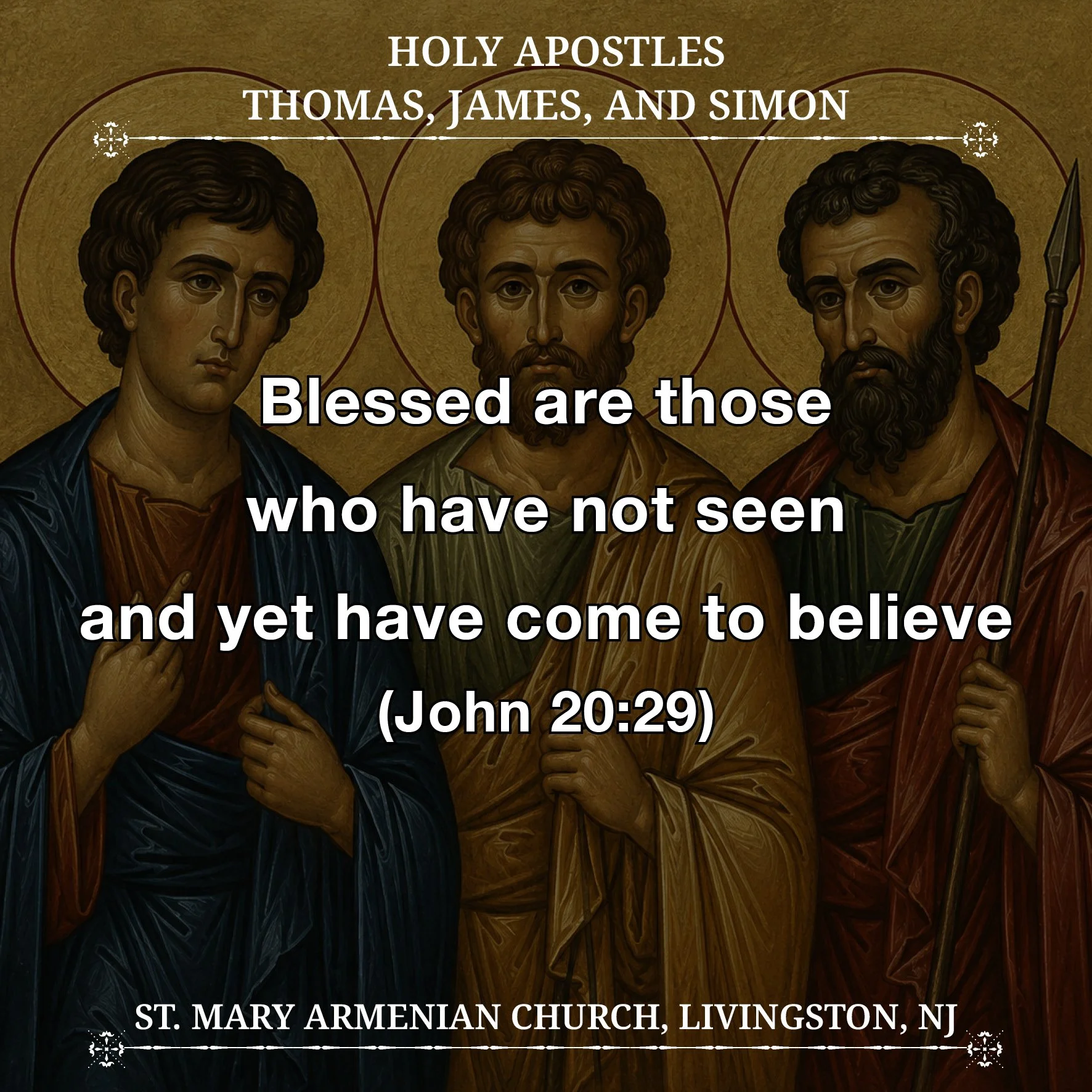
Commemoration DAY of
the Holy Apostles Thomas,
James, and Simon
St. Thomas the Apostle
Saint Thomas is best known for his initial doubt. When the other Apostles told him that they had seen the risen Lord, Thomas insisted that unless he saw Jesus with his own eyes and placed his hand into His wounded side, he would not believe.
Indeed, the following week, when the Apostles were again gathered in the Upper Room, Jesus appeared among them. Turning to Thomas, He said:
"Put your finger here and see My hands. Reach out your hand and put it into My side. Do not be unbelieving, but believing."
At that moment Thomas fell to his knees and exclaimed:
"My Lord and my God!"
Jesus concluded by saying:
"Because you have seen Me, you have believed; blessed are those who have not seen and yet have believed."
(John 20:24–29)
Despite this apparent skepticism—which is better understood as a desire for certainty than unbelief—Thomas proved himself to be a courageous and faithful Apostle.
When Jesus' friend Lazarus died, Jesus was beyond the Jordan. Upon hearing of Lazarus' death, He resolved to return and raise him from the dead. The Apostles hesitated because only days earlier the Jews had nearly stoned Jesus in Jerusalem.
At that moment Thomas stepped forward and said:
"Let us also go, that we may die with Him."
(John 11:16)
Especially in the Gospel of John, Thomas is known by the title "the Twin" (Didymus). According to tradition, he was considered the twin brother either of the Apostle Thaddeus or of another disciple.
Thomas was also one of the Apostles who interrupted Jesus with questions during the Last Supper. When Jesus said,
"You know where I am going, and you know the way,"
Thomas replied:
"Lord, we do not know where You are going. How can we know the way?"
Jesus answered with one of His most celebrated declarations:
"I am the way, the truth, and the life."
(John 14:4–6)
According to ancient tradition, Thomas traveled to the farthest reaches of the known world—to Parthia and eventually India. There, from apostolic times, a Christian community has existed whose members believe that their ancestors were converted through the preaching of Saint Thomas. For this reason they call themselves "the Christians of Saint Thomas" (or Saint Thomas Christians).
His traditional tomb is still venerated near the city of Madras (Chennai), India.
According to tradition, Thomas was martyred by being pierced with spears (or lances).
The Armenian Apostolic Church commemorates Saint Thomas together with the Apostles James son of Alphaeus and Simon the Zealot on the Saturday preceding the Third Sunday after the Feast of the Assumption of the Holy Mother of God.
St. James (James son of Alphaeus)
James is known as James the son of Alphaeus, distinguishing him from James the son of Zebedee. For the same reason he is sometimes called James the Less.
The Latin Church identifies him with James, the Brother of the Lord, but the Eastern Churches, including the Armenian Church, do not accept this identification.
According to tradition, James preached the Gospel along the southern coast of Palestine and later in Egypt, where he is believed to have suffered martyrdom.
St. Simon the Zealot
Simon—known in Greek as Simon—is identified in the Gospels by the title "the Cananaean", meaning "the Zealot."
The Zealots were a Jewish movement devoted to freeing Israel from foreign rule by whatever means necessary. They also sought to eliminate from among their people those whom they regarded as traitors or collaborators with foreign powers.
According to tradition, Simon preached the Gospel in Persia, where he suffered martyrdom.
The Armenian Apostolic Church commemorates him together with the Apostle Thomas on the same feast day.
SCRIPTURE READINGS
~ Wisdom 9:13-10:3 ~
For who can learn the counsel of God? Or who can discern what the Lord wills? For the reasoning of mortals is worthless, and our designs are likely to fail, for a perishable body weighs down the soul, and this earthy tent burdens the thoughtful mind. We can hardly guess at what is on earth, and what is at hand we find with labor, but who has traced out what is in the heavens? Who has learned your counsel unless you have given wisdom and sent your holy spirit from on high? And thus the paths of those on earth were set right, and people were taught what pleases you and were saved by wisdom.
Wisdom protected the first-formed father of the world, when he alone had been created; she delivered him from his transgression and gave him strength to rule all things. But when an unrighteous man departed from her in his anger, he perished because in rage he killed his brother.
~ Micah 7:18-20 ~
Who is a God like you, pardoning iniquity and passing over the transgression of the remnant of your possession? He does not retain his anger forever, because he delights in showing clemency. He will again have compassion upon us; he will tread our iniquities under foot. You will cast all our sins into the depths of the sea. You will show faithfulness to Jacob and unswerving loyalty to Abraham, as you have sworn to our ancestors from the days of old.
~ 1 Corinthians 12:28:13:3 ~
And God has appointed in the church first apostles, second prophets, third teachers; then deeds of power, then gifts of healing, forms of assistance, forms of leadership, various kinds of tongues. Are all apostles? Are all prophets? Are all teachers? Do all work miracles? Do all possess gifts of healing? Do all speak in tongues? Do all interpret? But strive for the greater gifts. And I will show you a still more excellent way. If I speak in the tongues of mortals and of angels, but do not have love, I am a noisy gong or a clanging cymbal. And if I have prophetic powers, and understand all mysteries and all knowledge, and if I have all faith, so as to remove mountains, but do not have love, I am nothing. If I give away all my possessions, and if I hand over my body so that I may boast, but do not have love, I gain nothing.
~ Holy Gospel of St. John 20:24-31 ~
But Thomas (who was called the Twin ), one of the twelve, was not with them when Jesus came. So the other disciples told him, "We have seen the Lord." But he said to them, "Unless I see the mark of the nails in his hands, and put my finger in the mark of the nails and my hand in his side, I will not believe." A week later his disciples were again in the house, and Thomas was with them. Although the doors were shut, Jesus came and stood among them and said, "Peace be with you." Then he said to Thomas, "Put your finger here and see my hands. Reach out your hand and put it in my side. Do not doubt but believe." Thomas answered him, "My Lord and my God!" Jesus said to him, "Have you believed because you have seen me? Blessed are those who have not seen and yet have come to believe." Now Jesus did many other signs in the presence of his disciples, which are not written in this book. But these are written so that you may come to believe that Jesus is the Messiah, the Son of God, and that through believing you may have life in his name.