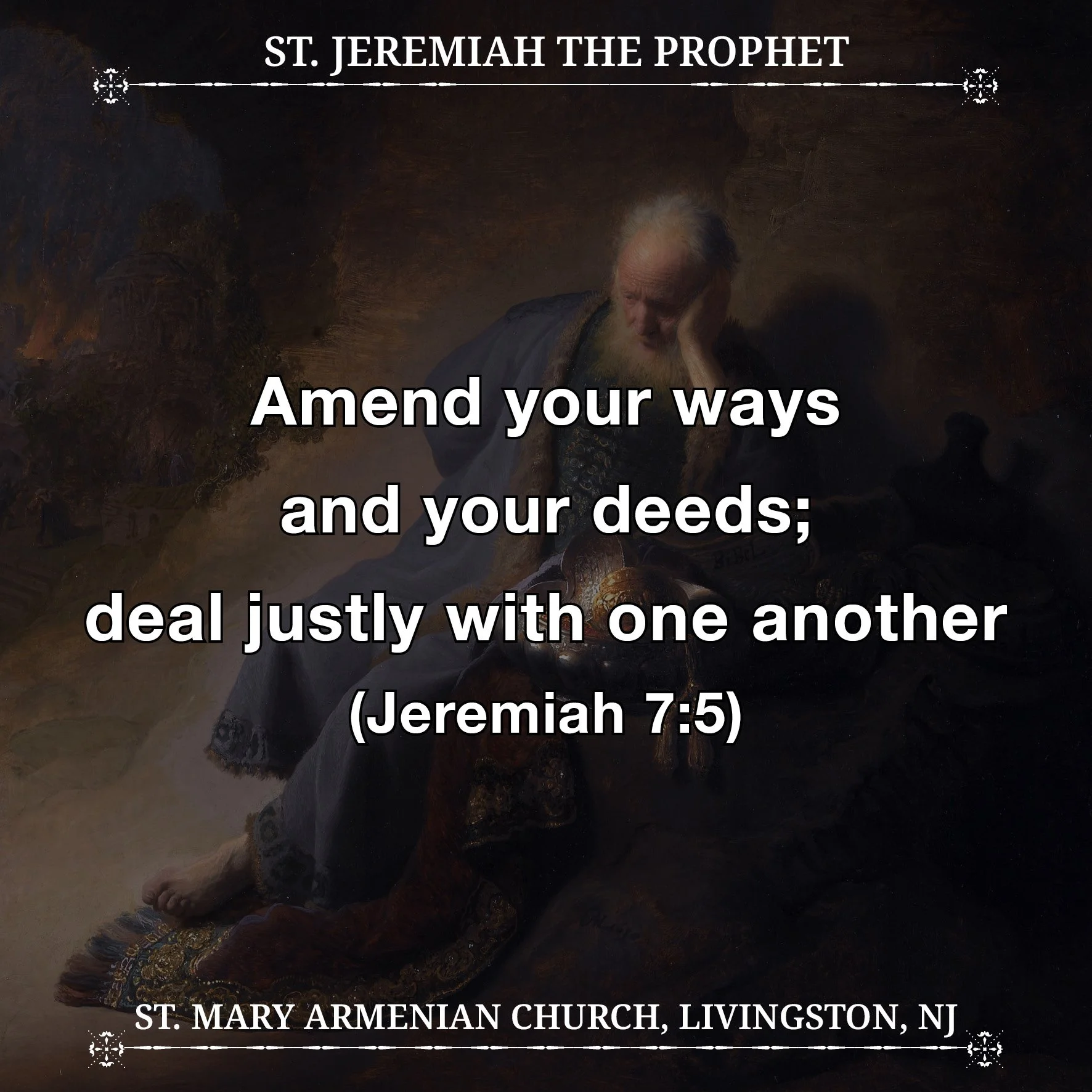
Commemoration DAY of
ST. JEREMIAH the Prophet
The Prophet Jeremiah is one of the greatest figures in the Bible. Few biblical personalities are known to us in such depth—especially regarding their inner life and emotional struggles—as Jeremiah, whose own writings reveal his heart with remarkable honesty.
Jeremiah was born around 650 B.C. in the village of Anathoth, not far from Jerusalem. Although he came from a priestly family, he never served as a priest. Instead, he criticized the conduct of the priests and often found himself in conflict with them. Until the fall of Jerusalem, his prophetic ministry was centered in the holy city.
According to Jeremiah's own testimony, his calling came under the following circumstances:
"The word of the Lord came to me, saying:
'Before I formed you in the womb I knew you,
before you were born I consecrated you;
I appointed you a prophet to the nations.'Then I said,
'Ah, Lord God! Truly I do not know how to speak, for I am only a youth.'But the Lord said to me,
'Do not say, "I am only a youth," for you shall go to all to whom I send you, and whatever I command you, you shall speak. Do not be afraid of them, for I am with you to deliver you.'Then the Lord stretched out His hand and touched my mouth, and said to me,
'Behold, I have put My words in your mouth. See, today I appoint you over nations and kingdoms, to uproot and tear down, to destroy and overthrow, to build and to plant.'"
(Jeremiah 1:4–10)
The divine voice added:
"Kings, princes, priests, and the people will fight against you, but they shall not prevail against you, for I am with you to rescue you."
Indeed, Jeremiah's entire life became the literal fulfillment of these words.
Few people have suffered as deeply as Jeremiah—both spiritually and physically. Few have been compelled to proclaim messages so unpopular and so contrary to their own heartfelt desires.
Though called while still very young, he willingly renounced marriage and the ordinary joys of life, devoting himself completely and faithfully to his prophetic vocation.
When his people had fallen irreversibly into idolatry and social injustice, Jeremiah prophesied the destruction of Jerusalem and the Temple. Because of these warnings, he was thrown into a cistern. Though it no longer contained water, its bottom was filled with mud, and Jeremiah sank into it. After several days, he was rescued through the intervention of one of the king's officials.
By this time, Babylon had become the dominant power, conquering the surrounding nations, including Judah. Its armies laid siege to Jerusalem.
Foreseeing that the city's destruction was inevitable, Jeremiah advised the people to surrender peacefully and to seek accommodation with Babylon rather than relying on Egypt. The king not only ignored his counsel but also imprisoned and mistreated him.
When King Nebuchadnezzar captured Jerusalem in 586 B.C., Jeremiah was still in prison. Learning of the prophet's political counsel, Nebuchadnezzar ordered his release and offered him honorable passage to Babylon. Jeremiah chose instead to remain with the poor remnant of his own people.
Later, after rebels assassinated the Babylonian-appointed governor, they fled to Egypt to escape Babylonian retaliation. They forcibly took the aged Jeremiah with them. According to tradition, while continuing to denounce his people's sins—as he believed God had commanded him—Jeremiah was eventually stoned to death by his own countrymen in Egypt.
Like all the prophets—and perhaps even more than most—Jeremiah was a fearless champion of social justice and true worship of God. He continually proclaimed:
"Amend your ways and your deeds. Deal justly with one another. Do not oppress the foreigner, the orphan, or the widow. Do not shed innocent blood. Do not follow other gods to your own destruction."
(cf. Jeremiah 7:1–6)
Living during one of the darkest periods of Israel's history, Jeremiah was often required to proclaim messages that ran directly against patriotic sentiment. A deeply sensitive man, he rebuked his people's sins while at the same time constantly interceding for them before God.
Eventually, however, the people's wickedness reached such depths that God forbade Jeremiah even to pray on their behalf:
"Do not pray for this people, nor plead for mercy on their behalf, nor intercede for them, for I will not listen to you. Do you not see what they are doing in the cities of Judah and in the streets of Jerusalem?"
Idolatry had spread everywhere.
And the Lord continued:
"Do they provoke Me? No—they bring shame upon themselves and disgrace their own faces."
(cf. Jeremiah 7:16–20)
Seeing that his people had become hopelessly lost and foreseeing the disasters that would befall them, Jeremiah often gave himself over to tears and lamentation.
His book contains many heartfelt laments, and the biblical book of Lamentations has traditionally been attributed to him. There are striking similarities between Jeremiah and Job. Jeremiah 20:14–18 recalls Job's curse upon the day of his birth, while the preceding verses resemble Job's profound complaints.
Yet throughout all his suffering, Jeremiah remained deeply united with God.
His prophecy of Jerusalem's destruction, his tears over the city, his unceasing sorrow for his people, and finally his rejection, stoning, and death all make him a powerful foreshadowing of Christ.
The Armenian Apostolic Holy Church commemorates the Prophet Jeremiah on the second Thursday following the Feast of the Assumption of the Holy Mother of God.
SCRIPTURE READINGS
~ Jeremiah 1:1-10, 38:1-13 ~
The words of Jeremiah son of Hilkiah, of the priests who were in Anathoth in the land of Benjamin, to whom the word of the Lord came in the days of King Josiah son of Amon of Judah, in the thirteenth year of his reign. It came also in the days of King Jehoiakim son of Josiah of Judah, and until the end of the eleventh year of King Zedekiah son of Josiah of Judah, until the captivity of Jerusalem in the fifth month. Now the word of the Lord came to me saying, "Before I formed you in the womb I knew you, and before you were born I consecrated you; I appointed you a prophet to the nations." Then I said, "Ah, Lord God! Truly I do not know how to speak, for I am only a boy." But the Lord said to me, "Do not say, "I am only a boy'; for you shall go to all to whom I send you, and you shall speak whatever I command you. Do not be afraid of them, for I am with you to deliver you, says the Lord." Then the Lord put out his hand and touched my mouth; and the Lord said to me, "Now I have put my words in your mouth. See, today I appoint you over nations and over kingdoms, to pluck up and to pull down, to destroy and to overthrow, to build and to plant."
Now Shephatiah son of Mattan, Gedaliah son of Pashhur, Jucal son of Shelemiah, and Pashhur son of Malchiah heard the words that Jeremiah was saying to all the people, Thus says the Lord, Those who stay in this city shall die by the sword, by famine, and by pestilence; but those who go out to the Chaldeans shall live; they shall have their lives as a prize of war, and live. Thus says the Lord, This city shall surely be handed over to the army of the king of Babylon and be taken. Then the officials said to the king, "This man ought to be put to death, because he is discouraging the soldiers who are left in this city, and all the people, by speaking such words to them. For this man is not seeking the welfare of this people, but their harm." King Zedekiah said, "Here he is; he is in your hands; for the king is powerless against you." So they took Jeremiah and threw him into the cistern of Malchiah, the king's son, which was in the court of the guard, letting Jeremiah down by ropes. Now there was no water in the cistern, but only mud, and Jeremiah sank in the mud. Ebed-melech the Ethiopian, a eunuch in the king's house, heard that they had put Jeremiah into the cistern. The king happened to be sitting at the Benjamin Gate, So Ebed-melech left the king's house and spoke to the king, "My lord king, these men have acted wickedly in all they did to the prophet Jeremiah by throwing him into the cistern to die there of hunger, for there is no bread left in the city." Then the king commanded Ebed-melech the Ethiopian, "Take three men with you from here, and pull the prophet Jeremiah up from the cistern before he dies." So Ebed-melech took the men with him and went to the house of the king, to a wardrobe of the storehouse, and took from there old rags and worn-out clothes, which he let down to Jeremiah in the cistern by ropes. Then Ebed-melech the Ethiopian said to Jeremiah, "Just put the rags and clothes between your armpits and the ropes." Jeremiah did so. Then they drew Jeremiah up by the ropes and pulled him out of the cistern. And Jeremiah remained in the court of the guard.
~ 2 Peter 2:9-22 ~
Then the Lord knows how to rescue the godly from trial, and to keep the unrighteous under punishment until the day of judgment —especially those who indulge their flesh in depraved lust, and who despise authority. Bold and willful, they are not afraid to slander the glorious ones, whereas angels, though greater in might and power, do not bring against them a slanderous judgment from the Lord. These people, however, are like irrational animals, mere creatures of instinct, born to be caught and killed. They slander what they do not understand, and when those creatures are destroyed, they also will be destroyed, suffering the penalty for doing wrong. They count it a pleasure to revel in the daytime. They are blots and blemishes, reveling in their dissipation while they feast with you. They have eyes full of adultery, insatiable for sin. They entice unsteady souls. They have hearts trained in greed. Accursed children! They have left the straight road and have gone astray, following the road of Balaam son of Bosor, who loved the wages of doing wrong, but was rebuked for his own transgression; a speechless donkey spoke with a human voice and restrained the prophet's madness. These are waterless springs and mists driven by a storm; for them the deepest darkness has been reserved. For they speak bombastic nonsense, and with licentious desires of the flesh they entice people who have just escaped from those who live in error. They promise them freedom, but they themselves are slaves of corruption; for people are slaves to whatever masters them. For if, after they have escaped the defilements of the world through the knowledge of our Lord and Savior Jesus Christ, they are again entangled in them and overpowered, the last state has become worse for them than the first. For it would have been better for them never to have known the way of righteousness than, after knowing it, to turn back from the holy commandment that was passed on to them. It has happened to them according to the true proverb, "The dog turns back to its own vomit," and, "The sow is washed only to wallow in the mud."
~ Holy Gospel of St. Matthew 2:16-18 ~
When Herod saw that he had been tricked by the wise men, he was infuriated, and he sent and killed all the children in and around Bethlehem who were two years old or under, according to the time that he had learned from the wise men. Then was fulfilled what had been spoken through the prophet Jeremiah: "A voice was heard in Ramah, wailing and loud lamentation, Rachel weeping for her children; she refused to be consoled, because they are no more."