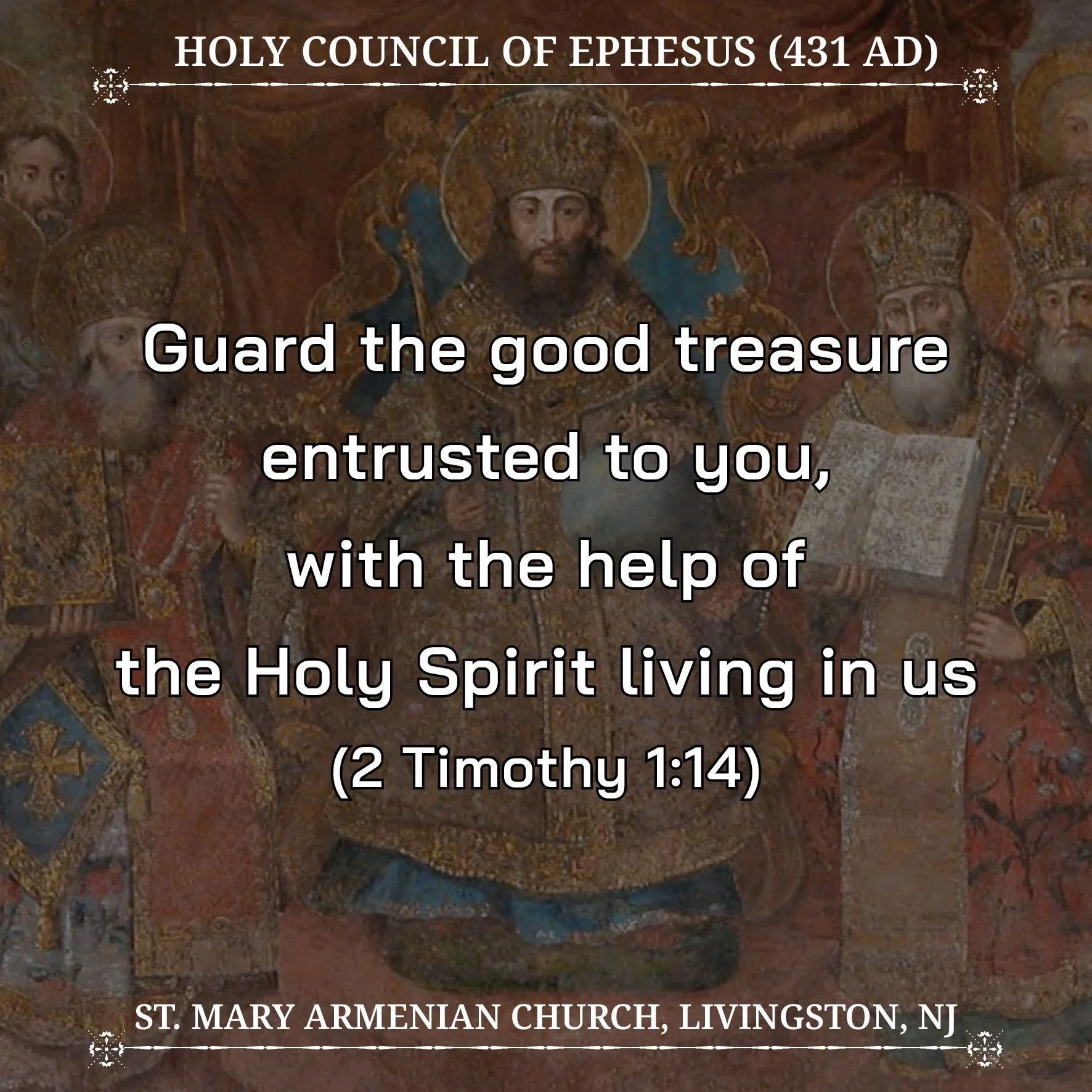
COMMEMORATION DAY OF
the 200 Fathers of
the Holy Council of Ephesus
Among the councils of the Church, the Ecumenical Councils hold a place of unique importance. They are called Ecumenical because representatives of the universal (catholic) Church from throughout the Christian world participated in them. The Armenian Apostolic Church recognizes only the first three Ecumenical Councils—the Council of Nicaea (325), the First Council of Constantinople (381), and the Council of Ephesus (431)—and professes only their doctrinal decisions and theological formulations.
In the Armenian Apostolic Holy Church, the Feast of the Third Ecumenical Council of Ephesus is commemorated on the Saturday preceding the Fast of the Feast of the Assumption of the Holy Mother of God.
The Ecumenical Council of Ephesus was convened in 431 A.D. during the reign of Emperor Theodosius II (Theodosius the Younger). Approximately 200 bishops participated in the council, which was called to examine and refute the teachings of Nestorius, the Patriarch of Constantinople.
Nestorius taught that the divine and human natures of Christ existed as two separate and independent realities. He argued that Jesus was born as a mere man and that the divine Logos became united with Him afterward. Consequently, Nestorius rejected the title Theotokos ("God-bearer" or "Mother of God") for the Blessed Virgin Mary, maintaining that she was only the mother of the human Jesus.
The Council of Ephesus condemned the teachings of Nestorius as contrary to the faith of the Church and affirmed the Christological doctrine articulated by St. Cyril of Alexandria. The council proclaimed that in the one Person of Jesus Christ, the divine and human natures are united inseparably and without confusion, division, or change. Christ is one Lord, one Son, and one Person, fully God and fully man.
Accordingly, the council affirmed that the Blessed Virgin Mary is rightly called Theotokos (Mother of God), because the One whom she bore in the flesh is the eternal Son of God incarnate. The Christological formula associated with St. Cyril of Alexandria—"One incarnate nature of God the Word" (Mia Physis tou Theou Logou Sesarkōmenē)—became a foundational expression of the Church's faith.
Although the Armenian Apostolic Church was unable to participate in the Council of Ephesus due to the political circumstances of the time, it subsequently accepted the council's doctrinal decisions and recognized its ecumenical authority, together with that of the First and Second Ecumenical Councils held at Nicaea (325) and Constantinople (381). The teachings of the Council of Ephesus continue to hold a central place in the Christological doctrine of the Armenian Church.
The Armenian Church formally condemned Nestorianism at the First Council of Dvin (506) and again at the Second Council of Dvin (554).
SCRIPTURE READINGS

~ Ezekiel 3:16-19 ~
At the end of seven days, the word of the Lord came to me: Mortal, I have made you a sentinel for the house of Israel; whenever you hear a word from my mouth, you shall give them warning from me. If I say to the wicked, "You shall surely die," and you give them no warning, or speak to warn the wicked from their wicked way, in order to save their life, those wicked persons shall die for their iniquity; but their blood I will require at your hand. But if you warn the wicked, and they do not turn from their wickedness, or from their wicked way, they shall die for their iniquity; but you will have saved your life.
~ 2 Timothy 1:6-14 ~
For this reason I remind you to rekindle the gift of God that is within you through the laying on of my hands; for God did not give us a spirit of cowardice, but rather a spirit of power and of love and of self-discipline. Do not be ashamed, then, of the testimony about our Lord or of me his prisoner, but join with me in suffering for the gospel, relying on the power of God, who saved us and called us with a holy calling, not according to our works but according to his own purpose and grace. This grace was given to us in Christ Jesus before the ages began, but it has now been revealed through the appearing of our Savior Christ Jesus, who abolished death and brought life and immortality to light through the gospel. For this gospel I was appointed a herald and an apostle and a teacher, and for this reason I suffer as I do. But I am not ashamed, for I know the one in whom I have put my trust, and I am sure that he is able to guard until that day what I have entrusted to him. Hold to the standard of sound teaching that you have heard from me, in the faith and love that are in Christ Jesus. Guard the good treasure entrusted to you, with the help of the Holy Spirit living in us.
~ Holy Gospel of St. Luke 10:16-20 ~
"Whoever listens to you listens to me, and whoever rejects you rejects me, and whoever rejects me rejects the one who sent me." The seventy returned with joy, saying, "Lord, in your name even the demons submit to us!" He said to them, "I watched Satan fall from heaven like a flash of lightning. See, I have given you authority to tread on snakes and scorpions, and over all the power of the enemy; and nothing will hurt you. Nevertheless, do not rejoice at this, that the spirits submit to you, but rejoice that your names are written in heaven."