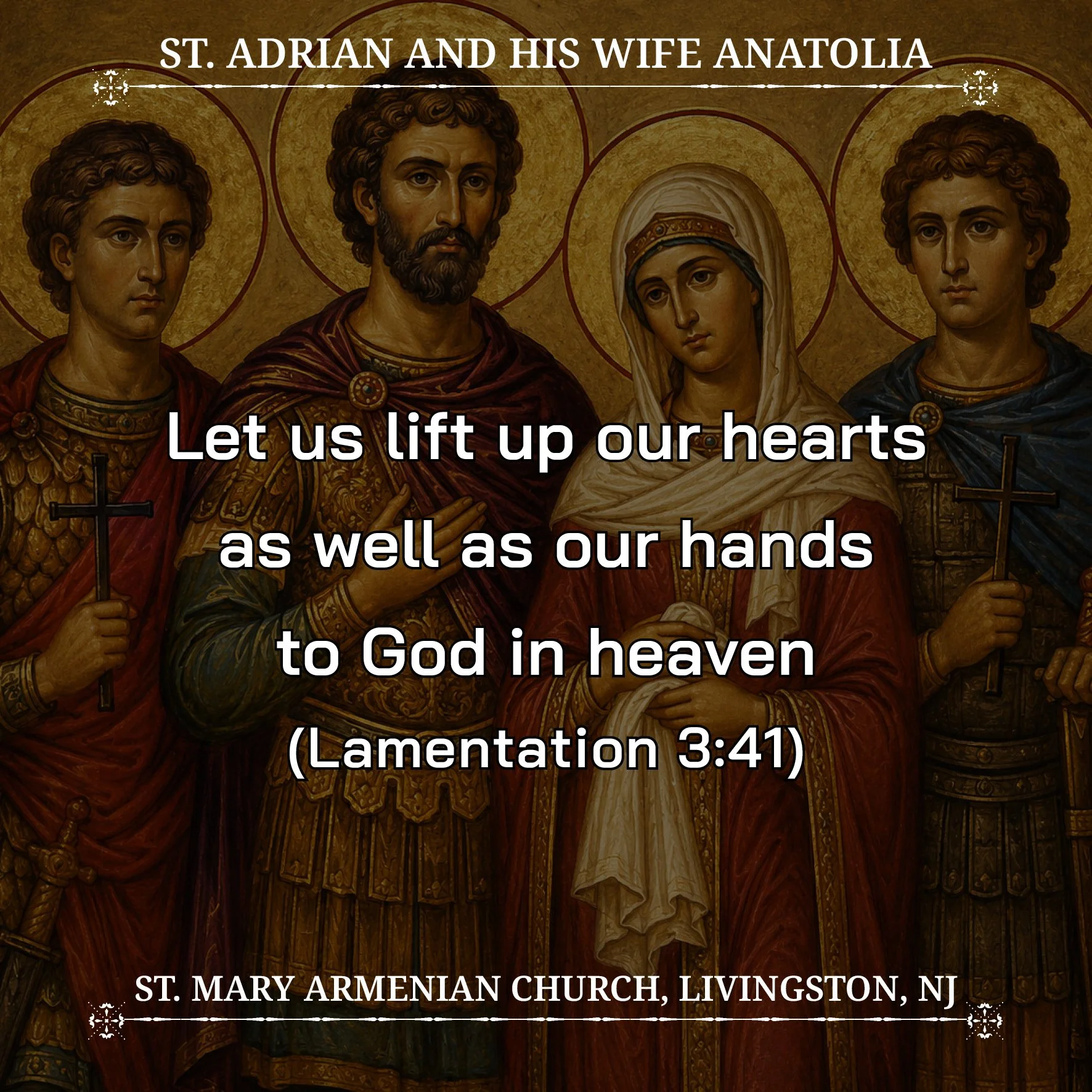
COMMEMORATION DAY OF
St. Adrian and His Wife Anatolia,
and of the Martyrs Theodore
and Eleutherius
St. Adrian the Martyr
Saint Adrian was a high-ranking officer in the Roman army during the reign of Emperor Maximinus. At first he was a pagan and actively took part in the persecution of Christians.
However, after witnessing the courage and steadfastness of the Christians under torture—and, most likely, through the prayers and influence of his Christian wife Anatolia—he eventually embraced the Christian faith.
Because of his conversion, Adrian was imprisoned and subjected to severe tortures. In the end, his legs were broken, and he died as a glorious martyr in AD 310.
St. Anatolia (Natalia), Wife of Adrian
In the Greek and Latin traditions she is better known as Saint Natalia.
She was the wife of the celebrated martyr Adrian, whose conversion to Christianity is attributed largely to her prayers and encouragement.
When Adrian was arrested during the persecutions under Diocletian, Anatolia tirelessly strengthened him and the other imprisoned Christians so that they would not weaken in faith but would courageously receive the crown of martyrdom.
She devoted herself so completely to serving imprisoned Christians that she came to be known as "the sister of the martyrs."
Because women were forbidden to witness the torture and execution of Christians, she disguised herself as a man in order to be present at her husband's martyrdom.
After Adrian's death, she went to Byzantium, where she lived a life of virtue and ended her days in peace.
St. Theodore Stratelates (Theodore the General)
Saint Theodore Stratelates was born in Heraclea of Pontus. During the reign of Emperor Licinius, he served as a general in the Roman army.
Although Licinius had initially joined Constantine the Great in issuing the Edict of Milan, which granted Christians freedom to practice their faith, he later reversed his policy and renewed the persecution of Christians.
When Licinius learned that Theodore was not only a Christian himself but was also converting many others to Christianity, he ordered him to renounce Christ and return to the pagan religion.
Strengthened by divine grace, Theodore declared that he was ready to endure every form of torture rather than deny Christ.
He was brutally scourged with iron hooks, then bound by his hands and suspended on a cross-like frame. Theodore endured every torment with unwavering faith.
Finally, in AD 319, he was beheaded and received the crown of martyrdom.
St. Eleutherius (Eleftherios)
The Armenian Church calendar commemorates Eleutherius as a martyr. However, no martyr by that exact name could be identified in either the Armenian Synaxaria or the Greek and Latin martyrologies.
Patriarch Torgom suggests that the name should more accurately be Thyrsus (Thyrsus).
Indeed, a martyr by that name appears in the Armenian Synaxarion published by Marzvantsi, as well as in the Greek and Latin traditions. According to these sources, Thyrsus was a native of Bithynia who suffered martyrdom in the middle of the third century, during the persecution under Emperor Decius, after enduring severe tortures.
He was martyred together with Luke, a venerable priest, and Callinicus, a pagan priest who was converted to Christianity after witnessing the miracles that occurred during Thyrsus's sufferings.
SCRIPTURE READINGS
~ Lamentation 3:22-56 ~
The steadfast love of the Lord never ceases, his mercies never come to an end; they are new every morning; great is your faithfulness. "The Lord is my portion," says my soul, "therefore I will hope in him." The Lord is good to those who wait for him, to the soul that seeks him. It is good that one should wait quietly for the salvation of the Lord. It is good for one to bear the yoke in youth, to sit alone in silence when the Lord has imposed it, to put one's mouth to the dust (there may yet be hope), to give one's cheek to the smiter, and be filled with insults. For the Lord will not reject forever. Although he causes grief, he will have compassion according to the abundance of his steadfast love; for he does not willingly afflict or grieve anyone. When all the prisoners of the land are crushed under foot, when human rights are perverted in the presence of the Most High, when one's case is subverted —does the Lord not see it? Who can command and have it done, if the Lord has not ordained it? Is it not from the mouth of the Most High that good and bad come? Why should any who draw breath complain about the punishment of their sins? Let us test and examine our ways, and return to the Lord. Let us lift up our hearts as well as our hands to God in heaven. We have transgressed and rebelled, and you have not forgiven. You have wrapped yourself with anger and pursued us, killing without pity; you have wrapped yourself with a cloud so that no prayer can pass through. You have made us filth and rubbish among the peoples. All our enemies have opened their mouths against us; panic and pitfall have come upon us, devastation and destruction. My eyes flow with rivers of tears because of the destruction of my people. My eyes will flow without ceasing, without respite, until the Lord from heaven looks down and sees. My eyes cause me grief at the fate of all the young women in my city. Those who were my enemies without cause have hunted me like a bird; they flung me alive into a pit and hurled stones on me; water closed over my head; I said, "I am lost." I called on your name, O Lord, from the depths of the pit; you heard my plea, "Do not close your ear to my cry for help, but give me relief!"
~ Romans 8:18-27 ~
I consider that the sufferings of this present time are not worth comparing with the glory about to be revealed to us. For the creation waits with eager longing for the revealing of the children of God; for the creation was subjected to futility, not of its own will but by the will of the one who subjected it, in hope that the creation itself will be set free from its bondage to decay and will obtain the freedom of the glory of the children of God. We know that the whole creation has been groaning in labor pains until now; and not only the creation, but we ourselves, who have the first fruits of the Spirit, groan inwardly while we wait for adoption, the redemption of our bodies. For in hope we were saved. Now hope that is seen is not hope. For who hopes for what is seen? But if we hope for what we do not see, we wait for it with patience. Likewise the Spirit helps us in our weakness; for we do not know how to pray as we ought, but that very Spirit intercedes with sighs too deep for words. And God, who searches the heart, knows what is the mind of the Spirit, because the Spirit intercedes for the saints according to the will of God.
~ Holy Gospel of St. John 16:1-4 ~
"I have said these things to you to keep you from stumbling. They will put you out of the synagogues. Indeed, an hour is coming when those who kill you will think that by doing so they are offering worship to God. And they will do this because they have not known the Father or me. But I have said these things to you so that when their hour comes you may remember that I told you about them. "I did not say these things to you from the beginning, because I was with you.”