COMMEMORATION DAY OF
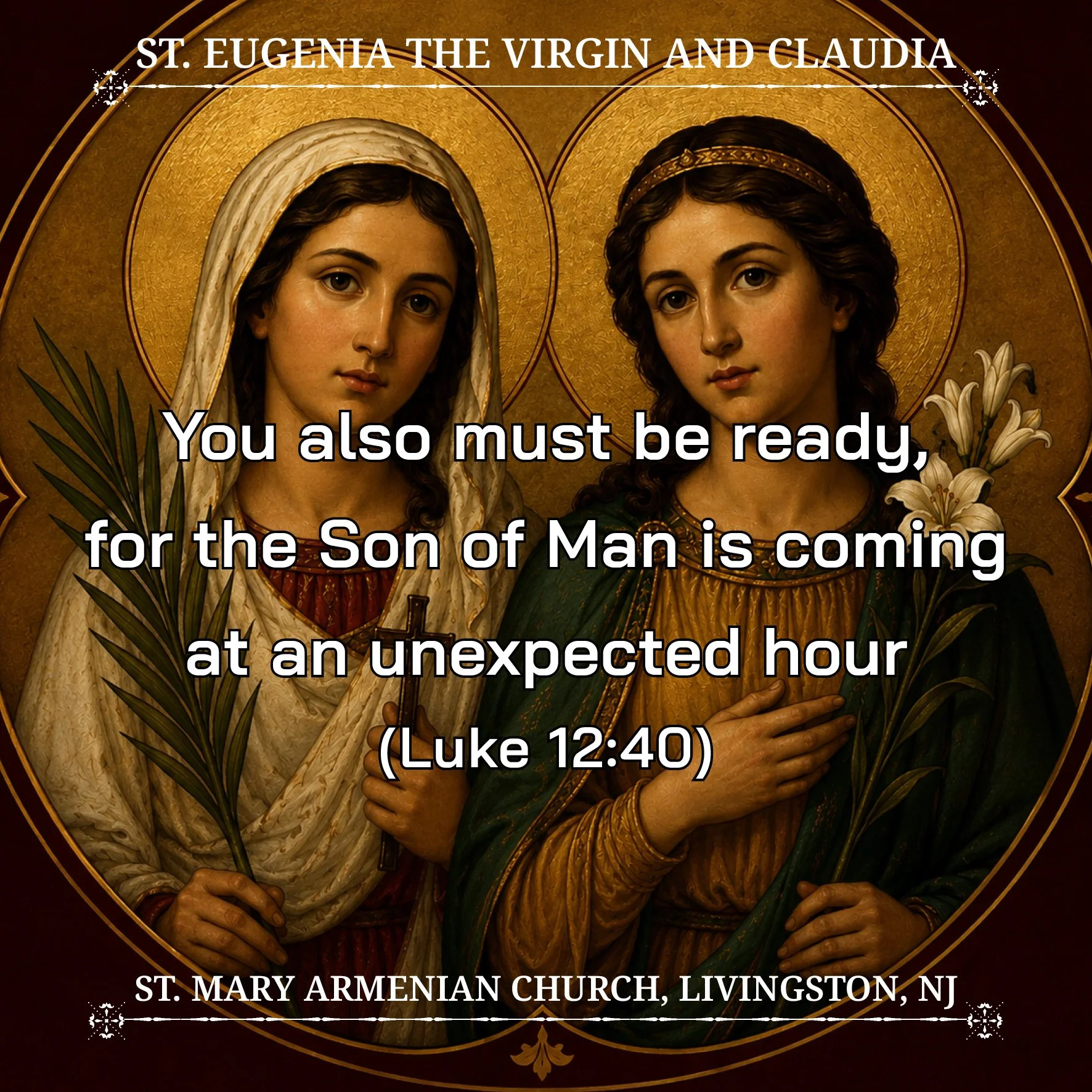
St. Eugenia the Virgin,
Her Father Philip, Her Mother Claudia,
Her Two Brothers Sergius and Apiton,
the Two Eunuchs, and the Holy Martyrs
Eugenius, Macarius, Valerius,
Canditus, and Aquila
St. Eugenia the Virgin and Claudia
These two—a daughter and her mother—belong to a family whose every member was martyred during the persecutions of Christians. For this reason, they are all included in the Church calendar of saints.
The father of the family, Philip, was a Roman nobleman who was appointed governor of Egypt. He moved to Alexandria, then the capital of Egypt, together with his wife Claudia, their daughter Eugenia, and their two sons. Since Alexandria was one of the greatest centers of learning in the ancient world, Philip ensured that Eugenia received an excellent education.
During her studies, she happened to obtain a collection of the Epistles of Saint Paul. Reading them with great interest, she became convinced of the truth of the Christian faith and resolved to become a Christian. She also persuaded the family's two eunuch servants to accept Christianity, and together they were baptized.
Unwilling to return home afterward, Eugenia disguised herself as a man and, accompanied by the two eunuchs, entered a monastery. Having always loved reading, she studied the entire Holy Scriptures and became remarkably knowledgeable. Her profound understanding of Scripture won the admiration of everyone around her.
After the abbot died, Eugenia—known in the monastery as Eugenios—was chosen as the new abbot because of her wisdom and spiritual maturity.
Some time later, a woman became passionately infatuated with the new abbot. When Eugenia rejected her immoral advances, the woman sought revenge by accusing "him" of attempting to rape her. She brought the accusation before the governor of Alexandria, who happened to be Eugenia's own father, Philip.
Philip had long since given up hope of finding his "lost" daughter and had become increasingly hostile toward Christians, blaming them for her disappearance. Determined to disgrace and severely punish this supposedly immoral monk, he convened a public trial.
When Eugenia was brought before the court in monastic clothing, both she and the Christian faith were publicly insulted. At last, she was forced to reveal her true identity. Her revelation exposed the false accuser and silenced the enemies of the faith, while filling her family with overwhelming joy.
After hearing his daughter's entire story, Philip was deeply moved by her faith and wisdom. He and his whole family converted to Christianity and thereafter became protectors of the Christians in Alexandria.
When the emperor learned of Philip's conversion, he removed him from office and ordered his successor to have him killed.
After Philip's martyrdom, the family returned to Rome, where they too were arrested as Christians. The two eunuchs were martyred first, followed by the Virgin Eugenia. According to the Latin martyrologies, these events occurred around the early third century (c. AD 200); the Greek tradition dates them to around AD 180, while Armenian synaxaria place them in the 80s AD.
Philip the Governor and His Two Sons
Philip and his wife Claudia were the parents of the renowned Virgin Eugenia and of the brothers Sergius and Apiton, who are commemorated together with their two servants, Prostus and Hyacinthus. Because their stories are so closely intertwined, they are difficult to separate. Here the focus is on Philip and his sons.
Philip was a Roman nobleman who lived in the second century. The emperor appointed him governor of Egypt, and he traveled there with his entire family.
While in Alexandria, his daughter Eugenia became a Christian, and through a series of events the entire family was eventually converted. The pagan leaders of Alexandria informed the emperor of Philip's conversion.
The emperor ordered Philip's dismissal. Philip gladly resigned his office, sold his possessions, distributed the proceeds to the poor, and withdrew with his family into the Christian quarter of the city.
Because he was a wise and virtuous man, gifted in teaching and leadership, the local Christians elected him bishop. Thus he exchanged high secular office for spiritual leadership. He served his people faithfully and was even credited with healing the sick and casting out demons.
The emperor then appointed a new governor, instructing him to eliminate Philip quietly, without causing public unrest. Agents pretending to be Christians gained Philip's confidence and, when the opportunity arose, mortally wounded him. Three days later, Philip surrendered his soul, receiving the crown of martyrdom.
Philip's sons, Sergius and Apiton, who lived lives of great piety, are likewise commemorated in the Armenian Church calendar.
Prostus and Hyacinthus
(The Greek and Latin form of the first name is Prostus.)
These two were the eunuch servants of Saint Eugenia. They accepted Christianity together with her in Egypt and entered the monastery alongside her.
After Philip's martyrdom, they accompanied Eugenia back to Rome.
During the reign of Emperor Gallienus, they were arrested as Christians. Refusing to sacrifice to idols, they were first brutally scourged and then beheaded in AD 262.
Their tombs, complete with their original gravestones, were discovered intact in Rome in 1845. Charred bones believed to belong to Hyacinthus were found in his grave, while the tomb of Prostus was empty.
Eugenius, Valerius, Canditus, and Aquila
These fellow martyrs came from Trebizond (modern Trabzon). During the persecutions under Diocletian and Maximinus, they took refuge in the nearby mountains.
Eventually they were captured and brought before the authorities. Refusing to renounce Christianity, they were imprisoned and subjected to hunger and thirst, followed by beatings and many other tortures. God's servants endured all these sufferings with patience and joy.
The four were first tested by fire and then beheaded, receiving the unfading crown of martyrdom.
The Priests Macarius and Eugenius
The Armenian Patriarch Torgom's book Saints and Feasts commemorates two priests named Macarius and Eugenius, apparently on December 24 and October 19, respectively. However, no corresponding joint commemoration can be clearly identified in the Armenian liturgical calendar.
Although there are other saints named Macarius and Eugenius commemorated separately in Armenian tradition, none is explicitly identified as a priest, making their exact identity difficult to determine. The Greek and Latin calendars contain numerous saints with these names, adding further uncertainty.
The Greek calendar commemorates one Macarius with Eudoxius on September 6, while another Macarius is commemorated with Zeno on April 10. Similar pairings appear in Armenian tradition but do not conclusively identify the saints in question.
Nevertheless, both the Greek and Latin calendars do commemorate a pair of priests named Macarius and Eugenius, who are always celebrated together. Patriarch Torgom identifies these with the separately commemorated Armenian saints of the same names, although Armenian sources do not explicitly describe them as priests.
The Armenian Synaxaria likewise commemorate them together: in the edition published by Peshdimaljian on December 19, and in the edition by Marzvantsi on December 24.
According to the Latin martyrologies, these two priests lived during the reign of Emperor Julian the Apostate. Because they openly rebuked the emperor, they endured severe tortures and were later exiled to Arabia—a destination that appears more plausible if Antioch was their center of activity than the Mauritania mentioned in some Armenian sources. There they continued preaching the Gospel.
The Armenian tradition states that they died peacefully in exile, whereas the Latin tradition records that they were beheaded in AD 362, thereby receiving the crown of martyrdom.
SCRIPTURE READINGS
~ Proverbs 1:20-25 ~
Wisdom cries out in the street; in the squares she raises her voice. At the busiest corner she cries out; at the entrance of the city gates she speaks: "How long, O simple ones, will you love being simple? How long will scoffers delight in their scoffing and fools hate knowledge? Give heed to my reproof; I will pour out my thoughts to you; I will make my words known to you. Because I have called and you refused, have stretched out my hand and no one heeded, and because you have ignored all my counsel and would have none of my reproof.
~ Isaiah 55:10-13 ~
For as the rain and the snow come down from heaven, and do not return there until they have watered the earth, making it bring forth and sprout, giving seed to the sower and bread to the eater, so shall my word be that goes out from my mouth; it shall not return to me empty, but it shall accomplish that which I purpose, and succeed in the thing for which I sent it. For you shall go out in joy, and be led back in peace; the mountains and the hills before you shall burst into song, and all the trees of the field shall clap their hands. Instead of the thorn shall come up the cypress; instead of the brier shall come up the myrtle; and it shall be to the Lord for a memorial, for an everlasting sign that shall not be cut off.
~ Romans 15:30-33 ~
I appeal to you, brothers and sisters, by our Lord Jesus Christ and by the love of the Spirit, to join me in earnest prayer to God on my behalf, that I may be rescued from the unbelievers in Judea, and that my ministry to Jerusalem may be acceptable to the saints, so that by God's will I may come to you with joy and be refreshed in your company. The God of peace be with all of you. Amen.
~ Holy Gospel of St. Luke 12:32-40 ~
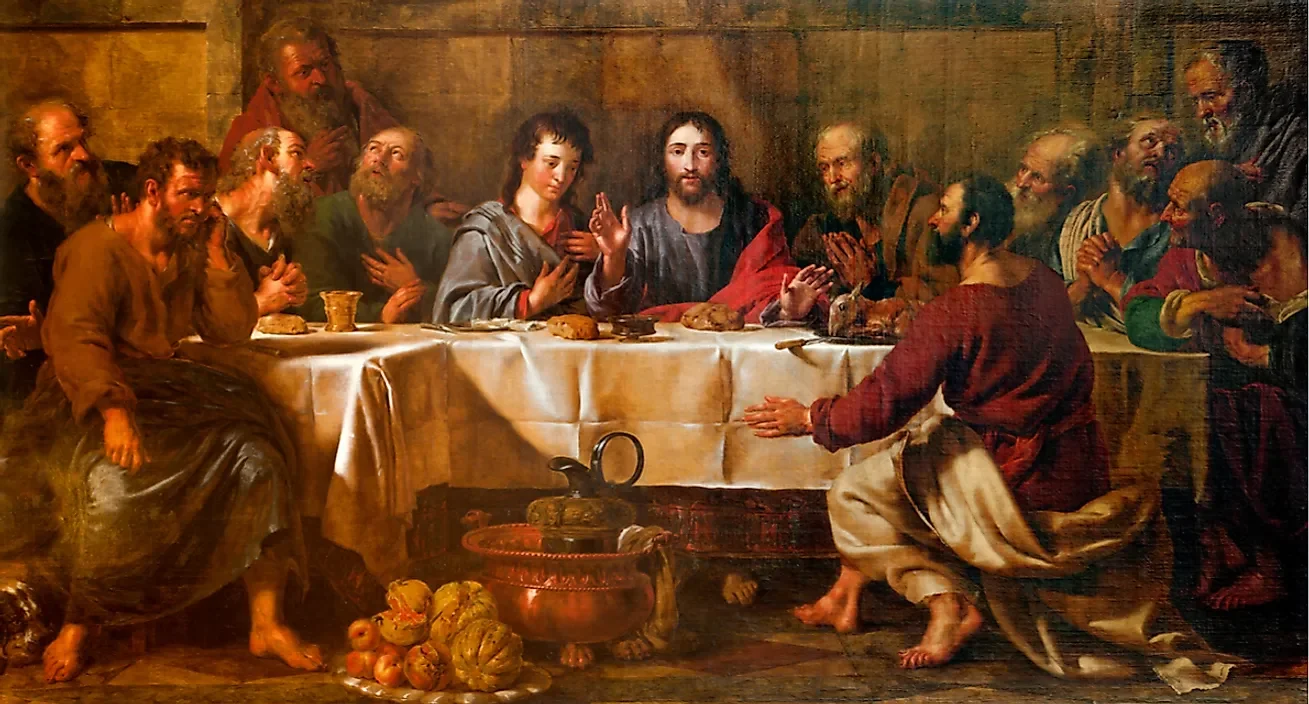
"Do not be afraid, little flock, for it is your Father's good pleasure to give you the kingdom. Sell your possessions, and give alms. Make purses for yourselves that do not wear out, an unfailing treasure in heaven, where no thief comes near and no moth destroys. For where your treasure is, there your heart will be also. "Be dressed for action and have your lamps lit; be like those who are waiting for their master to return from the wedding banquet, so that they may open the door for him as soon as he comes and knocks. Blessed are those slaves whom the master finds alert when he comes; truly I tell you, he will fasten his belt and have them sit down to eat, and he will come and serve them. If he comes during the middle of the night, or near dawn, and finds them so, blessed are those slaves. "But know this: if the owner of the house had known at what hour the thief was coming, he would not have let his house be broken into. You also must be ready, for the Son of Man is coming at an unexpected hour."