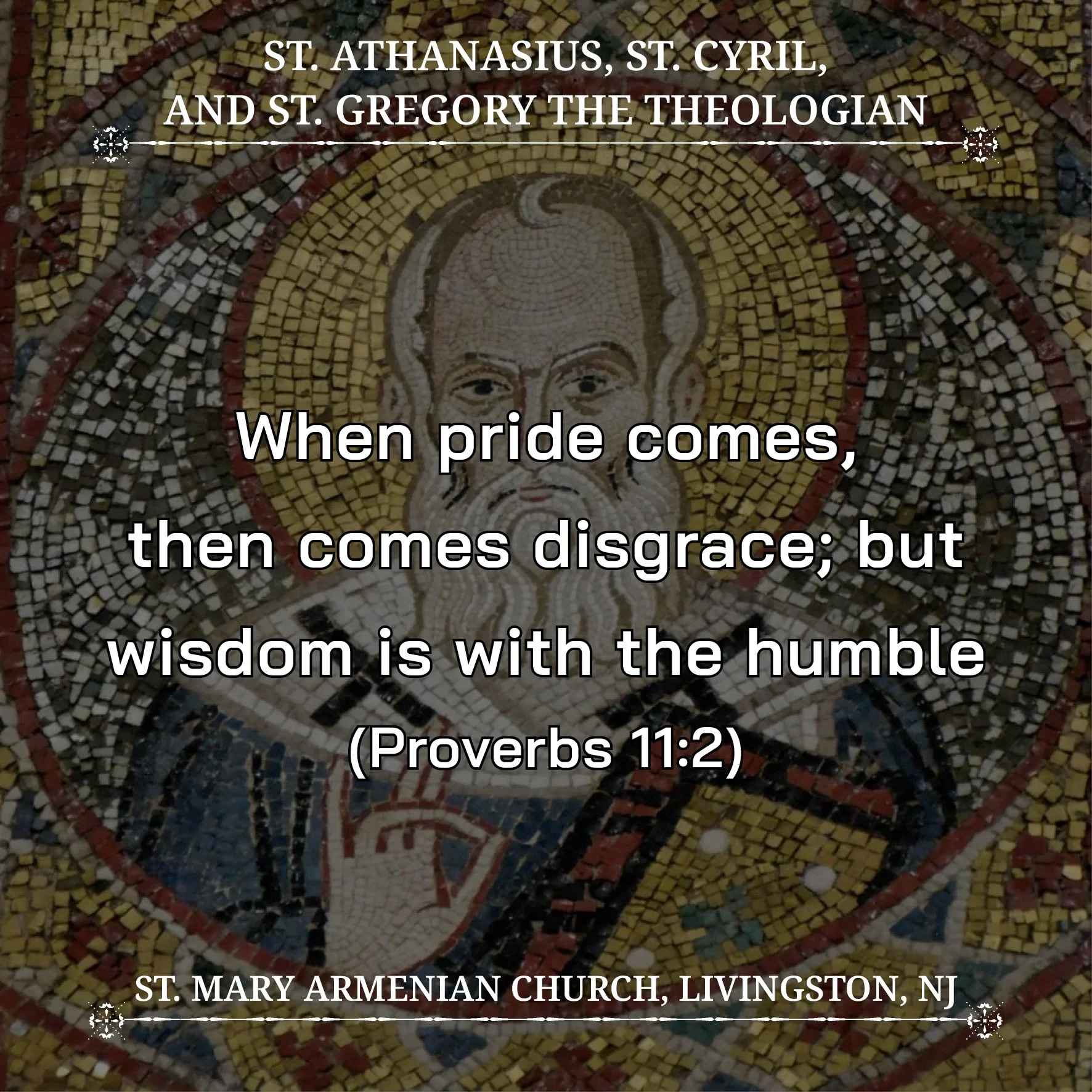
COMMEMORATION DAY OF
THE Holy Patriarchs St. Athanasius,
St. Cyril, and St. Gregory the Theologian
St. Athanasius the Patriarch
St. Athanasius is one of the greatest figures in the history of the Christian Church. He was born in 296 AD in Alexandria. He received his theological education in the renowned theological schools of his native city. He was ordained a deacon by Patriarch Alexander of Alexandria and served as his personal secretary. In this capacity, he attended the First Council of Nicaea (325 AD).
In 328 AD, at only 33 years of age, he succeeded Alexander as Patriarch of Alexandria. Nearly his entire life was devoted to combating Arianism, a heresy that had spread through most of the churches of his region, especially in Byzantium, Asia Minor, Syria, and Egypt.
Because of his unwavering defense of Nicene Christianity, Athanasius was repeatedly exiled by pro-Arian emperors. His first exile came in 336 AD under Emperor Constantine the Great. After Constantine's death he returned, but in 339 AD, driven by powerful Arian opponents, he fled to Rome. There he established close ties with the Church of Rome, which became his strongest ally in the struggle against Arianism, at a time when much of the Eastern Church had fallen under the influence of the Semi-Arians, who relentlessly persecuted him.
In 346 AD, he was restored to his patriarchal office, which had been seized by others. In 356 AD, he was again forced into exile, this time hiding near Alexandria until the death of the emperor who had persecuted him. His successor, Emperor Julian the Apostate, exiled him once more in 362 AD. After Julian's death, Athanasius returned again. His fifth and final exile occurred briefly in 365 AD. Upon his return, he spent the last seven to eight years of his life rebuilding the Christian Church and strengthening those faithful to the Nicene Creed.
His extraordinary efforts bore fruit shortly after his death. At the First Council of Constantinople (381 AD), the Nicene Creed triumphed definitively, and Arianism, after disturbing the peace of the Eastern Church for more than half a century, was finally condemned and faded into history.
Athanasius remained steadfast throughout every hardship. He never yielded, even slightly, to the pressures and persecutions of the Semi-Arians. At one point, among the clergy of the entire Christian Church, only Athanasius and a handful of companions remained faithful to the Nicene faith.
He wrote continuously in defense of the Nicene Creed and against Arianism, exposing the danger posed by bishops who, whether through good intentions or error, supported Semi-Arian theology. Between 360 and 373 AD, he devoted himself tirelessly to instructing, persuading, and reconciling bishops inclined toward Arianism.
He also defended the divinity of the Holy Spirit against Macedonius, Patriarch of Constantinople, and opposed the teaching of his friend Apollinaris, who claimed that Christ possessed a human body and soul but not a human rational mind, which was supposedly replaced by the Divine Logos. Athanasius insisted on Christ's complete humanity.
Athanasius also greatly encouraged monasticism and wrote the famous Life of St. Anthony, helping introduce the monastic ideal to the Western Church, where it would flourish in numerous religious orders.
His immense energy matched his strong and resolute character. Nearly all of his surviving writings are theological, apologetic, and polemical. Beginning in the Armenian Golden Age, more than forty of his works were translated into Armenian. His writings remain among the greatest treasures of Christian literature.
He died peacefully in 373 AD.
The Armenian Church commemorates St. Athanasius on the fourth Saturday after the Feast of the Transfiguration (Vardavar) and again with the Twelve Holy Doctors (Yergotasan Vardapetk) in late October.
St. Cyril of Alexandria
St. Cyril of Alexandria is regarded as the last Ecumenical Father of the Church to be included among the universally venerated saints. He was one of Christianity's most influential and energetic church leaders.
He was born in Alexandria around 380 AD and was the nephew of Patriarch Theophilus of Alexandria. As a young man, he is believed to have participated in the Synod of the Oak (403 AD), which deposed St. John Chrysostom.
In 412 AD, Cyril succeeded his uncle as Patriarch of Alexandria. Among his first actions was a vigorous campaign against the Novatian schismatics, closing their churches. He also confronted the Jewish community in Alexandria after violent conflicts with Christians, expelling many Jews from the city. At the same time, he came into conflict with the city's Roman governor, Orestes, who defended the Jewish population and resented Cyril's growing influence.
Cyril's name is especially associated with the defense of the Virgin Mary's title Theotokos ("God-bearer" or "Mother of God"). Nestorius, Patriarch of Constantinople, rejected this title and proposed instead Christotokos ("Mother of Christ"), arguing that Mary gave birth only to Christ's humanity.
The long-standing rivalry between the patriarchates of Alexandria and Constantinople, theological differences between the Alexandrian and Antiochene schools (Nestorius had studied in Antioch), and Cyril's determined personality all contributed to the controversy.
In 429 AD, Cyril defended the title Theotokos in his annual Paschal Letter. He convened a synod in Alexandria that condemned Nestorius and urged Pope Celestine I to do the same in 430 AD. After both synods had condemned Nestorius, Cyril sent him a letter accompanied by Twelve Anathemas, demanding that he accept and sign them. He also informed John, Patriarch of Antioch, who was a friend of Nestorius.
Nestorius rejected Cyril's demands and publicly denounced him, although he eventually agreed to use the increasingly popular title Theotokos. John of Antioch, however, preferred Nestorius' explanation over Cyril's anathemas.
To resolve the growing dispute, Emperor Theodosius II convened the Council of Ephesus in 431 AD. When Nestorius arrived, he found the churches of Ephesus closed to him because the bishop of the city supported Cyril. Cyril himself arrived with fifty bishops and enjoyed the support of bishops from Palestine, Asia Minor, and Greece.
John of Antioch was delayed. Despite requests from sixty-eight bishops to postpone the council until the Antiochene delegation arrived, Cyril opened the council on June 22, 431, even though the pope's representatives had not yet arrived. As the highest-ranking bishop present, he presided over the proceedings.
Nestorius refused repeated summonses to appear before the council. Consequently, the council condemned and deposed him as a heretic. Cyril's doctrinal letter to Nestorius, explaining his understanding of the Incarnation, was officially adopted by the council.
When John of Antioch finally arrived a week later, he held a rival council with forty-three bishops that, in turn, condemned and deposed Cyril. Ultimately, however, Emperor Theodosius II confirmed the decisions of Cyril's council, as did the papal delegation upon its arrival about a month later.
Despite his forceful temperament, Cyril remains one of Christianity's greatest theologians. He is the foremost representative of the Alexandrian theological tradition. While strongly emphasizing Christ's divinity, he never denied or diminished His humanity.
Building upon the teachings of Athanasius and the Cappadocian Fathers, Cyril systematized the doctrines of the Holy Trinity, the Incarnation, and Christ's nature.
His famous formula, "One incarnate nature of God the Word" (Mia Physis tou Theou Logou Sesarkomene), became the cornerstone of the Armenian Church's Christology. It emphasizes the unity of Christ's divine and human natures in opposition to Nestorian teaching, which divided them into two separate realities.
In the Christian East, Cyril became known as the "Seal of the Fathers." His doctrinal formulations were accepted by the Third Ecumenical Council, and many continue to be recognized by both Chalcedonian and Oriental Orthodox Churches.
He left behind numerous sermons, biblical commentaries, and theological works, many of which were translated into Armenian in the eighth century by Stepanos Syunetsi.
He died in 444 AD.
The Armenian Church commemorates St. Cyril on the fourth Saturday after Vardavar and again in late October together with the Twelve Holy Fathers.
St. Gregory of Nazianzus ("Gregory the Theologian")
St. Gregory of Nazianzus was born in 329 AD, the son of the bishop of Nazianzus. Together with St. Basil the Great and St. Gregory of Nyssa, he belonged to the famous Cappadocian Fathers and studied alongside them.
Like his close friends, Gregory devoted himself to the ascetic life in his youth, which suited his contemplative, prayerful, and retiring nature. However, contrary to his wishes, his father summoned him home, ordained him a celibate priest in 362 AD, and made him his assistant.
About ten years later, Gregory was consecrated bishop of the small town of Sasima, but he never had the opportunity to take up the post because the responsibilities of caring for his aging father demanded his full attention.
After his father's death in 374 AD, Gregory again withdrew into a life of contemplation, this time in Cilicia.
In 379 AD, he was invited to Constantinople, where his eloquent preaching won widespread admiration and contributed greatly to the triumph of the Nicene faith.
In 381 AD, he was elected Patriarch of Constantinople. Following the death of Patriarch Meletius of Antioch, Gregory presided over the First Council of Constantinople.
Administrative responsibilities, however, conflicted with his deeply contemplative temperament. Finding ecclesiastical politics burdensome, he resigned after only one year and returned to his family estate near Nazianzus. There he devoted the remainder of his life to prayer, theological reflection, and writing until his death in 389 AD.
Gregory left an extraordinary literary legacy, earning him the title "The Theologian." He was also one of the Church's greatest preachers and poets, leaving behind numerous sermons and spiritual poems that have become enduring treasures of Christian literature.
Like the writings of Basil and Gregory of Nyssa, more than forty of his works were translated into Armenian.
The Armenian Church commemorates St. Gregory twice each year: first, on the Saturday following the fourth Sunday after Vardavar, together with St. Athanasius and St. Cyril, and again on the Saturday near the end of October, during the feast of the Twelve Holy Doctors of the Church (Yergotasan Vardapetk).
SCRIPTURE READINGS
~ Proverbs 11:2-11 ~
When pride comes, then comes disgrace; but wisdom is with the humble. The integrity of the upright guides them, but the crookedness of the treacherous destroys them. Riches do not profit in the day of wrath, but righteousness delivers from death. The righteousness of the blameless keeps their ways straight, but the wicked fall by their own wickedness. The righteousness of the upright saves them, but the treacherous are taken captive by their schemes. When the wicked die, their hope perishes, and the expectation of the godless comes to nothing. The righteous are delivered from trouble, and the wicked get into it instead. With their mouths the godless would destroy their neighbors, but by knowledge the righteous are delivered. When it goes well with the righteous, the city rejoices; and when the wicked perish, there is jubilation. By the blessing of the upright a city is exalted, but it is overthrown by the mouth of the wicked.
~ Isaiah 61:3-7 ~
They will be called oaks of righteousness, the planting of the Lord, to display his glory. They shall build up the ancient ruins, they shall raise up the former devastations; they shall repair the ruined cities, the devastations of many generations. Strangers shall stand and feed your flocks, foreigners shall till your land and dress your vines; but you shall be called priests of the Lord, you shall be named ministers of our God; you shall enjoy the wealth of the nations, and in their riches you shall glory. Because their shame was double, and dishonor was proclaimed as their lot, therefore they shall possess a double portion; everlasting joy shall be theirs.
~ Hebrews 13:7-9 ~
Remember your leaders, those who spoke the word of God to you; consider the outcome of their way of life, and imitate their faith. Jesus Christ is the same yesterday and today and forever. Do not be carried away by all kinds of strange teachings; for it is well for the heart to be strengthened by grace, not by regulations about food, which have not benefited those who observe them.
~ Holy Gospel of St. John 16:33-17:8 ~
I have said this to you, so that in me you may have peace. In the world you face persecution. But take courage; I have conquered the world! After Jesus had spoken these words, he looked up to heaven and said, "Father, the hour has come; glorify your Son so that the Son may glorify you, since you have given him authority over all people, to give eternal life to all whom you have given him. And this is eternal life, that they may know you, the only true God, and Jesus Christ whom you have sent. I glorified you on earth by finishing the work that you gave me to do. So now, Father, glorify me in your own presence with the glory that I had in your presence before the world existed. "I have made your name known to those whom you gave me from the world. They were yours, and you gave them to me, and they have kept your word. Now they know that everything you have given me is from you; for the words that you gave to me I have given to them, and they have received them and know in truth that I came from you; and they have believed that you sent me.