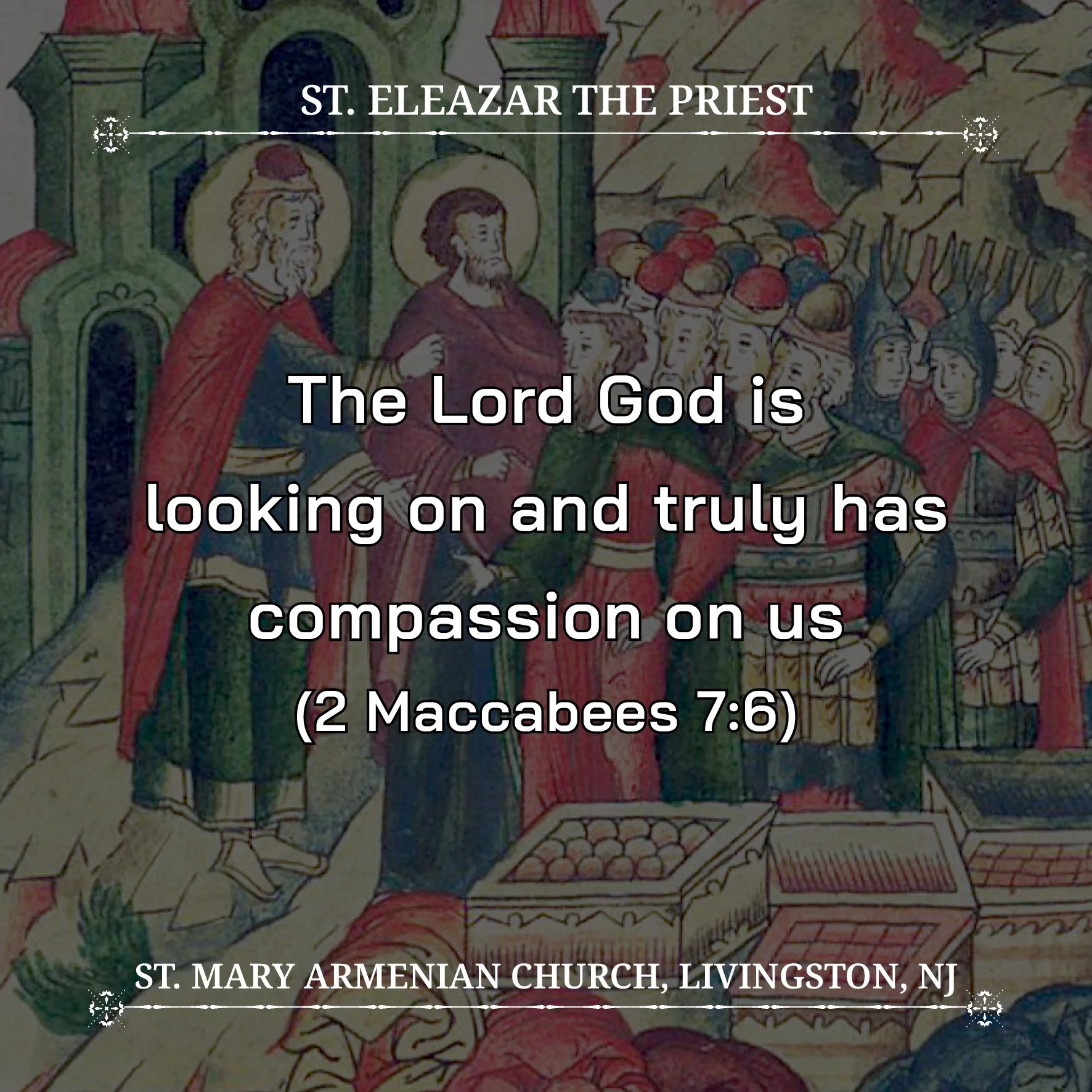
Commemoration DAY of
the Holy Maccabean Martyrs:
Eleazar the Priest, Solomonia (Shamuna),
and Her Seven Sons
Eleazar the Priest
During the persecution of the Jews under the Seleucid rulers of Antioch, a venerable elderly priest named Eleazar was brought before the authorities and forced to eat pork, which was forbidden by the Jewish Law. Eleazar refused and declared that he would rather suffer torture for his faith than preserve his life through cowardice.
The officials responsible for enforcing apostasy, out of respect for his advanced age, suggested a compromise. They advised him to prepare any meat he wished and eat it publicly while pretending that it was meat sacrificed to idols. In this way, they said, he could save his life.
But Eleazar, worthy of both his honorable old age and his sincere devotion to God, replied:
"Send me quickly to my grave. If I were to resort to such deception, many young people would think that Eleazar, at ninety years of age, had abandoned his faith. If I deceive them for the sake of preserving this brief earthly life, I would become a stumbling block to them and bring disgrace upon my name. Though I might escape human punishment through this deceit, whether living or dying, I could never escape the hand of the Almighty. Therefore, if I now die courageously, I will prove myself worthy of my old age and leave to the young a noble example of gladly and bravely dying for our holy laws."
(2 Maccabees 6:18–28)
When he finished speaking, he was immediately dragged away and scourged. Nearly dead from the beating, Eleazar sighed and said:
"The Lord, in His holy omniscience, knows the terrible physical agony I now endure from these blows. Though I could have escaped this cruel death, He also knows that in my soul I rejoice, because I suffer these torments out of reverence for Him."
(2 Maccabees 6:30)
Thus this venerable old man died, leaving by his death a heroic example for future generations, especially for the early Christians, who were deeply inspired by him and by the martyrs who followed.
Solomonia (Shamuna) and Her Seven Sons
During the same persecution under the Seleucid kings of Antioch occurred the martyrdom of a courageous mother and her seven equally steadfast sons.
The seven brothers were arrested together with their mother and brought before the king. They were beaten and tortured in an attempt to force them to eat pork.
The eldest son declared:
"Why do you question us? We are ready to die rather than violate the laws of our ancestors."
The king ordered that his tongue be cut out, the skin of his head be torn away, and his hands and feet be severed before the eyes of his mother and brothers. He was then thrown into a boiling cauldron and martyred.
The second brother was likewise scourged. Before his limbs were broken, the king asked whether he would eat pork. The young man answered:
"Never! You may take away this present life, but because we die for God's Law, the King of the universe will raise us up to an everlasting and new life."
When the third brother was asked the same question, he stretched out his hands and willingly offered his tongue, saying:
"The King of Heaven gave me these limbs, but His laws are more precious to me than they are. I believe that from Him I shall receive them again."
The king and all who witnessed this marveled at the young man's courage and his contempt for suffering.
As the fourth brother lay dying, he said to the king:
"It is better to die at the hands of men while trusting in God's promise to raise us again than to remain alive like you, for there will be no resurrection for you."
The fifth brother, dragged to the place of torture, declared:
"Though you are mortal, you have been given authority over men to act as you please. But do not think that God has abandoned our people. Wait, and you will see how His great power will punish both you and your descendants."
The sixth brother, before breathing his last, said:
"Do not deceive yourself, O king. These calamities have come upon us because of our sins, but do not imagine that you will escape the consequences of your wicked struggle against God."
The Courage of Their Mother
Their mother became especially worthy of everlasting remembrance.
She watched each of her seven sons suffer martyrdom before her own eyes, one after another. Yet she endured everything with courage because her hope was firmly placed in God.
Speaking to each of them in her native language, she encouraged them with noble determination and manly courage of spirit, saying:
"You came into my womb, but I do not know how. It was not I who gave you life and breath, nor formed the parts of your bodies. It is the Creator of all things who fashions each person from the very beginning and ordains the origin of everything. Therefore, in His mercy, He will restore to you your life and breath, because you now value His Law above your own lives."
The Youngest Son
Finally, the youngest son was brought forward.
The king attempted to persuade him with promises of wealth, honor, and high office if he would renounce the faith of his ancestors.
When the boy ignored these promises, the king summoned his mother and ordered her to persuade her son to save his life by obeying the king.
She approached him and said:
"My son, have pity on me. I carried you in my womb for nine months, nursed you for three years, raised you, and brought you to this age. Look at heaven and earth and everything in them, and know that God created all these things out of nothing, and that mankind also is His creation. Do not fear this butcher. Accept death and prove yourself worthy of your brave brothers, so that by God's mercy I may receive you again together with them."
Hardly had she finished speaking when the young man declared:
"What are you waiting for? I will not obey the king's command. I will obey the Law that was given to our fathers through Moses. And you, O king, who have devised every kind of torture against our nation, will not escape the hand of God. We suffer today because of our sins. If God has become angry with us for a little while in order to correct us, He will again be reconciled with His servants. But you, wicked man, do not deceive yourself with empty hopes. You who torture the servants of God will not escape the judgment of the Almighty and All-seeing God. My brothers died remaining faithful to God's covenant. After a brief suffering they have entered eternal life. Like them, I give my body and my life for the laws of our fathers. I pray that God may grant atonement to His people. And after many great afflictions, may He also lead you to confess that He alone is God. By the death of my brothers and myself, may God's wrath be turned away from our people."
Hearing these words, the king became enraged and had the young man put to death with even greater cruelty. The pure and holy youth departed this world trusting entirely in the Lord.
After all her sons had been killed, the blessed mother herself was also put to death.
(2 Maccabees 7)
The Names of the Seven Brothers
The Book of Maccabees itself does not record the names of the seven brothers. However, in the margin of an Armenian Bible published in Venice in 1860, their names are listed, in order, as:
Akar
Makar
Khoren
Khorsen
Aminadab
Galile
Gadide
These names differ completely from the versions found in the Greek and Latin liturgical calendars.
SCRIPTURE READINGS
~ Proverbs 29:2-7 ~
When the righteous are in authority, the people rejoice; but when the wicked rule, the people groan. A child who loves wisdom makes a parent glad, but to keep company with prostitutes is to squander one's substance. By justice a king gives stability to the land, but one who makes heavy exactions ruins it. Whoever flatters a neighbor is spreading a net for the neighbor's feet. In the transgression of the evil there is a snare, but the righteous sing and rejoice. The righteous know the rights of the poor; the wicked have no such understanding.
~ 2 Maccabees 6:18-7:42 ~
Eleazar, one of the foremost scribes, a man advanced in age and of noble appearance, was being forced to open his mouth to eat pork. But preferring a glorious death to a life of defilement, he went forward of his own accord to the instrument of torture, spitting out the meat as they should do who have the courage to reject food unlawful to taste even for love of life. Those in charge of that unlawful sacrifice took the man aside, because of their long acquaintance with him, and privately urged him to bring his own provisions that he could legitimately eat, and only to pretend to eat the sacrificial meat prescribed by the king. Thus he would escape death, and be treated kindly because of his old friendship with them. But he made up his mind in a noble manner, worthy of his years, the dignity of his advanced age, the merited distinction of his gray hair, and of the admirable life he had lived from childhood. Above all loyal to the holy laws given by God, he swiftly declared, “Send me to Hades!” “At our age it would be unbecoming to make such a pretense; many of the young would think the ninety-year-old Eleazar had gone over to an alien religion. If I dissemble to gain a brief moment of life, they would be led astray by me, while I would bring defilement and dishonor on my old age. Even if, for the time being, I avoid human punishment, I shall never, whether alive or dead, escape the hand of the Almighty. Therefore, by bravely giving up life now, I will prove myself worthy of my old age, and I will leave to the young a noble example of how to die willingly and nobly for the revered and holy laws.” He spoke thus, and went immediately to the instrument of torture. Those who shortly before had been kindly disposed, now became hostile toward him because what he had said seemed to them utter madness. When he was about to die under the blows, he groaned, saying: “The Lord in his holy knowledge knows full well that, although I could have escaped death, I am not only enduring terrible pain in my body from this scourging, but also suffering it with joy in my soul because of my devotion to him.” This is how he died, leaving in his death a model of nobility and an unforgettable example of virtue not only for the young but for the whole nation.
It also happened that seven brothers with their mother were arrested and tortured with whips and scourges by the king to force them to eat pork in violation of God’s law. One of the brothers, speaking for the others, said: “What do you expect to learn by questioning us? We are ready to die rather than transgress the laws of our ancestors.” At that the king, in a fury, gave orders to have pans and caldrons heated. These were quickly heated, and he gave the order to cut out the tongue of the one who had spoken for the others, to scalp him and cut off his hands and feet, while the rest of his brothers and his mother looked on. When he was completely maimed but still breathing, the king ordered them to carry him to the fire and fry him. As a cloud of smoke spread from the pan, the brothers and their mother encouraged one another to die nobly, with these words: “The Lord God is looking on and truly has compassion on us, as Moses declared in his song, when he openly bore witness, saying, ‘And God will have compassion on his servants.’” After the first brother had died in this manner, they brought the second to be made sport of. After tearing off the skin and hair of his head, they asked him, “Will you eat the pork rather than have your body tortured limb by limb?” Answering in the language of his ancestors, he said, “Never!” So he in turn suffered the same tortures as the first. With his last breath he said: “You accursed fiend, you are depriving us of this present life, but the King of the universe will raise us up[u] to live again forever, because we are dying for his laws.” After him the third suffered their cruel sport. He put forth his tongue at once when told to do so, and bravely stretched out his hands, as he spoke these noble words: “It was from Heaven that I received these; for the sake of his laws I disregard them; from him I hope to receive them again.” Even the king and his attendants marveled at the young man’s spirit, because he regarded his sufferings as nothing. After he had died, they tortured and maltreated the fourth brother in the same way. When he was near death, he said, “It is my choice to die at the hands of mortals with the hope that God will restore me to life; but for you, there will be no resurrection to life.” They next brought forward the fifth brother and maltreated him. Looking at the king, he said: “Mortal though you are, you have power over human beings, so you do what you please. But do not think that our nation is forsaken by God. Only wait, and you will see how his great power will torment you and your descendants.” After him they brought the sixth brother. When he was about to die, he said: “Have no vain illusions. We suffer these things on our own account, because we have sinned against our God; that is why such shocking things have happened. Do not think, then, that you will go unpunished for having dared to fight against God.” Most admirable and worthy of everlasting remembrance was the mother who, seeing her seven sons perish in a single day, bore it courageously because of her hope in the Lord. Filled with a noble spirit that stirred her womanly reason with manly emotion, she exhorted each of them in the language of their ancestors with these words: “I do not know how you came to be in my womb; it was not I who gave you breath and life, nor was it I who arranged the elements you are made of. Therefore, since it is the Creator of the universe who shaped the beginning of humankind and brought about the origin of everything, he, in his mercy, will give you back both breath and life, because you now disregard yourselves for the sake of his law.” Antiochus, suspecting insult in her words, thought he was being ridiculed. As the youngest brother was still alive, the king appealed to him, not with mere words, but with promises on oath, to make him rich and happy if he would abandon his ancestral customs: he would make him his Friend and entrust him with high office. When the youth paid no attention to him at all, the king appealed to the mother, urging her to advise her boy to save his life. After he had urged her for a long time, she agreed to persuade her son. She leaned over close to him and, in derision of the cruel tyrant, said in their native language: “Son, have pity on me, who carried you in my womb for nine months, nursed you for three years, brought you up, educated and supported you to your present age. I beg you, child, to look at the heavens and the earth and see all that is in them; then you will know that God did not make them out of existing things. In the same way humankind came into existence. Do not be afraid of this executioner, but be worthy of your brothers and accept death, so that in the time of mercy I may receive you again with your brothers.” She had scarcely finished speaking when the youth said: “What is the delay? I will not obey the king’s command. I obey the command of the law given to our ancestors through Moses. But you, who have contrived every kind of evil for the Hebrews, will not escape the hands of God. We, indeed, are suffering because of our sins. Though for a little while our living Lord has been angry, correcting and chastising us, he will again be reconciled with his servants. But you, wretch, most vile of mortals, do not, in your insolence, buoy yourself up with unfounded hopes, as you raise your hand against the children of heaven. You have not yet escaped the judgment of the almighty and all-seeing God. Our brothers, after enduring brief pain, have drunk of never-failing life, under God’s covenant. But you, by the judgment of God, shall receive just punishments for your arrogance. Like my brothers, I offer up my body and my life for our ancestral laws, imploring God to show mercy soon to our nation, and by afflictions and blows to make you confess that he alone is God. Through me and my brothers, may there be an end to the wrath of the Almighty that has justly fallen on our whole nation.” At that, the king became enraged and treated him even worse than the others, since he bitterly resented the boy’s contempt. Thus he too died undefiled, putting all his trust in the Lord. Last of all, after her sons, the mother was put to death. Enough has been said about the sacrificial meals and the excessive cruelties.
~ Hebrews 11:32-40 ~
And what more should I say? For time would fail me to tell of Gideon, Barak, Samson, Jephthah, of David and Samuel and the prophets— who through faith conquered kingdoms, administered justice, obtained promises, shut the mouths of lions, quenched raging fire, escaped the edge of the sword, won strength out of weakness, became mighty in war, put foreign armies to flight. Women received their dead by resurrection. Others were tortured, refusing to accept release, in order to obtain a better resurrection. Others suffered mocking and flogging, and even chains and imprisonment. They were stoned to death, they were sawn in two, they were killed by the sword; they went about in skins of sheep and goats, destitute, persecuted, tormented— of whom the world was not worthy. They wandered in deserts and mountains, and in caves and holes in the ground. Yet all these, though they were commended for their faith, did not receive what was promised, since God had provided something better so that they would not, apart from us, be made perfect.
~ Holy Gospel of St. Matthew 5:17-20 ~
"Do not think that I have come to abolish the law or the prophets; I have come not to abolish but to fulfill. For truly I tell you, until heaven and earth pass away, not one letter, not one stroke of a letter, will pass from the law until all is accomplished. Therefore, whoever breaks one of the least of these commandments, and teaches others to do the same, will be called least in the kingdom of heaven; but whoever does them and teaches them will be called great in the kingdom of heaven. For I tell you, unless your righteousness exceeds that of the scribes and Pharisees, you will never enter the kingdom of heaven.