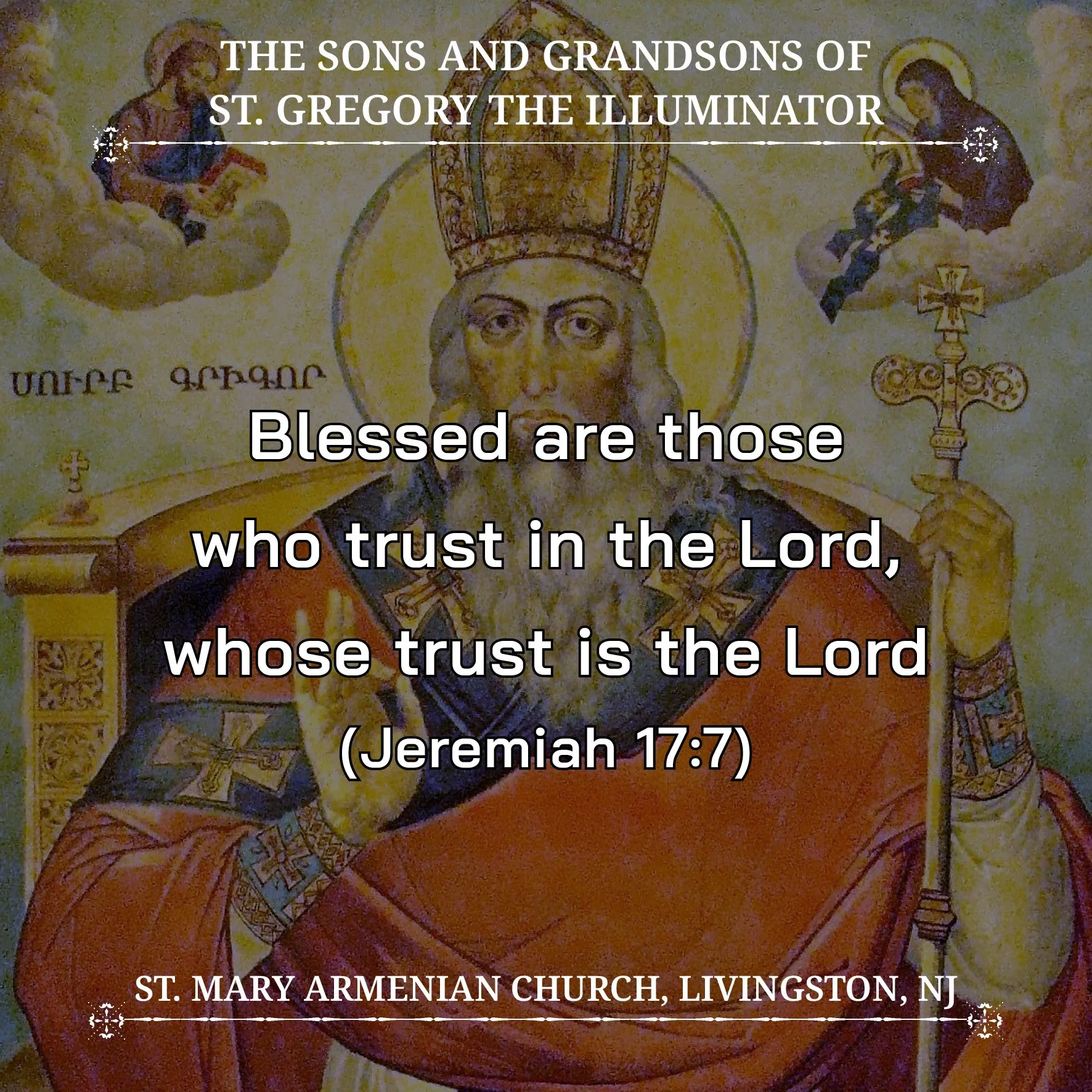
Commemoration DAY of
the Sons and Grandsons of
St. Gregory the Illuminator:
Aristakes, Vrtanes, Husik,
Grigoris, and Daniel
St. Aristakes the Catholicos (264–333)
Aristakes was the younger son of Saint Gregory the Illuminator, born in Caesarea in 264 AD. According to his biographer, Agathangelos, "from childhood he was brought up according to the service of God," meaning that he was raised from an early age for a life of devotion and ministry.
While still a young man, he embraced the ascetic life. As Agathangelos writes, he "adopted the rule of the solitary mountain dwellers," living among hermits under the spiritual guidance of an ascetic named Nicomachus. There he willingly subjected himself to hunger, thirst, hardship, and a simple life sustained by vegetables, clothed in coarse garments.
When he reached maturity and had attained great spiritual perfection, Aristakes gathered disciples of his own. He instructed them both in the disciplines of the spiritual life and in "serving the Gospel," indicating that he was also actively engaged in preaching. Enduring every trial and self-denial with willing courage, he attained a state of spiritual illumination and became "known to God and pleasing to all people." Thus, according to Agathangelos' restrained yet admiring account, Aristakes had already become an exemplary ascetic and spiritual leader before entering ecclesiastical office. This period of his life unfolded outside Armenia, in the region of Caesarea, while living as a hermit and preaching the Gospel.
Called Back to Armenia
Saint Gregory the Illuminator often spent long periods away from the patriarchal residence, traveling to preach the Gospel in distant regions or withdrawing into solitude.
King Tiridates III, recognizing Gregory's frequent absences and learning more about his sons, eventually sent messengers to bring them to Armenia. According to Agathangelos, they found Aristakes living in his secluded monastery in the wilderness. At first he refused the king's invitation, reluctant to leave his solitude, until "the multitude of Christians" persuaded him, saying:
"It is better to labor in cultivating God's vineyard than to remain alone in the desert."
Aristakes and his elder brother Vrtanes therefore accompanied the royal envoys to Armenia. Together with King Tiridates, they sought out their father and found him in his hermitage known as Manyay Ayr, in the district of Daranaghik.
The king requested that Saint Gregory consecrate both of his sons as bishops. As the Armenian historian Malachia Ormanian observes:
"By the common desire of all, Aristakes, being the more spiritual man, was called to the episcopate before his elder brother and was appointed assistant to his father in the patriarchal office."
Agathangelos likewise praises Aristakes, stating that after his consecration he undertook extensive pastoral and missionary work and that "his teaching surpassed even that of his father," meaning that he excelled as a teacher of the faith.
The Council of Nicaea
Few specific episodes of Aristakes' ministry are recorded. He spent much of his life traveling throughout Armenia, preaching from province to province and district to district.
His most notable achievement was representing the Armenian Church at the First Ecumenical Council of Nicaea in 325 AD, attending in place of his father. On the journey he was accompanied by prominent Eastern bishops, including John of Tizbon, Jacob of Nisibis, Euthalius of Edessa, and Leontius of Caesarea.
A well-known tradition from the Council tells that some Arians mocked Aristakes because his years of asceticism had left him thin and frail. They remarked that the Armenian bishop looked more like a peasant than a patriarch and sarcastically challenged him to take a plow and plow the sea.
Aristakes calmly accepted the challenge and, as though plowing solid ground, miraculously plowed the sea. Turning to his mockers, he said:
"If you too possess the true faith, go now and sow seed in the furrows I have made."
Ashamed, they were silenced, and their respect for him increased.
Second Catholicos of the Armenian Church
After Aristakes had been consecrated bishop and appointed his father's deputy, Saint Gregory was able to devote himself more fully to his life of solitude, confident that the patriarchal office was in capable hands.
When Saint Gregory disappeared from public life after receiving the Nicene Creed, and no one could discover his whereabouts, Aristakes naturally assumed full leadership of the Armenian Church. Having already governed effectively during his father's absences, he became the second Catholicos of the Armenian Church in 326 AD, at about sixty years of age.
His patriarchate lasted seven years.
Martyrdom
The Armenian historian Movses Khorenatsi calls Aristakes the "Spiritual Sword," explaining that he was "an enemy of every abomination and injustice."
One of those whom he openly rebuked was Arkeghelaos, the powerful prince of Tsopk, whose immoral and unjust conduct had drawn the Catholicos' condemnation, and perhaps even excommunication. Harboring resentment, the prince waited for an opportunity to take revenge.
While Aristakes was making one of his pastoral visits through the province of Fourth Armenia, he encountered Arkeghelaos on the road through Tsopk. There the prince killed him with his sword, and Aristakes received the crown of martyrdom.
His disciples carried his body to Til, his ancestral estate, where he was buried. Until the early twentieth century, his tomb was venerated at the Monastery of the Twin Patriarchs (Jukhtak Hayrapet) near Erzincan.
Hymn of the Armenian Church
The Armenian Sharakan (Book of Hymns) contains a special canon entitled "The Sons and Grandsons of Saint Gregory the Illuminator." In the hymn known as "Mankunk", each saint is commemorated individually. The first stanza is dedicated to Saint Aristakes, who is also known in some manuscripts as Rstakes.
Referring to his role in bringing the Nicene Creed to Armenia, the hymn proclaims:
Through you, O Holy Rstakes,
the divine confession of faith of the Holy Fathers
shone like a light upon all the Armenian people.
Unceasingly intercede for our souls.
St. Vrtanes the Catholicos (262–341)
Vrtanes was the elder son of Saint Gregory the Illuminator, born in Caesarea in 262 AD. Unlike his younger brother Aristakes, he first entered secular life, married, and had twin sons, Grigoris and Husik. Around 310 AD, he came to Armenia with his sons and his younger brother, Aristakes.
His Marriage and Family
The fact that Saint Gregory the Illuminator, his sons, and his grandsons had families has sometimes been cited to argue that bishops and catholicoi in the early Church were married while serving in office. However, two important points should be clarified.
First, these patriarchs married before entering the clergy, while they were still living as laymen. There is no historical evidence that their wives continued to live with them after they were ordained. More likely, either the spouses separated by mutual agreement, with the wives entering religious communities, or the wives had died before their husbands entered ecclesiastical service.
A later Armenian example is Catholicos Khrimian Hayrik, who was married as a layman but entered the priesthood only after his wife's death, eventually becoming Patriarch and later Catholicos.
The same was true of Bishop Vramshapuh of Barij, who first served as a married priest and, after the death of his wife, received the ranks of vardapet and bishop. His children were still living.
Likewise, when Vrtanes came to Armenia, his wife was no longer with him; only his twin sons accompanied him. They were about ten or twelve years old, and King Tiridates received them into the royal court to be educated alongside the other noble youths. Vrtanes himself, being a highly educated and spiritually mature man, probably assumed responsibilities within the royal court.
Bishop and Successor to Aristakes
Like his brother, Vrtanes was ordained priest and bishop by his father, Saint Gregory the Illuminator. This likely took place after Aristakes departed for the Council of Nicaea. During his brother's absence, Vrtanes administered the affairs of the patriarchate.
Even after Aristakes returned, Vrtanes continued overseeing much of the Church's administration, while Aristakes devoted himself primarily to missionary preaching throughout Armenia.
When news of Aristakes' martyrdom reached Vagharshapat in 333 AD, Vrtanes naturally succeeded him as the third Catholicos of the Armenian Church, at the venerable age of seventy.
The first years of his patriarchate were peaceful and prosperous. As the historian Faustus of Byzantium writes:
"Saint Vrtanes, like his father and brother, enlightened and guided the people, and righteousness and justice flourished in those days."
The Miracle at Ashtishat
Soon after Vrtanes became Catholicos, however, paganism again began to revive, even threatening his life.
Faustus of Byzantium records a remarkable incident.
Vrtanes had gone to Ashtishat, in the province of Taron, where stood the principal church of Armenia—the first and mother church—built on the site where Saint Gregory had overthrown the pagan temples. There he celebrated the Divine Liturgy commemorating Christ's saving Passion. Armenian kings, nobles, clergy, and multitudes of pilgrims customarily gathered there, especially seven times each year, to honor the holy places and particularly the shrine of Saint John the Baptist.
While Vrtanes was celebrating the liturgy with only a small company, about two thousand people who secretly continued practicing paganism assembled with the intention of murdering him. Their plot was encouraged in part by the queen herself, whom Vrtanes had rebuked for adultery and immoral conduct.
The mob surrounded the church courtyard, intending to seize the Catholicos. But as they attempted to advance, a miracle occurred: their arms were suddenly twisted behind their backs, and though no one had bound them, they became completely immobilized, falling helplessly to the ground.
When the liturgy concluded, Vrtanes approached them and asked:
"Who are you? Where have you come from? Whom do you seek, and why have you come?"
They openly confessed:
"We came to destroy this place and to kill you. We received permission and encouragement from the Queen of Armenia. But the Lord God has revealed His power to us and shown us that He alone is God. Now we know and believe that He alone is God. We remain here unable even to move."
Vrtanes then spent considerable time teaching them the Gospel and strengthening them in faith in Jesus Christ. After praying for them, he healed them and released them from their invisible bonds.
Freed, they all fell before him asking for repentance. He assigned them a period of penance, instructed them in the faith of the Holy Trinity, and baptized them. About two thousand people, not counting their wives and children, entered the Christian faith and were added to the Church.
Counselor of Kings
During Vrtanes' patriarchate, King Tiridates III died and was succeeded by his son Khosrov Kotak ("the Short"), who lacked both his father's physical stature and political abilities.
Vrtanes became not only the kingdom's spiritual leader but also one of its principal advisors in matters of government, diplomacy, and war. Encouraged by him, the Armenian army won major victories against renewed Persian invasions.
During one of these campaigns, however, the Armenian commander Vache Mamikonian was killed.
Faustus writes:
"Great mourning spread throughout Armenia, for many times the Lord had delivered the nation through his hand. But Bishop Vrtanes comforted everyone, including King Khosrov and the entire army, who had fallen into deep sorrow."
Vrtanes' consoling address begins with the words "Be comforted in Christ." It beautifully combines patriotism with Christian faith—qualities that would become hallmarks of Armenia's greatest church leaders throughout the centuries.
Among other things, he declared:
"Those who fell in battle died to preserve their homeland, the Church, and the law of God... so that Armenia would not be enslaved and the holy churches profaned... They gave their lives for the truth of the Lord, for the churches, the martyrs, the Law, the Holy Covenant, the rule of faith, the priesthood, and the countless faithful baptized into Christ. Those who do not spare their lives for such causes share the honor of Christ's martyrs. Therefore, let us not mourn them but honor them with the truth. Let us forever regard them as martyrs. Let everyone continually commemorate their courage as we do that of Christ's martyrs. Let us celebrate with joy, for through them we shall find favor with God, who will afterward grant us peace."
Faustus continues:
"The great High Priest Vrtanes established by law that their memory should be commemorated every year. He further decreed that all those who, in future generations, should die for the salvation of their homeland should likewise be remembered. He ordered that, during the Divine Liturgy, after the names of the saints were read, the names of these defenders should also be commemorated at the Holy Altar."
Thus, Vrtanes established an enduring Armenian tradition of honoring those who gave their lives in defense of both faith and homeland.
Correspondence with the Patriarch of Jerusalem
Vrtanes also consulted Patriarch Macarius of Jerusalem (314–334) regarding various liturgical and ecclesiastical matters. In response, Macarius composed a carefully organized document consisting of nine articles. This work, known as The Canons of Macarius, was later incorporated into the Armenian Book of Canons.
Final Years
Vrtanes served as Catholicos for eight years, courageously overcoming numerous difficulties and earning a lasting reputation as an experienced, energetic, and holy shepherd of the Armenian Church.
After the death of King Tiridates, Armenia entered a period of political instability. Nevertheless, Vrtanes successfully guided both Church and kingdom through these challenges. On at least two occasions, through his influential intervention, he secured Western military assistance and helped restore two Armenian kings to their throne. Throughout his life he remained their counselor, supporter, and spiritual guide, although, despite his efforts, they increasingly departed from the path of piety.
Death and Burial
Unlike his brother Aristakes, Vrtanes died a natural death at about eighty years of age.
He was buried in Thordan, in the district of Daranaghik, where his father, Saint Gregory the Illuminator, and King Tiridates III were also laid to rest.
In later centuries, the Monastery of the Holy Savior of the Nine Saints stood at this site, preserving and honoring the tombs of these great saints and national leaders.
Feast Day
Saint Vrtanes is commemorated together with the Sons and Grandsons of Saint Gregory the Illuminator.
The word dedicated to him in the Armenian hymn Mankunk reads:
You were chosen as the brave shepherd
of Christ's rational flock.
From your father, the Light, you blossomed forth as a noble ray,
O Lord Vrtanes.
Unceasingly intercede for our souls.
St. Husik the Catholicos (295–347)
Husik was the younger of the twin sons of Catholicos Vrtanes. While still very young, he was virtually compelled to marry the sister—or, according to some accounts, the daughter—of King Tiridates.
According to the historian Faustus of Byzantium, on the first night of his marriage Husik had a dream revealing that, although he would have twin sons, "they would not be pleasing to God" and would not enter the service of the Church. This revelation filled him with remorse for having married.
He "wept and prayed to God, repenting with great sorrow." Thereafter he refrained from marital relations and, like his father and his brother Grigoris, devoted himself entirely to the spiritual life. Before long his wife died, freeing him from this difficult situation.
Nevertheless, he continued to grieve that his own sons would not continue the family's ecclesiastical ministry. By that time the office of Catholicos had, to some extent, become hereditary within Saint Gregory the Illuminator's family, much like the Aaronic high priesthood of the Old Testament.
God, however, comforted Husik through a second vision, revealing that from one of his sons would be born a righteous descendant, and from him another, who would lay the foundations for a new spiritual renewal. They would become:
"the fountains of spiritual wisdom for the land of Armenia... pillars of the Church and ministers of the Living Word."
This prophecy referred to the future Catholicoi Saint Nerses the Great and Saint Sahak (Isaac) Partev. Therefore, "Husik gave great thanks to God for having been granted such a revelation and answer" (Faustus of Byzantium).
Election as Catholicos
Because Husik had married while still very young, he had not yet received holy orders. Consequently, when his father died in 341 AD and the patriarchal office naturally fell to him, he first had to be ordained.
At that time he was about forty to forty-five years old. King Tiran, who was also Husik's relative by marriage, sent him with a magnificent delegation of Armenian nobles and royal chariots to Caesarea for episcopal consecration. Faustus even records the names and family lineages of thirteen of the nobles who accompanied him.
After his ordination,
"they seated Husik upon the Apostolic Throne of Thaddeus and upon the throne of his grandfather, the great Gregory."
King Tiran himself traveled as far as Artashat to welcome the newly consecrated Catholicos upon his return.
His Character
Faustus of Byzantium gives the following description of Husik's inner life:
"After his father Vrtanes, Husik succeeded to the Apostolic Throne. He was truly his father's worthy son. In every respect he embraced an angelic way of life and acted always according to God's gifts and grace. Shepherding Christ's rational flock, he instructed everyone through the teachings of the Gospel. Though still young, he was vigorous and tall, handsome and noble in appearance, so that no one on earth equaled him. His soul was holy and radiant. He never occupied himself with earthly affairs. Like a brave soldier armed by Christ, he opposed the invisible enemy and overcame him. He never sought to please people or showed favoritism. Instead, he wielded the word of the Holy Spirit like a sword. The Giver of grace filled him with knowledge, which flowed like a spring into the ears and hearts of those who heard him."
His Bold Rebukes
Despite Husik's holiness, King Tiran, the nobles, and much of the nation lived contrary to God's commandments. Murder, injustice, bloodshed, and many other sins had become commonplace.
Against all these evils Husik continually spoke with "gentle and measured words and Christian exhortations," warning, rebuking, and reminding everyone of the unquenchable fire and eternal judgment.
He feared God so deeply that neither royal favor nor royal displeasure influenced him. Filled with knowledge of Scripture, he openly denounced the king and the nobles and even forbade them to enter the church.
Faustus writes that:
"He imposed severe ecclesiastical penalties upon them and, by priestly authority, rebuked them for their lawlessness, immorality, adultery, bloodshed, oppression, robbery, hatred of the poor, and many other similar sins."
Martyrdom
These rebukes earned Husik the hatred of King Tiran and his court.
One day the king and his nobles attempted to enter a church while Husik was celebrating the Divine Liturgy. The Catholicos courageously confronted them and said directly to the king:
"You are not worthy. Why are you entering? Do not come in."
Tiran immediately flew into a rage and ordered his attendants to attack him.
Inside the church they stoned the holy bishop, beating him so severely that he was left half dead.
This occurred at the fortress of Bnabel in the province of Tsopk.
Church officials carried the mortally wounded Catholicos to Thordan, his ancestral estate, where, after serving as Catholicos for only about six years, he died from his injuries. He was buried beside his father Vrtanes and his grandfather Saint Gregory the Illuminator.
A Historical Clarification
Although Husik died after being beaten for boldly confronting the king, the Armenian historian Movses Khorenatsi preserves another tradition claiming that Husik was stoned for smashing an image of Emperor Julian the Apostate.
However, this account does not fit the chronology, since Julian ruled from 360 to 363 AD, whereas Husik is generally believed to have died before 350 AD.
Liturgical Commemoration
Husik is commemorated together with the Sons and Grandsons of Saint Gregory the Illuminator.
The word dedicated to him in the Armenian hymn Mankunk alludes to the tradition recorded by Khorenatsi:
Praised among the martyrs, and worthy son of your father,
with courage you shattered the image of the lawless,
O Lord Saint Husik.
Unceasingly intercede for our souls.
St. Grigoris, Catholicos of Aghvank (295–337)
Grigoris was the first of the twin sons of Catholicos Vrtanes, born in Caesarea in 295 AD. He came to Armenia in 310 AD together with his father and his twin brother Husik.
Although he was raised and educated at the Armenian royal court, Grigoris longed for a life of celibacy. He entered the service of the Church under the guidance of his uncle, Saint Aristakes, who ordained him to the celibate clergy while he was still young because of
"the fruits of his Spirit-filled virtues, his spiritual character and maturity, and his possession of the knowledge of God" (Faustus of Byzantium).
Though still very young in age, his outstanding character, ability, and spiritual maturity led to his consecration as bishop for Aghvank (Caucasian Albania) and Iberia (Georgia), that is, for the lands bordering the Maskuts (Massagetae).
Missionary to the Caucasus
Saint Gregory the Illuminator had already preached among these Caucasian peoples, but the seeds of the Gospel had not yet taken deep root.
Furthermore, a delegation from the more receptive inhabitants of those northern regions had come to King Tiridates requesting that one of Gregory's descendants be sent to strengthen Christianity there.
Thus, around 320 AD, when Grigoris was only about twenty-five years old, he was consecrated bishop and sent to the Caucasus. Handsome in appearance and noble in bearing, he quickly won the respect of the people.
His mission at first prospered greatly.
According to Faustus:
"He went and renewed the churches there with wise and orderly leadership, following the example of his grandfather, the first Gregory."
He extended his missionary activity even into the frontier regions of Atropatene.
"He became a preacher of the true faith of Christ and made a marvelous and wonderful impression upon everyone."
Meanwhile, he never relaxed the rigor of his own spiritual discipline:
"Through the most difficult and countless acts of self-denial, through fasting, holiness, sleepless vigils, untiring prayers, and fervor, he continually prayed to God for everyone. By God's grace he faithfully advanced the work of the Gospel and the oversight of the holy Church. With zeal and diligence he encouraged all people to embrace a virtuous life, and by his prayers day and night he inspired both those near and those far away with spiritual fervor."
His Martyrdom
After strengthening the churches in the central and southern regions, Grigoris traveled northward and entered the camp of the King of the Maskuts, whose army consisted of many Caucasian tribes.
There he began preaching Christ and proclaiming the Gospel.
At first they listened willingly and accepted his teaching about the one true God.
But when Grigoris began explaining the moral demands of the Gospel, they learned that before the true God
robbery, plunder, murder, greed, oppression, theft, and coveting the possessions of others were hateful sins.
Hearing this, they became angry and said:
"If we no longer plunder, raid, or seize what belongs to others, how shall we support so great an army?"
Although Grigoris patiently tried to persuade them, using "many gracious words" to encourage them to earn their livelihood peacefully, they refused to listen any further.
They said among themselves:
"By these teachings this man wishes to rob us of our bravery. If we listen to him and become Christians, how shall we live? We shall not even be able to ride our horses according to our ancient customs."
They concluded that Grigoris had been sent by the Armenian king to prevent their customary raids into Armenia by means of his preaching.
Therefore they resolved to kill him.
They brought a fierce horse, tied Grigoris by ropes to its tail, and released it across the plain called Vatnyats, near the shores of the Caspian Sea.
Thus the faithful preacher of Christ received the crown of martyrdom.
Burial
His companions recovered his holy relics and carried them to the village of Amaras, where they buried him in a church.
Faustus concludes:
"Every year the people of that region gather on his feast day and commemorate his courageous witness."
Thus, in 337 AD, Saint Grigoris was cruelly martyred when he was scarcely forty years old.
His tomb has survived to the present day in the Monastery of Amaras in the village of Amaras in Artsakh (Nagorno-Karabakh), within the church that bears his name.
The Armenian Church commemorates Saint Grigoris twice each year:
On the Feast of the Sons and Grandsons of Saint Gregory the Illuminator.
On the Feast of the Discovery of His Relics, celebrated on the fifth Monday after the Feast of the Holy Cross, together with the Twelve Armenian Hermits.
The word dedicated to Saint Grigoris in the Mankunk hymn of the Armenian Church reads:
By your pure virginity you were numbered among the bodiless angels,
a true high priest and witness of Christ, O Saint Grigoris.
Unceasingly intercede for our souls.
St. Daniel the Syrian, Chorepiscopus (†374)
Saint Daniel was a Syrian who became thoroughly Armenian in spirit and ministry. He is regarded as the spiritual son of Saint Gregory the Illuminator and was martyred by order of the Armenian king for defending the Armenian Church and the authority of the Armenian Catholicosate.
The historian Faustus of Byzantium devotes an entire chapter (Book IV, Chapter 14) to his life.
Disciple of Saint Gregory
Daniel was a disciple of Saint Gregory the Illuminator, who ordained him chorepiscopus—a rural bishop serving under the authority of another bishop.
Faustus calls him "a marvelous man" and states that he was appointed supervisor of the churches of the province of Taron. He also attributes to Daniel responsibility for "the administration of the great judicial affairs."
The historian Movses Khorenatsi refers to him as a hyouperetēs ("assistant" or "administrator"), which the Armenian scholar Malachia Ormanian interprets as the superintendent of the estates belonging to the family of Saint Gregory or to the Patriarchal See, whose principal center was Ashtishat in Taron, the main base of Daniel's ministry.
Faustus, however, describes his office even more broadly, calling him:
"the overseer, commander, inspector, and guardian of all the great churches of Armenia."
Missionary and Evangelist
Daniel was also renowned as an apostolic missionary.
According to Faustus:
"He preached in the foreign lands of Persia and converted countless people from error to the worship of the true God."
He was faithful not only in carrying out his office but also
"to the authority of the Patriarchal Throne and to the preservation of the faith of the Universal Armenian Church."
Wonderworker
Alongside his preaching, Daniel was celebrated for extraordinary miracles.
Faustus writes:
"He was a marvelous man who performed miracles and mighty works in the name of our Lord and Savior Jesus Christ."
Neither heat nor cold, distance nor hardship hindered him.
It was said that:
during winter, the snow melted before him as he traveled;
on his journeys, he sped like lightning and arrived at his destination like a bird in flight;
he raised the dead, healed the sick, and performed so many miracles that, according to the historian, "it is impossible to record them all one by one."
Ascetic Life
Although Daniel lived the life of a hermit in deserted places, he never neglected the needs of others.
His clothing was simple, and he did not even carry a staff. His food consisted only of the roots of wild plants.
Faustus says of him:
"His word was powerful before God. Whatever he asked, he received; whatever he spoke came to pass."
His Disciples
Daniel trained several distinguished ascetics, to each of whom Faustus devotes a short account:
Shaghitan, who was said to be accompanied by more than twenty lions and healed many sick people.
Epiphan, who converted many pagans to Christianity and was called "the light of the land of Tsopk."
Artith, Bishop of Basean, a man filled with holiness and the Holy Spirit, who traveled widely performing great miracles.
Gind of Taron, a man of exceptional virtue who became the foremost of the Armenian hermits and the spiritual teacher of the monasteries of Armenia.
Refusal of the Catholicosate
After the death of Catholicos Husik, the Armenian Church needed a new Catholicos.
Since Husik's sons had chosen military and secular careers and had no desire to enter the clergy, the attention of the nation naturally turned to Daniel, who was admired for his holiness, learning, and his close spiritual relationship with Saint Gregory the Illuminator.
Messengers found him in the town of Til and brought him before King Tiran.
Already an elderly man, Daniel knew why he had been summoned. Before the king could speak, he himself began addressing the king and those assembled, delivering a stern prophetic rebuke.
Faustus preserves this discourse at great length.
Daniel declared:
"Have you forgotten your Creator God, His mercy toward you, and the wonders He has worked for you? You have returned to the idolatry and errors of your forefathers and have surrendered yourselves to hatred, greed, oppression of the poor, immorality, deceit, robbery, and murder."
He compared the Armenians to ancient Israel:
"You have become like the Jewish nation, who not only refused to listen to the apostles and prophets sent to them but even killed them. You have done the same."
Then he uttered a solemn prophecy:
"The Lord will take away your kingdom and your priesthood. Like Israel, you shall be divided and scattered throughout the world. You shall remain like sheep without a shepherd—abandoned and without care."
Finally, the righteous old man concluded:
"You have called me to be your head and leader. But how can I lead those who refuse to turn to the Lord? How can I become the head of a nation that the Lord has forsaken? How can I lift up my hands in prayer for those whose hands are stained with the blood of His holy servants?"
Martyrdom
At first the king stood silent in astonishment.
Then, overcome with anger, King Tiran ordered Daniel to be strangled to death.
His disciples recovered the body of the blessed martyr and buried him in a place called Hatsyats Drakht ("Paradise of Hats"), where Daniel had spent much of his ascetic life.
Until recent centuries, the Monastery of Saint Daniel stood there, preserving his tomb.
The final tome of the Mankunk hymn dedicated to this feast honors him with these words:
Through your ascetic life you became a companion of the heavenly hosts while still on earth.
Rebuking the king, you were martyred for the name of the Lord, O Saint Daniel.
Unceasingly intercede for our souls.
Feast Day
The Armenian Church commemorates Aristakes together with the Sons and Grandsons of Saint Gregory the Illuminator.
The feast is ordinarily observed on the third Saturday after the Feast of the Nativity, depending on the Armenian liturgical calendar. When the period between the Nativity and Great Lent is unusually short, the feast is transferred to the third Saturday after the Feast of the Transfiguration (Vardavar).
SCRIPTURE READINGS
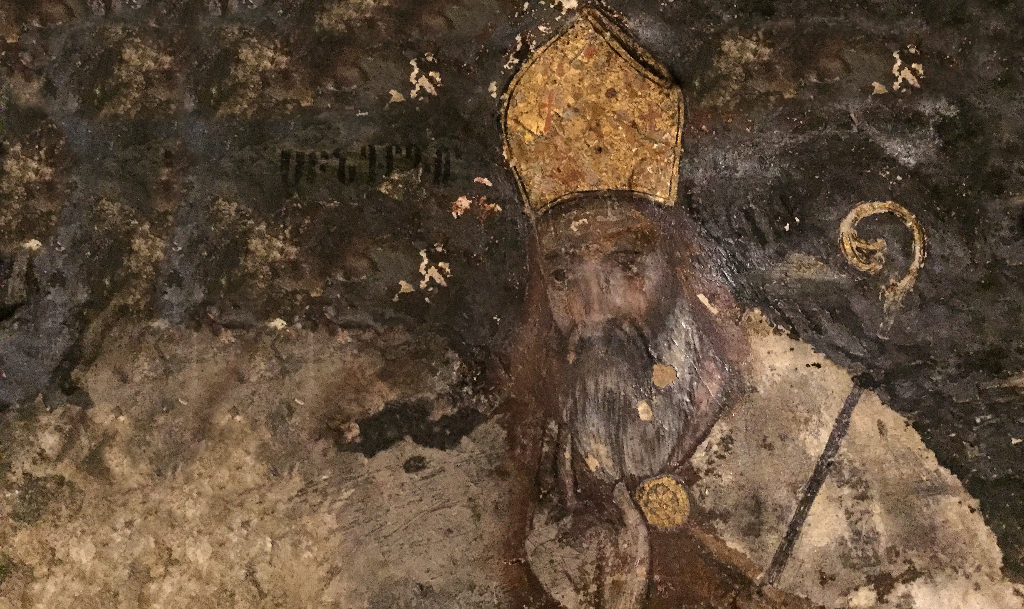
~ Jeremiah 17:7-8 ~
Blessed are those who trust in the Lord, whose trust is the Lord. They shall be like a tree planted by water, sending out its roots by the stream. It shall not fear when heat comes, and its leaves shall stay green; in the year of drought it is not anxious, and it does not cease to bear fruit.
~ Isaiah 61:3-7 ~
They will be called oaks of righteousness, the planting of the Lord, to display his glory. They shall build up the ancient ruins, they shall raise up the former devastations; they shall repair the ruined cities, the devastations of many generations. Strangers shall stand and feed your flocks, foreigners shall till your land and dress your vines; but you shall be called priests of the Lord, you shall be named ministers of our God; you shall enjoy the wealth of the nations, and in their riches you shall glory. Because their shame was double, and dishonor was proclaimed as their lot, therefore they shall possess a double portion; everlasting joy shall be theirs.
~ 2 Timothy 1:6-14 ~
For this reason I remind you to rekindle the gift of God that is within you through the laying on of my hands; for God did not give us a spirit of cowardice, but rather a spirit of power and of love and of self-discipline. Do not be ashamed, then, of the testimony about our Lord or of me his prisoner, but join with me in suffering for the gospel, relying on the power of God, who saved us and called us with a holy calling, not according to our works but according to his own purpose and grace. This grace was given to us in Christ Jesus before the ages began, but it has now been revealed through the appearing of our Savior Christ Jesus, who abolished death and brought life and immortality to light through the gospel. For this gospel I was appointed a herald and an apostle and a teacher, and for this reason I suffer as I do. But I am not ashamed, for I know the one in whom I have put my trust, and I am sure that he is able to guard until that day what I have entrusted to him. Hold to the standard of sound teaching that you have heard from me, in the faith and love that are in Christ Jesus. Guard the good treasure entrusted to you, with the help of the Holy Spirit living in us.
~ Holy Gospel of St. Luke 11:29-32 ~
When the crowds were increasing, he began to say, "This generation is an evil generation; it asks for a sign, but no sign will be given to it except the sign of Jonah. For just as Jonah became a sign to the people of Nineveh, so the Son of Man will be to this generation. The queen of the South will rise at the judgment with the people of this generation and condemn them, because she came from the ends of the earth to listen to the wisdom of Solomon, and see, something greater than Solomon is here! The people of Nineveh will rise up at the judgment with this generation and condemn it, because they repented at the proclamation of Jonah, and see, something greater than Jonah is here!