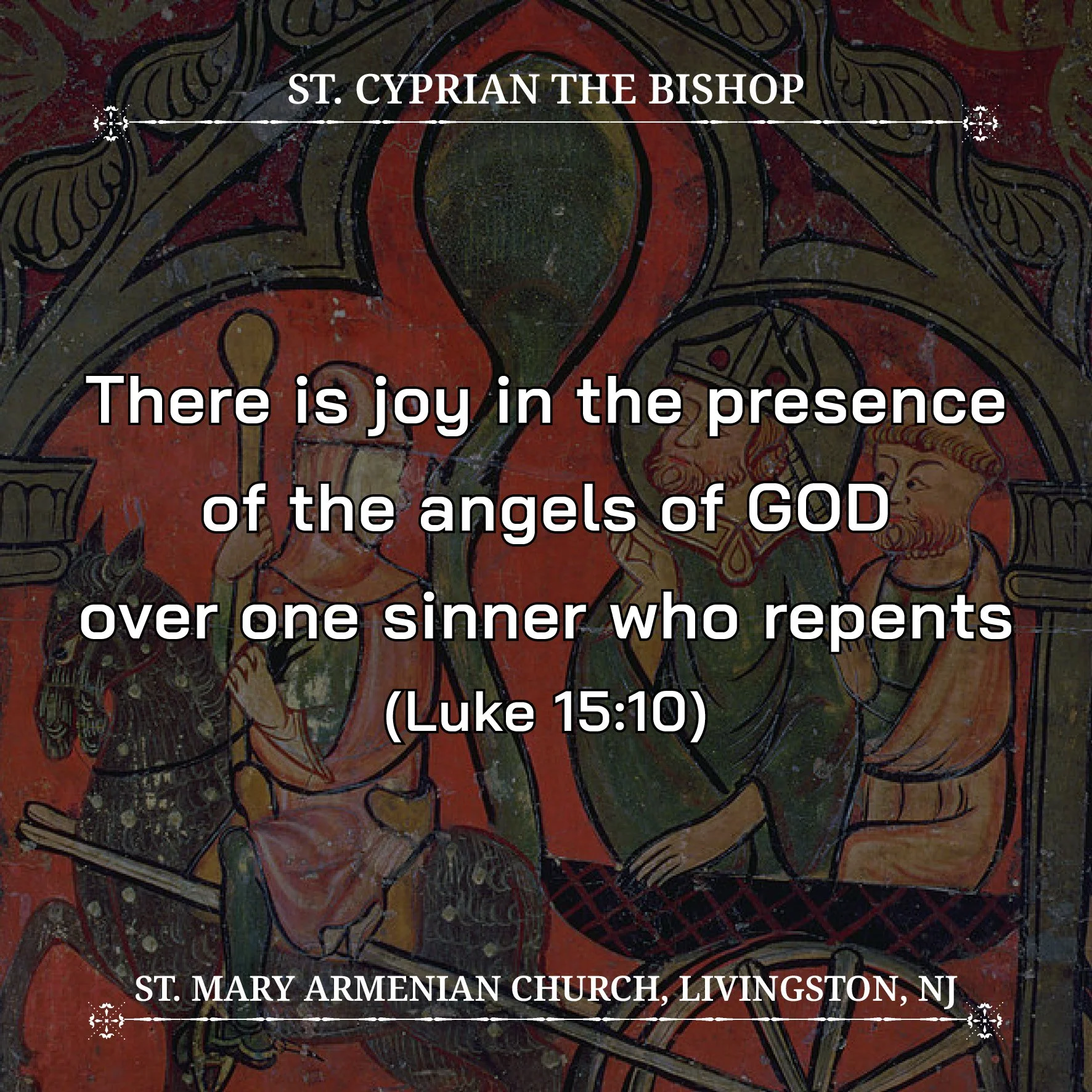
Commemoration DAY of
ST. Cyprian the Bishop
and the Forty-Five Martyrs,
the Holy Virgins Justina,
Euphemia, and Christina
Saint Cyprian the Bishop
In the history of the Church, two renowned saints named Cyprian are known. One—the more historically prominent—is the African bishop from the West, while the other, whose story is more legendary, belongs to the East.
The first, one of the greatest Fathers of the Western Church, lived in the first half of the third century (c. 200–258 AD). Converted from paganism at the age of forty-five, he quickly became Bishop of Carthage, one of the most important cities of Roman North Africa (in present-day Tunisia) and a major center of Christianity.
The second, an Eastern popular saint, lived during the latter half of the third century and served as a bishop in Syria, though it is uncertain whether he ministered in Antioch or another city. In Armenian tradition, these two Cyprians have often been confused.
The Latin Church commemorates the African and Antiochian Cyprians on separate feast days, while the Armenian and Greek Churches observe only one feast without explicitly distinguishing between them. Since the Armenian and Greek calendars commemorate the Virgin Justina together with Cyprian, it is clear that the Cyprian being honored is the Eastern Cyprian of Antioch, whose life is inseparably connected with that of Saint Justina. The Greek Church celebrates them together on October 2, corresponding to the Armenian Haysmavurk. The Armenian Church commemorates them on the Monday following the second Sunday after the Feast of the Transfiguration (Vardavar). The African Cyprian is commemorated only in the Latin tradition, on September 16.
The Life of Saint Cyprian
According to the Armenian Haysmavurk, Cyprian was a nobleman of Antioch from a distinguished and wealthy family. He was highly educated, versed in philosophy, and renowned for his mastery of magic.
In the same city lived Justina, the daughter of a pagan priest. After becoming a Christian, she converted her parents as well. A pagan nobleman wished to marry her, but she refused, declaring that she was already betrothed to Christ.
Desperate, the nobleman sought the help of the magician Cyprian, offering him a great sum of money to use his magical arts to win Justina's love. Instead, events took an unexpected turn: Cyprian himself was overwhelmed by the divine power manifested through Justina. Recognizing that her faith possessed a power greater than his magic, he abandoned sorcery, accepted baptism, and became a Christian.
Within a short time, he advanced through all the ranks of the clergy and was consecrated bishop. He devoted himself wholeheartedly to preaching the Gospel. His activities eventually attracted the attention of the imperial authorities, who arrested him and subjected him to severe tortures. Through God's power, he survived them all. Finally, he was sent to Nicomedia (modern İzmit), where, by order of Emperor Diocletian, he was beheaded.
Among Armenians, Saint Cyprian is especially famous because of the popular prayer book attributed to him, one of the most widely distributed devotional books sold by the Jerusalem Armenian Patriarchate. It begins by listing more than four hundred names of God, concluding with the prayer:
"By the power of Your holy and awesome names, be the protector of Your servant."
The prayer book also contains a chapter entitled The Conversion of Patriarch Cyprian, in which the saint recounts his own conversion in the highly embellished style characteristic of Eastern hagiography.
The Forty-Five Martyrs
These martyrs served in the imperial regiment known as the "Armenian Legion," stationed in the city of Nicopolis in Lesser Armenia during the reign of Emperor Licinius.
During the persecution of Christians, forty-three soldiers of the legion boldly confessed that they were Christians and intended to remain faithful to Christ.
When asked where they were from, their spokesman, Levond, replied:
"Some are from this city, and others from the surrounding districts, but our true homeland is heaven, where our Heavenly Father and our Lord Jesus Christ dwell. He taught us not to worship idols."
The judge answered:
"Your Christ was crucified long ago and is dead."
Levond replied:
"You have heard only of His death. Now learn that He rose again and lives forever in heaven."
The judge asked:
"How can someone who died three hundred years ago still be alive?"
Levond answered:
"Indeed, He accepted death for our sake, to free us from sin and idolatry. But He rose again and lives forever. He also taught us to die for His sake, so that we too may rise again and live eternally."
A lengthy discussion followed in which Levond exposed the futility of idolatry and proclaimed the greatness of Christianity.
The soldiers were imprisoned and subjected to severe tortures while continuing in constant prayer. An Armenian woman secretly brought them water, but eventually she was forbidden to do so. Levond called to her in Armenian, instructing her to pass the water through a nearby window so that his companions would not weaken and lose the crown of martyrdom.
Two prison guards, witnessing both the prisoners' courage and the miraculous light shining in the prison, rushed inside and declared:
"We too are Christians and wish to become soldiers of Christ."
Their number thus increased to forty-five.
Eventually, the judge sentenced them to death by fire. Their legs were first broken to prevent them from escaping the flames. As they were thrown into the fire, one soldier who had accidentally been left behind cried out:
"I am here! I am here!"
He too was seized and cast into the fire, where all forty-five glorified God together and surrendered their souls in the year 317 AD.
Their bones were thrown into a river, but through God's providence they were recovered by Christians and buried with honor.
Saint Justina the Virgin
As already noted, the life of Saint Justina is closely connected with that of Saint Cyprian, and they are commemorated together. Her Greek name is Justina.
Raised in pagan Antioch, she embraced Christianity, converted her parents, and devoted herself to a life of exceptional holiness. A young man fell in love with her, but she firmly rejected him. He sought the help of the magician Cyprian, who repeatedly attempted through demonic powers to influence her, but all his enchantments failed.
Recognizing that Justina possessed a divine power far greater than his own magical arts, Cyprian repented, accepted baptism, and became a Christian. Together they devoted themselves to preaching the Gospel. After enduring many tortures, from which they were miraculously delivered, they were finally sent to Nicomedia, where Emperor Diocletian ordered them to be beheaded around the year 300 AD.
Saint Euphemia the Virgin
Euphemia was the daughter of a wealthy Christian family in Chalcedon and was raised in every virtue. Desiring to dedicate herself entirely to God, she vowed perpetual virginity.
During a pagan festival honoring one of the city's gods, her absence was noticed. Soldiers found her in hiding with forty-nine other Christians, all engaged in prayer.
They were ordered to participate in the pagan celebration, but all openly confessed that they were Christians and had completely rejected idolatry.
The forty-nine Christians were immediately executed. Euphemia, however, was subjected to prolonged and terrible tortures, yet miraculously survived each one.
Finally, she was thrown to wild beasts. The animals merely licked her hands and feet instead of attacking her. Euphemia prayed that she would rather die by the teeth of beasts than through human cruelty. At last, a bear bit her, and she peacefully surrendered her soul to God.
The beasts did not mutilate her holy body. Christians secretly recovered it and buried her with honor around 303 or 307 AD.
Saint Christina the Virgin
Saint Christina was from Tyre, which Eastern Christian tradition identifies with the famous city of Tyre in Phoenicia (modern Lebanon), placing her life in the early second century. Western tradition, however, associates her with a small town in Italy and dates her life to the late fourth century.
In both traditions, her father was the governor of the city. When Christina was only ten or twelve years old, he built a tower, filled it with gold and silver idols, and dedicated both the tower and his daughter to the pagan gods. Surrounded by twelve attendants, Christina was appointed a priestess.
Enlightened by divine grace, Christina gradually came to understand the emptiness of idolatry. The teachings she had heard about Christ in her childhood became increasingly clear to her, leading her to embrace Christianity.
She smashed the idols, sold their gold and silver, and distributed the proceeds to the poor.
Her father flew into a rage, subjected her to unspeakable tortures, and imprisoned her, warning that if she did not renounce Christianity by the following day, she would be put to death. That very night, however, he died suddenly.
The next governor subjected the young girl to even harsher tortures. Seeing that she remained steadfast in her faith, he finally ordered her execution by the sword.
According to Western tradition, her relics were later transferred to Palermo in Sicily, where a magnificent church was built over her tomb, and devotion to Saint Christina spread widely.
The Armenian Church commemorates them on the Monday following the second Sunday after Vardavar.
SCRIPTURE READINGS
~ Isaiah 46:12-13 ~
Listen to me, you stubborn of heart, you who are far from deliverance: I bring near my deliverance, it is not far off, and my salvation will not tarry; I will put salvation in Zion, for Israel my glory.
~ Galatians 3:13-22 ~
Christ redeemed us from the curse of the law by becoming a curse for us—for it is written, "Cursed is everyone who hangs on a tree"— in order that in Christ Jesus the blessing of Abraham might come to the Gentiles, so that we might receive the promise of the Spirit through faith. Brothers and sisters, I give an example from daily life: once a person's will has been ratified, no one adds to it or annuls it. Now the promises were made to Abraham and to his offspring; it does not say, "And to offsprings," as of many; but it says, "And to your offspring," that is, to one person, who is Christ. My point is this: the law, which came four hundred thirty years later, does not annul a covenant previously ratified by God, so as to nullify the promise. For if the inheritance comes from the law, it no longer comes from the promise; but God granted it to Abraham through the promise. Why then the law? It was added because of transgressions, until the offspring would come to whom the promise had been made; and it was ordained through angels by a mediator. Now a mediator involves more than one party; but God is one. Is the law then opposed to the promises of God? Certainly not! For if a law had been given that could make alive, then righteousness would indeed come through the law. But the scripture has imprisoned all things under the power of sin, so that what was promised through faith in Jesus Christ might be given to those who believe.
~ Holy Gospel of St. Luke 15:1-10 ~
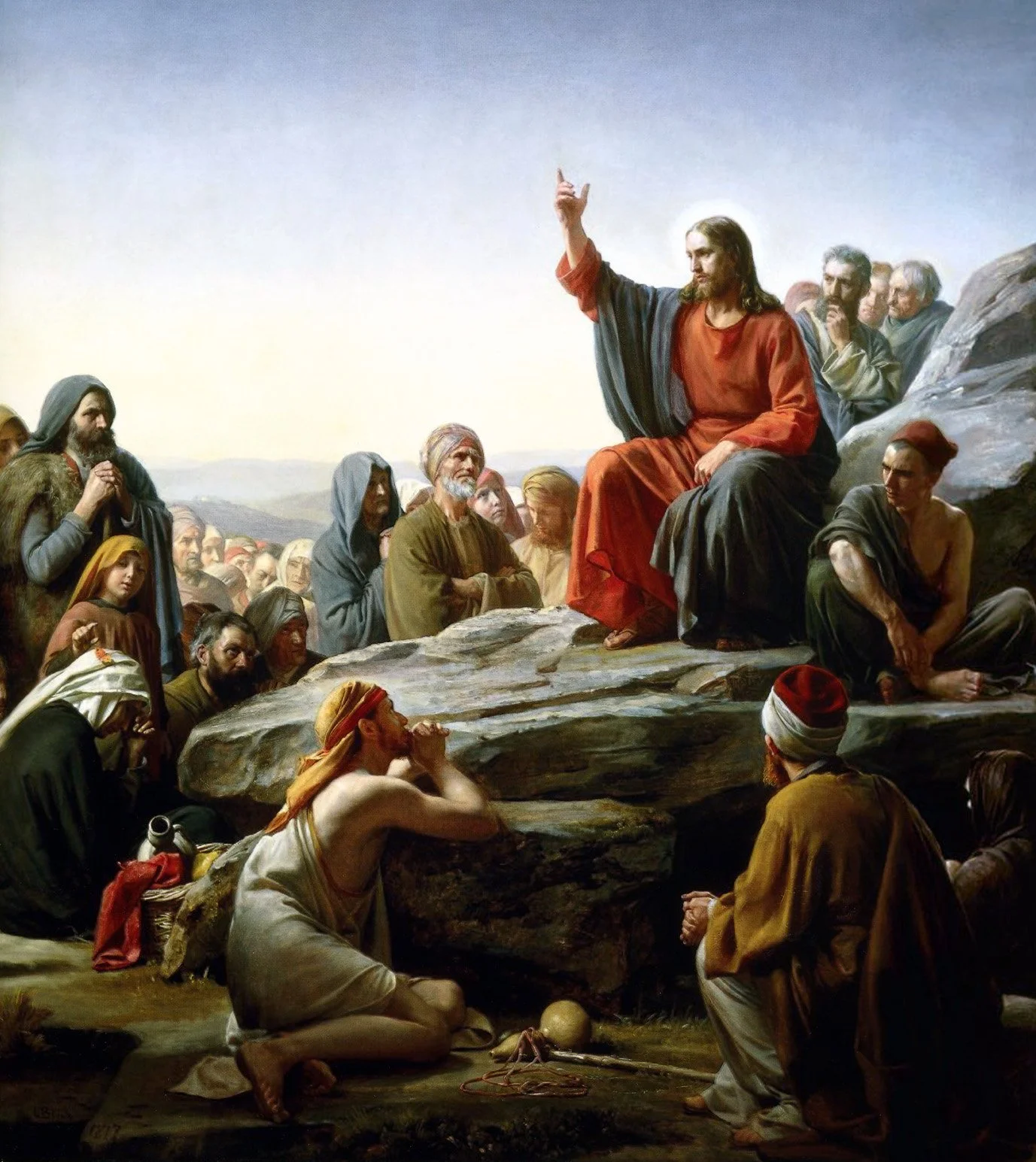
Now all the tax collectors and sinners were coming near to listen to him. And the Pharisees and the scribes were grumbling and saying, "This fellow welcomes sinners and eats with them." So he told them this parable: "Which one of you, having a hundred sheep and losing one of them, does not leave the ninety-nine in the wilderness and go after the one that is lost until he finds it? When he has found it, he lays it on his shoulders and rejoices. And when he comes home, he calls together his friends and neighbors, saying to them, "Rejoice with me, for I have found my sheep that was lost.' Just so, I tell you, there will be more joy in heaven over one sinner who repents than over ninety-nine righteous persons who need no repentance. "Or what woman having ten silver coins, if she loses one of them, does not light a lamp, sweep the house, and search carefully until she finds it? When she has found it, she calls together her friends and neighbors, saying, "Rejoice with me, for I have found the coin that I had lost.' Just so, I tell you, there is joy in the presence of the angels of God over one sinner who repents."