Commemoration Day of
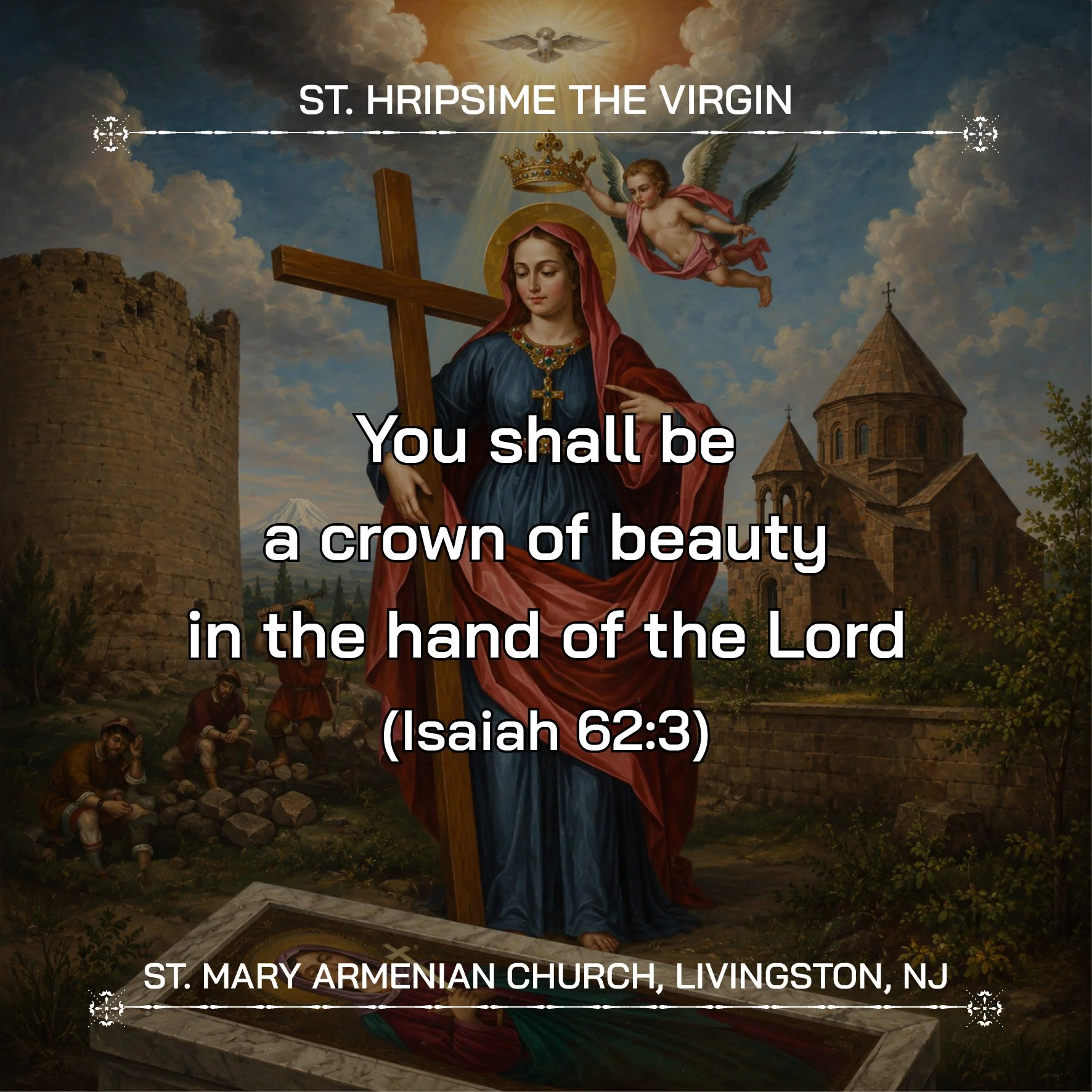
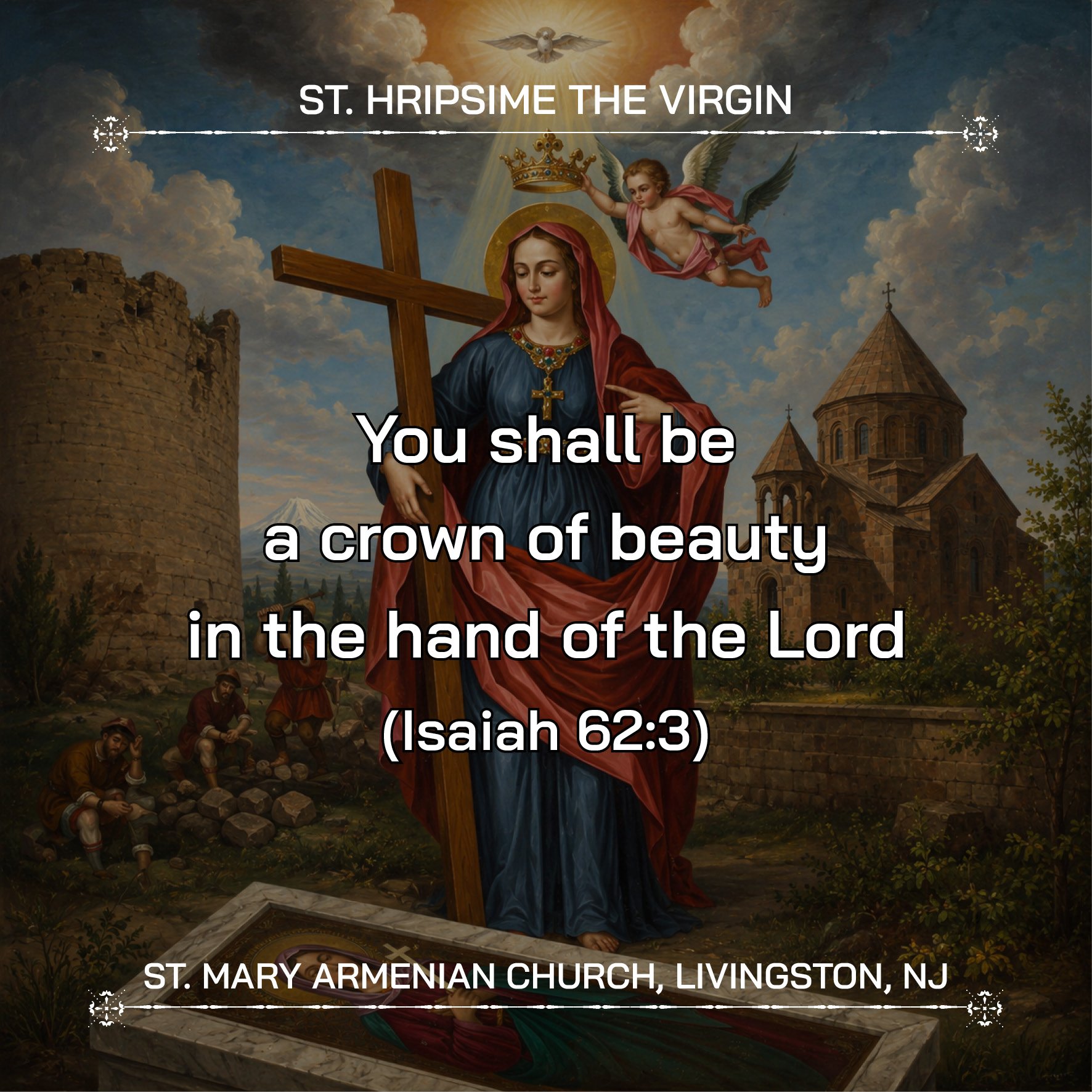
St. Hripsime the Virgin
and Her Companions
These are a group of 37 martyrs who are commemorated under two separate names in Armenian calendars and synaxaria because they were martyred over the course of two days and in separate groups.
Historical tradition considers them Roman, but because they were martyred in Armenia and shed their pure blood in our land before the adoption of Christianity, Armenians came to regard them as their own and especially beloved by the Armenian Church.
According to the historian Agathangelos, the primary source of their story, the Roman Emperor Diocletian (284–305) wished to marry the most beautiful virgin in his empire. Scouts sent throughout the land discovered, in the noble virgin named Hripsime, the most beautiful bride. She was one of the Christian virgins living in a convent in Rome under the leadership of the abbess Gayane.
When the virgins learned of the emperor’s command, they secretly fled Rome by night. Traveling by ship, they first went to Alexandria in Egypt, then to Jerusalem, and afterward through Edessa to Van, where they settled for a time on the slopes of Mount Varag. Feeling unsafe there as well, they traveled north and finally settled near Vagharshapat, the capital of Armenia at that time, in a place called Hndzan.
The reason they were found in Armenia was again connected to Diocletian, who instructed King Trdat of Armenia to locate the virgins who had taken refuge in his kingdom and send them back to the emperor. Indeed, Trdat’s men quickly found Hripsime and brought her before the king. Trdat, captivated by her beauty, decided to possess her himself. Hripsime rejected and resisted him.
The king summoned Gayane and ordered her to persuade her disciple to accept his proposal. Instead, Gayane encouraged her spiritual daughter to remain steadfast in her refusal and not exchange the joy of heaven for earthly glory and pleasures. Because she disobeyed the king’s command, Gayane was subjected to severe torture and thrown into the royal prison along with two companions.
Hripsime eventually escaped and fled to join her companions. But Trdat, who was described as a giant and powerful man, was ashamed, according to the hymn, that “he had been defeated by a maiden like a child.” Enraged, he sent executioners and ordered Hripsime’s death. They stretched her upon stakes fixed into the ground by her hands and feet and burned her body with torches. Seeing that she was still alive, they gouged out her eyes and dismembered her limb by limb, thus martyring the glorious witness of Christ.
When the other virgins approached to gather and bury her body honorably, 32 of them were slaughtered by the sword.
The executioners then invaded their dwelling and found the only surviving virgin, who had remained behind because of illness, and killed her as well.
The following day, Trdat ordered the execution of the leader and abbess of the group, Gayane, together with her two companions. First, Gayane’s tongue was cut out because she had dared encourage Hripsime to resist the king. Then, like Hripsime, they were stretched upon the ground by their hands and feet, flayed alive, and finally killed by the sword. The martyrdom of Gayane and her companions took place outside the city on the southern side.
At the time of these martyrdoms, Saint Gregory the Illuminator was still imprisoned in Khor Virap. For nine days the relics of the saints remained unburied, yet no wild beast or bird of prey approached them.
As punishment for the murder of the innocent virgins, King Trdat went mad. In order to heal him, Gregory was released from the pit, and his first act was to gather the unburied relics of the holy virgins separately into tombs and bury them at the places of their martyrdom.
He built three shrines:
one at the place where Hripsime and her 32 companions were martyred,
another at their dwelling place, where the sick virgin was killed,
and the third at the site where Saint Gayane and her two companions were martyred.
The tombs containing the bodies of the virgins were sealed with Gregory’s seal.
A century later, the shrines had fallen into ruin and were nearly forgotten. Therefore, Catholicos St. Sahak the Great (387–438) searched for and rediscovered them. He added his own seal beside that of Gregory the Illuminator and rebuilt the shrines with honor.
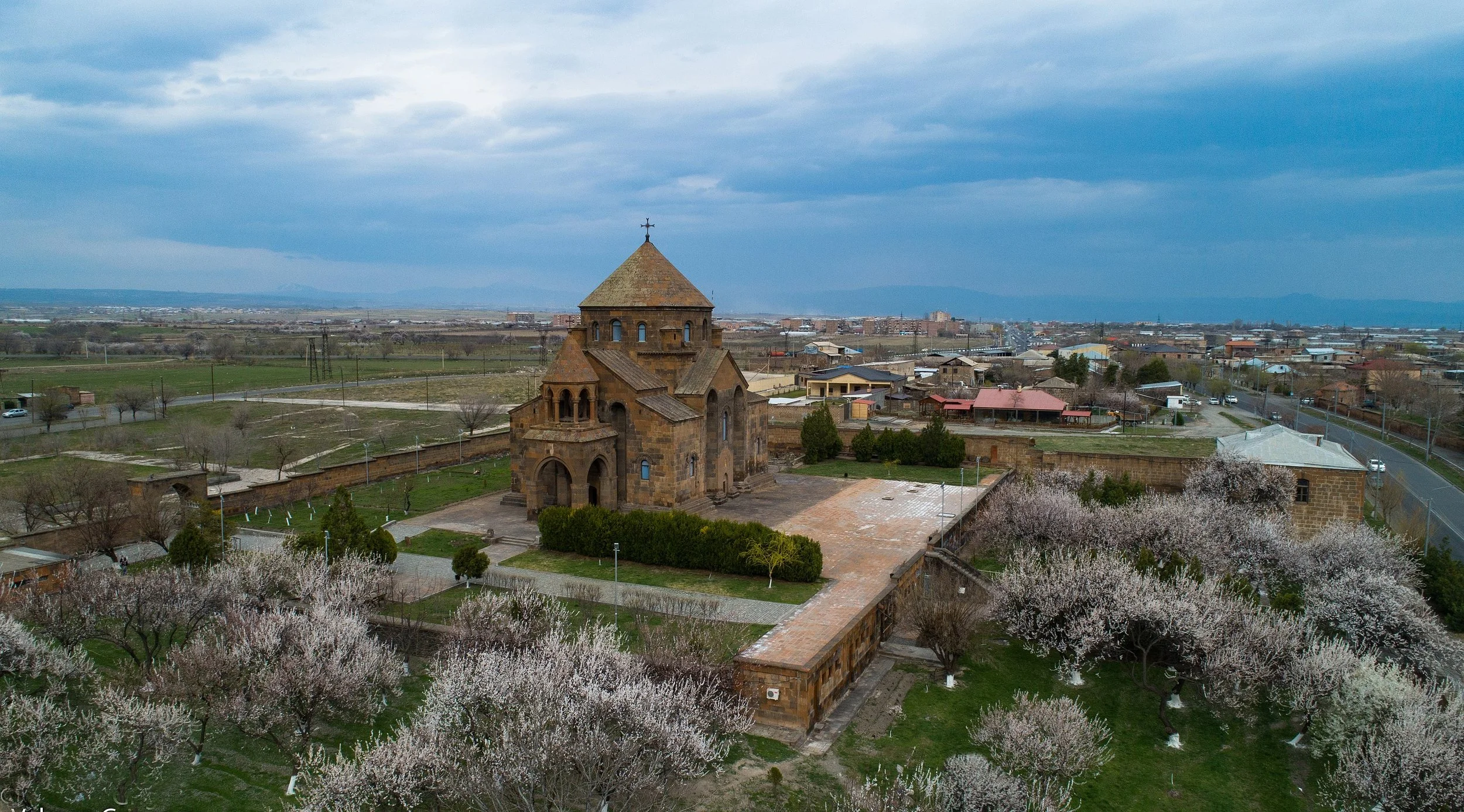
Two centuries later, during the reign of Catholicos Komitas of Aghdzk (615–628), the chapels again had become neglected. After demolishing the old shrine of Hripsime, he discovered the tombs of the holy virgins, added his seal to them, reburied them, and in 618 built above them a magnificent church described as: “Marvelous, graceful, lovely, and radiant.”
Beneath the altar of this cathedral he built an underground chapel where the saint’s tomb remains to this day. The church itself has also survived almost entirely unchanged except for the bell tower, which was added in later centuries.
Likewise, Catholicos Ezr I of Parajnakert (630–641) replaced the modest chapel of Gayane with a magnificent new church: “Spacious and luminous, built with carved stone and lime.”
This church too has survived almost intact.
The third chapel was later rebuilt by Catholicos Nahabed I (1691–1705) under the name Shoghakat.
The historian Ormanian testifies that beneath the cathedrals of Hripsime and Gayane there are underground chambers built of large stones in which the saints’ bones are preserved. Their existence was reconfirmed in later centuries: the Hripsime chamber during an attempted theft by Latin monks, and the Gayane chamber through investigations prompted by the curiosity of Father Hovhannes, as recorded by the historian Arakel of Tabriz.
In 1978, during restoration work near the northeastern wall of the Church of Saint Hripsime, archaeologists discovered an early Christian basilica-type chapel. Excavations in 1979 uncovered several graves containing decapitated skeletons, believed to be the remains of Hripsime’s 32 companions.
Regarding this discovery, Catholicos Vazgen I and the Mother See of Holy Etchmiadzin issued an official statement declaring: “This latest discovery is a new material testimony to the historical authenticity of the Christian faith of the Armenian people.”
According to Agathangelos, the virgins were martyred in the year 301, the same year Gregory emerged from the pit. Their martyrdom occurred on the 26th and 27th days of the Armenian month of Hori, corresponding according to Ormanian to November 6 and 7, though Armenian synaxaria later listed them on October 5 and 6.
Today, the Armenian Church commemorates:
the feast of the Hripsimian Virgins on the first Monday following the Sunday marking the beginning of the Resurrection Sundays,
and the Gayanian Virgins on the following Tuesday.
The Hripsimian Virgins occupy a central place in Armenian hagiography and are extensively described by Agathangelos and Movses Khorenatsi.
Armenian synaxaria likewise devote nearly ten pages to their story. Each concludes with a hymn of praise dedicated to the saints. One such hymn says: “Bride of Christ, who today through your martyr’s blood were translated into heaven, adorned like a queen seated at the right hand of the Heavenly King, receive us also—your children born from your virginal labor, the faithful of the Armenian Church who celebrate you—into the choir of your heavenly bridal chamber, so that together with you we may glorify the Father, the Son, and the Holy Spirit forever. Amen.”
Another hymn praises Hripsime and Gayane: “Hripsime, who like the sun rose from the West into the Eastern world, together with the radiant stars who were with you… Hripsime, beauty of virgins, glory of martyrs, joy of angels, terror of demons…” and continues: “Gayane, purest wisdom, conqueror of adversaries… Hripsime, brightest ray, fruitful olive tree, sweet-fruited palm…”
The narrative concludes with these words: “It is fitting that we marvel at the boundless love of mankind shown by our Savior and the inscrutable providence of His supreme wisdom, who through the shedding of the blood of the holy virgins and through their intercession granted wondrous enlightenment to the land of Armenia…”
The Armenian people’s devotion to the Holy Hripsimian Virgins became so profound that it produced two enduring masterpieces.
The first is the Saint Hripsime Church, one of the masterpieces of Armenian architecture, distinguished by its restrained grandeur and extraordinary beauty.
The second is the beautiful hymn “Persons Dedicated to the Love of Christ” (“Anzik Nviryal”), composed in honor of the Hripsimian Virgins. Both works are associated with Catholicos Komitas, who before becoming catholicos served as custodian of the sanctuary of Saint Hripsime.
The hymn “Anzik Nviryal” is arranged according to the letters of the Armenian alphabet and therefore consists of 36 stanzas. It became the first and finest example of alphabetically structured Armenian hymns, inspiring many later compositions.
Ormanian described the hymn as: “A masterpiece of Armenian poetic meter, rich in language and style, remarkable in its poetic artistry… an incomparable sacred poem.”
The melody, though simple and monophonic, is deeply moving, graceful, lively, and sweet-flowing, making it one of the most important hymns in Armenian sacred music.
Three verses are traditionally highlighted:
“Souls dedicated to the love of Christ,
Heavenly martyrs and wise virgins,
Through you Mother Zion celebrates with her children in pride.
Hripsime, bearer of the desirable great mystery,
Chosen from the earth and numbered among the angels;
You became an example of holiness for virgins,
A teacher for righteous men.
Having reached the summit of glory,
The thirty-seven companions are praised with honor and splendor,
For this is the number of the blessed virgins
Who were crowned with unfading crowns
In everlasting eternity.”
SCRIPTURE READINGS
~ Proverbs 31:29-31 ~
“Many daughters have done virtuously, and many have achieved excellence, but you surpass them all. Charm is deceitful and beauty is vain, but a woman who fears the Lord shall be praised. Give her of the fruit of her hands, and let her own works praise her in the gates.”
~ Isaiah 61:10-62:3 ~
I will greatly rejoice in the Lord, my whole being shall exult in my God; for he has clothed me with the garments of salvation, he has covered me with the robe of righteousness, as a bridegroom decks himself with a garland, and as a bride adorns herself with her jewels. For as the earth brings forth its shoots, and as a garden causes what is sown in it to spring up, so the Lord God will cause righteousness and praise to spring up before all the nations.
For Zion's sake I will not keep silent, and for Jerusalem's sake I will not rest, until her vindication shines out like the dawn, and her salvation like a burning torch. The nations shall see your vindication, and all the kings your glory; and you shall be called by a new name that the mouth of the Lord will give. You shall be a crown of beauty in the hand of the Lord, and a royal diadem in the hand of your God.
~ Romans 15:30-16:2 ~
I appeal to you, brothers and sisters, by our Lord Jesus Christ and by the love of the Spirit, to join me in earnest prayer to God on my behalf, that I may be rescued from the unbelievers in Judea, and that my ministry to Jerusalem may be acceptable to the saints, so that by God's will I may come to you with joy and be refreshed in your company. The God of peace be with all of you. Amen.
I commend to you our sister Phoebe, a deacon of the church at Cenchreae, so that you may welcome her in the Lord as is fitting for the saints, and help her in whatever she may require from you, for she has been a benefactor of many and of myself as well.
~ Holy Gospel of St. Matthew 10:26-33 ~
"So have no fear of them; for nothing is covered up that will not be uncovered, and nothing secret that will not become known. What I say to you in the dark, tell in the light; and what you hear whispered, proclaim from the housetops. Do not fear those who kill the body but cannot kill the soul; rather fear him who can destroy both soul and body in hell. Are not two sparrows sold for a penny? Yet not one of them will fall to the ground apart from your Father. And even the hairs of your head are all counted. So do not be afraid; you are of more value than many sparrows. "Everyone therefore who acknowledges me before others, I also will acknowledge before my Father in heaven; but whoever denies me before others, I also will deny before my Father in heaven.