Commemoration Day of
the Prophet Elijah
Among the faithful prophets of God who lived in Israel, Saint Elijah stands out among the biblical prophets for his ascetic life in the wilderness, his many miracles, his fiery zeal, and his extraordinary departure from this world. He is one of only two people in the Bible (the other being Enoch) about whom it is written that they were “taken up” into heaven without dying (Genesis 5:18–24).
His story is recorded in the Third and Fourth Books of Kings in the Bible. Scripture tells us that Elijah was a Tishbite from the settlement of Tishbe in Gilead. He lived in the first half of the 9th century BC during the reign of King Ahab. Elijah became the embodiment of God’s righteous anger on earth. He lived far from the corrupting influences of “civilization,” in the midst of nature.
God sent him to King Ahab, who was one of the most wicked kings descended from Solomon and among all the kings before him. Ahab’s wife, the Phoenician Jezebel, was an idol worshiper and had brought idols and around a thousand pagan priests from her homeland in order to spread idolatry in Israel. Jezebel had also massacred many prophets of God. At that time, the land had sunk into idolatry, and the Israelites had forgotten their true God, whom Elijah faithfully and zealously served.
Fiery Elijah, protector of the persecuted and the poor, appeared before King Ahab and fearlessly rebuked and condemned him, declaring that the land of Israel would have no rain or even dew for several years as punishment.
A king’s faithfulness to God is the source of a nation’s prosperity, whereas idolatry and disobedience to God inevitably lead to disaster. The Prophet Elijah reminded the king of God’s commandments.
He tried to keep his people from following idols by showing them who the one true God really is. He urged Israel not to worship Baal, but instead to place their hope and faith in God.
Ahab and Jezebel persecuted Elijah because he sought to bring repentance into people’s hearts. Since Israel had turned away from the Lord and become idolatrous, a great drought struck the land, and for three and a half years no rain fell in Israel.
By God’s command, Elijah withdrew to the brook Cherith, from which he drank water, while ravens brought him bread and meat twice a day. Because of the drought, the brook eventually dried up, and once again by God’s command Elijah traveled north to the city of Zarephath, where a widow welcomed him and gave him shelter. Elijah blessed the woman’s jars of oil and flour so that they would never become empty, and he also raised her dead son back to life.
In the third year of the drought, Elijah again went before Ahab and instructed him to gather his thousand priests on Mount Carmel and summon the people of Israel:
“How long will you waver between two opinions? If the Lord is God, follow Him; but if Baal is god, then follow Baal.
Bring two bulls—one for you and one for me. Let each of us place the sacrifice on the altar, but do not light the fire. Then you will call upon your god, and I will call upon the Lord my God. The God who answers by fire—He is the true God.”
And so it was done. Through a divine miracle, Elijah demonstrated the power of the true God of Israel and exposed the helplessness and deception of the pagan priests. Seeing this, the people, by Elijah’s command, seized the priests and killed them. Elijah then prayed, and rain finally returned.
Queen Jezebel, enraged by the killing of her priests, threatened to have Elijah killed the very next day.
Despite his courage and miraculous powers, Elijah was still “a man subject to passions like us,” as the Apostle James says (James 5:17). Therefore, fearing Jezebel’s threats, he fled southward to Mount Sinai, where he waited in a cave for a new message from God.
God appeared to him in the form of a gentle breeze and commanded him to return and anoint Hazael as king of Syria, Jehu as king of Israel, and Elisha as the prophet who would succeed him.
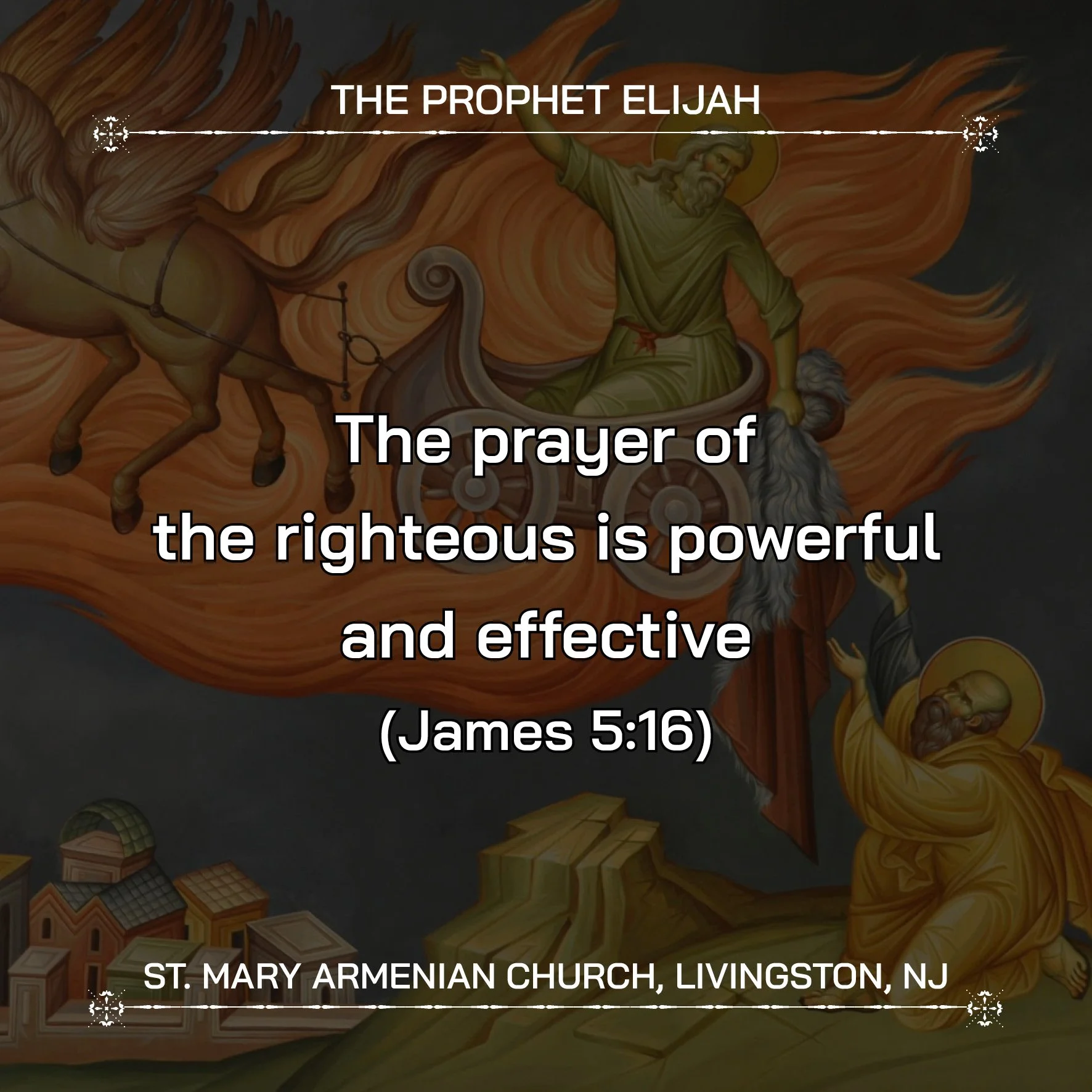
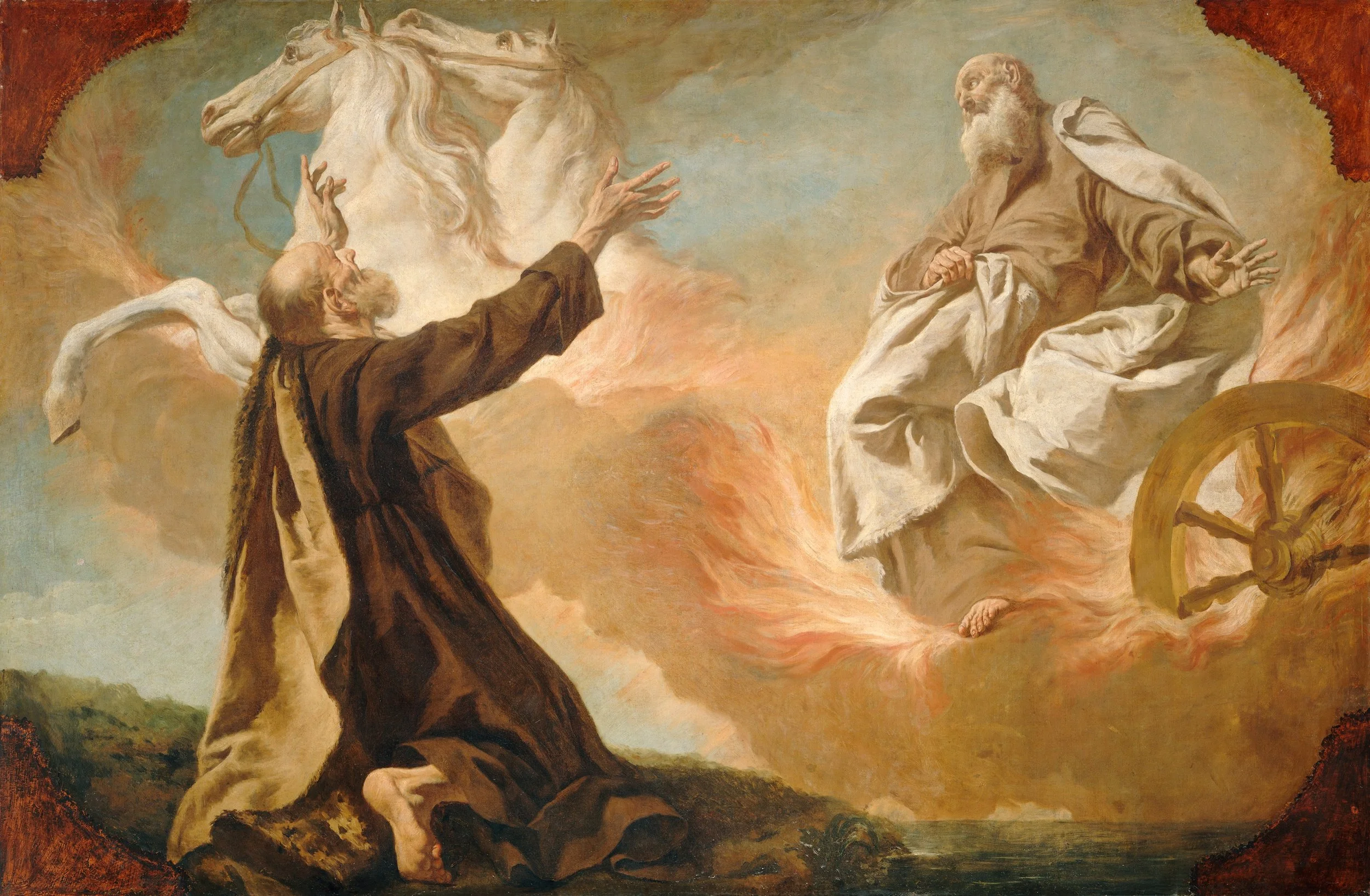
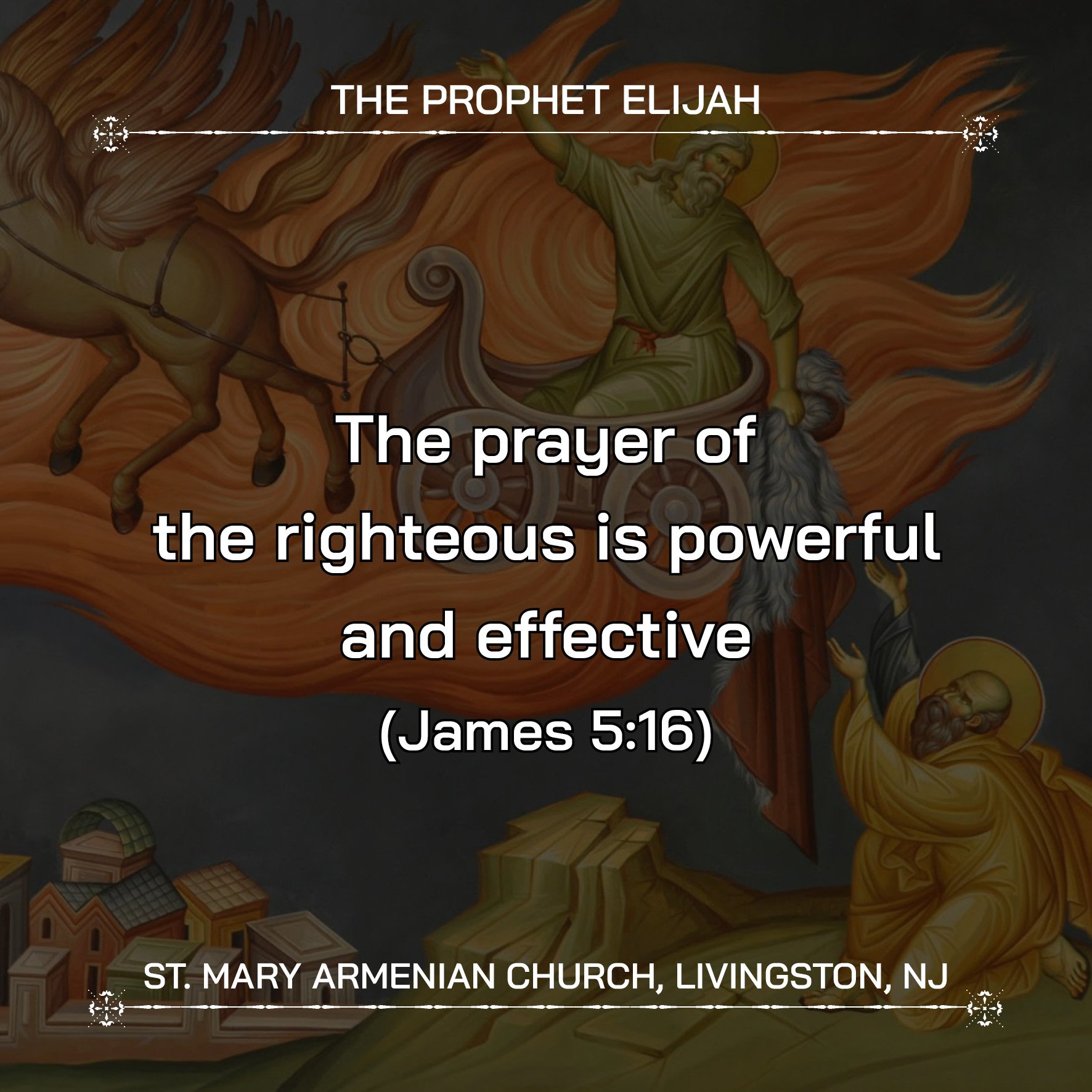
After glorifying Elijah on earth through many miracles, God took him up to heaven in a fiery chariot and whirlwind. Elijah ascended into heaven before the eyes of Elisha without experiencing ordinary human death. Before this, Elisha had asked Elijah to receive a double portion of his spirit—that is, twice the power given to Elijah—and indeed this came to pass. As Elijah was taken up in the chariot, he threw down his mantle, which Elisha picked up. Thus, although Elijah’s life was filled with miracles, Elisha surpassed him in this regard because he had received a double portion of Elijah’s spirit.
According to the Prophet Malachi, Elijah will return to earth at the end of the world as the forerunner of Christ’s Second Coming, just as John the Baptist became the forerunner of the Lord’s First Coming. This is why John the Baptist is compared to Elijah in the Gospel, and it is said that he came in the spirit of Elijah.
At the Transfiguration of the Lord Jesus on the mountain, Elijah was one of the two holy men who appeared and spoke with Him.
Perhaps it is because Elijah did not experience death and because of the unique honor of becoming the forerunner of the Lord’s Second Coming that the Armenian Church commemorates him on the Sunday following the Feast of Pentecost, even though saints are generally not commemorated on Sundays in the Armenian Church.
SCRIPTURE READINGS
~ 1 Kings 18:29-46 ~
As midday passed, they raved on until the time of the offering of the oblation, but there was no voice, no answer, and no response. Then Elijah said to all the people, "Come closer to me"; and all the people came closer to him. First he repaired the altar of the Lord that had been thrown down; Elijah took twelve stones, according to the number of the tribes of the sons of Jacob, to whom the word of the Lord came, saying, "Israel shall be your name"; with the stones he built an altar in the name of the Lord. Then he made a trench around the altar, large enough to contain two measures of seed. Next he put the wood in order, cut the bull in pieces, and laid it on the wood. He said, "Fill four jars with water and pour it on the burnt offering and on the wood." Then he said, "Do it a second time"; and they did it a second time. Again he said, "Do it a third time"; and they did it a third time, so that the water ran all around the altar, and filled the trench also with water. At the time of the offering of the oblation, the prophet Elijah came near and said, "O Lord, God of Abraham, Isaac, and Israel, let it be known this day that you are God in Israel, that I am your servant, and that I have done all these things at your bidding. Answer me, O Lord, answer me, so that this people may know that you, O Lord, are God, and that you have turned their hearts back." Then the fire of the Lord fell and consumed the burnt offering, the wood, the stones, and the dust, and even licked up the water that was in the trench. When all the people saw it, they fell on their faces and said, "The Lord indeed is God; the Lord indeed is God." Elijah said to them, "Seize the prophets of Baal; do not let one of them escape." Then they seized them; and Elijah brought them down to the Wadi Kishon, and killed them there. Elijah said to Ahab, "Go up, eat and drink; for there is a sound of rushing rain." So Ahab went up to eat and to drink. Elijah went up to the top of Carmel; there he bowed himself down upon the earth and put his face between his knees. He said to his servant, "Go up now, look toward the sea." He went up and looked, and said, "There is nothing." Then he said, "Go again seven times." At the seventh time he said, "Look, a little cloud no bigger than a person's hand is rising out of the sea." Then he said, "Go say to Ahab, "Harness your chariot and go down before the rain stops you.' " In a little while the heavens grew black with clouds and wind; there was a heavy rain. Ahab rode off and went to Jezreel. But the hand of the Lord was on Elijah; he girded up his loins and ran in front of Ahab to the entrance of Jezreel.
~ 2 Kings 2:1-15 ~
Now when the Lord was about to take Elijah up to heaven by a whirlwind, Elijah and Elisha were on their way from Gilgal. Elijah said to Elisha, "Stay here; for the Lord has sent me as far as Bethel." But Elisha said, "As the Lord lives, and as you yourself live, I will not leave you." So they went down to Bethel. The company of prophets who were in Bethel came out to Elisha, and said to him, "Do you know that today the Lord will take your master away from you?" And he said, "Yes, I know; keep silent." Elijah said to him, "Elisha, stay here; for the Lord has sent me to Jericho." But he said, "As the Lord lives, and as you yourself live, I will not leave you." So they came to Jericho. The company of prophets who were at Jericho drew near to Elisha, and said to him, "Do you know that today the Lord will take your master away from you?" And he answered, "Yes, I know; be silent." Then Elijah said to him, "Stay here; for the Lord has sent me to the Jordan." But he said, "As the Lord lives, and as you yourself live, I will not leave you." So the two of them went on. Fifty men of the company of prophets also went, and stood at some distance from them, as they both were standing by the Jordan. Then Elijah took his mantle and rolled it up, and struck the water; the water was parted to the one side and to the other, until the two of them crossed on dry ground. When they had crossed, Elijah said to Elisha, "Tell me what I may do for you, before I am taken from you." Elisha said, "Please let me inherit a double share of your spirit." He responded, "You have asked a hard thing; yet, if you see me as I am being taken from you, it will be granted you; if not, it will not." As they continued walking and talking, a chariot of fire and horses of fire separated the two of them, and Elijah ascended in a whirlwind into heaven. Elisha kept watching and crying out, "Father, father! The chariots of Israel and its horsemen!" But when he could no longer see him, he grasped his own clothes and tore them in two pieces. He picked up the mantle of Elijah that had fallen from him, and went back and stood on the bank of the Jordan. He took the mantle of Elijah that had fallen from him, and struck the water, saying, "Where is the Lord, the God of Elijah?" When he had struck the water, the water was parted to the one side and to the other, and Elisha went over. When the company of prophets who were at Jericho saw him at a distance, they declared, "The spirit of Elijah rests on Elisha." They came to meet him and bowed to the ground before him.
~ James 5:16-20 ~
Therefore confess your sins to one another, and pray for one another, so that you may be healed. The prayer of the righteous is powerful and effective. Elijah was a human being like us, and he prayed fervently that it might not rain, and for three years and six months it did not rain on the earth. Then he prayed again, and the heaven gave rain and the earth yielded its harvest. My brothers and sisters, if anyone among you wanders from the truth and is brought back by another, you should know that whoever brings back a sinner from wandering will save the sinner's soul from death and will cover a multitude of sins.
~ Holy Gospel of St. Luke 4:25-30 ~
But the truth is, there were many widows in Israel in the time of Elijah, when the heaven was shut up three years and six months, and there was a severe famine over all the land; yet Elijah was sent to none of them except to a widow at Zarephath in Sidon. There were also many lepers in Israel in the time of the prophet Elisha, and none of them was cleansed except Naaman the Syrian." When they heard this, all in the synagogue were filled with rage. They got up, drove him out of the town, and led him to the brow of the hill on which their town was built, so that they might hurl him off the cliff. But he passed through the midst of them and went on his way.