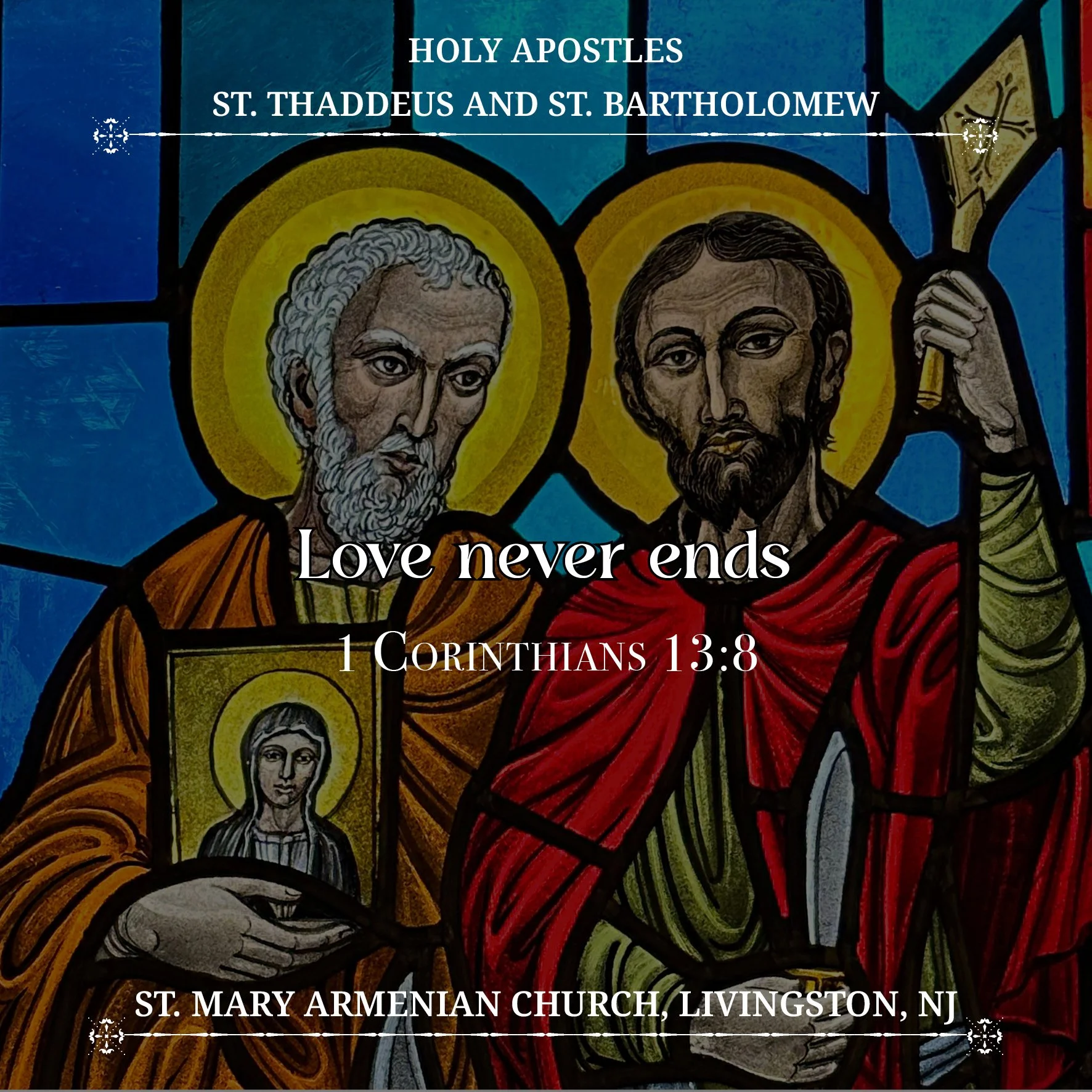
Commemoration Day of
the Holy Apostles
Thaddeus and Bartholomew,
Our First Illuminators
St. Thaddeus the Apostle
The first Illuminator of Armenia and the best-known Apostle among the Armenian people.
In the Gospel of Luke (6:16) and in the Acts of the Apostles (1:13), he is known as Judas of James. In the Gospel of John, he is mentioned as “Judas, not Iscariot” (14:22). During Christ's Farewell Discourse, he was among those who interrupted Him with the following question:
Lord, what do You mean when You say that You will reveal Yourself to us and not to the world?
Jesus replies indirectly that He will manifest Himself among those who love Him and, conversely, that He will never manifest Himself among those who have no love.
St. Matthew the Apostle calls him “Lebbaeus, who was surnamed Thaddaeus” (Matthew 10:3), while Mark simply calls him Thaddeus (Mark 3:18). The Catholic Church identifies him with Jude, the Brother of the Lord, in whose name there is also a short epistle among the General Epistles, of which it is the last. The Eastern Churches, however, do not accept this identification.
According to our national tradition, St. Thaddeus the Apostle first came to Edessa, where, in accordance with Christ's promise, he healed King Abgar and converted him to Christianity. Indeed, Edessa is regarded as one of the most ancient centers of Christianity.
Thaddeus carried his preaching northward, entering the territories of the Armenian King Sanatruk. There he preached and converted many Armenians, who constituted the firstfruits and foundation of the Armenian Apostolic Church.
He also entered the royal court and converted the king's daughter, Sandukht, who was subsequently martyred at the hands of her own father.
Finally, after performing numerous miracles and bringing thousands of souls to conversion, St. Thaddeus the Apostle himself was martyred by the sword in the province of Artaz, situated in the western part of present-day Iranian Azerbaijan. His tomb has been preserved there to this day, and a magnificent church was built over it.
We commemorate his memory twice: once together with St. Bartholomew the Apostle and once together with St. Sandukht the Virgin.
St. Bartholomew the Apostle
Although his name appears in our ecclesiastical calendars in the Armenian forms Bartoghimeos or Bartughimeos, the correct form of his name is Bartholomeos, meaning “son of Tolmai.”
He is one of the two Apostles known as the First Illuminators of Armenia. In the Gospel of John, his calling to the apostolic ministry is recorded under the name Nathanael.
After St. Philip the Apostle had been “found” by Jesus, he in turn “found Nathanael” and said to him:
We have found Him of whom Moses wrote in the Book of the Law, and of whom the prophets also wrote in their books: Jesus of Nazareth, the son of Joseph.
Nathanael, who was from the village of Cana, near Nazareth, and who knew that town well, replied frankly:
Can anything good come out of Nazareth?
Philip did not attempt to persuade him, but simply said:
Come and see for yourself.
When Jesus saw Nathanael approaching Him, He said:
Behold, truly an Israelite in whom there is no deceit.
“From where do You know me?” Nathanael asked with the same boldness.
“Before Philip called you, I saw you under the fig tree,” Jesus replied.
The meaning of this reference remains a mystery to us, but it was clearly understood by Nathanael, who changed his opinion, at least concerning Jesus of Nazareth, and exclaimed:
Rabbi, You are the Son of God! You are the King of Israel!
The expression “King of Israel” simply means “Messiah”—the long-awaited Savior. Through this confession of faith, Nathanael earned the honorary title of the First-Confessing Apostle.
Through divine providence and foreknowledge, it was fitting that the Apostle of the nation that was the first to confess Christianity should himself be among the first to confess Jesus as the Son of God.
We also encounter Nathanael's name among the seven Apostles who, after the Resurrection, had gone to Galilee in the hope of meeting Jesus. Having grown weary of waiting, they went fishing together and, indeed, under mysterious circumstances, were deemed worthy of beholding the Savior.
According to tradition, after preaching in various lands throughout the Iranian plateau, Bartholomew entered Armenia and continued the work of St. Thaddeus the Apostle, who had arrived there before him.
Like St. Thaddeus, he too entered the royal court and converted the king's sister to Christianity. For this reason, he was arrested by the Armenian King Sanatruk and subjected to severe tortures, ultimately being flayed alive and suffering martyrdom in the southeastern part of Armenia.
A magnificent sanctuary was built over his tomb in Aghbak, where a monastery was also established. Today, it lies in ruins.
We commemorate his memory together with that of Armenia's other Illuminator, St. Thaddeus the Apostle, on the Saturday following the first Sunday of the Fast of Advent.
SCRIPTURE READINGS
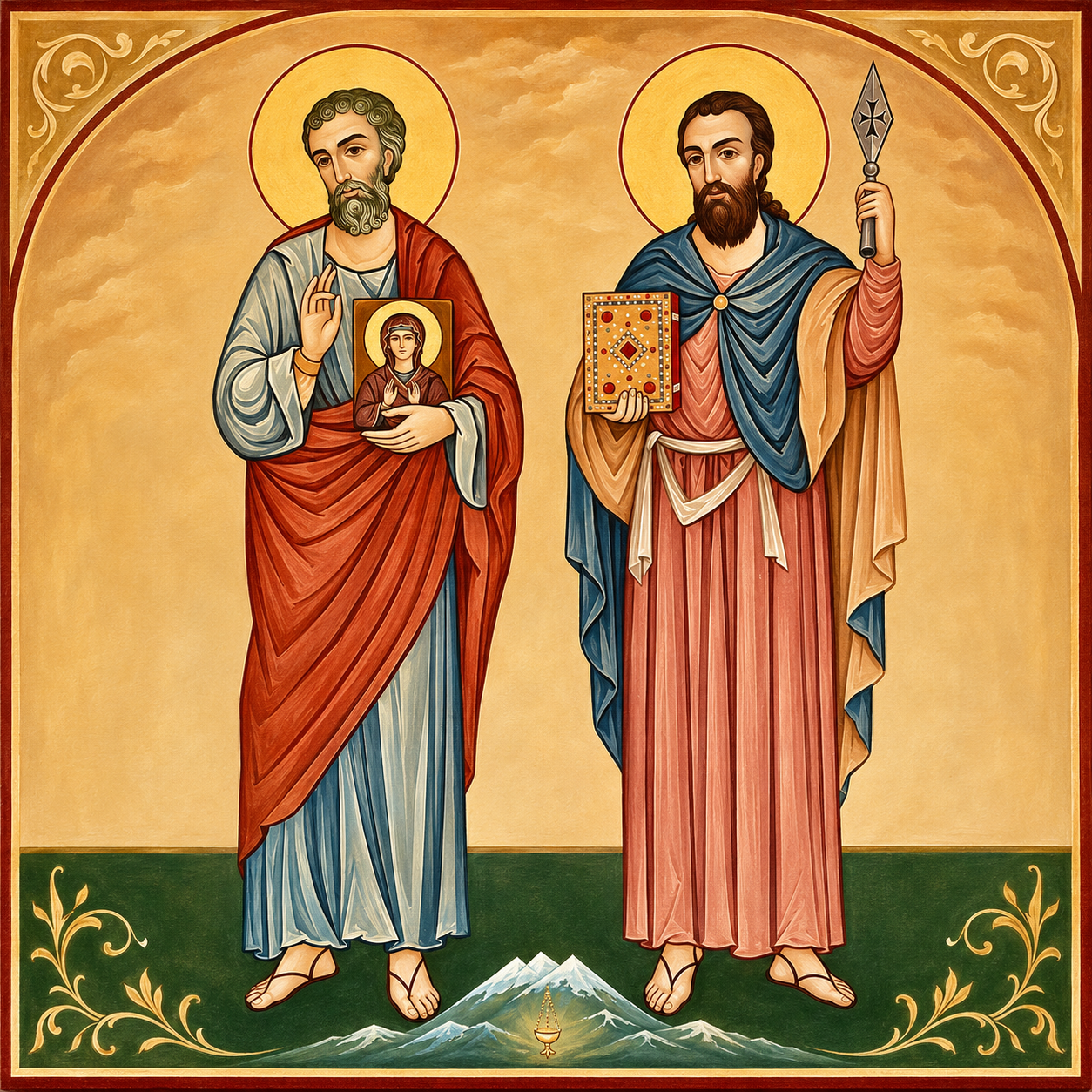
~ Wisdom of Solomon 9:13–10:2 ~
For who can learn the counsel of God? Or who can discern what the Lord wills? For the reasoning of mortals is worthless, and our designs are likely to fail; for a perishable body presses down the soul, and this earthy tent burdens the thoughtful mind. We can hardly guess at what is on earth, and what is at hand we find with labor; but who has traced out what is in the heavens? Who has learned your counsel, unless you have given wisdom and sent your holy spirit from on high? And thus the paths of those on earth were set right, and people were taught what pleases you, and were saved by wisdom. Wisdom protected the first-formed father of the world, when he alone had been created; she delivered him from his transgression, and gave him strength to rule all things.
~ Jeremiah 16:16-19 ~
I am now sending for many fishermen, says the Lord, and they shall catch them; and afterward I will send for many hunters, and they shall hunt them from every mountain and every hill, and out of the clefts of the rocks. For my eyes are on all their ways; they are not hidden from my presence, nor is their iniquity concealed from my sight. And I will doubly repay their iniquity and their sin, because they have polluted my land with the carcasses of their detestable idols, and have filled my inheritance with their abominations. O Lord, my strength and my stronghold, my refuge in the day of trouble.
~ 1 Corinthians 12:26-13:10 ~
If one member suffers, all suffer together with it; if one member is honored, all rejoice together with it. Now you are the body of Christ and individually members of it. And God has appointed in the church first apostles, second prophets, third teachers; then deeds of power, then gifts of healing, forms of assistance, forms of leadership, various kinds of tongues. Are all apostles? Are all prophets? Are all teachers? Do all work miracles? Do all possess gifts of healing? Do all speak in tongues? Do all interpret? But strive for the greater gifts. And I will show you a still more excellent way.
If I speak in the tongues of mortals and of angels, but do not have love, I am a noisy gong or a clanging cymbal. And if I have prophetic powers, and understand all mysteries and all knowledge, and if I have all faith, so as to remove mountains, but do not have love, I am nothing. If I give away all my possessions, and if I hand over my body so that I may boast, but do not have love, I gain nothing. Love is patient; love is kind; love is not envious or boastful or arrogant or rude. It does not insist on its own way; it is not irritable or resentful; it does not rejoice in wrongdoing, but rejoices in the truth. It bears all things, believes all things, hopes all things, endures all things. Love never ends. But as for prophecies, they will come to an end; as for tongues, they will cease; as for knowledge, it will come to an end. For we know only in part, and we prophesy only in part; but when the complete comes, the partial will come to an end.
~ Holy Gospel of St. Matthew 9:35-10:7 ~
Then Jesus went about all the cities and villages, teaching in their synagogues, and proclaiming the good news of the kingdom, and curing every disease and every sickness. When he saw the crowds, he had compassion for them, because they were harassed and helpless, like sheep without a shepherd. Then he said to his disciples, "The harvest is plentiful, but the laborers are few; therefore ask the Lord of the harvest to send out laborers into his harvest."
Then Jesus summoned his twelve disciples and gave them authority over unclean spirits, to cast them out, and to cure every disease and every sickness. These are the names of the twelve apostles: first, Simon, also known as Peter, and his brother Andrew; James son of Zebedee, and his brother John; Philip and Bartholomew; Thomas and Matthew the tax collector; James son of Alphaeus, and Thaddaeus; Simon the Cananaean, and Judas Iscariot, the one who betrayed him. These twelve Jesus sent out with the following instructions: "Go nowhere among the Gentiles, and enter no town of the Samaritans, but go rather to the lost sheep of the house of Israel. As you go, proclaim the good news, "The kingdom of heaven has come near.'