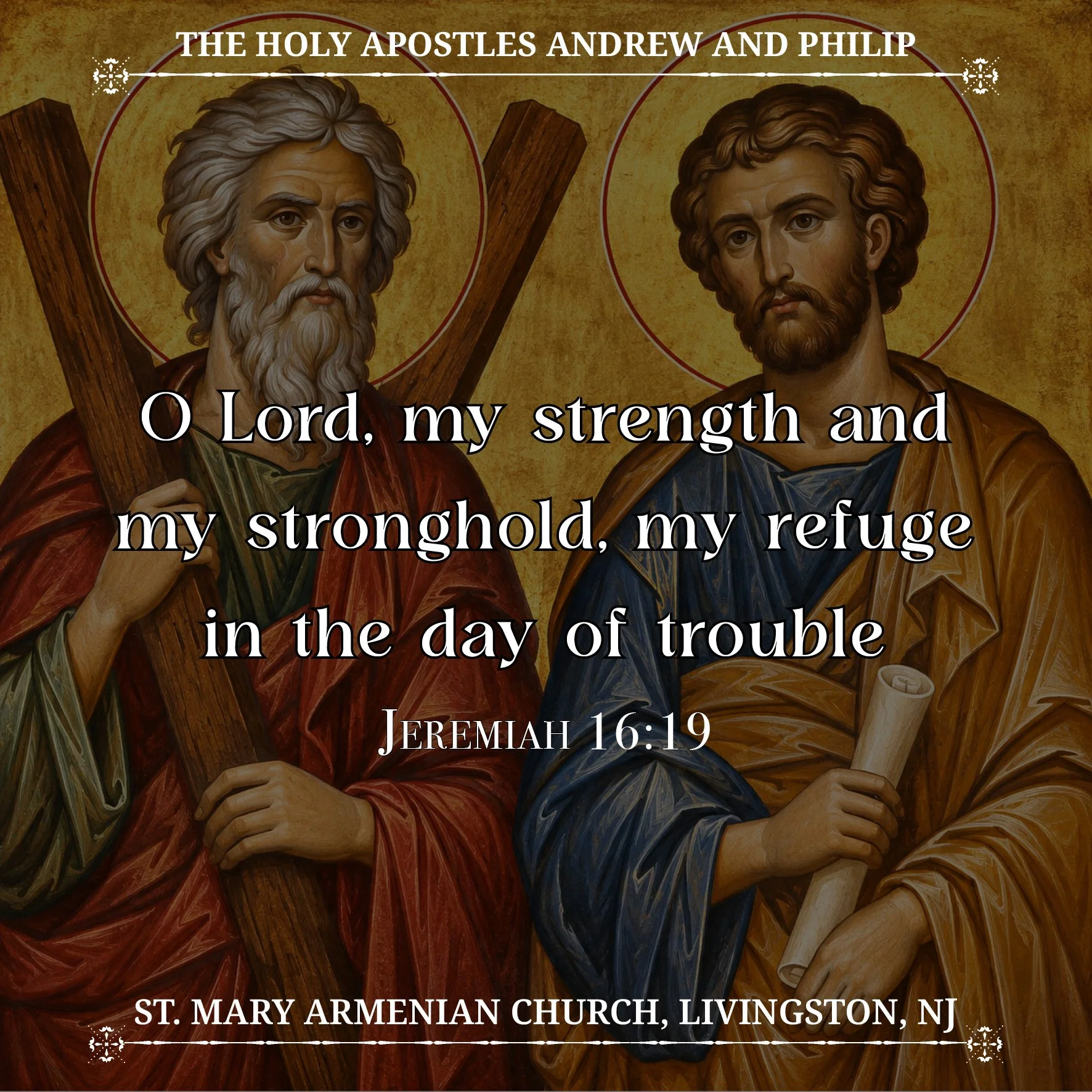
Commemoration Day of
the Holy Apostles
Andrew and Philip
St. Andrew the Apostle
Andrew was the brother of the Apostle Peter and shared the same occupation as a fisherman. Because he was the first among the known apostles to follow Jesus, he is also called the “First-Called Apostle.”
Andrew and, most likely, John the Evangelist had originally been disciples of John the Baptist. Upon hearing John’s testimony concerning Jesus, “Behold, the Lamb of God who takes away the sin of the world,” they followed Him (John 1:35–40).
Later, Andrew and his brother Peter were formally called by Jesus to the apostolic ministry (Matthew 4:18–21).
Very little is said about Andrew in the Gospels, and nothing is mentioned of him in the Acts of the Apostles. His name appears in the account of the miracle of the multiplication of the loaves, when he informs Jesus that a young boy has five barley loaves and two fish. Christ blessed and multiplied this food, feeding a multitude of more than five thousand people (John 6:2–8; 12:22).
According to tradition, Andrew preached the Gospel in Scythia, although he left behind no lasting traces of his ministry or established church there. He is also believed to have preached in northern Greece and in the city of Patras.
Andrew suffered martyrdom by crucifixion on a cross shaped like the letter X. For this reason, such a cross is known as Saint Andrew’s Cross.
The Church of Scythia and the Greek Ecumenical Patriarchate regard Saint Andrew as their patron saint.
The Armenian Apostolic Church commemorates Saint Andrew together with the Apostle Philip on the Saturday preceding the Eve of the Fast of the Advent season (Hisnag).
St. Philip the Apostle
Philip was among the first apostles called by Jesus.
After His baptism and temptation in the wilderness, when Jesus decided to return to Galilee, “He found Philip and said to him, ‘Follow Me.’ Now Philip was from Bethsaida, the city of Andrew and Peter” (John 1:43–44).
It is believed that Philip, too, may have originally been a disciple of John the Baptist before becoming a follower of Jesus.
Philip is mentioned on several occasions in the Gospel of John, often in connection with the Apostle Andrew.
For example, during the miracle of the multiplication of the loaves, Jesus first asks Philip where they could obtain enough bread to feed the enormous crowd.
The Evangelist explains, “He said this to test him, for He Himself knew what He would do.”
Philip responds, “Two hundred denarii worth of bread would not be sufficient for them, even if each one were to receive a little” (John 6:5–7).
Philip is also mentioned in connection with a group of Gentiles who wished to see Jesus. They approached Philip, perhaps encouraged by his distinctly Greek name, which means “lover of horses,” or by his knowledge of the Greek language.
Philip and Andrew—whose name, interestingly, is also Greek—then brought their request before Jesus.
During the Last Supper, as Jesus was delivering His final teachings to His disciples, they repeatedly interrupted Him with questions.
Philip was among those who questioned Him.
When Jesus said, “If you had known Me, you would have known My Father also. From now on you know Him and have seen Him,” Philip interrupted:
“Lord, show us the Father, and that will be enough for us.”
Jesus replied:
“Have I been with you so long, and yet you have not known Me, Philip? He who has seen Me has seen the Father. How can you say, ‘Show us the Father’?” (John 14:7–10).
According to tradition, Philip preached the Gospel in Asia Minor and suffered martyrdom by crucifixion in the city of Hierapolis.
The Armenian Apostolic Church celebrates his feast together with that of his inseparable companion, the Apostle Andrew, on the Saturday following the ninth Sunday after the Feast of the Holy Cross.
SCRIPTURE READINGS
~ Wisdom of Solomon 9:13–10:2 ~
For who can learn the counsel of God? Or who can discern what the Lord wills? For the reasoning of mortals is worthless, and our designs are likely to fail; for a perishable body weighs down the soul, and the earthy tent burdens the thoughtful mind. We can hardly guess at what is on earth, and what is at hand we find with labor; but who has traced out what is in the heavens? Who has learned your counsel, unless you have given wisdom and sent your holy spirit from on high? And thus the paths of those on earth were set right, and people were taught what pleases you, and were saved by wisdom. Wisdom protected the first-formed father of the world, when he alone had been created; she delivered him from his transgression, and gave him strength to rule all things.
~ Jeremiah 16:16-19 ~
I am now sending for many fishermen, says the Lord, and they shall catch them; and afterward I will send for many hunters, and they shall hunt them from every mountain and every hill, and out of the clefts of the rocks. For my eyes are on all their ways; they are not hidden from my presence, nor is their iniquity concealed from my sight. And I will doubly repay their iniquity and their sin, because they have polluted my land with the carcasses of their detestable idols, and have filled my inheritance with their abominations. O Lord, my strength and my stronghold, my refuge in the day of trouble, to you shall the nations come from the ends of the earth and say: Our ancestors have inherited nothing but lies, worthless things in which there is no profit.
~ Book of Acts 8:26-40 ~
Then an angel of the Lord said to Philip, "Get up and go toward the south to the road that goes down from Jerusalem to Gaza." (This is a wilderness road.) So he got up and went. Now there was an Ethiopian eunuch, a court official of the Candace, queen of the Ethiopians, in charge of her entire treasury. He had come to Jerusalem to worship and was returning home; seated in his chariot, he was reading the prophet Isaiah. Then the Spirit said to Philip, "Go over to this chariot and join it." So Philip ran up to it and heard him reading the prophet Isaiah. He asked, "Do you understand what you are reading?" He replied, "How can I, unless someone guides me?" And he invited Philip to get in and sit beside him. Now the passage of the scripture that he was reading was this: "Like a sheep he was led to the slaughter, and like a lamb silent before its shearer, so he does not open his mouth. In his humiliation justice was denied him. Who can describe his generation? For his life is taken away from the earth." The eunuch asked Philip, "About whom, may I ask you, does the prophet say this, about himself or about someone else?" Then Philip began to speak, and starting with this scripture, he proclaimed to him the good news about Jesus. As they were going along the road, they came to some water; and the eunuch said, "Look, here is water! What is to prevent me from being baptized?" He commanded the chariot to stop, and both of them, Philip and the eunuch, went down into the water, and Philip baptized him. When they came up out of the water, the Spirit of the Lord snatched Philip away; the eunuch saw him no more, and went on his way rejoicing. But Philip found himself at Azotus, and as he was passing through the region, he proclaimed the good news to all the towns until he came to Caesarea.
~ Holy Gospel of St. John 1:35-51 ~
The next day John again was standing with two of his disciples, and as he watched Jesus walk by, he exclaimed, "Look, here is the Lamb of God!" The two disciples heard him say this, and they followed Jesus. When Jesus turned and saw them following, he said to them, "What are you looking for?" They said to him, "Rabbi" (which translated means Teacher), "where are you staying?" He said to them, "Come and see." They came and saw where he was staying, and they remained with him that day. It was about four o'clock in the afternoon. One of the two who heard John speak and followed him was Andrew, Simon Peter's brother. He first found his brother Simon and said to him, "We have found the Messiah" (which is translated Anointed ). He brought Simon to Jesus, who looked at him and said, "You are Simon son of John. You are to be called Cephas" (which is translated Peter ). The next day Jesus decided to go to Galilee. He found Philip and said to him, "Follow me." Now Philip was from Bethsaida, the city of Andrew and Peter. Philip found Nathanael and said to him, "We have found him about whom Moses in the law and also the prophets wrote, Jesus son of Joseph from Nazareth." Nathanael said to him, "Can anything good come out of Nazareth?" Philip said to him, "Come and see." When Jesus saw Nathanael coming toward him, he said of him, "Here is truly an Israelite in whom there is no deceit!" Nathanael asked him, "Where did you get to know me?" Jesus answered, "I saw you under the fig tree before Philip called you." Nathanael replied, "Rabbi, you are the Son of God! You are the King of Israel!" Jesus answered, "Do you believe because I told you that I saw you under the fig tree? You will see greater things than these." And he said to him, "Very truly, I tell you, you will see heaven opened and the angels of God ascending and descending upon the Son of Man."