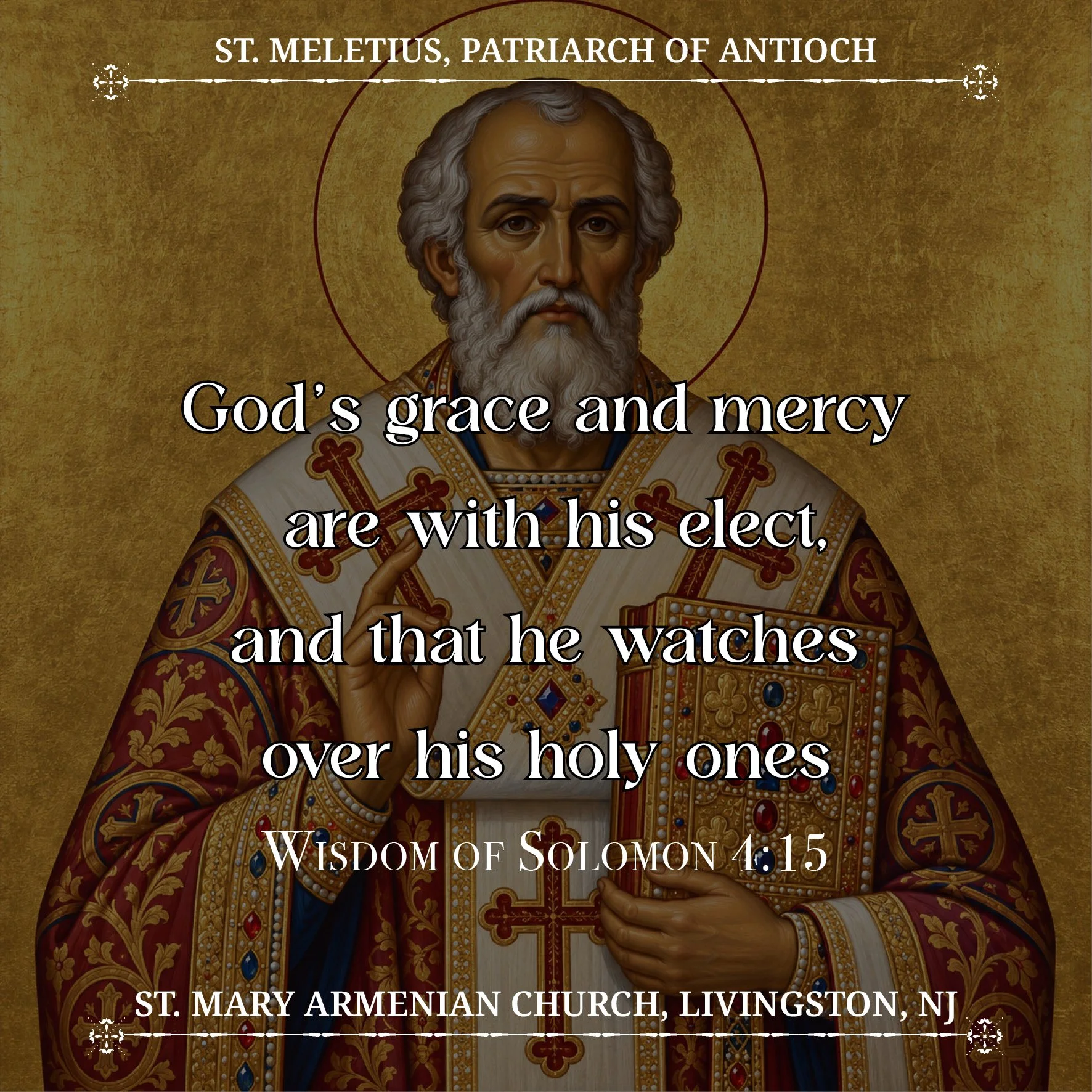
Commemoration Day of
St. Meletius, Patriarch of Antioch;
St. Menas of Egypt;
Bishop Meletius;
the Priest Bura;
and the Deacon Shinu
St. Meletius, Patriarch of Antioch
St. Meletius is a fascinating figure for many reasons. His name became almost involuntarily associated with nearly all the theological disputes and religious movements of his time, to such an extent that many of the ecclesiastical controversies and divisions of that period came to be known by his name.
He lived during the era of the great patriarchs of the Eastern Church and had personal contact with all of them. Some became his supporters, while others took opposing positions.
Meletius occupied a middle position among the great church leaders of his time. Although he did not possess the same distinction in speech, action, and writing as some of his contemporaries, he was also free from the excessive passion and partiality that characterized certain others.
Another interesting aspect of his life is that he was perhaps the only patriarch of the universal Christian Church to have come from the territory of Armenia. It would not be unreasonable to suppose that he may even have been Armenian by nationality, since his activities, character, and way of thinking were so distinctly “Armenian.”
Meletius was born in Melitene (modern-day Malatya), in Lesser Armenia.
In 358 AD, he became Bishop of Sebastia, the capital of First Armenia. Two years later, he voluntarily resigned from that position.
During this period, the Patriarchal See of Antioch was at the center of intense theological disputes concerning Orthodoxy. The Arians had dominated the patriarchal throne and its affairs for approximately thirty years.
In 360 AD, when Eudoxius, the Arian Patriarch of Antioch, was appointed to the See of Constantinople, the patriarchal throne of Antioch became vacant.
The people had grown weary of these fruitless controversies and sought a more peace-loving candidate who would be acceptable to both sides.
They eventually agreed upon Meletius.
Apparently, Meletius was neither openly committed to the Nicene position nor firmly aligned with Arianism. His principal approach was to avoid rigid theological positions.
He lived a holy life, was gentle in his conduct, and sincere in his devotion to God. He placed little importance on the subtle metaphysical arguments that had deeply divided the Church during his lifetime.
Consequently, both sides hoped that Meletius would succeed in restoring peace to this great city, which had been torn apart by religious controversy.
A large crowd gathered to welcome him, since the opposing factions had united around his candidacy.
Indeed, from the beginning, he succeeded in winning the affection of the inhabitants of this troubled city.
He avoided debates over controversial theological questions and devoted his preaching primarily to moral and practical matters. He also worked to correct certain prominent abuses and irregularities within the Church.
Meletius earned the respect of many of the great ecclesiastical figures of his time, particularly the Cappadocian Fathers and St. John Chrysostom. He even gained the respect of St. Epiphanius of Cyprus, who had initially opposed him.
St. Gregory of Nazianzus affirmed that Meletius was truly a devout, simple, sincere, and God-loving man.
Peace seemed to radiate from his face, and those who encountered him naturally trusted and respected him.
Gregory concluded that his very name, which was associated in Greek with the sweetness of honey, had become a reflection of his personality and character.
The Orthodox Christians were especially enthusiastic about him, while the Arians remained cautious and observant.
Although Meletius had said nothing directly against the Arians, neither had he said anything that could be interpreted as supporting their position.
Eventually, Emperor Constantius, who favored Arianism, organized a council in Antioch with the intention of discovering Meletius's true theological convictions.
The emperor invited numerous bishops to this gathering and required each of them to speak on a well-known biblical passage that had become a central subject of the Arian controversy: Proverbs 8:22.
In this passage, the “Wisdom” of God, understood as the “Word” or Logos, declares:
“The Lord created Me at the beginning of His way.”
Both sides agreed that these words referred to the preexistence of Christ.
The Arians, however, interpreted the passage as evidence that the Son of God had a “beginning” and was therefore a created being—an interpretation also maintained by Jehovah's Witnesses in modern times.
The Orthodox, on the other hand, understood the passage to mean:
“When God began His work of creation ‘in the beginning,’ He already had Me with Him.”
According to this interpretation, the Son was without beginning and was not a created being.
Patriarch Meletius delivered a lengthy discourse, during which his profound knowledge and understanding of Holy Scripture became evident.
He concluded:
“To believe in Christ means to believe that the Son is like the Father. He is His image, through whom all things exist and who is the Creator of all things.
“The Son is not an imperfect image of the Father, but a perfect one. Just as an effect corresponds to its cause, so the Son corresponds to the Father.
“The generation of the Only-Begotten Son, which took place before all ages, contains within it the idea of His co-existence with the Father.”
Meletius then turned to the moral significance of the biblical passage.
By avoiding specialized theological terminology as much as possible, he managed to satisfy nearly everyone present.
Nevertheless, from certain theological and doctrinal expressions he used, the listeners were able to determine toward which side Meletius was inclined.
The Orthodox were greatly pleased, while the Arians felt as though they had received a blow delivered through a covering of cotton.
St. Basil of Caesarea, who was present at the gathering, wrote to St. Epiphanius of Cyprus, who still had doubts concerning Meletius's Orthodoxy:
“Meletius was the first among those who boldly spoke in defense of the truth.”
When Meletius finished his discourse, those present asked him to provide a brief formula summarizing his teaching.
Without speaking, Meletius raised three fingers before the assembly. He then folded two of them, leaving one finger extended, and declared:
“Although the Godhead is presented to the human mind in three Persons, we have spoken of it as though it were one.”
His supporters subsequently adopted this gesture as a symbol of his teaching.
However, this sermon cost Meletius his patriarchal throne.
The Arians, using various unfounded accusations and pretexts, persuaded the emperor to depose and exile him.
This occurred after Meletius had served as patriarch for only a few months.
Following his departure, the patriarchal throne naturally returned to Arian control.
The situation became even more complicated when the Orthodox Christians themselves divided into two factions.
One group, named after Eustathius, the former Nicene Orthodox Patriarch of Antioch (324–330), became known as the Eustathians.
The other group became known as the Meletians, or followers of Meletius.
A man named Paulinus led the first group, while Diodorus led the Meletian faction.
Following the death of Constantius and the accession of Julian, the new emperor revoked the exile decrees of his predecessor.
Although Meletius returned from exile, his position had been weakened by opposition from both the Arians and Paulinus.
Consequently, he was unable to regain full control of his patriarchal throne.
During this period, St. Athanasius also came to Antioch and wished to establish communion with Meletius.
Unfortunately, following misguided advice, Meletius delayed giving his approval to this sincere and beneficial proposal.
Athanasius eventually departed the city, declaring that he was in communion with Paulinus, the rival of Meletius.
This development further complicated the already difficult situation.
When the Arian Emperor Valens came to power, Meletius was once again exiled to his homeland of Armenia.
After two years, however, he managed to return and regain possession of his patriarchal throne.
In 371 AD, he was exiled for a third time.
Meanwhile, another faction emerged among the Orthodox Christians of Antioch, declaring itself to be in communion with St. Athanasius and the See of Rome.
Following the death of Valens, his successor, Emperor Theodosius, revoked the previous decrees of exile.
Thus, in 378 AD, Meletius returned to Antioch.
One of his first actions was to convene a council of 150 bishops and issue a confession of faith that would eventually receive the approval of the Ecumenical Council of Constantinople.
In 381 AD, Emperor Theodosius invited the bishops of the Eastern Church to Constantinople, first to elect a new patriarch and then to discuss various other ecclesiastical matters.
Since the Patriarch of Alexandria was unable to attend, Patriarch Meletius presided over the council.
In this capacity, he received special recognition and attention from Emperor Theodosius.
St. Gregory of Nazianzus was elected Patriarch of Constantinople, and Meletius formally installed him upon the patriarchal throne.
The council began its proceedings with the confirmation, or reaffirmation, of the Nicene Creed.
During one of these sessions, Patriarch Meletius unexpectedly passed away.
He was honored with magnificent funeral orations, and the emperor himself attended his funeral.
His body was subsequently transported from Constantinople to Antioch, where he was laid to rest.
The Armenian Church commemorates St. Meletius on the ninth Monday following the Feast of the Holy Cross.
St. Menas of Egypt
St. Menas was a virtuous Christian soldier who served in the Roman army stationed in the city of Cotyaeum (modern-day Kütahya) in Asia Minor.
Observing the corruption and idolatry surrounding him, as well as the injustice and wickedness prevailing in the world, he decided to abandon military life and dedicate himself to a life of solitude in the desert.
After spending some time practicing asceticism and growing in the spiritual life, he learned that Emperor Diocletian had issued an edict ordering the persecution of Christians and that hundreds were being martyred for their faith.
Desiring to receive the crown of martyrdom himself, Menas descended from the desert into the city and openly declared that he was a Christian.
He was arrested and subjected to extremely severe tortures.
Finally, in 303 AD, he was beheaded, and his body was burned.
His remains were later collected and placed in a special tomb.
In time, a magnificent church was constructed over his burial place, which became an important center of pilgrimage.
The Armenian Church commemorates St. Menas of Egypt on the ninth Monday following the Feast of the Holy Cross.
St. Meletius, or Meles, the Bishop
In the Armenian Church calendar, we find two saints bearing the name Meletius.
The first is Meletius, Patriarch of Antioch, while the second is commemorated together with St. James, Patriarch of Nisibis.
In the Armenian Yaysmawurk (Synaxarion, or collection of the lives of the saints), there is no separate commemoration of a saint named Meletius.
However, there is a commemoration of a bishop named Meli or Meles on November 22.
We may therefore identify this second Meletius with Meles of the Armenian Synaxarion.
According to the accounts preserved in the Yaysmawurk, Meles was Persian by nationality.
He initially served as a Christian soldier in the Persian army.
Eventually, he abandoned military life and dedicated himself to spiritual service.
He was later consecrated Bishop of the city of Bitrazan.
However, because the majority of the city's inhabitants were worshippers of the sun, he was persecuted and driven out of the city.
As a result, he undertook a long journey to Jerusalem and Alexandria, where he met St. Anthony the Great.
St. Anthony advised him to return to Persia and continue his missionary work there.
During his return journey, Meles encountered St. James of Nisibis.
He continued his evangelistic mission as far as Ctesiphon, the capital of Persia at that time.
There, he worked to reconcile disputes among Christians and succeeded in bringing many pagans to the Christian faith.
The local ruler eventually arrested him and demanded that he worship the sun.
The blessed bishop rebuked the ruler for making such a foolish demand.
Enraged by this response, the ruler killed Meles with his own sword.
Thus, St. Meles received the crown of martyrdom for his steadfast faith in Christ.
The Armenian Church commemorates St. Meletius (Meles) the Bishop on the ninth Monday following the Feast of the Holy Cross.
St. Bura the Priest
St. Bura was a disciple of the Persian Bishop Meles and served as a priest.
He suffered martyrdom in Persia, where he was stoned to death because he refused to worship the sun and fire.
By remaining faithful to his Christian beliefs and rejecting idolatry, he received the crown of martyrdom.
The Armenian Church commemorates St. Bura the Priest on the ninth Monday following the Feast of the Holy Cross.
St. Shen, or Shinu, the Deacon
St. Shen, also known as Shinu, served as a deacon under Bishop Meles.
He was martyred in Persia together with Bishop Meles and the priest Bura during the reign of Shapur II, King of Persia, who was known as Shapur the Long-Lived.
He was most likely Persian by nationality.
Like his fellow martyrs, he remained steadfast in his Christian faith and gave his life rather than renounce Christ.
The Armenian Church commemorates St. Shen (Shinu) the Deacon on the ninth Monday following the Feast of the Holy Cross.
SCRIPTURE READINGS
~ Wisdom of Solomon 4:7-15 ~
But the righteous, though they die early, will be at rest. For old age is not honored for length of time, or measured by number of years; but understanding is gray hair for anyone, and a blameless life is ripe old age. There were some who pleased God and were loved by him, and while living among sinners were taken up. They were caught up so that evil might not change their understanding or guile deceive their souls. For the fascination of wickedness obscures what is good, and roving desire perverts the innocent mind. Being perfected in a short time, they fulfilled long years; for their souls were pleasing to the Lord, therefore he took them quickly from the midst of wickedness. Yet the peoples saw and did not understand, nor take such a thing to heart, that God’s grace and mercy are with his elect, and that he watches over his holy ones.
~ Isaiah 12:1-6 ~
You will say in that day: I will give thanks to you, O Lord, for though you were angry with me, your anger turned away, and you comforted me. Surely God is my salvation; I will trust, and will not be afraid, for the Lord God is my strength and my might; he has become my salvation. With joy you will draw water from the wells of salvation. And you will say in that day: Give thanks to the Lord, call on his name; make known his deeds among the nations; proclaim that his name is exalted. Sing praises to the Lord, for he has done gloriously; let this be known in all the earth. Shout aloud and sing for joy, O royal Zion, for great in your midst is the Holy One of Israel.
~ 1 John 5:1-6 ~
Everyone who believes that Jesus is the Christ has been born of God, and everyone who loves the parent loves the child. By this we know that we love the children of God, when we love God and obey his commandments. For the love of God is this, that we obey his commandments. And his commandments are not burdensome, for whatever is born of God conquers the world. And this is the victory that conquers the world, our faith. Who is it that conquers the world but the one who believes that Jesus is the Son of God? This is the one who came by water and blood, Jesus Christ, not with the water only but with the water and the blood. And the Spirit is the one that testifies, for the Spirit is the truth.
~ Holy Gospel of St. Luke 9:23-27 ~
Then he said to them all, "If any want to become my followers, let them deny themselves and take up their cross daily and follow me. For those who want to save their life will lose it, and those who lose their life for my sake will save it. What does it profit them if they gain the whole world, but lose or forfeit themselves? Those who are ashamed of me and of my words, of them the Son of Man will be ashamed when he comes in his glory and the glory of the Father and of the holy angels. But truly I tell you, there are some standing here who will not taste death before they see the kingdom of God."