
Commemoration Day of
the Archangels
Gabriel and Michael
and All the Heavenly Hosts
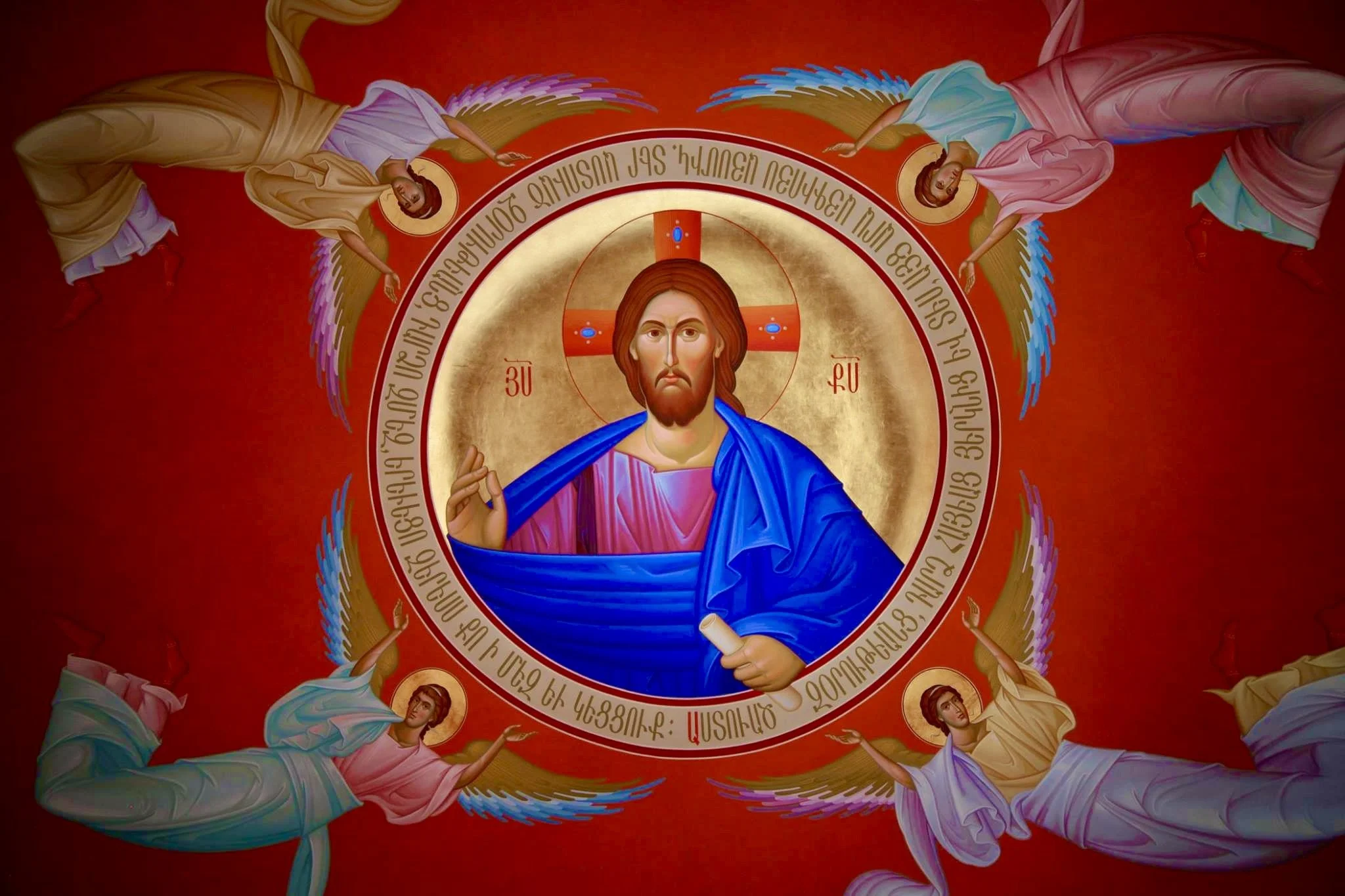
In addition to the Feasts of Our Lord and the commemorations of the saints, the Armenian Church also sets aside one day each year to honor the angels.
According to the Armenian Church calendar, their commemoration takes place on the Saturday following the eighth Sunday of the Holy Cross, under the title:
“Commemoration of the Holy Archangels Gabriel and Michael and All the Heavenly Hosts.”
The word angel (Hebrew: Malakh; Greek: Angelos) means “messenger.” The word “angel” appears approximately 500 times in the Holy Bible.
In Scripture, angels are described as countless multitudes, referred to as the “army of God” (Genesis 32:2) and “a thousand thousands and ten thousand times ten thousand” (Daniel 7:10).
Their primary mission is to communicate God's messages and divine will to humanity and to carry out His commands among the nations and throughout the universe (Genesis 16:7; Judges 6:11; Daniel 6:22).
Angels played an important role throughout the earthly life of Christ, from the Annunciation to the Ascension.
Equally significant is the role they have fulfilled, and continue to fulfill, in the salvation of humanity:
“Are not all angels ministering spirits sent to serve those who will inherit salvation?” (Hebrews 1:14).
Like human beings, angels are rational beings; however, they are incorporeal and spiritual in nature.
Their nature is described through the imagery of fire:
“He makes His angels spirits, and His ministers a flame of fire.” (Hebrews 1:7).
Because angels are spiritual or “incorporeal” (immaterial) beings, they are invisible by nature. However, if God wills, they may become visible in various bodily forms and appearances.
Angels have no gender; there is no distinction between male and female among them. As Scripture states:
“For in the resurrection they neither marry nor are given in marriage, but are like angels in heaven.” (Matthew 22:30).
Angels neither multiply nor diminish in number and, therefore, experience neither birth nor death.
As ministering beings, angels are considered lower than human beings in two respects. First, humanity was created in the image and likeness of God. Second, for the salvation of humankind, the Son of God did not become an angel but became man (Hebrews 2:16).
Throughout the Bible, from Genesis to Revelation, there are numerous references, accounts, and events involving angels.
For example, angels visited Abraham in connection with the destruction of the wicked cities of Sodom and Gomorrah (Genesis, chapters 18–19).
They announced the joyful news of Christ's birth to the shepherds and introduced the first hymn of the Christian Church, “Glory to God in the Highest” (Luke 2:8–15).
Angels ministered to Christ in the wilderness following His temptation, as the Evangelist Matthew writes:
“Then the devil left Him, and behold, angels came and ministered to Him.” (Matthew 4:11).
They were the first blessed messengers to proclaim His Resurrection (Matthew 28).
Angels also played an important role in the lives of the apostles (Acts, chapter 12), while the Book of Revelation contains numerous accounts of their activities associated with the end of the world.
From the history of the Armenian Church, we know that an angel of the fourth order visited St. Gregory the Illuminator every day during his imprisonment in Khor Virap.
Likewise, at the founding of the Cathedral of Holy Etchmiadzin, the Only-Begotten Son of God descended upon the land of Armenia, accompanied by a host of angels, and revealed the location and design of the first Christian cathedral.
The Hierarchy of Angels
According to the renowned work The Celestial Hierarchy, attributed to Dionysius the Areopagite, the angelic orders are divided into three hierarchies, each consisting of three ranks.
First Hierarchy
The Many-Eyed Cherubim
The Holy-Chanting, Six-Winged Seraphim
The Thrones of the Uncreated Divinity
Second Hierarchy
The Ever-Unchanging Dominions
The Invincible Holy Virtues
The Supreme Powers
Third Hierarchy
The Incorporeal Principalities
The Archangels of the Heavenly Heights
The Hosts of Angels
Of these angelic orders, two—the Cherubim and the Seraphim—are specifically mentioned in the Old Testament.
The Seraphim, the heavenly singers, are described in the Book of the Prophet Isaiah.
“Holy, holy, holy is the Lord of hosts; the whole earth is full of His glory!” (Isaiah 6:1–7).
This was the hymn sung by the six-winged, holy-chanting Seraphim in the vision of the Prophet Isaiah.
When Adam was expelled from Paradise, the Cherubim were entrusted with guarding the way to the Tree of Life (Genesis 3:24).
The Cherubim are regarded as the throne-bearers of God. They are described as having four faces: one resembling a cherub, another a human being, the third a lion, and the fourth an eagle.
They have four wings and numerous eyes, which is why they are called the “Many-Eyed Cherubim.”
By God's command, carved figures and representations of the Cherubim were placed upon the Ark of the Covenant and in Solomon's Temple.
In his Epistle to the Colossians, the Apostle Paul affirms that all things, both in heaven and on earth, were created through Christ. He also specifically mentions the Thrones, Dominions, and Authorities (Colossians 1:16).
Additional references to the other angelic orders may be found in the writings of the Apostle Paul and in the other general epistles.
Angels are also known by particular names, according to their position or the role they fulfill in God's divine plan:
Gabriel — “Image of God”
Michael — “Mighty”
Raphael — “Healing”
Anael — “Fullness of God”
Uriel — “Vision”
Barachiel — “Divine Being”
Adoniel
Phanuel
Jeremiel
Salathiel
And others (Daniel 9:21; 10:13, 21; 12:1; Luke 1:19, 26; Tobit 12:15).
The Archangels
Archangel Gabriel
Gabriel is one of the seven archangels who present the prayers of humanity before God.
Even in the Old Testament, Gabriel revealed and interpreted the visions of the prophets concerning the coming of the Savior.
In the New Testament, the Archangel Gabriel became the messenger who announced the births of John the Baptist and our Savior, Jesus Christ (Luke 1:26–38).
Archangel Michael
The other archangel well known to us from Holy Scripture is Michael, who fought against the enemies of the people of Israel.
As the commander of the heavenly hosts, he invisibly battles Satan, defending Israel in the Old Covenant and the Church of Christ in the New Covenant.
In the Book of Revelation, written by St. John the Evangelist, Michael's battle in heaven and his victory over the dragon—Satan—and his evil forces are described.
For this reason, Archangel Michael is traditionally depicted in sacred art wearing armor, holding a sword in his hand, and standing upon a dragon beneath his feet.
He is also portrayed holding a balance scale, weighing the souls of the departed.
Archangel Raphael
We read about Archangel Raphael in the Book of Tobit (12:12, 15), one of the deuterocanonical books of Holy Scripture.
In this account, Raphael accompanies Tobias, the son of Tobit, in disguise and helps ensure the success of his journey.
Raphael is also entrusted with the mission of presenting the prayers of righteous people before God.
Guardian Angels
According to the Holy Bible, every person has a guardian angel (Matthew 18:10; Luke 15:10; Genesis 28:12; John 1:51).
The Book of Daniel indicates that every nation has its own angel (Daniel 10:13).
According to the Book of Revelation, churches also have their own angels, to whom Jesus addressed His messages intended for their entire congregations (Revelation 1:20; 2:1, 8).
The Apostle Peter also had his own guardian angel (Acts 12:15).
Guardian angels not only protect human beings from the dangers of this world but also guide them toward the Kingdom of Heaven, provided that they willingly follow that path.
The guardian angel is a manifestation of God's divine providence.
For this reason, the Church continually prays and petitions: “For the angel of peace to guard our souls, let us pray to the Lord.”
In Classical Armenian: «Զհրեշտակ խաղաղութեան պահապան անձանց մերոց ի Տեառնէ խնդրեսցուք»։
Fallen Angels
Angels continually glorify God.
However, some of them, abusing the free will granted to them, rebelled against God and became evil angels, known as Satan and demons (Matthew 25:41; Revelation 12:9).
God cast them into the depths of darkness, placing them in chains to be kept until the Day of Judgment:
“God cast them into Tartarus and committed them to chains of gloomy darkness to be kept until the judgment.” (2 Peter 2:4).
The Veneration of Angels in the Armenian Church
Throughout medieval Armenian literature, numerous homilies, sermons, panegyrics, hymns, and spiritual songs were dedicated to the angels.
Several churches and monasteries have also been named in honor of the angels or the Holy Archangels, including:
Zvartnots Cathedral, traditionally associated with the Heavenly Angels.
The altar of the bell tower of the Mother See of Holy Etchmiadzin, dedicated to the Holy Archangels.
The Church of the Holy Archangels in Astapat.
The Monastery of the Holy Archangels in Tokat.
The Monastery of the Holy Archangels in Sebastia (Sivas).
The Church of the Holy Archangels at the Armenian Monastery of St. James in Jerusalem.
The Church of the Holy Archangels in the Balat district of Constantinople (Istanbul).
These sacred places bear witness to the longstanding reverence of the Armenian Church for the holy angels and archangels, who serve God, proclaim His divine will, protect the faithful, and continually glorify His holy name.
SCRIPTURE READINGS
~ Genesis 18:33-19:2 ~
And the Lord went his way, when he had finished speaking to Abraham; and Abraham returned to his place.
The two angels came to Sodom in the evening, and Lot was sitting in the gateway of Sodom. When Lot saw them, he rose to meet them, and bowed down with his face to the ground. He said, "Please, my lords, turn aside to your servant's house and spend the night, and wash your feet; then you can rise early and go on your way." They said, "No; we will spend the night in the square."
~ Job 38:4-7 ~
"Where were you when I laid the foundation of the earth? Tell me, if you have understanding. Who determined its measurements—surely you know! Or who stretched the line upon it? On what were its bases sunk, or who laid its cornerstone when the morning stars sang together and all the heavenly beings shouted for joy?
~ Isaiah 6:1-7 ~
In the year that King Uzziah died, I saw the Lord sitting on a throne, high and lofty; and the hem of his robe filled the temple. Seraphs were in attendance above him; each had six wings: with two they covered their faces, and with two they covered their feet, and with two they flew. And one called to another and said: "Holy, holy, holy is the Lord of hosts; the whole earth is full of his glory." The pivots on the thresholds shook at the voices of those who called, and the house filled with smoke. And I said: "Woe is me! I am lost, for I am a man of unclean lips, and I live among a people of unclean lips; yet my eyes have seen the King, the Lord of hosts!" Then one of the seraphs flew to me, holding a live coal that had been taken from the altar with a pair of tongs. The seraph touched my mouth with it and said: "Now that this has touched your lips, your guilt has departed and your sin is blotted out."
~ Ezekiel 1:1-20 ~
In the thirtieth year, in the fourth month, on the fifth day of the month, as I was among the exiles by the river Chebar, the heavens were opened, and I saw visions of God. On the fifth day of the month (it was the fifth year of the exile of King Jehoiachin), the word of the Lord came to the priest Ezekiel son of Buzi, in the land of the Chaldeans by the river Chebar; and the hand of the Lord was on him there. As I looked, a stormy wind came out of the north: a great cloud with brightness around it and fire flashing forth continually, and in the middle of the fire, something like gleaming amber. In the middle of it was something like four living creatures. This was their appearance: they were of human form. Each had four faces, and each of them had four wings. Their legs were straight, and the soles of their feet were like the sole of a calf's foot; and they sparkled like burnished bronze. Under their wings on their four sides they had human hands. And the four had their faces and their wings thus: their wings touched one another; each of them moved straight ahead, without turning as they moved. As for the appearance of their faces: the four had the face of a human being, the face of a lion on the right side, the face of an ox on the left side, and the face of an eagle; such were their faces. Their wings were spread out above; each creature had two wings, each of which touched the wing of another, while two covered their bodies. Each moved straight ahead; wherever the spirit would go, they went, without turning as they went. In the middle of the living creatures there was something that looked like burning coals of fire, like torches moving to and fro among the living creatures; the fire was bright, and lightning issued from the fire. The living creatures darted to and fro, like a flash of lightning. As I looked at the living creatures, I saw a wheel on the earth beside the living creatures, one for each of the four of them. As for the appearance of the wheels and their construction: their appearance was like the gleaming of beryl; and the four had the same form, their construction being something like a wheel within a wheel. When they moved, they moved in any of the four directions without veering as they moved. Their rims were tall and awesome, for the rims of all four were full of eyes all around. When the living creatures moved, the wheels moved beside them; and when the living creatures rose from the earth, the wheels rose. Wherever the spirit would go, they went, and the wheels rose along with them; for the spirit of the living creatures was in the wheels.
~ Hebrews 1:6-14 ~
And again, when he brings the firstborn into the world, he says, "Let all God's angels worship him." Of the angels he says, "He makes his angels winds, and his servants flames of fire." But of the Son he says, "Your throne, O God, is forever and ever, and the righteous scepter is the scepter of your kingdom. You have loved righteousness and hated wickedness; therefore God, your God, has anointed you with the oil of gladness beyond your companions." And, "In the beginning, Lord, you founded the earth, and the heavens are the work of your hands; they will perish, but you remain; they will all wear out like clothing; like a cloak you will roll them up, and like clothing they will be changed. But you are the same, and your years will never end." But to which of the angels has he ever said, "Sit at my right hand until I make your enemies a footstool for your feet"? Are not all angels spirits in the divine service, sent to serve for the sake of those who are to inherit salvation?
~ Holy Gospel of St. Matthew 18:10-14 ~
"Take care that you do not despise one of these little ones; for, I tell you, in heaven their angels continually see the face of my Father in heaven. What do you think? If a shepherd has a hundred sheep, and one of them has gone astray, does he not leave the ninety-nine on the mountains and go in search of the one that went astray? And if he finds it, truly I tell you, he rejoices over it more than over the ninety-nine that never went astray. So it is not the will of your Father in heaven that one of these little ones should be lost.