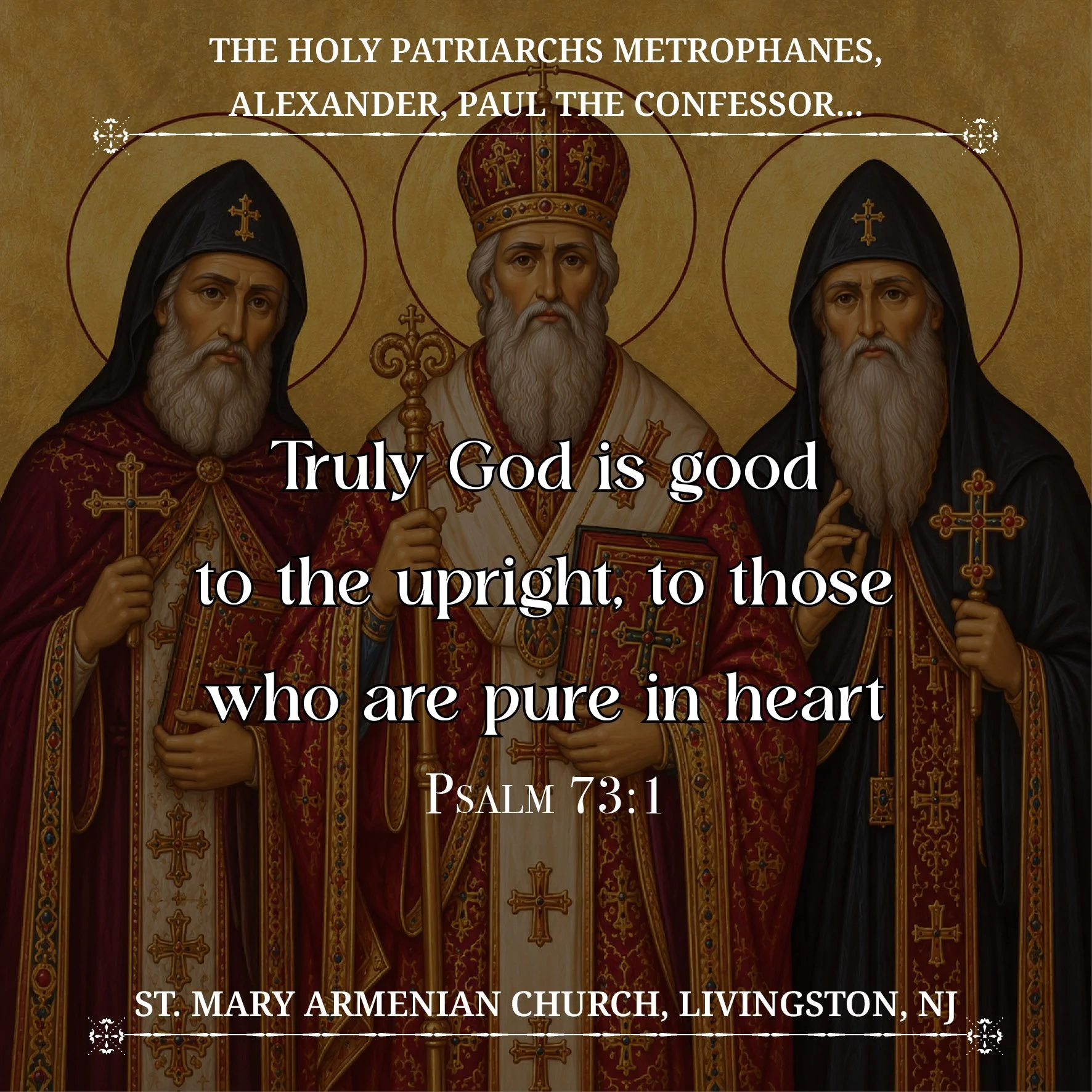
Commemoration Day of
the Holy Patriarchs Metrophanes,
Alexander, Paul the Confessor,
and the Holy Notaries
Marcian and Martyrius
St. Metrophanes, Patriarch of Constantinople
St. Metrophanes was among the first historically recorded bishops of Constantinople, serving from 306 to 325 AD.
He was fortunate to witness the transformation of the ancient city of Byzantium into the capital of the Roman Empire during his episcopacy. The city was rebuilt and named Constantinople, meaning “the City of Constantine.” As the city's importance grew, the status of its episcopal see gradually increased, eventually becoming a patriarchal throne.
By 325 AD, Metrophanes was already very elderly and unable to attend the First Ecumenical Council of Nicaea. Instead, he sent the senior priest Alexander as his representative, who would later become his successor.
According to tradition, following the Council of Nicaea, Emperor Constantine invited the bishops who had participated in the council to Constantinople to attend the ceremonial dedication and official inauguration of his newly established capital.
On this occasion, the emperor and the assembled bishops visited the aged patriarch to pay their respects.
With the assistance of others, Metrophanes celebrated the Divine Liturgy and the Sacrament of Holy Communion, in which all those present participated. He then announced before everyone that his death was approaching. After appointing his successor, he peacefully departed this life.
The Armenian Church commemorates St. Metrophanes on the eighth Thursday following the Feast of the Holy Cross.
St. Alexander, Patriarch of Constantinople
St. Alexander was the second historically recorded Archbishop of Constantinople and the successor of St. Metrophanes.
According to tradition, he was consecrated bishop by the Fathers of the Council of Nicaea when they came to Constantinople at the invitation of Emperor Constantine and attended the funeral of his predecessor.
Alexander had participated in the Council of Nicaea as the representative of the elderly Metrophanes.
He was a generous, eloquent, righteous, and God-loving shepherd of the Church. He was deeply devout and observed strict fasting, never breaking his fast before sunset.
The sudden and terrible death of Arius, the leader of the Arian heresy, is traditionally attributed to the prayers of St. Alexander and St. James of Nisibis.
St. Alexander reposed peacefully in the Lord in 340 AD.
The Armenian Church commemorates St. Alexander on the eighth Thursday following the Feast of the Holy Cross.
St. Paul the Confessor, Patriarch of Constantinople
St. Paul the Confessor was the third Patriarch of Constantinople, serving during the period from 340 to 350 AD. He was born in the city of Thessalonica.
He was described as “a devout man, God-fearing and well-versed in the Holy Scriptures.”
Shortly after his election as Archbishop of Constantinople, Emperor Constantius, who supported Arianism, deposed him and appointed the Arian Eusebius in his place.
Following the death of Eusebius, Paul regained his episcopal throne. However, he was exiled once again, and Macedonius, known as the “Pneumatomachian” or “Opponent of the Holy Spirit,” was appointed in his place. Macedonius denied the divinity of the Holy Spirit.
In 348 AD, at the urging of Constans, Emperor of the West, Constantius, Emperor of the East, restored Paul to his patriarchal throne.
However, after the death of Emperor Constans, Paul was exiled once more, this time to the city of Cucusus.
According to tradition, an imperial representative strangled the holy patriarch with his own omophorion, the episcopal vestment worn around the shoulders.
In 381 AD, following the Second Ecumenical Council, the relics of St. Paul were brought to Constantinople, where he was buried with honor as a saint, confessor, and martyr.
St. Paul was a great defender of Orthodox Christianity and a friend of St. Athanasius and Pope Julius.
The Armenian Church commemorates St. Paul the Confessor on the eighth Thursday following the Feast of the Holy Cross.
Sts. Marcian and Martyrius
Saints Marcian and Martyrius were two senior clerics who also served as notaries in the Patriarchate of Constantinople during the time of the Orthodox Patriarch Paul, in the middle of the fourth century.
The reigning emperor, Constantius, who was a supporter of Arianism, removed Patriarch Paul from office and exiled him to the city of Cucusus in Byzantine Armenia.
When the Arian successors in the patriarchate learned that Paul continued to uphold and reaffirm the Nicene faith even during his exile, they sent orders for his execution.
The guards subsequently strangled the holy patriarch.
Upon learning of his death, the patriarch's notaries, Marcian and Martyrius, publicly proclaimed that Patriarch Paul had been murdered because he defended and preached the faith established by the Council of Nicaea.
As a result, the Arian prefect (governor) of the city ordered their beheading in the 350s AD.
Thus, Saints Marcian and Martyrius suffered martyrdom for their steadfast devotion to the Orthodox Christian faith and their defense of the Nicene Creed.
The Armenian Church commemorates Saints Marcian and Martyrius on the eighth Thursday following the Feast of the Holy Cross.
SCRIPTURE READINGS
~ Wisdom of Solomon 6:22-26 ~
Therefore if you delight in thrones and scepters, O monarchs over the peoples, honor wisdom, so that you may reign forever. I will tell you what wisdom is and how she came to be, and I will not hide secrets from you, but I will trace her course from the beginning of creation, and make knowledge of her clear, and I will not pass by the truth. Neither will I travel in the company of pining envy, for envy will have no fellowship with wisdom. A multitude of wise people is the salvation of the world, and a sensible king is the stability of any people.
~ Zechariah 12:6-10 ~
On that day I will make the clans of Judah like a blazing pot on a pile of wood, like a flaming torch among sheaves; and they shall devour to the right and to the left all the surrounding peoples, while Jerusalem shall again be inhabited in its place, in Jerusalem. And the Lord will give victory to the tents of Judah first, that the glory of the house of David and the glory of the inhabitants of Jerusalem may not be exalted over that of Judah. On that day the Lord will shield the inhabitants of Jerusalem so that the feeblest among them on that day shall be like David, and the house of David shall be like God, like the angel of the Lord, at their head. And on that day I will seek to destroy all the nations that come against Jerusalem. And I will pour out a spirit of compassion and supplication on the house of David and the inhabitants of Jerusalem, so that, when they look on the one whom they have pierced, they shall mourn for him, as one mourns for an only child, and weep bitterly over him, as one weeps over a firstborn.
~ Hebrews 13:7-9 ~
Remember your leaders, those who spoke the word of God to you; consider the outcome of their way of life, and imitate their faith. Jesus Christ is the same yesterday and today and forever. Do not be carried away by all kinds of strange teachings; for it is well for the heart to be strengthened by grace, not by regulations about food, which have not benefited those who observe them.
~ Holy Gospel of St. Matthew 4:23-25 ~
Jesus went throughout Galilee, teaching in their synagogues and proclaiming the good news of the kingdom and curing every disease and every sickness among the people. So his fame spread throughout all Syria, and they brought to him all the sick, those who were afflicted with various diseases and pains, demoniacs, epileptics, and paralytics, and he cured them. And great crowds followed him from Galilee, the Decapolis, Jerusalem, Judea, and from beyond the Jordan.