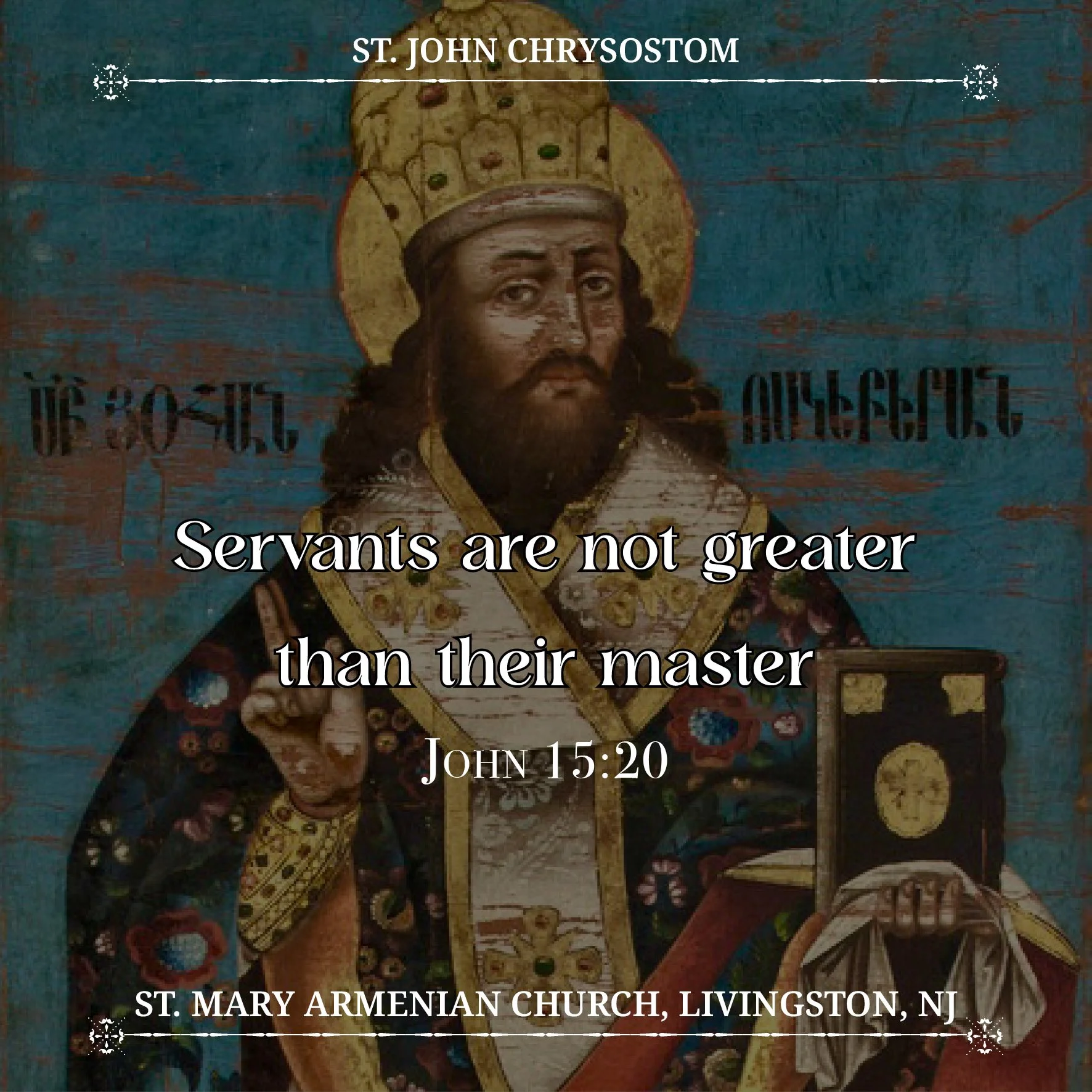
Commemoration Day of
The Patriarch
St. John Chrysostom
St. John Chrysostom is one of the most distinguished and gifted teachers of the Christian Church.
He was born in AD 347, the only child of a military commander who served in the Roman army and died at an early age. Although his widowed mother raised him in the Christian faith, John was not baptized until adulthood.
He received his education in Antioch, where he studied law and rhetoric under the renowned orator Libanius. He studied theology under Diodore of Tarsus, one of the leading representatives of the theological School of Antioch at that time.
Like nearly all the great Church Fathers of his era, John devoted himself to an ascetic life from an early age. Initially, he practiced asceticism within his own home, as he was responsible for caring for his widowed and aging mother.
Following his mother's death, he withdrew into the wilderness, where he lived from AD 373 to 381. During those years, he practiced such severe ascetic discipline that his health became seriously impaired.
In AD 381, he was ordained a deacon and began serving in Antioch. In AD 386, he was ordained a priest. Through his extraordinary eloquence and inspiring preaching, he earned the popular title “Chrysostom,” meaning “Golden-Mouthed,” a name that remained associated with him for the rest of his life.
He devoted his remarkable gift of preaching to the moral and spiritual reform of Antioch, a disorderly city whose inhabitants were, for the most part, Christians in name only.
At the same time, he dedicated himself to the interpretation of the Holy Scriptures. His biblical commentaries were delivered with such elegance, clarity, and depth that he came to be recognized as one of the greatest interpreters of Scripture in the early Church.
In AD 398, against his own wishes, John Chrysostom was elected Patriarch of Constantinople.
With the same energy and determination that had characterized his ministry in Antioch, he undertook the spiritual and moral reform of the imperial capital, which, because of internal conflicts and immoral practices, had departed significantly from the principles of Christian life.
Corruption and religious indifference had become deeply rooted not only within the imperial court and among members of the clergy, but also throughout the general population.
Along with his integrity, holiness, and deep personal piety, Chrysostom possessed extraordinary courage in openly condemning every form of immorality, regardless of the social standing or authority of those responsible.
Because he showed no fear in rebuking wrongdoing, even among the highest-ranking members of society, he incurred the anger of Empress Eudoxia.
Theophilus, Patriarch of Alexandria, who himself aspired to become Patriarch of Constantinople, also turned against Chrysostom and joined forces with the empress.
In AD 403, Chrysostom was condemned by a local ecclesiastical council on twenty-nine charges. According to this account, only one of these accusations had any validity: his inappropriate remarks concerning the empress.
The council was presided over by Patriarch Theophilus, who was motivated by jealousy and hostility toward Chrysostom.
An order was issued for his exile. However, on the night of his departure, a terrifying earthquake and fire struck Constantinople. Frightened by these events, the empress summoned Chrysostom back and restored him to his patriarchal throne.
Nevertheless, the experience of exile did not persuade Chrysostom to soften his convictions or change his course.
He continued preaching with the same uncompromising severity against the extravagance, corruption, and immoral conduct of the imperial court.
Despite his popularity among the people and the support he received from the Western Church, neither could prevent the weak-willed Emperor Arcadius and his capricious wife, Eudoxia, from issuing a second order of exile against the blessed patriarch.
At first, Chrysostom was exiled toward the region of Antioch. However, when the authorities realized that, despite his weakened health, the relatively mild climate would allow him to survive, they ordered him to be transferred farther away.
He was subsequently exiled to Cucusus and then to Pontus.
The great patriarch ultimately suffered what was, in effect, a martyr's death. Though gravely ill, he was forced to travel on foot over long distances, enduring extremely harsh climatic and geographical conditions.
He died in the city of Comana in AD 407.
His final words were:
“Glory be to God for all things.”
In AD 438, his remains were brought back to Constantinople with great solemnity and honor. They were laid to rest in the Church of the Holy Apostles, where his bitter enemy, Empress Eudoxia, had also been buried following her death in AD 404.
St. John Chrysostom was truly great in spirit, courage, preaching, and, above all, in his extraordinary literary and theological legacy.
For centuries, his writings have served as a rich source of spiritual nourishment for Christian Churches throughout the world, and they continue to retain their profound significance and value to this day.
Among his most important contributions is the Divine Liturgy attributed to him, many elements of which are also found in the Divine Liturgy of the Armenian Apostolic Church.
His writings include a treatise on the priesthood, composed during his years as a priest, numerous sermons, and extensive commentaries on the Holy Scriptures.
A large portion of these works was translated into Armenian as early as the fifth century, in the beautiful and refined language of Classical Armenian (Grabar). Other writings were translated during subsequent centuries.
Chrysostom also composed magnificent prayers for various feast days and liturgical celebrations, some of which are still used in the Armenian Apostolic Church today.
The Armenian Church celebrates the feast of St. John Chrysostom twice each year: first, on the seventh Thursday following the Feast of the Discovery of the Holy Cross, and again on the last Saturday of October, together with the Twelve Doctors of the Church.
SCRIPTURE READINGS

~ Isaiah 49:1-6 ~
Listen to me, O coastlands, pay attention, you peoples from far away! The Lord called me before I was born, while I was in my mother's womb he named me. He made my mouth like a sharp sword, in the shadow of his hand he hid me; he made me a polished arrow, in his quiver he hid me away. And he said to me, "You are my servant, Israel, in whom I will be glorified." But I said, "I have labored in vain, I have spent my strength for nothing and vanity; yet surely my cause is with the Lord, and my reward with my God." And now the Lord says, who formed me in the womb to be his servant, to bring Jacob back to him, and that Israel might be gathered to him, for I am honored in the sight of the Lord, and my God has become my strength— he says, "It is too light a thing that you should be my servant to raise up the tribes of Jacob and to restore the survivors of Israel; I will give you as a light to the nations, that my salvation may reach to the end of the earth."
~ Book of Acts 20:25-38 ~
"And now I know that none of you, among whom I have gone about proclaiming the kingdom, will ever see my face again. Therefore I declare to you this day that I am not responsible for the blood of any of you, for I did not shrink from declaring to you the whole purpose of God. Keep watch over yourselves and over all the flock, of which the Holy Spirit has made you overseers, to shepherd the church of God that he obtained with the blood of his own Son. I know that after I have gone, savage wolves will come in among you, not sparing the flock. Some even from your own group will come distorting the truth in order to entice the disciples to follow them. Therefore be alert, remembering that for three years I did not cease night or day to warn everyone with tears. And now I commend you to God and to the message of his grace, a message that is able to build you up and to give you the inheritance among all who are sanctified. I coveted no one's silver or gold or clothing. You know for yourselves that I worked with my own hands to support myself and my companions. In all this I have given you an example that by such work we must support the weak, remembering the words of the Lord Jesus, for he himself said, "It is more blessed to give than to receive.' " When he had finished speaking, he knelt down with them all and prayed. There was much weeping among them all; they embraced Paul and kissed him, grieving especially because of what he had said, that they would not see him again. Then they brought him to the ship.
~ Holy Gospel of St. John 15:17-25 ~
I am giving you these commands so that you may love one another. "If the world hates you, be aware that it hated me before it hated you. If you belonged to the world, the world would love you as its own. Because you do not belong to the world, but I have chosen you out of the world—therefore the world hates you. Remember the word that I said to you, "Servants are not greater than their master.' If they persecuted me, they will persecute you; if they kept my word, they will keep yours also. But they will do all these things to you on account of my name, because they do not know him who sent me. If I had not come and spoken to them, they would not have sin; but now they have no excuse for their sin. Whoever hates me hates my Father also. If I had not done among them the works that no one else did, they would not have sin. But now they have seen and hated both me and my Father. It was to fulfill the word that is written in their law, "They hated me without a cause.'