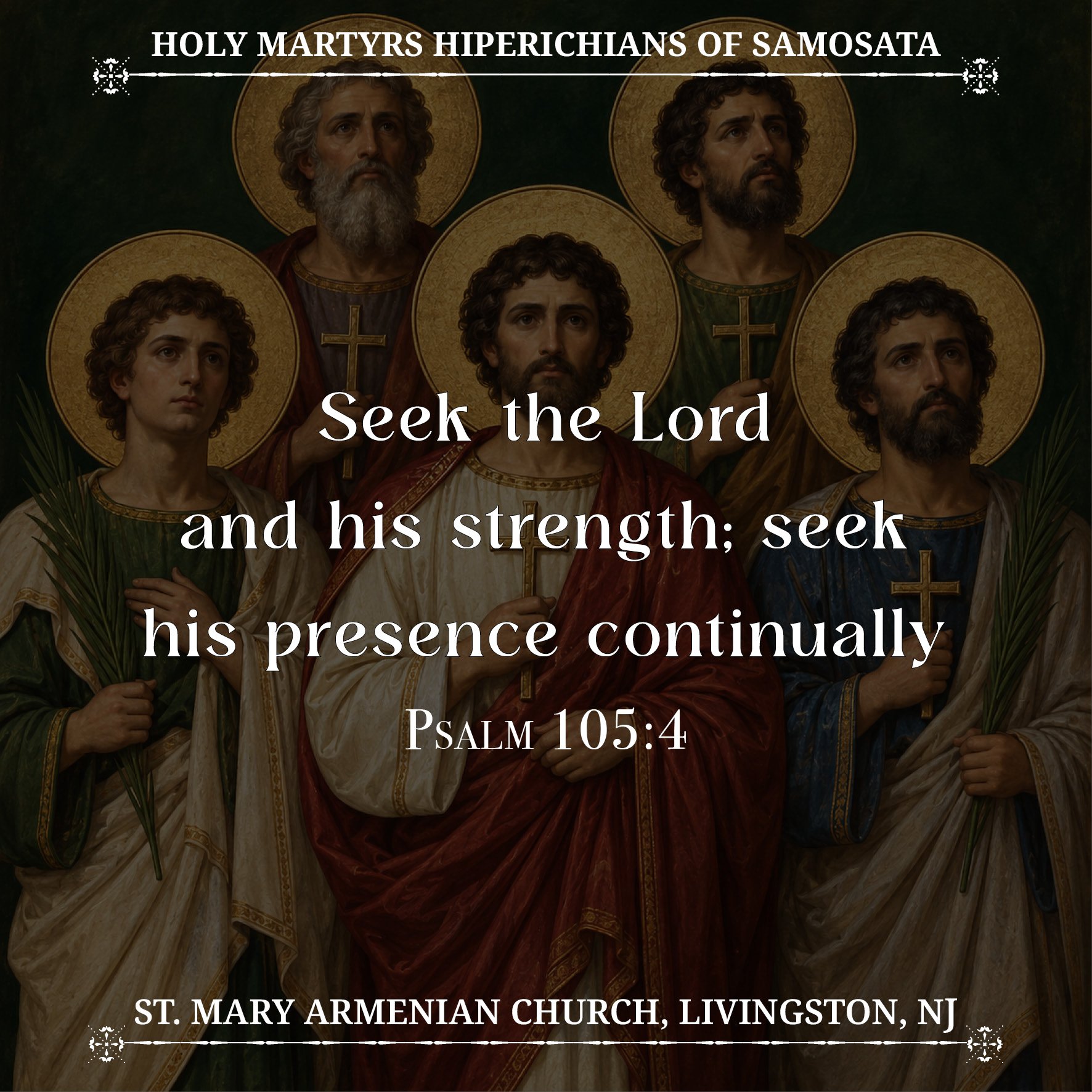
Commemoration Day of
Holy Martyrs Hiperichians of Samosata,
St. Severian of Sebaste,
and St. Babelas the Elder
and His Eighty-Four Disciples
The Holy Hiperichians
The Holy Hiperichians were seven Christian martyrs who lived during the reign of Emperor Galerius or Maximinus Daia, toward the end of the third century or the beginning of the fourth century. They came from the city of Samosata, located in the southern region of Armenia known as Third Armenia.
During a festival held in their city in honor of pagan idols, Hiperichus and his companion Philotheus remained in their home, engaged in prayer.
Five of their friends, who were pagans, came to visit them. Seeing that the two men were not participating in the festivities of the day, they became curious and asked why.
Hiperichus and Philotheus revealed that they were Christians. They spoke of the worthlessness of idols and preached the teachings of Christ to their friends.
Convinced by their words, the five friends embraced Christianity, believed in Christ, and were baptized.
All seven were eventually brought before a judge, where they remained steadfast in their Christian faith. They were beaten with rods and thrown into prison.
They endured lengthy interrogations and severe tortures, during which members of the crowd expressed admiration for their courage and unwavering faith.
Finally, an order was given for them to be crucified outside the city. The following day, when they were found still alive, their executioners drove a nail into each of their heads, bringing their martyrdom to its completion.
The Armenian Apostolic Church commemorates these holy martyrs on the seventh Tuesday following the Feast of the Holy Cross.
St. Severian of Sebaste
St. Severian was a distinguished military officer in the imperial army stationed in the region of Sebaste during the reign of Emperor Licinius.
When the renowned Forty Martyrs of Sebaste were imprisoned, Severian regularly visited them and cared for their needs.
Following their martyrdom, he continued to defend Christians and openly criticize the authorities for their unjust and unwarranted persecution of the faithful.
Eventually, the imperial duke of Sebaste summoned Severian to answer for his actions and statements, which were considered to be against the state.
Severian appeared before the duke and openly acknowledged that he defended Christians because he himself belonged to the same faith. He also declared that the emperor's order to persecute Christians was unjust and contrary to the best interests of the empire.
Enraged by his boldness, the duke ordered Severian to be beaten with oxhide whips.
Afterward, the duke mockingly asked him:
“Have you now reaped the fruits of your insolence? Be wise, then, and return to the religion of the state.”
However, neither threats nor harsh punishments could persuade Severian to abandon his faith. He responded to every accusation and act of intimidation with courage and conviction.
Finally, the duke ordered that heavy stones be tied around Severian's neck and feet and that he be suspended from the city wall.
Mocking him, the judge declared:
“Now you shall receive your reward from your Heavenly Father.”
Severian did not respond to the insult. Instead, he turned to God in prayer, saying:
“O Eternal God, I call upon You, for You are the Lord of life and death. Grant me heavenly victory, so that the lawless enemy may not boast over me. May all things be accomplished according to Your glory and Your will.”
He continued praying for the persecuted Christians, entrusting them to God's divine protection:
“Grant them patience and courage to glorify Your holy name.”
Having offered these prayers, Severian surrendered his soul to God.
His body fell in pieces beneath the city wall. The Christians reverently gathered his remains, carried them to his native village, and buried them with honor and dignity.
The Armenian Apostolic Church commemorates St. Severian of Sebaste on the seventh Tuesday following the Feast of the Holy Cross.
St. Babelas the Elder and His Eighty-Four Disciples
Patriarch Torgom Gushakian provides the following account of St. Babelas and his eighty-four disciples:
“During the reign of Emperor Maximinus, Babelas was an elderly teacher in a city of Bithynia. He devoted himself to educating and raising Christian children in the teachings of the Holy Scriptures, while also preaching the faith of the Gospel to pagans. When the emperor learned of his activities, he questioned Babelas, asking why he taught outsiders rather than limiting his instruction to members of his own faith. The elderly teacher answered: ‘Because the true religion belongs to the Christians.’ Upon hearing these words, the authorities ordered his jaw and teeth to be shattered. He was then beheaded. Alongside him, eighty-four children, his disciples, were also beheaded, like innocent lambs. Their parents, filled with sorrow yet also with spiritual joy, buried their children together with their teacher. They believed that their children had become a pure and undefiled offering to God.”
The Armenian Apostolic Church commemorates St. Babelas the Elder and his eighty-four martyred disciples on the seventh Tuesday following the Feast of the Holy Cross.
SCRIPTURE READINGS
~ Proverbs 12:8-13 ~
One is commended for good sense, but a perverse mind is despised. Better to be despised and have a servant, than to be self-important and lack food. The righteous know the needs of their animals, but the mercy of the wicked is cruel. Those who till their land will have plenty of food, but those who follow worthless pursuits have no sense. The wicked covet the proceeds of wickedness, but the root of the righteous bears fruit. The evil are ensnared by the transgression of their lips, but the righteous escape from trouble.
~ Isaiah 49:8-11 ~
Thus says the Lord: In a time of favor I have answered you, on a day of salvation I have helped you; I have kept you and given you as a covenant to the people, to establish the land, to apportion the desolate heritages; saying to the prisoners, "Come out," to those who are in darkness, "Show yourselves." They shall feed along the ways, on all the bare heights shall be their pasture; they shall not hunger or thirst, neither scorching wind nor sun shall strike them down, for he who has pity on them will lead them, and by springs of water will guide them. And I will turn all my mountains into a road, and my highways shall be raised up.
~ 2 Corinthians 4:6-14 ~
For it is the God who said, "Let light shine out of darkness," who has shone in our hearts to give the light of the knowledge of the glory of God in the face of Jesus Christ. But we have this treasure in clay jars, so that it may be made clear that this extraordinary power belongs to God and does not come from us. We are afflicted in every way, but not crushed; perplexed, but not driven to despair; persecuted, but not forsaken; struck down, but not destroyed; always carrying in the body the death of Jesus, so that the life of Jesus may also be made visible in our bodies. For while we live, we are always being given up to death for Jesus' sake, so that the life of Jesus may be made visible in our mortal flesh. So death is at work in us, but life in you. But just as we have the same spirit of faith that is in accordance with scripture—"I believed, and so I spoke"—we also believe, and so we speak, because we know that the one who raised the Lord Jesus will raise us also with Jesus, and will bring us with you into his presence.
~ Holy Gospel of St. Luke 10:21-24 ~
At that same hour Jesus rejoiced in the Holy Spirit and said, "I thank you, Father, Lord of heaven and earth, because you have hidden these things from the wise and the intelligent and have revealed them to infants; yes, Father, for such was your gracious will. All things have been handed over to me by my Father; and no one knows who the Son is except the Father, or who the Father is except the Son and anyone to whom the Son chooses to reveal him." Then turning to the disciples, Jesus said to them privately, "Blessed are the eyes that see what you see! For I tell you that many prophets and kings desired to see what you see, but did not see it, and to hear what you hear, but did not hear it."