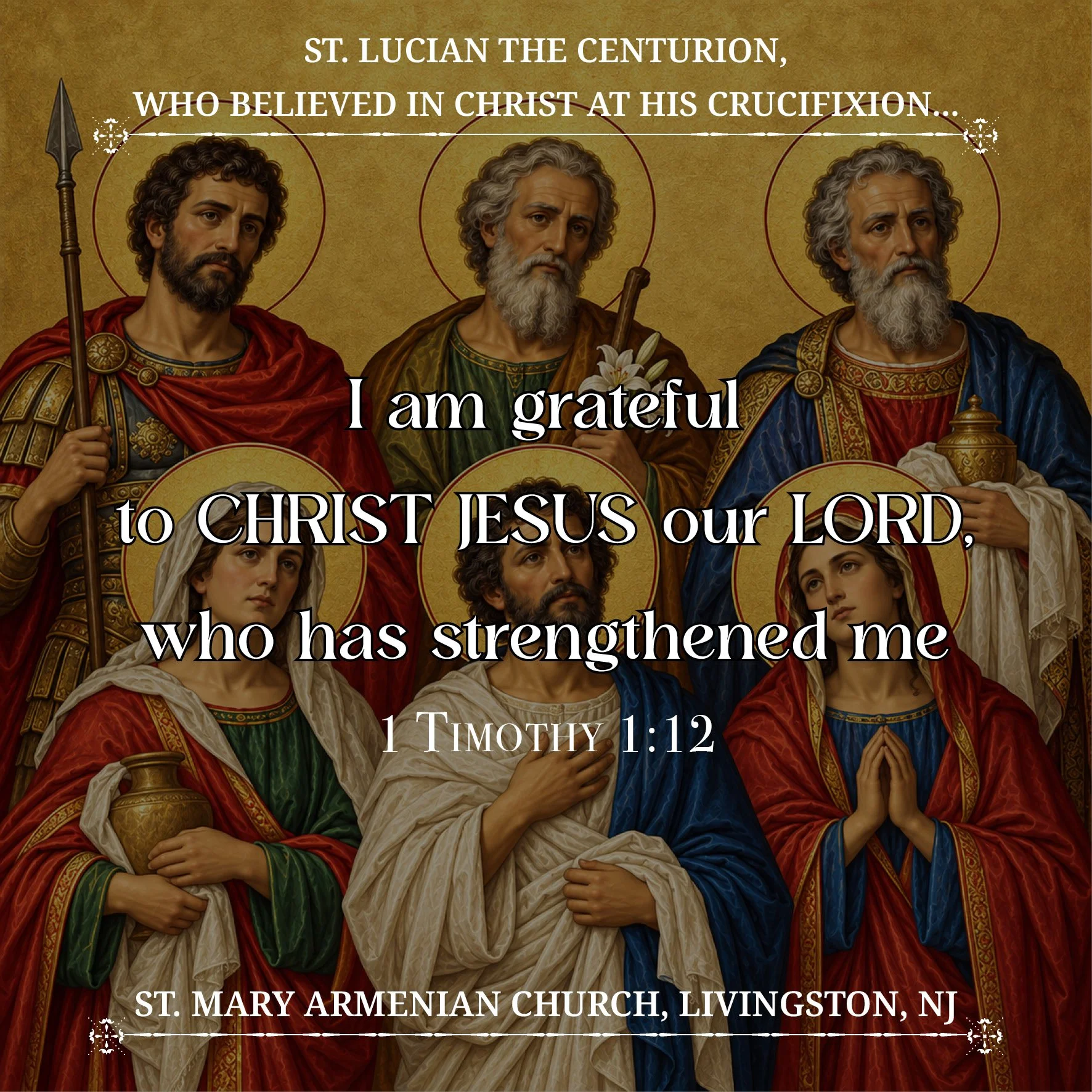
Commemoration Day of
St. Lucian the Centurion,
Who Believed in Christ
at His Crucifixion;
Joseph, the Father of God;
Joseph of Arimathea;
and Lazarus, the Friend of Christ,
with His Two Sisters,
Martha and Mary
St. Lucian the Centurion
Although our Church calendars and liturgical calendars give his name as “Lunkianos,” and in some places even as “Khunkianos,” the correct form is “Lucian.”
Although this name is not mentioned in the Gospels, the person himself appears in their pages, for tradition identifies him as the centurion who supervised the events surrounding the Crucifixion of Jesus.
Lucian had listened to all the words Jesus spoke on the way to the Cross and while hanging upon it.
He had come to the conclusion that Jesus of Nazareth was not only innocent of wrongdoing, but also an extraordinary man.
The miraculous events that followed Jesus' death—the darkening of the sun, the earthquake, and other extraordinary occurrences—profoundly affected this fair-minded and impartial man.
Finally, he spontaneously declared:
“Certainly this man was righteous” (Luke 23:47).
Or, as recorded elsewhere:
“Truly this man was the Son of God” (Matthew 27:54).
An ancient tradition maintains that this centurion and his companions eventually became Christians, received baptism, and returned to their homeland of Cappadocia, in the region of present-day Kayseri.
There they devoted themselves to preaching Christianity and, because of their missionary activities, were eventually martyred.
All the saints commemorated after the Seventy Disciples are celebrated together on the Monday following the sixth Sunday of the Holy Cross.
St. Joseph, the “Father of God”
Joseph was the man regarded as the earthly father of Jesus and the husband of Mary, the Mother of God. It is in this sense that he is given the title “Father of God.”
Joseph also belonged to the lineage of David.
The Gospel describes him as a “righteous” man.
Scripture first mentions him when he was already betrothed to Mary, living in Nazareth, and earning his livelihood as a carpenter.
They had not yet been married when Joseph learned that his betrothed was pregnant.
Joseph was bewildered and troubled. Because he was an honorable man, he decided, without making the circumstances public, to “dismiss her quietly.”
While he was considering these things, an angel of the Lord appeared to him in a vision and said:
“Joseph, son of David, do not be afraid to take Mary as your wife, for the child conceived in her is of the Holy Spirit. She will bear a son, and you shall name Him Jesus (which means SAVIOR), for He will save His people from their sins.”
All this took place in fulfillment of the word of God spoken through the prophet Isaiah:
“Behold, the virgin shall conceive and bear a son, and they shall call His name Emmanuel,” which means “God with us.”
When Joseph awoke from sleep, he did as the angel had instructed him.
He took Mary as his wife and became bound to her with even greater love and respect.
In every circumstance, he became her guardian and protector, for she had been granted by God the highest honor: the calling to become the Mother of the “Son of the Most High.”
When Jesus was born, Joseph fulfilled all the requirements of the Law.
On the eighth day, he had the Child circumcised.
When Jesus was forty days old, Joseph brought Him to the Temple to be presented to God. There, by offering two doves in accordance with the Law, he fulfilled the prescribed obligation and received the Child back into his care.
When a mortal threat arose against the life of Jesus, Joseph, at the command of an angel of God, took the Child and His mother to Egypt.
After remaining there for several years, he once again obeyed the angel's command, returned, and settled in Nazareth.
When Jesus reached the age of twelve, Joseph took Him to Jerusalem in accordance with the requirements of the Law.
On their return journey, Joseph and Mary realized that the Child was not with them.
They went back to Jerusalem and found Jesus in the Temple, surrounded by teachers of the Law and giving them intelligent answers.
There, Joseph witnessed the first dawning of Jesus' greatness.
After this incident, Joseph is no longer mentioned in the Gospels.
From this, we conclude that Joseph died well before Jesus began His public ministry.
Joseph holds a highly honored position in the Catholic Church and has been proclaimed its patron saint.
Yet, just as his position is exalted in the Catholic Church, it is comparatively insignificant in the Eastern Churches, especially in our own Armenian Church.
For example, in our Church, we cannot recall a single church dedicated in his name or any special hymn composed in his honor.
Even his feast of commemoration is combined with that of a group of other saints who, in essence, have no direct connection with him. This commemoration takes place on the Monday following the sixth Sunday of the Holy Cross.
Yet few have been such great heroes of faith as Joseph.
We can appreciate this when we consider that, although he knew the child conceived in his wife's womb was not his own, he believed the angel's revelation that the conception was divine and continued to remain her husband.
Can one imagine a greater act of heroism than to live a life of virginity alongside an angelic woman, serving simply as the lifelong guardian of her perpetual virginity—a woman who had received the highest divine grace of becoming the Mother of God's incarnate Son?
Can one imagine a greater honor and responsibility than to be a father and fulfill all the duties of fatherhood toward One who was to be called the “Son of the Most High”?
Although Jesus has often been called the “Son of God,” the “Son of David,” and the “Son of Man,” He has also been called, and will forever remain, the “Son of Joseph.”
This is Joseph's inseparable and eternal glory.
Therefore, the supreme respect shown by the Catholic Church toward the memory of this righteous and humble man is entirely justified.
It is also fitting that he should be depicted holding his Divine Child high upon the strong arm of a laborer, while carrying in his other hand a lily, the symbol of his innocence and spiritual purity.
There is no justification for our Church's indifference toward this humble laborer, who, although of royal descent, possessed a soul equally—and indeed even more—noble than his ancestry.
He was worthy of receiving the incomparable title “Father of God.”
In the Armenian Yaysmavurk (Synaxarion, or Lives of the Saints), St. Joseph is described as a man entirely filled with sweetness and gentleness: meek, merciful, compassionate, sympathetic toward the sufferings of others, and endowed with the kindest of dispositions.
St. Joseph of Arimathea
By bringing together what the Gospels tell us about this honorable man, we arrive at the following description:
“A wealthy man, respectable, good, and righteous; a secret disciple of Jesus, who was waiting for the Kingdom of God” (Matthew 27:57–61; Mark 15:42–47; Luke 23:50–54; John 19:38–42).
In our Armenian translation of Holy Scripture, he is also called a “prince,” a term rendered in other translations as “counselor” or “member of the council,” meaning that he belonged to the supreme Jewish council, the Sanhedrin.
From these few details, Joseph emerges as a noble individual in terms of his wealth, his position in society, and, above all, his character.
Joseph was among the first of the relatively few wealthy individuals who became disciples of Christ, either secretly or openly, and placed their social standing and financial resources at the service of spreading and advancing the Christian cause.
When Joseph learned that Jesus had already died upon the Cross, and knowing that according to Jewish law His body could not remain on the Cross that day, he had the courage to approach Pilate personally and request the body of Jesus so that he might bury Him.
Pilate granted his request.
Through this action, Joseph truly demonstrated that he was a “good and righteous” man, for among the Jews, taking responsibility for the burial of an abandoned dead person was considered one of the greatest acts of charity.
Courage and boldness are also qualities of a righteous person.
An unrighteous person may be shameless or presumptuous, but cannot be truly courageous and bold in the noble and genuine meaning of those words.
Joseph's action becomes even greater and more admirable when we consider that he wished to take responsibility for the body of someone who had been abandoned by everyone and condemned as a “criminal” by both the state and the highest authorities of His own people.
He intended to give this person an honorable burial.
Joseph was fully aware that, by doing so, he would provoke at least the anger and hostility of his fellow council members.
A second important consideration is that, even after Jesus' humiliating death, Joseph had not lost his respect and affection for Him.
He wished to perform one final act of friendship toward the young Teacher for whom he had felt sincere love and admiration.
This was itself evidence of the genuine greatness and nobility of Joseph's character.
By arranging an honorable burial for Jesus, Joseph confirmed what the Gospel says about him:
“He had not agreed with the decision and actions of his fellow council members.”
Although one of the Evangelists describes Joseph's discipleship as “secret,” his appearance before Pilate to request the body of his Master demonstrates that, when the occasion demanded it, he did not hesitate to act openly.
Apparently, Joseph was not himself a preacher or evangelist of the Kingdom of God. Nevertheless, he longed spiritually for the establishment of that Kingdom on earth and hoped to become personally a part of it.
He believed that he had found this Kingdom in the pure and authoritative teachings of the Teacher from Galilee, to whom he wished to remain faithful even after Christ's death.
Wealth and high social position often possess a corrupting influence.
Those who surrender themselves to this influence frequently become arrogant, proud, materialistic, and self-centered, turning into a festering embodiment of selfishness.
One must possess a strength greater than the power of wealth and status in order to place them at the service of noble human purposes, rather than becoming their servant.
It is comforting to encounter noble souls such as Joseph, who were not corrupted by the destructive influence of material possessions and worldly glory.
It is equally interesting and encouraging to observe that the two other Josephs mentioned earlier—Joseph “the Handsome” and Joseph the “Father of God”—also remained uncorrupted, despite having been granted great worldly and spiritual honors.
Joseph of Arimathea was granted the incomparable privilege of personally taking down the body of Jesus from the Cross and burying Him in the new tomb that he had prepared for his own family.
After fulfilling this blessed and sacred duty, Joseph is no longer mentioned in the New Testament.
An early medieval tradition takes him as far as England, where he is said to have founded the first Christian church in that country.
According to the same tradition, Joseph brought with him to England the chalice that Jesus had used at the Last Supper when He instituted the Holy Sacrament of Communion.
This Holy Chalice was subsequently lost, but the tradition remained that it would one day be rediscovered by the most virtuous of knights.
Consequently, medieval knights spared no effort in attempting to surpass one another in virtue so that they might become worthy of this honor.
Joseph's tomb is said to be known to this day and is located near the Tomb of the Savior, within a chapel under Armenian jurisdiction.
We commemorate his memory on the Monday following the sixth Sunday of the Holy Cross.
It is interesting to note that, although Nicodemus also assisted Joseph in the burial of Jesus, his name does not appear in the Church's liturgical calendar.
StS. Lazarus, Martha, and Mary
These three were a brother and two sisters toward whom Jesus felt a special love and friendship.
Whenever Jesus came to Jerusalem, He would stay at their home in the village of Bethany, near Jerusalem, on the southeastern slope of the Mount of Olives.
In the Gospel of John, the illness of Lazarus, his death, the grief and suffering of his sisters, and finally his resurrection at the hands of Jesus are described with the detailed precision of an eyewitness (John 11:1–44).
After his resurrection, we have no further information about Lazarus, apart from the fact that when the Jewish authorities decided to put Jesus to death, they also wished to kill Lazarus.
This was because his resurrection had greatly contributed to the spread of Jesus' fame and popularity.
However, there is no indication anywhere in the Gospels that they ever carried out their decision against Lazarus.
The person who appears to have managed this household, consisting of a brother and his two sisters, was the elder sister, Martha.
She was an active, hardworking, and diligent woman, about whom the following incident is recorded in the Gospel:
“One day, Jesus entered a village, and a woman named Martha welcomed Him into her home.
“Martha had a sister named Mary, who came and sat at Jesus' feet and listened to His words.
“But Martha was occupied with many tasks. She came and stood before Jesus and said:
“‘Lord, do You not care that my sister has left me to serve alone? Tell her, then, to come and help me.’
“Jesus answered:
“‘Martha, Martha, you are worried and troubled about many things, but only one thing is necessary: to listen to the Word of God. Mary has chosen the better portion, which shall never be taken away from her.’” (Luke 10:38–42)
From this Gospel passage, we may conclude that Martha has come to be regarded as the model of the active Christian, while Mary represents the devout and prayerful believer who listens attentively to the Word of God.
Of these three, Mary was the most fortunate, not only because she had chosen the “better portion,” but also because she was privileged to render one of the greatest acts of service to Christ.
After the resurrection of her brother, Mary had the blessed opportunity to anoint Jesus with precious ointment.
Although her motive for anointing Him was a feeling of gratitude, when certain people criticized this noble act as a “waste,” Jesus gave it a much higher significance.
Jesus said:
“Why do you trouble her for having performed a good deed? ... She has anointed My body beforehand in preparation for My burial.
“Truly, I say to you, wherever this Gospel is preached throughout the whole world, what she has done will also be told in memory of her.” (Mark 14:8–9)
It is incorrect to identify Mary, the sister of Lazarus, with Mary Magdalene or with the unnamed sinful woman who also anointed Jesus, as has sometimes been attempted in the Catholic Church.
These three women are distinct individuals.
According to one tradition, Lazarus and his sisters traveled to Cyprus, where they eventually died.
Another tradition maintains that they went to Marseille and died there.
As for the tomb from which Jesus called Lazarus back to life after he had been dead for four days, it is still traditionally identified with an underground burial place in his village of Bethany.
Today, Bethany is described as a modest Muslim village, containing one or two magnificent churches, both ancient and more recent.
We commemorate Lazarus, Martha, and Mary together with Joseph of Arimathea on the Monday following the sixth Sunday of the Holy Cross.
SCRIPTURE READINGS
~ Proverbs 15:27-32 ~
Those who are greedy for unjust gain make trouble for their households, but those who hate bribes will live. The mind of the righteous ponders how to answer, but the mouth of the wicked pours out evil. The Lord is far from the wicked, but he hears the prayer of the righteous. The light of the eyes rejoices the heart, and good news refreshes the body. The ear that heeds wholesome admonition will lodge among the wise. Those who ignore instruction despise themselves, but those who heed admonition gain understanding.
~ Joel 2:12-13 ~
Yet even now, says the Lord, return to me with all your heart, with fasting, with weeping, and with mourning; rend your hearts and not your clothing. Return to the Lord, your God, for he is gracious and merciful, slow to anger, and abounding in steadfast love, and relents from punishing.
~ 1 Timothy 1:12-17 ~
I am grateful to Christ Jesus our Lord, who has strengthened me, because he judged me faithful and appointed me to his service, even though I was formerly a blasphemer, a persecutor, and a man of violence. But I received mercy because I had acted ignorantly in unbelief, and the grace of our Lord overflowed for me with the faith and love that are in Christ Jesus. The saying is sure and worthy of full acceptance, that Christ Jesus came into the world to save sinners—of whom I am the foremost. But for that very reason I received mercy, so that in me, as the foremost, Jesus Christ might display the utmost patience, making me an example to those who would come to believe in him for eternal life. To the King of the ages, immortal, invisible, the only God, be honor and glory forever and ever. Amen.
~ Holy Gospel of St. Matthew 27:50-61 ~
Then Jesus cried again with a loud voice and breathed his last. At that moment the curtain of the temple was torn in two, from top to bottom. The earth shook, and the rocks were split. The tombs also were opened, and many bodies of the saints who had fallen asleep were raised. After his resurrection they came out of the tombs and entered the holy city and appeared to many. Now when the centurion and those with him, who were keeping watch over Jesus, saw the earthquake and what took place, they were terrified and said, "Truly this man was God's Son!" Many women were also there, looking on from a distance; they had followed Jesus from Galilee and had provided for him. Among them were Mary Magdalene, and Mary the mother of James and Joseph, and the mother of the sons of Zebedee. When it was evening, there came a rich man from Arimathea, named Joseph, who was also a disciple of Jesus. He went to Pilate and asked for the body of Jesus; then Pilate ordered it to be given to him. So Joseph took the body and wrapped it in a clean linen cloth and laid it in his own new tomb, which he had hewn in the rock. He then rolled a great stone to the door of the tomb and went away. Mary Magdalene and the other Mary were there, sitting opposite the tomb.