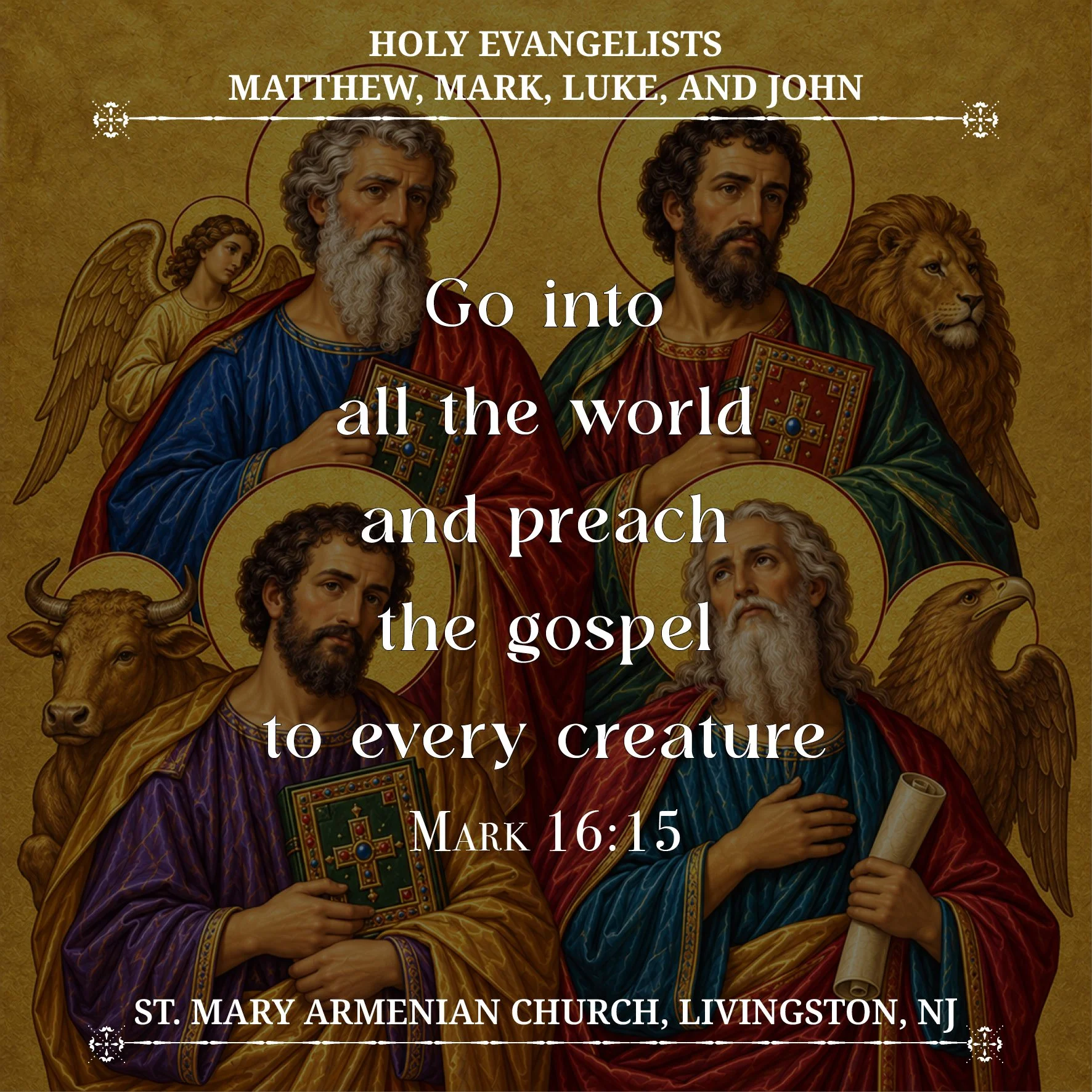
Commemoration Day of
THE Holy Evangelists
Matthew, Mark,
Luke, and John
St. Matthew THE EVANGELIST
Matthew was a tax collector in Capernaum, meaning that he was a government official.
Tax collectors were hated by the Jews for two reasons. First, they were Jewish officials serving a foreign power, collecting taxes on behalf of a despised government and dealing directly with the various classes of society. Second, they collected more than the prescribed amount in order to enrich themselves.
They were identified with “sinners” and were generally mentioned together with them.
In contrast, tax collectors are presented in a favorable light in the Gospels.
For example, among those who came to John the Baptist to be baptized were tax collectors who asked the prophet what they should do. John instructed them:
“Collect no more than the amount prescribed for you” (Luke 3:12–13).
Also well known is the parable of the tax collector and the Pharisee, who went to the Temple to pray.
The tax collector, acknowledging his sinfulness, begged God for forgiveness of his sins. Jesus affirmed:
“This man went down to his house justified rather than the Pharisee,” who, according to Jewish standards, was considered a model of piety.
Also well known is the conversion of Zacchaeus the tax collector, who demonstrated his repentance by giving his possessions to the poor and restoring fourfold whatever he had wrongfully taken from others.
Among these tax collectors was Levi, the son of Alphaeus, whose former, or Hebrew, name was Matthew.
As Christ was passing by, Matthew was sitting at his tax office in Capernaum.
The Son of God, who knows the hearts of all people, recognized in him the qualities of an apostle and simply said:
“Follow Me.”
In all likelihood, Matthew had already heard Christ preaching in the synagogue of Capernaum and had either witnessed or heard about His miracles.
Consequently, he was already favorably disposed toward Christ, so that when he was called by Him, he willingly and lovingly “left everything” and followed Jesus.
However, before leaving his occupation and his circle of associates, Matthew organized a great reception at his home, inviting his fellow tax collectors as well as Christ and His disciples.
This occasion gave the scribes and Pharisees considerable reason to complain, saying:
“Jesus eats with sinners and tax collectors.”
To this, Jesus gave one of His famous responses:
“Those who are well have no need of a physician, but those who are sick. Go and learn what this means: ‘I desire mercy, not sacrifice.’”
The latter words were a quotation from the prophets.
Christ further added:
“For I have not come to call the righteous, but sinners” (Matthew 9:9–13).
This is all that the Gospels tell us about Matthew.
Tradition attempts to fill in the remaining details, stating that his missionary journeys took him as far as Abyssinia (Ethiopia), or to Persia and Parthia, the latter being regarded as the place of his martyrdom.
Matthew's greatest glory is his Gospel, the first book of the New Testament and the most fitting link between the Old and New Testaments.
Indeed, the opening page of his Gospel begins with a reference to the lawful ancestors of Jesus Christ, “the Son of David, the Son of Abraham,” recalling the founding fathers and royal lineages of the Old Testament.
His Gospel contains at least sixty quotations from Old Testament prophecies, forty of which are presented as prophecies fulfilled in Christ.
Thus, one of the key expressions in this Gospel is:
“What was spoken through the prophet was fulfilled.”
Another characteristic expression is “the Kingdom of Heaven,” which appears approximately thirty to forty times throughout the book.
Matthew's purpose is to establish that Jesus of Nazareth was the long-awaited Messiah.
Particularly famous is the Sermon on the Mount (chapters 5–7) in Matthew's Gospel.
It may be regarded as the lawbook or constitution of the New Covenant and, at the same time, as one of the highest achievements of religious literature for all humanity.
In our Church, Matthew is commemorated together with his three fellow Evangelists on the Saturday preceding the sixth Sunday of the Holy Cross.
ST. Mark THE EVANGELIST
In our Church calendar, the names John and Mark have been assigned to two different individuals and have consequently entered the calendar as separate persons.
However, the individual known by these two names is first mentioned in the Acts of the Apostles when the Apostle Peter, after being released from prison, came to their house:
“And Peter ... came to the house of Mary, the mother of John, who was called Mark” (Acts 12:12).
From this passage, we learn that John and Mark are two names for the same person, one Hebrew and the other Greco-Roman in form.
Having two names was common among many of the leading figures of the early Christian Church.
The same passage also shows that his mother was a prominent person in the newly established Church.
More importantly, their home was one of the principal gathering places of the early Christians, as the passage continues:
“Where many were gathered together and were praying.”
Mark, therefore, was from Jerusalem and was a relative of the Apostle Barnabas.
This is confirmed by the Apostle Paul in the greeting of his Letter to the Colossians:
“Mark, the cousin of Barnabas” (Colossians 4:10).
When Barnabas and Paul came to Jerusalem, bringing the material contributions of the believers in Antioch to the impoverished Church in Jerusalem, they took with them on their return “John, who was also called Mark” (Acts 12:25).
Mark accompanied them on their first missionary journey as an attendant or assistant.
However, shortly after reaching Asia Minor, Mark caused Paul some displeasure and returned to Jerusalem.
For this reason, Paul did not wish to have Mark accompany them on their second journey.
This disagreement led Barnabas and Mark to return to Cyprus, where, in all likelihood, they continued the evangelistic work they had begun.
From Paul's letters, we learn that Paul and Mark were eventually reconciled.
As mentioned earlier, during Paul's imprisonment in Rome, Mark was with him.
Through Mark, Paul sent greetings to the Church of Colossae, where Mark was to be sent for missionary service.
In his Second Letter to Timothy, Paul instructed Timothy:
“Bring Mark with you, for he is a useful assistant to me” (2 Timothy 4:11).
What immortalized Mark's name, and what constitutes his lasting contribution to the Christian Church, is his Gospel.
Although it is the shortest of the four Gospels, it is also considered the oldest.
There is a tradition that it was written under the direction and guidance of the Apostle Peter, who refers to him in his First Epistle as:
“Mark, my son” (1 Peter 5:13).
The Gospel of Mark is believed to have been written for the Gentiles, particularly the Romans.
In it, Mark presents Christ as a powerful figure, both in word and in deed.
His writing style is simple, direct, and concise.
Mark is commemorated together with the four Evangelists on the Saturday preceding the sixth Sunday of the Holy Cross.
ST. Luke the evangelist
The name of this remarkable individual is mentioned only two or three times in the New Testament, and even then only in the letters of the Apostle Paul, among various other names.
He is first mentioned in Paul's very brief Letter to Philemon as a “fellow worker” (verse 24), and in the Letter to the Colossians as “Luke, the beloved physician” (Colossians 4:14).
Elsewhere, the Apostle states that everyone has departed from him and that “only Luke is with me” (2 Timothy 4:10–11).
From these references, we conclude that Luke was a physician by profession and one of the Apostle Paul's most faithful and devoted fellow workers.
Indeed, beginning with chapter 16, verse 11 of the Acts of the Apostles, the author begins to narrate events in the first person, indicating that the writer was personally present and participated in these events.
It is well known that the author of the Acts of the Apostles is none other than Luke himself.
We may therefore conclude that Luke joined the Apostle Paul at Troas during Paul's second missionary journey and accompanied him through his fourth and last known journey to Rome.
From his name and various other circumstances, it may be inferred that Luke was not Jewish, but rather a Christian convert from paganism.
The priceless legacy Luke has left us consists of his Gospel and the Acts of the Apostles.
We do not consider it right to regard one Gospel as superior to another. Each is just as important, complete, and necessary as the others.
After all, each Gospel possesses its own particular beauty, distinctive character, and fragrance, just as the rose and the carnation, the lily and the chrysanthemum each possess their own unique glory and splendor.
Luke's Gospel, both in its literary qualities and its content, is a work of beauty and perfection from beginning to end, from the tender accounts of Jesus' childhood to the sorrowful travelers on the road to Emmaus.
The incomparable parables of the Good Samaritan and the Prodigal Son are deeply moving.
Equally universal in their significance is the special concern shown by our Savior toward the poor, the destitute, the humble, women, children, and sinners.
Salvation is a central theme of this Gospel.
Prayer also occupies a particularly prominent place.
Some of the oldest hymns of the Christian Church are taken from or inspired by this Gospel, including the “Ave Maria,” the “Magnificat,” the “Gloria in Excelsis,” and others.
Luke's contribution to the Christian Church through the Acts of the Apostles is irreplaceable.
This book is the continuation and second volume of his Gospel and, so to speak, the first book of Church history.
Without this precious work, much concerning the origins, birth, and earliest steps of the Christian Church would have remained in darkness.
First, with Jerusalem as its center, the book describes the establishment and growth of the Church in Palestine.
Then, with Antioch and Ephesus as important centers, it traces the spread of Christianity into the neighboring lands of Syria, Cyprus, Asia Minor, Greece, and eventually as far as Rome.
Thus, although Luke remains largely in the background throughout the pages of the New Testament, he is one of the most distinguished figures of the early Church.
He is commemorated together with his fellow Evangelists on the Saturday preceding the sixth Sunday of the Holy Cross.
St. John THe Theologian Evangelist
The most radiant and thoughtful figure among the apostles. The Disciple of Love, the Theologian Evangelist, and the Prophet of Revelation.
Contrary to the image of a gentle and tranquil person that people commonly associate with John, the Gospels initially present him as an intolerant, vengeful, energetic, and ambitious young man, yet one who was always filled with devotion to Christ.
The three years he spent as a disciple of Christ were more than sufficient to transform him into one of the most magnificent personalities of the Gospel.
Within him were harmoniously united qualities of human character that might otherwise seem contradictory: zeal and serenity, courage and kindness, greatness and humility, love and sternness.
He appears to have been the youngest of the apostles, yet at the same time the longest-lived.
Because of his gentle character, devotion, and other noble qualities, he was worthy of receiving Jesus' special affection, to such an extent that he was given the title “the Beloved Disciple.”
John earned this love partly through certain innocent and well-intentioned statements he made in defense of Christ.
But he deserved it even more on the night of Jesus' arrest, when the other disciples abandoned Him and fled.
John followed his beloved Master throughout the night of His suffering, along the road to the Cross, and all the way to Golgotha.
There he was granted the supreme privilege: Jesus entrusted His mother to John and declared John to be her son.
Thus, in the person of the Mother of God, John received a second mother, as dear and incomparable as his own devout mother.
On Sunday morning, when John learned that Jesus' tomb was empty, he hurried to the tomb with Peter.
He saw everything and, without yet having seen the risen Christ, “believed” in Jesus' Resurrection.
John, together with his brother James and Peter, whose names are inseparably associated with his in the opening chapters of the Acts of the Apostles, was one of the pillars of the early Church.
For example, the healing of a man who had been lame from birth, which caused great excitement among the Jews and led to the arrest and imprisonment of Peter and John, is attributed equally to both apostles.
The following day, they were brought before the supreme council of their people, where they answered with great boldness.
When the leaders “saw the boldness of Peter and John and realized that they were uneducated and ordinary men, they were astonished.”
Finding no lawful grounds on which to punish them, the authorities simply ordered them “not to speak or teach at all in the name of Jesus.”
But Peter and John answered:
“Whether it is right in the sight of God to listen to you rather than to God, you must judge. For we cannot keep from speaking about what we have seen and heard.”
After threatening them further, the authorities released them out of consideration for the people, who were glorifying God because of the miracle that had taken place (Acts 4:1–22).
After the Council of Jerusalem, almost all the apostles gradually dispersed to various countries.
According to tradition, John went to Ephesus, where he lived for many years and expanded the work that the Apostle Paul had begun there.
Eventually, he was exiled to the island of Patmos in the Aegean Sea.
It was there that he experienced the mysterious vision presented to us in the Book of Revelation, also known as the Revelation of John.
John's greatest glory is his Gospel, which was written in a style and spirit different from those of the three preceding Gospels.
Its purpose is to present Christ as the Son of God.
This book is the most profound and spiritual of the twenty-seven books of the New Testament.
In this Gospel, Christ gives a deeper and more complete revelation of Himself and of God.
The Gospel of John complements the first three Gospels.
The Evangelist devotes almost half of his book to the words and deeds of Jesus during the final days of His earthly life.
Especially magnificent is the prologue of the Gospel, in which Christ is presented as the “Word” of God, that is, Divine Wisdom personified, who:
“In the beginning was the Word, and the Word was with God, and the Word was God.”
It is also noteworthy that in this Gospel, neither John himself, nor his brother, nor his mother is mentioned by name.
This is significant for two reasons.
First, it is an important indication that the Gospel was written by John.
Second, it emphasizes his modesty and humility.
In the New Testament, there are also three Epistles bearing John's name.
The first is a magnificent writing consisting of five chapters.
Its purpose is to strengthen believers in their faith in Christ, inspire them with confidence in eternal life, and warn them to avoid sin and false teachers.
Its key words are “love”, which is used more than twenty times; “knowledge”, or expressions of similar meaning, which occur approximately thirty times; and “fellowship.”
The Second and Third Epistles, each consisting of only one chapter, are among the shortest writings in the New Testament.
They differ from the First Epistle in that they are addressed to particular individuals.
The Second Epistle is addressed to:
“The elect Lady and her children.”
This is the only writing in the New Testament addressed to a woman.
The key words of this Epistle are likewise “love” and “truth.”
The Third Epistle is addressed to:
“The beloved Gaius.”
Both the Gospel and the Epistles were written during the final years of the Apostle's life.
John is believed to have died around A.D. 100, at approximately ninety-five years of age.
Although he experienced many sufferings throughout his life, he died peacefully in Ephesus.
It is said that in his old age, when he was no longer able to deliver lengthy sermons, he would still come to church simply to say:
“Little children, love one another.”
A magnificent church was once built over his tomb, of which only ruins remain today.
SCRIPTURE READINGS
~ Wisdom of Solomon 9:13-10:2 ~
For who can learn the counsel of God? Or who can discern what the Lord wills? For the reasoning of mortals is worthless, and our designs are likely to fail; for a perishable body presses down the soul, and this earthy tent burdens the thoughtful mind. We can hardly guess at what is on earth, and what is at hand we find with labor; but who has traced out what is in the heavens? Who has learned your counsel, unless you have given wisdom and sent your holy spirit from on high? And thus the paths of those on earth were set right, and people were taught what pleases you, and were saved by wisdom.
Wisdom protected the first-formed father of the world, when he alone had been created; she delivered him from his transgression, and gave him strength to rule all things.
~ Ezekiel 1:3-11 ~
The word of the Lord came to the priest Ezekiel son of Buzi, in the land of the Chaldeans by the river Chebar; and the hand of the Lord was on him there. As I looked, a stormy wind came out of the north: a great cloud with brightness around it and fire flashing forth continually, and in the middle of the fire, something like gleaming amber. In the middle of it was something like four living creatures. This was their appearance: they were of human form. Each had four faces, and each of them had four wings. Their legs were straight, and the soles of their feet were like the sole of a calf's foot; and they sparkled like burnished bronze. Under their wings on their four sides they had human hands. And the four had their faces and their wings thus: their wings touched one another; each of them moved straight ahead, without turning as they moved. As for the appearance of their faces: the four had the face of a human being, the face of a lion on the right side, the face of an ox on the left side, and the face of an eagle; such were their faces. Their wings were spread out above; each creature had two wings, each of which touched the wing of another, while two covered their bodies.
~ Zechariah 6:1-8 ~
And again I looked up and saw four chariots coming out from between two mountains—mountains of bronze. The first chariot had red horses, the second chariot black horses, the third chariot white horses, and the fourth chariot dappled gray horses. Then I said to the angel who talked with me, "What are these, my lord?" The angel answered me, "These are the four winds of heaven going out, after presenting themselves before the Lord of all the earth. The chariot with the black horses goes toward the north country, the white ones go toward the west country, and the dappled ones go toward the south country." When the steeds came out, they were impatient to get off and patrol the earth. And he said, "Go, patrol the earth." So they patrolled the earth. Then he cried out to me, "Lo, those who go toward the north country have set my spirit at rest in the north country."
~ Ephesians 4:7-13 ~
But each of us was given grace according to the measure of Christ's gift. Therefore it is said, "When he ascended on high he made captivity itself a captive; he gave gifts to his people." (When it says, "He ascended," what does it mean but that he had also descended into the lower parts of the earth? He who descended is the same one who ascended far above all the heavens, so that he might fill all things.) The gifts he gave were that some would be apostles, some prophets, some evangelists, some pastors and teachers, to equip the saints for the work of ministry, for building up the body of Christ, until all of us come to the unity of the faith and of the knowledge of the Son of God, to maturity, to the measure of the full stature of Christ.
~ Holy Gospel of St. Luke 6:13-19 ~
And when day came, he called his disciples and chose twelve of them, whom he also named apostles: Simon, whom he named Peter, and his brother Andrew, and James, and John, and Philip, and Bartholomew, and Matthew, and Thomas, and James son of Alphaeus, and Simon, who was called the Zealot, and Judas son of James, and Judas Iscariot, who became a traitor. He came down with them and stood on a level place, with a great crowd of his disciples and a great multitude of people from all Judea, Jerusalem, and the coast of Tyre and Sidon. They had come to hear him and to be healed of their diseases; and those who were troubled with unclean spirits were cured. And all in the crowd were trying to touch him, for power came out from him and healed all of them.