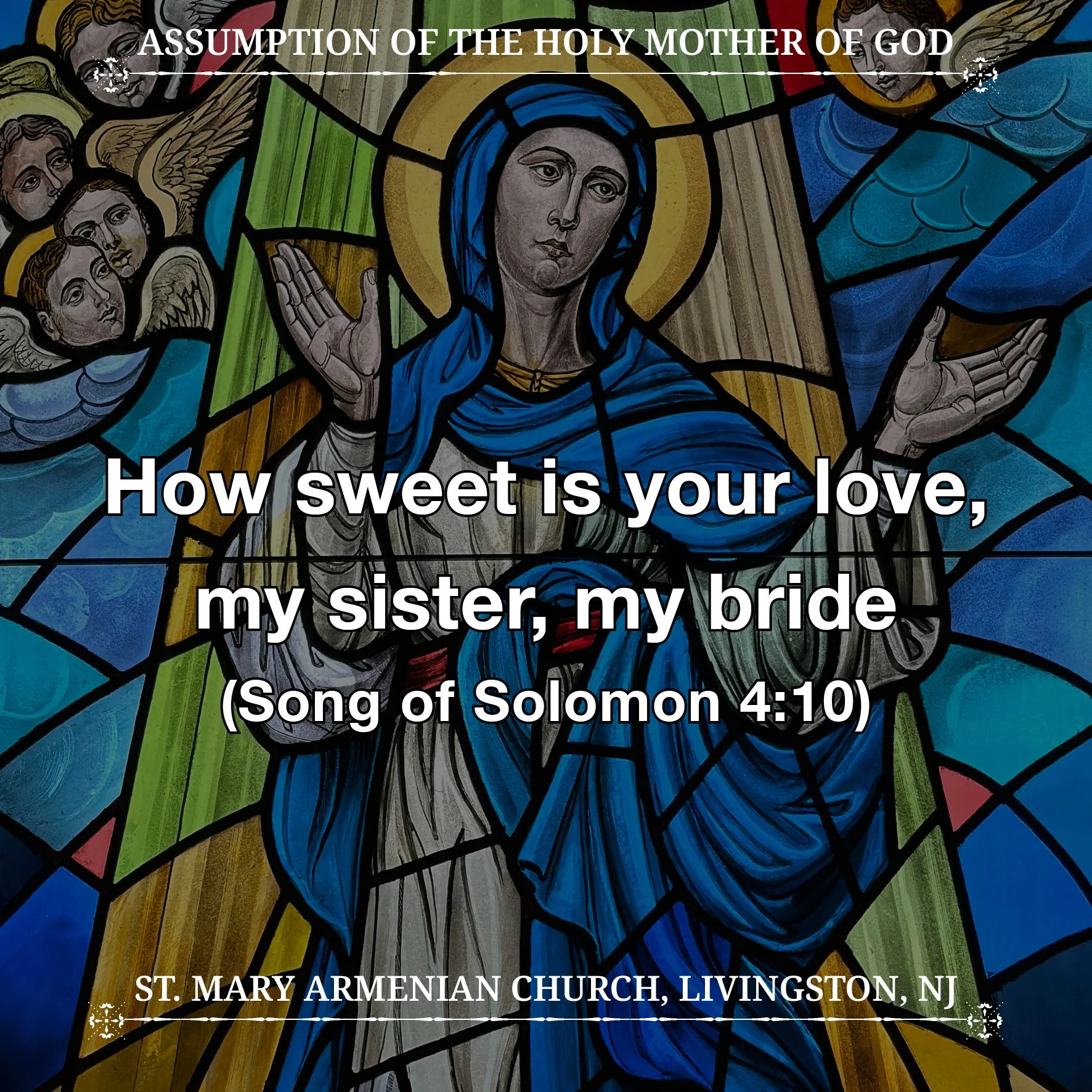
Feast of the Assumption
of the Holy Mother of God
The Feast of the Assumption of the Holy Mother of God is one of the five major feast days of the Armenian Church. It is celebrated on the Sunday nearest to August 15, that is, on the Sunday falling between August 12 and 18. This feast dates back to the earliest centuries of Christianity and was officially established in 582 A.D. by Emperor Maurice.
The life of the Blessed Virgin Mary after the Ascension of her Divine Son is known only through Holy Tradition. According to tradition, after the Ascension of our Lord Jesus Christ, the Mother of God, in obedience to her Son's command (John 19:26–27), lived for about fifteen years under the care of the Apostle John the Theologian. She devoted her days and nights to fasting and prayer. She frequently visited the Lord's empty tomb, where she knelt in prayer, and she was surrounded by the love and care of the disciples. The Holy Virgin passed away peacefully.
During one of her visits to Golgotha, the Archangel Gabriel appeared before her holding a palm branch, the symbol of peace, and said:
"O Mother of Holiness and Harbor of Blessedness, Temple of Joy and City of the Kingdom, pathway of the human race to Christ, the time has come for you to depart from this world to God. Your Lord, the Only-Begotten Son, who chose you from among all people to be His Mother and the salvation of the whole world, now desires to translate you with glory from this world into His incomprehensible glory."
Returning home, Mary told John and later the other Apostles what had happened, showing them the palm branch brought by the Archangel Gabriel, from which heavenly light radiated. The Apostle John celebrated the Divine Liturgy so that the Virgin might receive Holy Communion one last time.
Preparing for her departure to the heavenly realm, the Mother of God instructed that her room be adorned and candles lit. She gave her two garments and other belongings to the widows and virgins who lived with her and expressed her wish to be buried in the Valley of Gethsemane beside her righteous parents and Joseph.
Finally, the hour came for her translation from earth to heaven.
Many candles were burning. The Apostles surrounded the beautifully adorned bier upon which the Mother of God rested. Her peaceful and pure face shone with heavenly radiance, and a marvelous fragrance emanated from her body. Stretching out her hands toward the east, she gave thanks to and blessed God.
Suddenly, an indescribable light shone forth. Those present were filled with awe as Jesus Christ appeared above the room, surrounded by angels and saints.
Moving her lips gently, the Holy Virgin prayed to the Lord for the salvation of the entire world. She rose lightly from her bed, bowed before Christ, and peacefully surrendered her soul into the hands of her Only-Begotten Son, as though falling asleep. Her soul ascended and joined the heavenly hosts, while her body remained incorrupt, exuding the fragrance of sweet incense rather than the odor of death.
As the solemn funeral procession, accompanied by the blessed Apostles and other faithful Christians carrying torches and candles while singing psalms and hymns, made its way toward Gethsemane, a great radiant cloud suddenly appeared directly above them and accompanied the procession. The city echoed with their sacred hymns.
An angry crowd attacked the Apostles in an attempt to scatter the procession. At that moment, the cloud descended and surrounded the funeral cortege like a protective wall. Many of the attackers were struck blind.
Tradition recounts another miracle that occurred that day. A Jewish priest named Sophonia struck the holy bier, intending to overturn it. Instantly, his hands were severed at the elbows and remained attached to the bier. Falling to the ground in terror, he sincerely repented of his actions. Seeing his genuine repentance, the Apostle Peter healed his hands. Sophonia then joined the Christians and became a follower of Christ. That day many who had lived in spiritual darkness came to faith, and numerous Jews and Gentiles were baptized.
Upon reaching Gethsemane, the Apostles placed the blessed body in a tomb and sealed its entrance with a great stone. For three days they, together with the faithful, prayed continuously at the tomb. Throughout this time they heard the sweet singing and praises of the angels.
On the fourth morning, the hosts of angels, led by Jesus Christ Himself, descended from heaven and carried the body of the Mother of God into heaven.
The Apostle Bartholomew was absent during the burial. When he returned to Jerusalem, he was deeply saddened that he had been unable to bid farewell to the Holy Mother of God. He asked the Apostles to open her tomb so that he too might see her one last time. The Apostles prayed and agreed. When they opened the tomb, they found only the burial cloths—the body of the Holy Virgin was no longer there. They glorified God, realizing that the Mother of God had been assumed into heaven.
For this reason, the earthly end of the Virgin Mary's life is traditionally described as her Dormition ("falling asleep") rather than her death, emphasizing that she was taken into heaven.
Based on this ancient tradition, the Fathers of the Church later established the Feast of the Assumption of the Holy Mother of God.
Tradition also preserves the memory of the first icon of the Mother of God. When Mary was called to be with her Only-Begotten Son, the Apostle John took a piece of cypress wood—the same kind from which the Life-Giving Cross had been made—and painted an image of the Virgin upon it. Together with the other Apostles, he asked her to place the wooden panel upon her face, bless it, and intercede before the Lord on behalf of the world, which at that time was suffering greatly from an outbreak of leprosy, especially in Jerusalem.
A radiant arch of light appeared over the Holy Virgin, and a cross-shaped beam of heavenly light descended upon the icon. She pressed the image to her face and moistened it with the abundant tears she shed before the Lord. The Apostle Peter then received the icon from her hands, and all the Apostles venerated the Mother of God and joyfully received her life-giving blessing.
The Apostles entrusted this icon to Bartholomew so that it might comfort him and accompany him on his missionary journeys. Armenian sources relate that Bartholomew brought it to Armenia, where many sick people were healed through it. He placed it at a site called Darbnots Kar in the district of Andzevats, where a church dedicated to the Mother of God was built in honor of the icon. A convent, later known as the Monastery of Hogyats, was subsequently established there. Following this ancient example, the sanctuaries of Armenian churches are dedicated to the Mother of God and adorned with her image.
The present location of the icon brought by the Apostle Bartholomew is unknown. Tradition says only that it was hidden within a wall to protect it from invading forces.
Many literary treasures have been dedicated to the Mother of God, including hymns and canticles attributed to Movses Kertogh (Moses the Poet), as well as numerous beautiful devotional songs and melodies.
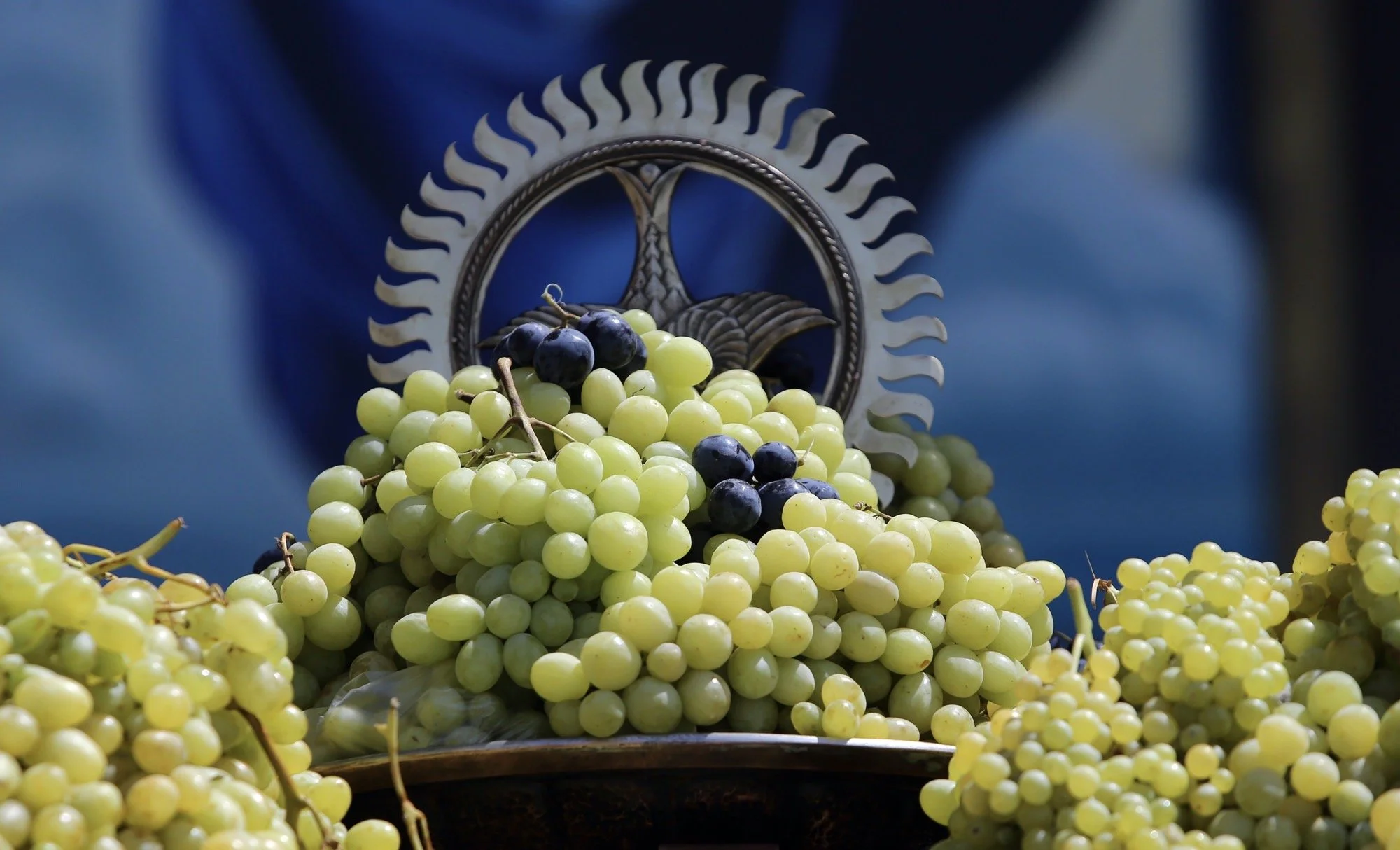
On the Feast of the Assumption of the Mother of God, immediately after the Divine Liturgy, the Armenian Church celebrates the Blessing of the Grapes (Khaghogh Orhnek), one of its most beloved annual traditions.
Blessing of the Grapes
In our national and church life great importance is given to the Divine traditions which originate from the Holy Scriptures. They became the best way to express the unique image of our nation and church. Thus, these traditions were valued and adopted as sacred services, improving throughout the centuries.
One of the holy celebrations of the Armenian Church is the Blessing of the Grapes which is offered following the celebration of Divine Liturgy on the Feast of the Assumption of the Holy Mother of God. It is also one of the Holy Traditions of the Universal Church.
During pre-Christian times "the feast of Roots and Fruit" constituted part and parcel of the religious rituals of almost all nations. On this day a special ceremony was conducted by the servants of the temple, during which the first fruit of the year was offered to the corresponding God embodying fertility; as a sign of obedience, gratitude and fruitfulness for the coming year.
Although the above-mentioned ceremony of offering the first fruit was also found in Armenian traditions, it was not distinguished as "the feast of Roots and Fruit". It was considered to be one of the feasts devoted to the Goddess Anahit as she embodied fertility and fruitfulness.
After Armenia’s adoption of Christianity as the state religion in 301 AD, St. Gregory the Illuminator implemented new directions in the Armenian Church concerning traditions. The first Armenian Patriarch changed the essentials of the services, but included parts of some customs and rites of the old Armenian religion into the new Christian Church traditions. One of them was the offering of the first fruit from the harvest. After reviewing and modifying this tradition, St. Gregory the Illuminator Christianized the service and introduced it into the Armenian Church traditions correlating it with the Feast of the Assumption of the Holy Mother of God. Upon the direction of St. Gregory the "offering" of the fruit was changed to be a Holy blessing of the harvest conducted by a priest.
The order of offering the first fruit to God was established by the Prophet Moses: 1 "When you have come into the land that the Lord your God is giving you as an inheritance to possess, and you possess it, and settle in it, 2 you shall take some of the first of all the fruit of the ground, which you harvest from the land that the Lord your God is giving you, and you shall put it in a basket and go to the place that the Lord your God will choose as a dwelling for his name. 3 You shall go to the priest who is in office at that time, and say to him, "Today I declare to the Lord your God that I have come into the land that the Lord swore to our ancestors to give us.
[…] 10 "So now I bring the first of the fruit of the ground that you, O Lord, have given me. You shall set it down before the Lord your God and bow down before the Lord your God." (Deuteronomy 26:11- 3; 10 )
During the services, the following harvests were offered: wheat, barley, grapes, figs, pomegranates, olives, honey. Among these offerings, the grapes were of special significance for the Romans, for two reasons. Firstly wine, which was considered to be the best remedy for removing sadness and was associated with happiness and well-being was made of grapes. Secondly the grape was the national symbol of Israel and at the same time a symbol of peace and well-being.
According to this God-founded cannon every year Israelis offered the first fruit of their gardens to God’s temple. They clearly understood and frankly believed that all the fruit they enjoyed was granted to them by God in Heaven. Thus, in gratitude, they had to offer the first fruits of their harvest and their just earnings to the Merciful God.
In the Armenian Church grapes are given preference over other fruits to be blessed as the first fruit of the harvest. This is conditioned by a number of historical and religious circumstances. After the devastating flood, our ancestor Noah planted a vineyard in the valley on the slopes of Mt. Ararat and grew grapes. 9:20 Noah, a man of the soil, was the first to plant a vineyard. (Genesis 9:20)
The fruit of the vineyard became the decoration of the Araratian valley; it was considered to be the noblest fruit and was called the KING OF THE FRUIT. Jesus Christ repeatedly assimilated himself with the vine 15:1 "I am the true vine, and my Father is the vinegrower." (John 15:1). According to the explanation given by our Church Fathers the Holy Mother of God is the selected branch that presented humanity with a pure and life-giving vine - Jesus Christ. The blessing of the fruit conducted on the feast of the Assumption of the Holy Mother of God coincides with the end of summer when the grape ripens.
According to the generalized tradition the choice of grapes over other fruits is usually explained by the convenience of the season, however some consider that it is not exactly so. As it has been mentioned, our Lord described himself as the vine and when we read in the Gospel (John 15 1:8) we see that His words reveal the symbolic mission of the grape vines in the life of the Church. Thus, the hypothesis that only suitable weather conditions were a factor in the choice is questioned. Because these factors, the Armenian Church has given preference to the grape, which every year on the feast of the Assumption of the Holy Mother of God is blessed after the Divine Liturgy and given to the faithful in attendance.
Although St. Gregory the Illuminator didn’t establish a specific service for offering the first fruit of the harvest, his followers kept this tradition and handed it down through generations. St. Sahag of Partev canonized it "as a rule" and St. Nerses the Graceful turned this tradition into a formal service establishing readings from the gospel of the prophets and the apostles as well as a special prayer of blessing for the consecration.
Thus, the blessing of grapes became a devout ceremony attached to the feast of the Assumption of the Holy Mother of God.
Today it is traditional for faithful Armenians who have grape vines or vineyards to offer the first fruit of their harvest during the blessing of the grapes so that the original meaning of the ceremony established by St. Gregory the Illuminator would be continued and the divine and heavenly blessing would abundantly inundate their fields.
The canons of the Armenian Church do not prohibit eating grapes before the Blessing of the Grapes, and the tradition of abstaining from eating grapes before the ceremony is rooted in the people, and has become a national custom. As the grape was given preference for blessing over all other fruits, then waiting with obedience and abstinence until the blessing of the grapes follows in the tradition established by St. Gregory.
Source: ArmenianChurch.org
SCRIPTURE READINGS
~ Song of Solomon 4:9-15 ~
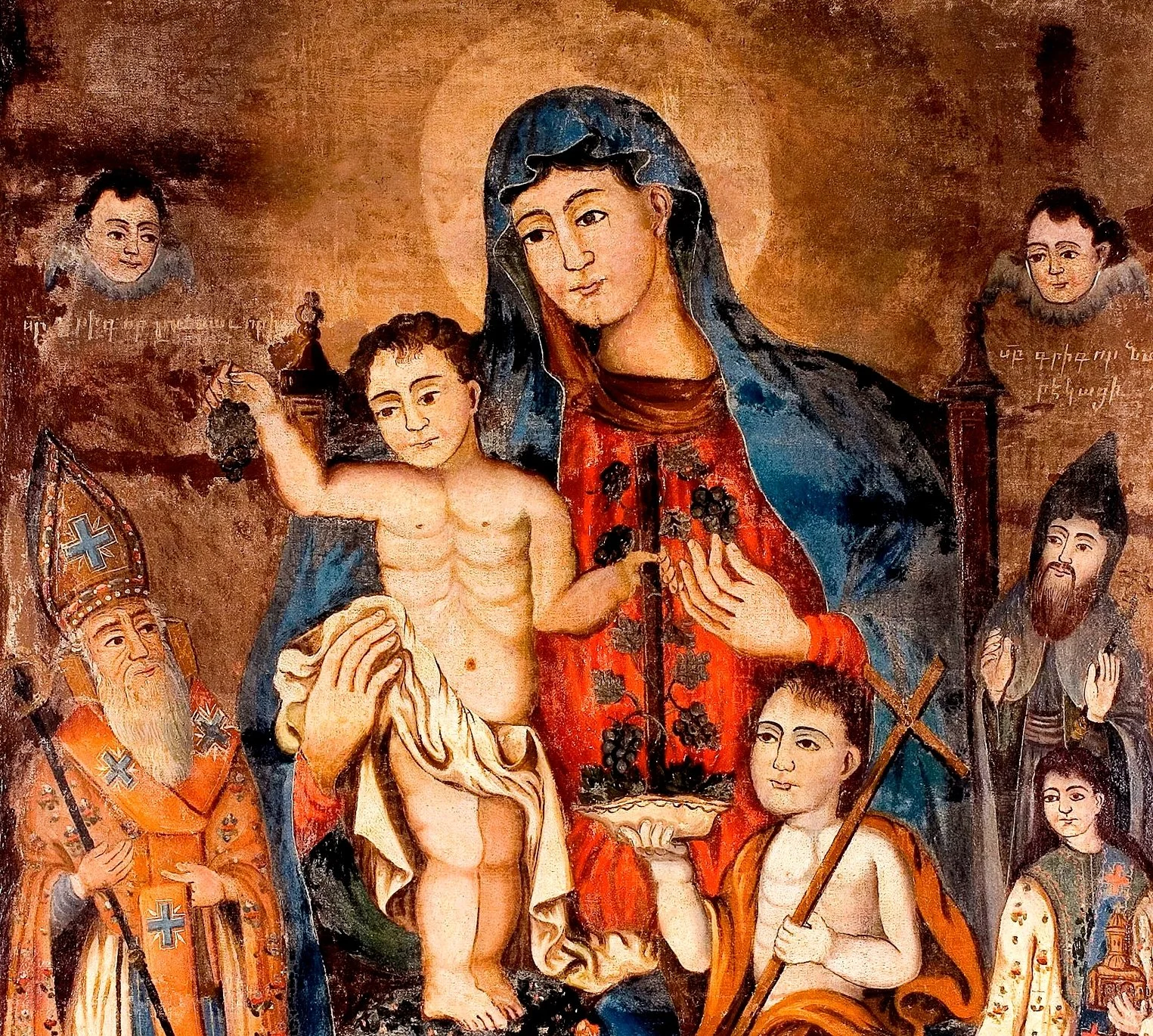
You have ravished my heart, my sister, my bride, you have ravished my heart with a glance of your eyes, with one jewel of your necklace. How sweet is your love, my sister, my bride! how much better is your love than wine, and the fragrance of your oils than any spice! Your lips distill nectar, my bride; honey and milk are under your tongue; the scent of your garments is like the scent of Lebanon. A garden locked is my sister, my bride, a garden locked, a fountain sealed. Your channel is an orchard of pomegranates with all choicest fruits, henna with nard, nard and saffron, calamus and cinnamon, with all trees of frankincense, myrrh and aloes, with all chief spices— a garden fountain, a well of living water, and flowing streams from Lebanon.
~ Isaiah 7:10-16 ~
Again the Lord spoke to Ahaz, saying, Ask a sign of the Lord your God; let it be deep as Sheol or high as heaven. But Ahaz said, I will not ask, and I will not put the Lord to the test. Then Isaiah said: "Hear then, O house of David! Is it too little for you to weary mortals, that you weary my God also? Therefore the Lord himself will give you a sign. Look, the young woman is with child and shall bear a son, and shall name him Immanuel. He shall eat curds and honey by the time he knows how to refuse the evil and choose the good. For before the child knows how to refuse the evil and choose the good, the land before whose two kings you are in dread will be deserted.
~ Galatians 3:29-4:7 ~
And if you belong to Christ, then you are Abraham's offspring, heirs according to the promise. My point is this: heirs, as long as they are minors, are no better than slaves, though they are the owners of all the property; but they remain under guardians and trustees until the date set by the father. So with us; while we were minors, we were enslaved to the elemental spirits of the world. But when the fullness of time had come, God sent his Son, born of a woman, born under the law, in order to redeem those who were under the law, so that we might receive adoption as children. And because you are children, God has sent the Spirit of his Son into our hearts, crying, "Abba! Father!" So you are no longer a slave but a child, and if a child then also an heir, through God.
~ Holy Gospel of St. Luke 2:1-7 ~
In those days a decree went out from Emperor Augustus that all the world should be registered. This was the first registration and was taken while Quirinius was governor of Syria. All went to their own towns to be registered. Joseph also went from the town of Nazareth in Galilee to Judea, to the city of David called Bethlehem, because he was descended from the house and family of David. He went to be registered with Mary, to whom he was engaged and who was expecting a child. While they were there, the time came for her to deliver her child. And she gave birth to her firstborn son and wrapped him in bands of cloth, and laid him in a manger, because there was no place for them in the inn.