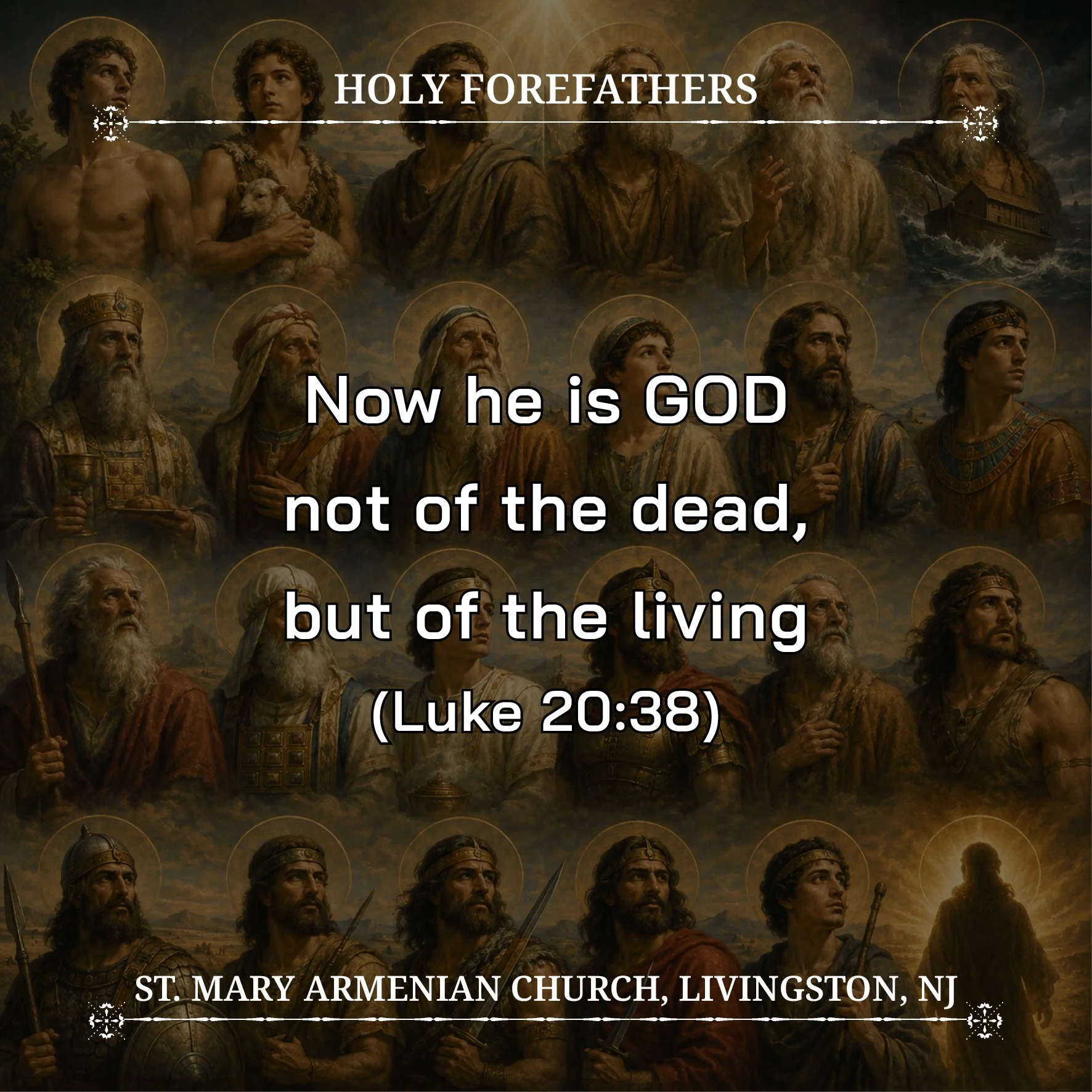
Commemoration DAY of
Holy Forefathers: Adam, Abel, Seth,
Enosh, Enoch, Noah, Melchizedek,
Abraham, Isaac, Jacob, Joseph,
Moses, Aaron, Eleazar, Joshua, Samuel,
Samson, Jephthah, Barak, Gideon,
and the Other Holy Forefather
The Patriarchs are those figures of the Old Testament for whom the Greek Septuagint (the ancient Greek translation of the Old Testament) uses the word "patriarch" (patriarchēs), a title that was applied to both religious and civil leaders. The Armenian term "nahapet" (patriarch or forefather) is its equivalent.
The Book of Genesis presents two genealogies of the patriarchs. The first (Genesis 4:17–18) begins with Cain and continues to Methushael and Lamech. The second (Genesis 5:3–31) begins with Seth and likewise ends with Lamech.
The Christian Church also numbers Adam, the forefather of humanity, among the saints. In doing so, it affirms the truth that Christ's saving blood was shed for all the children of Adam, beginning with their first father. Through Adam's redemption, the curse brought by Adam is removed from all who repent, believe, are baptized, and become members of Christ's Church.
The patriarchs were entrusted with a profoundly important role. Many of them lived for hundreds of years because they continually sought to draw near to God and to live lives pleasing to Him. Experiencing and enjoying God's presence, they instructed, warned, and guided the people, keeping them from straying onto sinful paths. Through their holy lives, they became examples of righteousness for others.
The highest purpose of the patriarchs' way of life was to fulfill the almighty will of God. As intercessors before the Most High, they made the relationship between God and humanity even more immediate—a relationship that has always been essential.
Above all, for those living today, the patriarchs remain a valuable and enduring example through their holy desire to seek, pursue, and attain righteousness.
SCRIPTURE READINGS
~ Genesis 4:1-8, 5:3-11, 5:23-24, 5:32, 9:28-29, 14:14-20, 25:7-11, 35:27-29, 49:32-50:13, 50:24-26 ~
Now the man knew his wife Eve, and she conceived and bore Cain, saying, "I have produced a man with the help of the Lord." Next she bore his brother Abel. Now Abel was a keeper of sheep, and Cain a tiller of the ground. In the course of time Cain brought to the Lord an offering of the fruit of the ground, and Abel for his part brought of the firstlings of his flock, their fat portions. And the Lord had regard for Abel and his offering, but for Cain and his offering he had no regard. So Cain was very angry, and his countenance fell. The Lord said to Cain, "Why are you angry, and why has your countenance fallen? If you do well, will you not be accepted? And if you do not do well, sin is lurking at the door; its desire is for you, but you must master it." Cain said to his brother Abel, "Let us go out to the field." And when they were in the field, Cain rose up against his brother Abel, and killed him.
When Adam had lived one hundred thirty years, he became the father of a son in his likeness, according to his image, and named him Seth. The days of Adam after he became the father of Seth were eight hundred years; and he had other sons and daughters. Thus all the days that Adam lived were nine hundred thirty years; and he died. When Seth had lived one hundred five years, he became the father of Enosh. Seth lived after the birth of Enosh eight hundred seven years, and had other sons and daughters. Thus all the days of Seth were nine hundred twelve years; and he died. When Enosh had lived ninety years, he became the father of Kenan. Enosh lived after the birth of Kenan eight hundred fifteen years, and had other sons and daughters. Thus all the days of Enosh were nine hundred five years; and he died.
Thus all the days of Enoch were three hundred sixty-five years. Enoch walked with God; then he was no more, because God took him.
After Noah was five hundred years old, Noah became the father of Shem, Ham, and Japheth.
After the flood Noah lived three hundred fifty years. All the days of Noah were nine hundred fifty years; and he died.
When Abram heard that his nephew had been taken captive, he led forth his trained men, born in his house, three hundred eighteen of them, and went in pursuit as far as Dan. He divided his forces against them by night, he and his servants, and routed them and pursued them to Hobah, north of Damascus. Then he brought back all the goods, and also brought back his nephew Lot with his goods, and the women and the people. After his return from the defeat of Chedorlaomer and the kings who were with him, the king of Sodom went out to meet him at the Valley of Shaveh (that is, the King's Valley). And King Melchizedek of Salem brought out bread and wine; he was priest of God Most High. He blessed him and said, "Blessed be Abram by God Most High, maker of heaven and earth; and blessed be God Most High, who has delivered your enemies into your hand!" And Abram gave him one-tenth of everything.
This is the length of Abraham's life, one hundred seventy-five years. Abraham breathed his last and died in a good old age, an old man and full of years, and was gathered to his people. His sons Isaac and Ishmael buried him in the cave of Machpelah, in the field of Ephron son of Zohar the Hittite, east of Mamre, the field that Abraham purchased from the Hittites. There Abraham was buried, with his wife Sarah. After the death of Abraham God blessed his son Isaac. And Isaac settled at Beer-lahai-roi.
Jacob came to his father Isaac at Mamre, or Kiriath-arba (that is, Hebron), where Abraham and Isaac had resided as aliens. Now the days of Isaac were one hundred eighty years. And Isaac breathed his last; he died and was gathered to his people, old and full of days; and his sons Esau and Jacob buried him.
When Jacob ended his charge to his sons, he drew up his feet into the bed, breathed his last, and was gathered to his people.
Then Joseph threw himself on his father's face and wept over him and kissed him. Joseph commanded the physicians in his service to embalm his father. So the physicians embalmed Israel; they spent forty days in doing this, for that is the time required for embalming. And the Egyptians wept for him seventy days. When the days of weeping for him were past, Joseph addressed the household of Pharaoh, "If now I have found favor with you, please speak to Pharaoh as follows: My father made me swear an oath; he said, "I am about to die. In the tomb that I hewed out for myself in the land of Canaan, there you shall bury me.' Now therefore let me go up, so that I may bury my father; then I will return." Pharaoh answered, "Go up, and bury your father, as he made you swear to do." So Joseph went up to bury his father. With him went up all the servants of Pharaoh, the elders of his household, and all the elders of the land of Egypt, as well as all the household of Joseph, his brothers, and his father's household. Only their children, their flocks, and their herds were left in the land of Goshen. Both chariots and charioteers went up with him. It was a very great company. When they came to the threshing floor of Atad, which is beyond the Jordan, they held there a very great and sorrowful lamentation; and he observed a time of mourning for his father seven days. When the Canaanite inhabitants of the land saw the mourning on the threshing floor of Atad, they said, "This is a grievous mourning on the part of the Egyptians." Therefore the place was named Abel-mizraim; it is beyond the Jordan. Thus his sons did for him as he had instructed them. They carried him to the land of Canaan and buried him in the cave of the field at Machpelah, the field near Mamre, which Abraham bought as a burial site from Ephron the Hittite.
Then Joseph said to his brothers, "I am about to die; but God will surely come to you, and bring you up out of this land to the land that he swore to Abraham, to Isaac, and to Jacob." So Joseph made the Israelites swear, saying, "When God comes to you, you shall carry up my bones from here." And Joseph died, being one hundred ten years old; he was embalmed and placed in a coffin in Egypt.
~ Numbers 20:23-29 ~
Then the Lord said to Moses and Aaron at Mount Hor, on the border of the land of Edom, "Let Aaron be gathered to his people. For he shall not enter the land that I have given to the Israelites, because you rebelled against my command at the waters of Meribah. Take Aaron and his son Eleazar, and bring them up Mount Hor; strip Aaron of his vestments, and put them on his son Eleazar. But Aaron shall be gathered to his people, and shall die there." Moses did as the Lord had commanded; they went up Mount Hor in the sight of the whole congregation. Moses stripped Aaron of his vestments, and put them on his son Eleazar; and Aaron died there on the top of the mountain. Moses and Eleazar came down from the mountain. When all the congregation saw that Aaron had died, all the house of Israel mourned for Aaron thirty days.
~ Deuteronomy 34:5-12 ~
Then Moses, the servant of the Lord, died there in the land of Moab, at the Lord's command. He was buried in a valley in the land of Moab, opposite Beth-peor, but no one knows his burial place to this day. Moses was one hundred twenty years old when he died; his sight was unimpaired and his vigor had not abated. The Israelites wept for Moses in the plains of Moab thirty days; then the period of mourning for Moses was ended. Joshua son of Nun was full of the spirit of wisdom, because Moses had laid his hands on him; and the Israelites obeyed him, doing as the Lord had commanded Moses. Never since has there arisen a prophet in Israel like Moses, whom the Lord knew face to face. He was unequaled for all the signs and wonders that the Lord sent him to perform in the land of Egypt, against Pharaoh and all his servants and his entire land, and for all the mighty deeds and all the terrifying displays of power that Moses performed in the sight of all Israel.
~ Joshua 24:29-33 ~
After these things Joshua son of Nun, the servant of the Lord, died, being one hundred ten years old. They buried him in his own inheritance at Timnath-serah, which is in the hill country of Ephraim, north of Mount Gaash. Israel served the Lord all the days of Joshua, and all the days of the elders who outlived Joshua and had known all the work that the Lord did for Israel. The bones of Joseph, which the Israelites had brought up from Egypt, were buried at Shechem, in the portion of ground that Jacob had bought from the children of Hamor, the father of Shechem, for one hundred pieces of money; it became an inheritance of the descendants of Joseph. Eleazar son of Aaron died; and they buried him at Gibeah, the town of his son Phinehas, which had been given him in the hill country of Ephraim.
~ Samuel 15:34-16:13 ~
Then Samuel went to Ramah; and Saul went up to his house in Gibeah of Saul. Samuel did not see Saul again until the day of his death, but Samuel grieved over Saul. And the Lord was sorry that he had made Saul king over Israel.
he Lord said to Samuel, "How long will you grieve over Saul? I have rejected him from being king over Israel. Fill your horn with oil and set out; I will send you to Jesse the Bethlehemite, for I have provided for myself a king among his sons." Samuel said, "How can I go? If Saul hears of it, he will kill me." And the Lord said, "Take a heifer with you, and say, "I have come to sacrifice to the Lord.' Invite Jesse to the sacrifice, and I will show you what you shall do; and you shall anoint for me the one whom I name to you." Samuel did what the Lord commanded, and came to Bethlehem. The elders of the city came to meet him trembling, and said, "Do you come peaceably?" He said, "Peaceably; I have come to sacrifice to the Lord; sanctify yourselves and come with me to the sacrifice." And he sanctified Jesse and his sons and invited them to the sacrifice. When they came, he looked on Eliab and thought, "Surely the Lord's anointed is now before the Lord." But the Lord said to Samuel, "Do not look on his appearance or on the height of his stature, because I have rejected him; for the Lord does not see as mortals see; they look on the outward appearance, but the Lord looks on the heart." Then Jesse called Abinadab, and made him pass before Samuel. He said, "Neither has the Lord chosen this one." Then Jesse made Shammah pass by. And he said, "Neither has the Lord chosen this one." Jesse made seven of his sons pass before Samuel, and Samuel said to Jesse, "The Lord has not chosen any of these." Samuel said to Jesse, "Are all your sons here?" And he said, "There remains yet the youngest, but he is keeping the sheep." And Samuel said to Jesse, "Send and bring him; for we will not sit down until he comes here." He sent and brought him in. Now he was ruddy, and had beautiful eyes, and was handsome. The Lord said, "Rise and anoint him; for this is the one." Then Samuel took the horn of oil, and anointed him in the presence of his brothers; and the spirit of the Lord came mightily upon David from that day forward. Samuel then set out and went to Ramah.
~ Hebrews 11:1-31 ~
Now faith is the assurance of things hoped for, the conviction of things not seen. Indeed, by faith our ancestors received approval. By faith we understand that the worlds were prepared by the word of God, so that what is seen was made from things that are not visible. By faith Abel offered to God a more acceptable sacrifice than Cain's. Through this he received approval as righteous, God himself giving approval to his gifts; he died, but through his faith he still speaks. By faith Enoch was taken so that he did not experience death; and "he was not found, because God had taken him." For it was attested before he was taken away that "he had pleased God." And without faith it is impossible to please God, for whoever would approach him must believe that he exists and that he rewards those who seek him. By faith Noah, warned by God about events as yet unseen, respected the warning and built an ark to save his household; by this he condemned the world and became an heir to the righteousness that is in accordance with faith. By faith Abraham obeyed when he was called to set out for a place that he was to receive as an inheritance; and he set out, not knowing where he was going. By faith he stayed for a time in the land he had been promised, as in a foreign land, living in tents, as did Isaac and Jacob, who were heirs with him of the same promise. For he looked forward to the city that has foundations, whose architect and builder is God. By faith he received power of procreation, even though he was too old—and Sarah herself was barren—because he considered him faithful who had promised. Therefore from one person, and this one as good as dead, descendants were born, "as many as the stars of heaven and as the innumerable grains of sand by the seashore." All of these died in faith without having received the promises, but from a distance they saw and greeted them. They confessed that they were strangers and foreigners on the earth, for people who speak in this way make it clear that they are seeking a homeland. If they had been thinking of the land that they had left behind, they would have had opportunity to return. But as it is, they desire a better country, that is, a heavenly one. Therefore God is not ashamed to be called their God; indeed, he has prepared a city for them. By faith Abraham, when put to the test, offered up Isaac. He who had received the promises was ready to offer up his only son, of whom he had been told, "It is through Isaac that descendants shall be named for you." He considered the fact that God is able even to raise someone from the dead—and figuratively speaking, he did receive him back. By faith Isaac invoked blessings for the future on Jacob and Esau. By faith Jacob, when dying, blessed each of the sons of Joseph, "bowing in worship over the top of his staff." By faith Joseph, at the end of his life, made mention of the exodus of the Israelites and gave instructions about his burial. By faith Moses was hidden by his parents for three months after his birth, because they saw that the child was beautiful; and they were not afraid of the king's edict. By faith Moses, when he was grown up, refused to be called a son of Pharaoh's daughter, choosing rather to share ill-treatment with the people of God than to enjoy the fleeting pleasures of sin. He considered abuse suffered for the Christ to be greater wealth than the treasures of Egypt, for he was looking ahead to the reward. By faith he left Egypt, unafraid of the king's anger; for he persevered as though he saw him who is invisible. By faith he kept the Passover and the sprinkling of blood, so that the destroyer of the firstborn would not touch the firstborn of Israel. By faith the people passed through the Red Sea as if it were dry land, but when the Egyptians attempted to do so they were drowned. By faith the walls of Jericho fell after they had been encircled for seven days. By faith Rahab the prostitute did not perish with those who were disobedient, because she had received the spies in peace.
~ Holy Gospel of St. Luke 20:34-40 ~
Jesus said to them, "Those who belong to this age marry and are given in marriage; but those who are considered worthy of a place in that age and in the resurrection from the dead neither marry nor are given in marriage. Indeed they cannot die anymore, because they are like angels and are children of God, being children of the resurrection. And the fact that the dead are raised Moses himself showed, in the story about the bush, where he speaks of the Lord as the God of Abraham, the God of Isaac, and the God of Jacob. Now he is God not of the dead, but of the living; for to him all of them are alive." Then some of the scribes answered, "Teacher, you have spoken well." For they no longer dared to ask him another question.