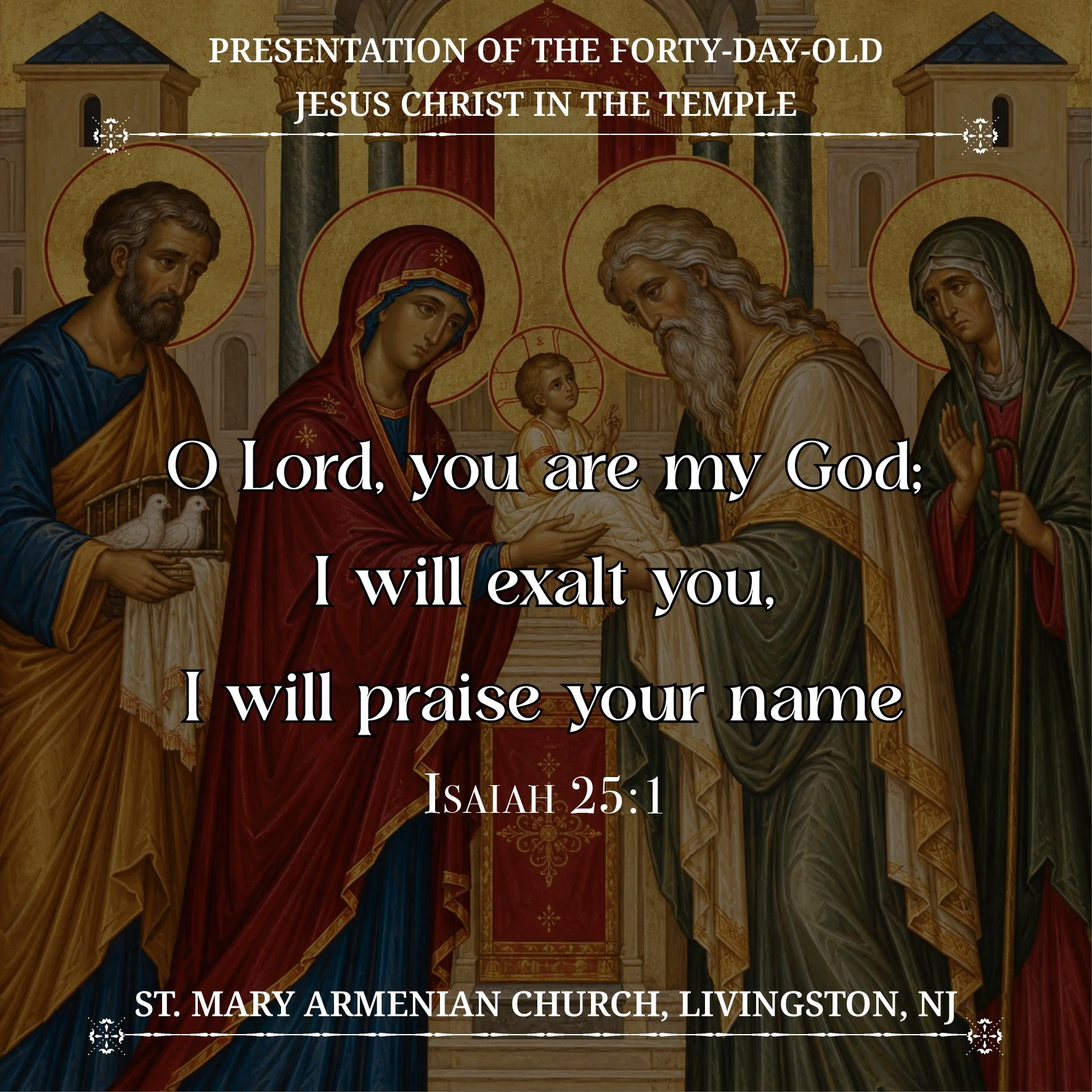
Feast of the Presentation of
the Forty-Day-Old Jesus Christ
in the Temple
For two thousand years, every Christian has heeded the call to always go forth to meet Christ by celebrating Տեառնընդառաջ (Dyarununtarach), the Feast of the Presentation of the Lord. For us Armenians, this feast is a celebration embraced by the entire nation.
Looking back at the history of this feast, we learn that it was established twenty centuries ago by St. James, the Brother of the Lord. The Armenian Apostolic Holy Church has continued to celebrate Tiarn’ndaraj without change, forty days after the Nativity of Christ, on February 14.
Of the four Evangelists, only Luke recounts the events of the Presentation of the Lord. Eight days after Christ’s birth, on January 13, He was circumcised and given the name Jesus, meaning “The Lord will save.” Thirty-three days later, Joseph and Mary, together with the Infant Jesus, traveled to Jerusalem to “present Him to the Lord” (Luke 2:22).
The Laws of the Old Testament
Although Joseph and Mary were not subject to the law, because Jesus, born of the Holy Virgin, had been conceived through the power of the Holy Spirit, they nevertheless came to the Temple to fulfill its requirements.
Jesus Christ entered the Temple to fulfill the very law that He Himself had established, thereby affirming His true humanity. He did not come to abolish the Law and the Prophets, but rather to fulfill His own law, setting an example of humility and meekness.
The laws they were to observe concerned the consecration of firstborn children and the purification of mothers.
According to the Mosaic Law, a woman was considered ritually unclean after giving birth. If the newborn was a boy, the period of purification was forty days; if a girl, eighty days.
After this period had passed, the parents would go to the Temple, bringing a one-year-old lamb as a burnt offering and a pair of pigeons or turtledoves as a sin offering.
Poor families, such as the family of Jesus, were permitted to offer two turtledoves or two young pigeons, one as a burnt offering and the other as a sin offering (Leviticus 12).
The Old Testament also contained a special law concerning firstborn sons.
Following the striking down of the firstborn of the Egyptians, God commanded that all firstborn among the Israelites, both human and animal, be consecrated to Him (Exodus 24:19–20), meaning that they were to be dedicated to service in God's Temple.
When the Prophet Moses ascended Mount Sinai to receive the Ten Commandments, the Israelites forgot God and made a golden calf to worship.
Only the tribe of Levi stood with Moses in punishing those who worshiped the calf (Exodus 22:6). From that time onward, the entire tribe of Levi, including its people and animals, was chosen for the service of God, while the males of the other tribes were released from this obligation (Numbers 3:12).
However, this exemption was not granted without a price. Every family with a firstborn son was required to pay a redemption fee to the Levites.
Initially, the redemption price was established at five shekels of silver (Numbers 3:47). Later, however, it became customary to determine the amount according to each family's financial means and by mutual agreement.
Why a Turtledove and Why a Pigeon?
According to Church tradition, the turtledove is a bird associated with chastity and symbolizes Christ.
The turtledove's chastity is demonstrated by the belief that when one member of a pair dies, the surviving bird remains without another mate until death.
This also symbolizes those who live a Christian life and, having turned away from sin, do not return to it.
The pigeon, on the other hand, is a gentle and peaceful bird. Unlike the eagle, it is not a bird of prey, and thus symbolizes the boundless meekness of Christ.
A pigeon cares not only for its own young but also for the young of others, just as Jesus extends His mercy and compassion not only to the righteous but also to sinners.
Pigeons are also innocent and travel in flocks, symbolizing the multitude of believers.
This example from the infancy of Jesus teaches us that, in the worship of God, what matters most is not the extravagance of the offering but rather a life of chastity, modesty, and virtue.
Material offerings must also be accompanied by prayer and fasting so that the gift or sacrifice may be complete and acceptable to God.
Sacred Tradition Tells Us
When Joseph and Mary approached the Temple with the forty-day-old Infant Jesus, the eastern gate, which had been closed by God's command, opened by itself with a tremendous rumbling sound.
Thus was fulfilled the prophecy spoken by the Prophet Ezekiel six hundred years before Christ:
“The gate shall remain shut; it shall not be opened, and no one shall enter through it, for the Lord God of Israel has entered through it. Therefore it shall remain shut. As for the prince, he shall sit within it to eat bread before the Lord. He shall enter by way of the vestibule of the gate, and shall go out by the same way.” (Ezekiel 44:1–3)
In other words, the eastern gate would open only before the God of Israel, and so it came to pass.
Hearing the thunderous sound of the gate, the inhabitants of the city rushed out of their homes.
Since it was already dark, they took burning torches and lamps and hurried toward the Temple to meet the Lord, eager to see the One who had come.
Calling out to one another, they proclaimed:
“The Lord has passed through this gate!”
Upon entering the Temple, they saw Joseph and Mary holding the Infant Jesus in their arms.
The Prophecy and Blessing of Simeon the Elder
In the Temple, Simeon the Elder and Anna the Prophetess came forward to meet the Lord.
In the Gospel, Simeon the Elder is simply described as “a man.”
According to tradition, Simeon was one of the seventy-two learned scribes who translated the books of the Old Testament from Hebrew into Greek at the command of the king of Egypt, who was devoted to learning and literature.
By the king's order, six wise men were chosen from each of the twelve tribes of Israel.
On the island of Pharos, they worked in separate rooms without consulting one another. Through the inspiration of the Holy Spirit, they translated the entire Old Testament in seventy-two days.
All their translations were identical, both in meaning and in wording, because the work had been accomplished not through human wisdom but through divine inspiration.
The young translator Simeon, through God's providence, came upon the words of the Prophet Isaiah:
“Behold, a virgin shall conceive and bear a son.” (Isaiah 7:14)
Simeon hesitated, thinking that the Gentiles would not believe these words, and he erased them.
At the same time, however, he worried that his translation would differ from those of his companions regarding this prophecy.
Simeon then fell asleep. When he awoke, he discovered that the words he had erased had been restored in golden letters.
He wept throughout the night and blessed the eyes of those who would one day see the Child born of the Virgin and hold Him in their arms.
The Holy Spirit of God promised Simeon:
“You shall not see death before you have seen the Lord's Anointed One.”
Like the Apostles, Simeon was deemed worthy of the blessing about which the Lord said:
“Blessed are your eyes, for they see, and your ears, for they hear. Truly I say to you, many prophets and righteous people longed to see what you see, but did not see it.” (Matthew 13:16–17)
Years passed, and finally, when Simeon had reached the age of 344, the Holy Spirit called to him, saying:
“Come, old man, go to the Temple and behold what you have long desired to see. Here is the Virgin and her Son.”
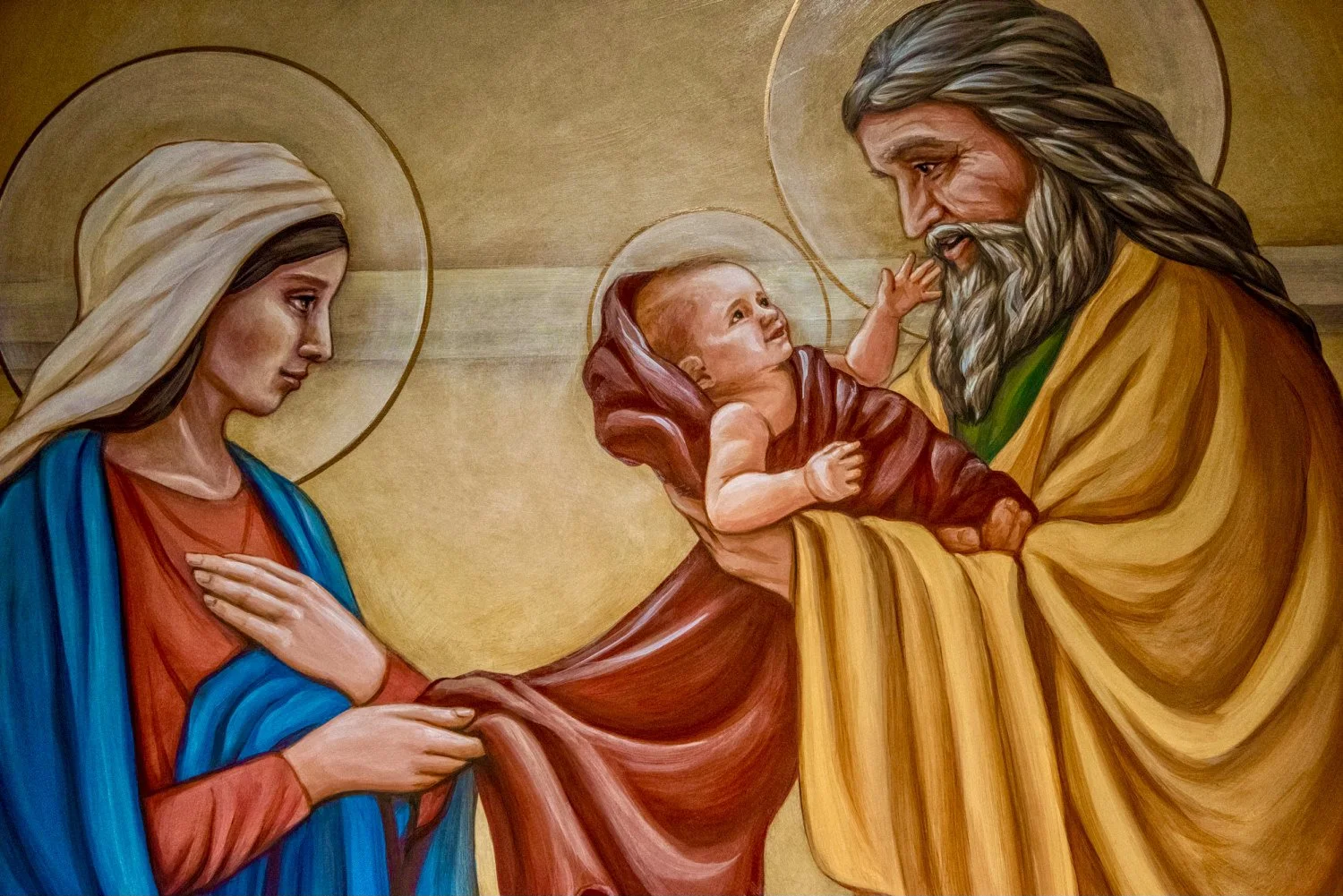
When Simeon saw the forty-day-old Infant in the Temple, he glorified God and prayed:
“Lord, now let Your servant depart in peace, according to Your word, for my eyes have seen Your salvation, which You have prepared before the face of all peoples, a light for revelation to the Gentiles, and the glory of Your people Israel.”
With prophetic inspiration, Simeon declared that this Child, who had been presented in the Temple, was the salvation prepared by God, the light of the Gentiles, and the glory of Israel.
As Joseph and Mary listened in amazement to his inspired words, Simeon turned toward Mary and, through the spirit of prophecy, foretold the events of Jesus' life and the sorrows that Mary would endure.
He said:
“Just as Jesus will be the cause of the rising of those who believe in Him, so He will also be the cause of the falling of those who do not believe. Opposition will arise around His name, and the secrets of hearts will be revealed. Because of this, Mary's own heart will also be pierced with sorrow.”
These words undoubtedly weighed heavily upon Mary. Nevertheless, they did not diminish the wonder inspired by Simeon's first prophetic words of blessing.
Having finished speaking, the elder returned the Child to His mother and was released from the sufferings of old age, surrendering his soul to God there in the Temple.
Anna the Prophetess
Widows lived in the Temple of Jerusalem, where, in addition to participating in Temple worship, they cared for young virgins and girls dedicated to God.
Their leader was a widow named Anna, the daughter of Phanuel, from the tribe of Asher.
She was eighty-four years old and had become a widow after seven years of marriage, thereafter withdrawing to live in the Temple.
Mary had spent her childhood under the care of the widows of the Temple. The chronology of events also suggests that Mary may have been under Anna's care.
Seeing the great grace bestowed upon the young woman she had once cared for, Anna rejoiced and was filled with spiritual joy.
Upon seeing the forty-day-old Jesus, she too glorified God and spoke about Him to those who were present.
According to the interpretations of the holy Fathers of the Church, Simeon represents Adam, while Anna represents Eve.
Likewise, Simeon symbolizes the ancient Law, while Anna represents the fulfillment of prophecy.
The Rite of Presenting Forty-Day-Old Infants
in the Armenian Church
The Old Testament law requiring infants to be brought to the Temple and presented to God on the fortieth day after birth acquired new meaning and was preserved within Christianity.
According to the rite established by the Fathers of the Armenian Church, whenever a child is born into a family, the parents are to bring the newborn to church on the fortieth day after birth.
The child's mother kneels before the entrance of the church and, after confessing her sins to the priest, receives absolution.
The priest then turns to God in prayer, asking Him to cleanse the woman of bodily impurities and make her worthy to enter the church and partake of the Body and Blood of the Lord.
After this rite has been performed, the parents enter the church and stand before the Holy Altar.
The officiating priest takes the infant into his arms and asks God that His All-Seeing Eye and Almighty Right Hand may always watch over and protect the child.
The Rite of Presentation concludes with the prayers “Bahbaneech” (Prayer of Protection) and “Hayr Mer” (The Lord's Prayer).
SCRIPTURE READINGS
~ Isaiah 24:21-25:8 ~
On that day the Lord will punish the host of heaven in heaven, and on earth the kings of the earth. They will be gathered together like prisoners in a pit; they will be shut up in a prison, and after many days they will be punished. Then the moon will be abashed, and the sun ashamed; for the Lord of hosts will reign on Mount Zion and in Jerusalem, and before his elders he will manifest his glory.
O Lord, you are my God; I will exalt you, I will praise your name; for you have done wonderful things, plans formed of old, faithful and sure. For you have made the city a heap, the fortified city a ruin; the palace of aliens is a city no more, it will never be rebuilt. Therefore strong peoples will glorify you; cities of ruthless nations will fear you. For you have been a refuge to the poor, a refuge to the needy in their distress, a shelter from the rainstorm and a shade from the heat. When the blast of the ruthless was like a winter rainstorm, the noise of aliens like heat in a dry place, you subdued the heat with the shade of clouds; the song of the ruthless was stilled. On this mountain the Lord of hosts will make for all peoples a feast of rich food, a feast of well-aged wines, of rich food filled with marrow, of well-aged wines strained clear. And he will destroy on this mountain the shroud that is cast over all peoples, the sheet that is spread over all nations; he will swallow up death forever. Then the Lord God will wipe away the tears from all faces, and the disgrace of his people he will take away from all the earth, for the Lord has spoken.
~ Book of Acts 7:47-50 ~
But it was Solomon who built a house for him. Yet the Most High does not dwell in houses made with human hands; as the prophet says, "Heaven is my throne, and the earth is my footstool. What kind of house will you build for me, says the Lord, or what is the place of my rest? Did not my hand make all these things?'
~ Galatians 4:1-7 ~
My point is this: heirs, as long as they are minors, are no better than slaves, though they are the owners of all the property; but they remain under guardians and trustees until the date set by the father. So with us; while we were minors, we were enslaved to the elemental spirits of the world. But when the fullness of time had come, God sent his Son, born of a woman, born under the law, in order to redeem those who were under the law, so that we might receive adoption as children. And because you are children, God has sent the Spirit of his Son into our hearts, crying, "Abba! Father!" So you are no longer a slave but a child, and if a child then also an heir, through God.
~ The Holy Gospel according to St. Luke 2:41-52 ~
Now every year his parents went to Jerusalem for the festival of the Passover. And when he was twelve years old, they went up as usual for the festival. When the festival was ended and they started to return, the boy Jesus stayed behind in Jerusalem, but his parents did not know it. Assuming that he was in the group of travelers, they went a day's journey. Then they started to look for him among their relatives and friends. When they did not find him, they returned to Jerusalem to search for him. After three days they found him in the temple, sitting among the teachers, listening to them and asking them questions. And all who heard him were amazed at his understanding and his answers. When his parents saw him they were astonished; and his mother said to him, "Child, why have you treated us like this? Look, your father and I have been searching for you in great anxiety." He said to them, "Why were you searching for me? Did you not know that I must be in my Father's house?" But they did not understand what he said to them. Then he went down with them and came to Nazareth, and was obedient to them. His mother treasured all these things in her heart. And Jesus increased in wisdom and in years, and in divine and human favor.