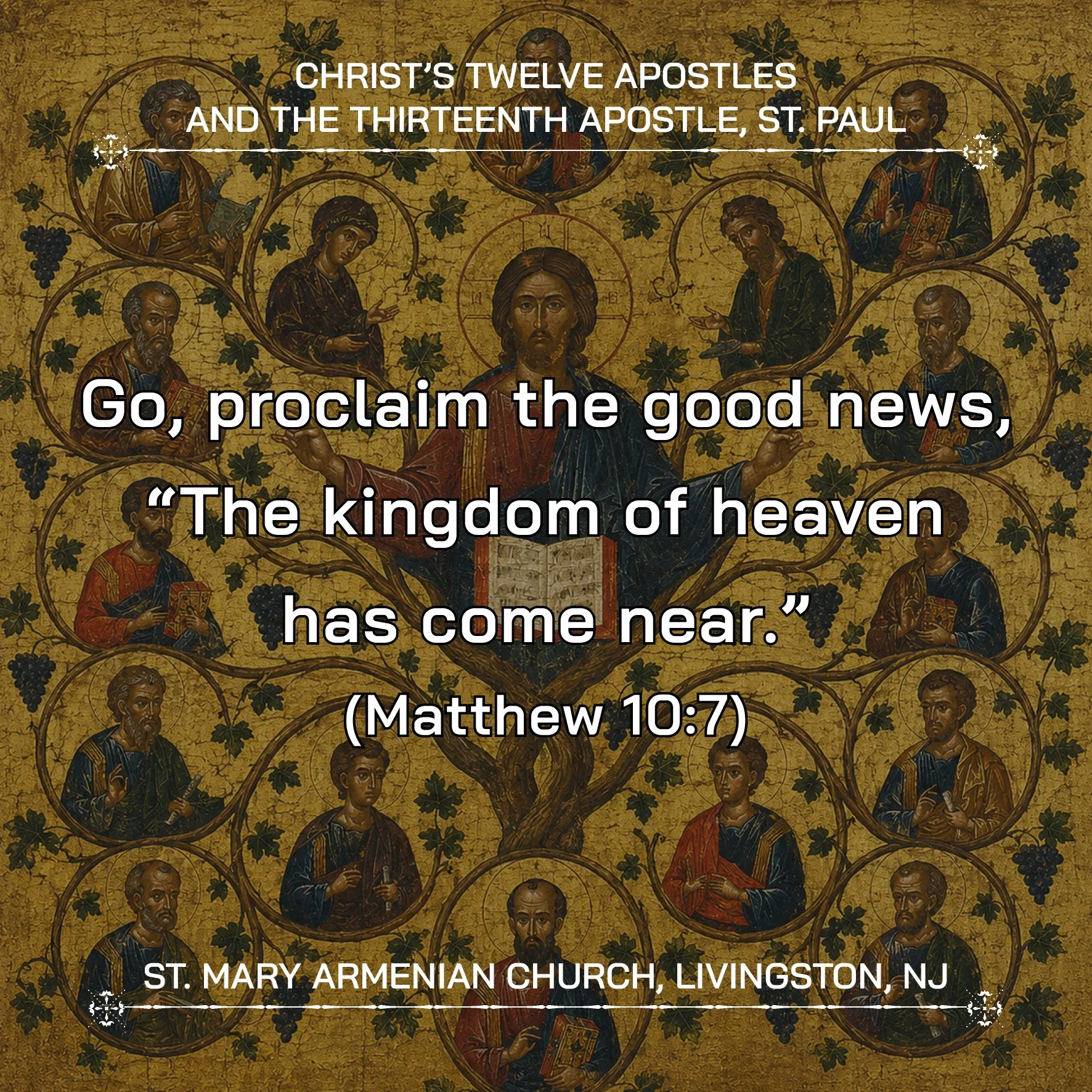
Commemoration Day of
Christ's Twelve Apostles
and the Thirteenth Apostle, St. Paul
The Twelve Apostles, chosen by our Lord Jesus Christ, were His closest disciples, the first proclaimers of the Gospel, and faithful witnesses to the life, death, and resurrection of the Incarnate Christ.
As recorded in the Holy Gospel:
"Jesus called His twelve disciples to Him and gave them authority to drive out unclean spirits and to heal every disease and sickness."
— Matthew 10:1
The twelve Apostles were Simon (Peter), Andrew, James the son of Zebedee, John, Philip, Bartholomew, Thomas, Matthew, James the son of Alphaeus, Thaddeus (Jude), Simon the Zealot, and Judas Iscariot, who later betrayed the Lord. Following Judas' death, Matthias was chosen to take his place among the Eleven, restoring the number of the Apostles to twelve.
Faithful to Christ's final command, the Apostles went out into the world to proclaim the Good News to all nations. They preached the Gospel, taught the commandments of Christ, baptized believers in the name of the Father, the Son, and the Holy Spirit, and established Christian communities throughout the world. Through their ministry, they became the founders of the Holy Church.
Among the greatest heralds of the Christian faith is St. Paul, who, although not one of the original Twelve, was personally called by the risen Christ to proclaim the Gospel. Because of his extraordinary missionary work and unwavering witness, the Church honors him as the Thirteenth Apostle.
The ministry and missionary journeys of the Apostles are recorded in the biblical book The Acts of the Apostles. St. Paul's life, teachings, and pastoral care are further preserved in his fourteen epistles, written to the churches he founded and to individual believers. These letters remain a cornerstone of Christian doctrine and spiritual guidance.
The Armenian Apostolic Church commemorates the Twelve Holy Apostles together with St. Paul, the Thirteenth Apostle, on the Saturday of the fasting week preceding the Feast of the Holy Transfiguration. This joint commemoration honors their faithful witness, sacrificial service, and enduring contribution to the spread of Christ's Gospel. In addition, the liturgical calendar of the Armenian Church includes separate feast days dedicated to individual Apostles throughout the year.
As we commemorate the Holy Apostles, we give thanks for their unwavering faith, courage, and devotion to Christ. May their example inspire us to remain steadfast in our own faith and to joyfully bear witness to the Gospel in our daily lives.
SCRIPTURE READINGS
~ Wisdom of Solomon 9:9-10:2~
With you is wisdom, she who knows your works and was present when you made the world; she understands what is pleasing in your sight and what is right according to your commandments. Send her forth from the holy heavens, and from the throne of your glory send her, that she may labor at my side and that I may learn what is pleasing to you. For she knows and understands all things, and she will guide me wisely in my actions and guard me with her glory. Then my works will be acceptable, and I shall judge your people justly and shall be worthy of the throne of my father. For who can learn the counsel of God? Or who can discern what the Lord wills? For the reasoning of mortals is worthless, and our designs are likely to fail, for a perishable body weighs down the soul, and this earthy tent burdens the thoughtful mind. We can hardly guess at what is on earth, and what is at hand we find with labor, but who has traced out what is in the heavens? Who has learned your counsel unless you have given wisdom and sent your holy spirit from on high? And thus the paths of those on earth were set right, and people were taught what pleases you and were saved by wisdom.”
Wisdom protected the first-formed father of the world, when he alone had been created; she delivered him from his transgression and gave him strength to rule all things.
~ Exodus 15:23-27 ~
When they came to Marah, they could not drink the water of Marah because it was bitter. That is why it was called Marah. And the people complained against Moses, saying, "What shall we drink?" He cried out to the Lord; and the Lord showed him a piece of wood; he threw it into the water, and the water became sweet. There the Lord made for them a statute and an ordinance and there he put them to the test. He said, "If you will listen carefully to the voice of the Lord your God, and do what is right in his sight, and give heed to his commandments and keep all his statutes, I will not bring upon you any of the diseases that I brought upon the Egyptians; for I am the Lord who heals you." Then they came to Elim, where there were twelve springs of water and seventy palm trees; and they camped there by the water.
~ 1 Thessalonians 2:9-16 ~
You remember our labor and toil, brothers and sisters; we worked night and day, so that we might not burden any of you while we proclaimed to you the gospel of God. You are witnesses, and God also, how pure, upright, and blameless our conduct was toward you believers. As you know, we dealt with each one of you like a father with his children, urging and encouraging you and pleading that you lead a life worthy of God, who calls you into his own kingdom and glory. We also constantly give thanks to God for this, that when you received the word of God that you heard from us, you accepted it not as a human word but as what it really is, God's word, which is also at work in you believers. For you, brothers and sisters, became imitators of the churches of God in Christ Jesus that are in Judea, for you suffered the same things from your own compatriots as they did from the Jews, who killed both the Lord Jesus and the prophets, and drove us out; they displease God and oppose everyone by hindering us from speaking to the Gentiles so that they may be saved. Thus they have constantly been filling up the measure of their sins; but God's wrath has overtaken them at last.
~ Holy Gospel of St. Matthew 9:36-10:7 ~
When he saw the crowds, he had compassion for them, because they were harassed and helpless, like sheep without a shepherd. Then he said to his disciples, "The harvest is plentiful, but the laborers are few; therefore ask the Lord of the harvest to send out laborers into his harvest." Then Jesus summoned his twelve disciples and gave them authority over unclean spirits, to cast them out, and to cure every disease and every sickness. These are the names of the twelve apostles: first, Simon, also known as Peter, and his brother Andrew; James son of Zebedee, and his brother John; Philip and Bartholomew; Thomas and Matthew the tax collector; James son of Alphaeus, and Thaddaeus; Simon the Cananaean, and Judas Iscariot, the one who betrayed him. These twelve Jesus sent out with the following instructions: "Go nowhere among the Gentiles, and enter no town of the Samaritans, but go rather to the lost sheep of the house of Israel. As you go, proclaim the good news, "The kingdom of heaven has come near.'