Commemoration Day of
St. isaiah the Prophet
St. Isaiah the Prophet
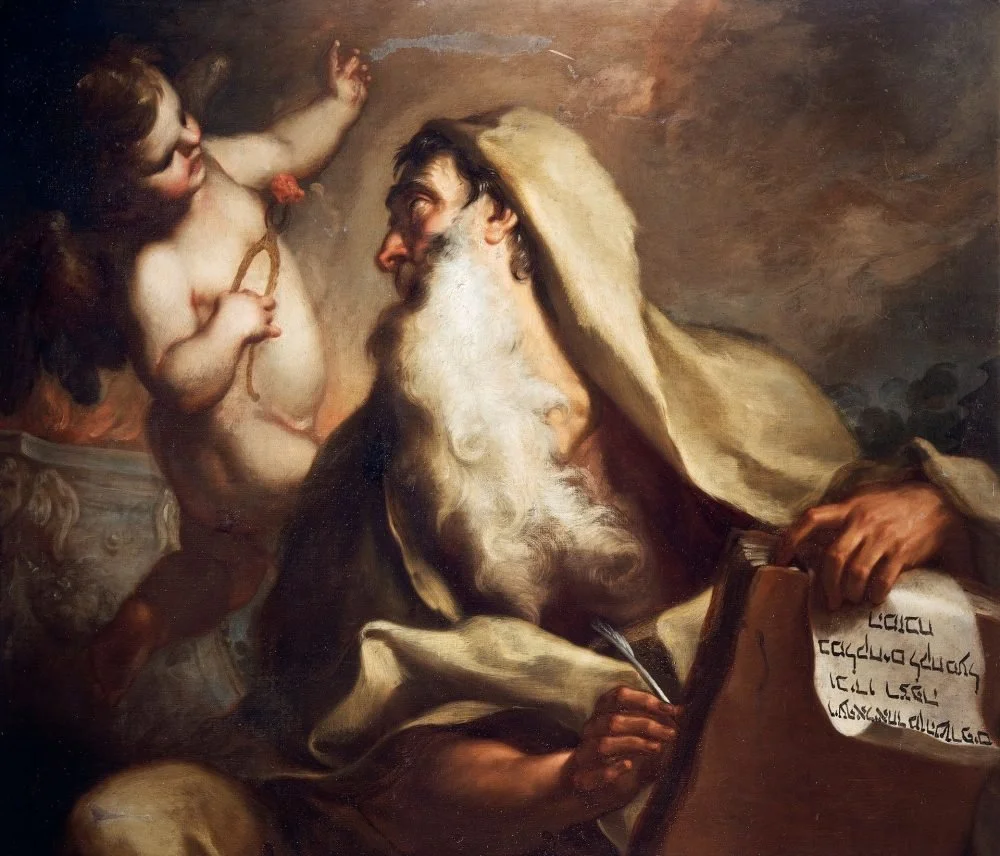
The Prophet Isaiah prophesied in the middle of the 8th century BC, about half a century before Christ. He was born in Jerusalem and spent nearly his entire life there. He was married and had children. His prophetic calling is described in his own book as follows:
"In the year that King Uzziah died, I saw the Lord seated on a high and exalted throne, and the temple was filled with His glory. Around Him stood the seraphim, each with six wings... They continually called to one another, saying:
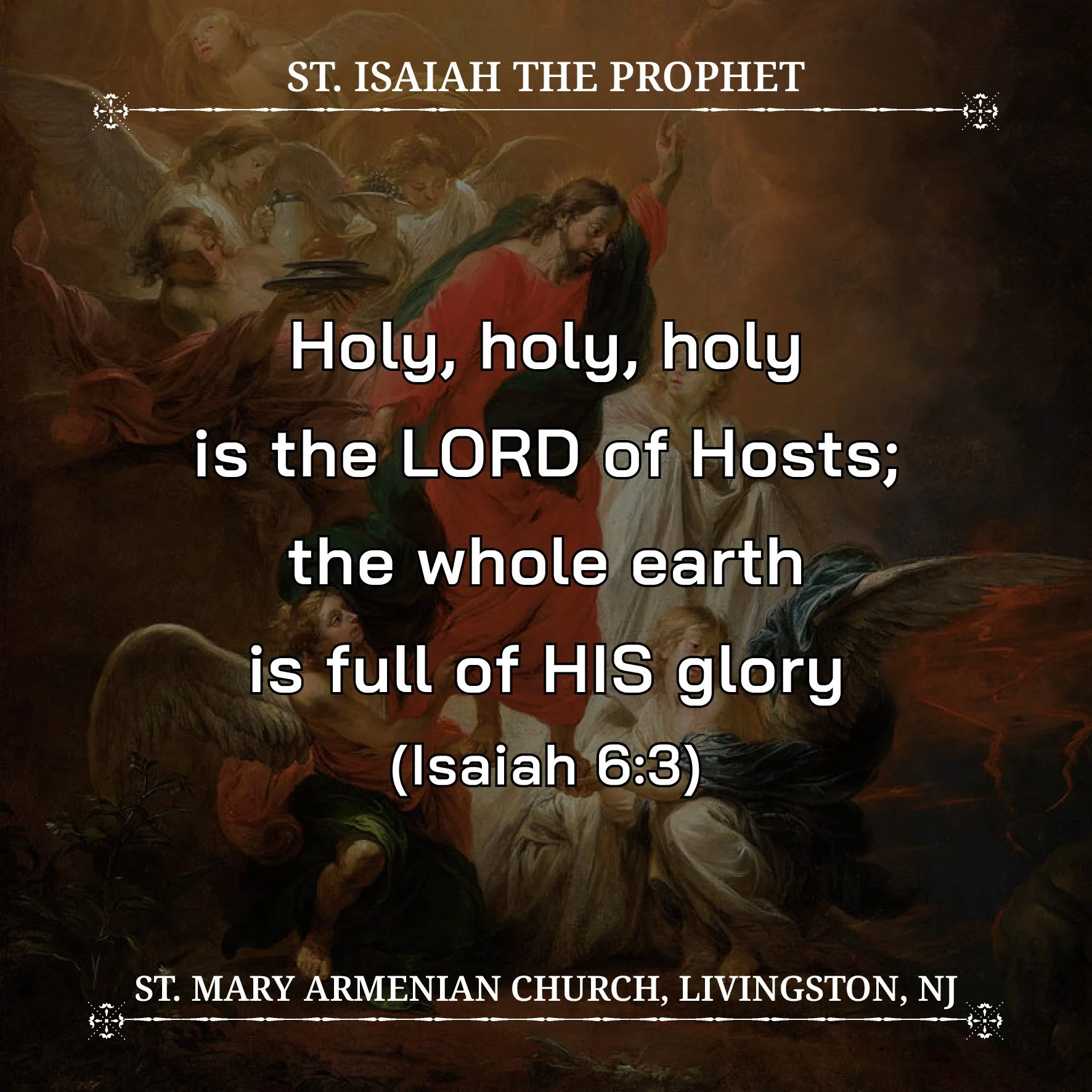
'Holy, holy, holy is the Lord of Hosts; the whole earth is full of His glory.'
At the sound of their voices, the doors of the Temple shook, and the house was filled with smoke, symbolizing the presence of God. Then I cried:
'Woe is me! I am ruined,
For I am a man of unclean lips,
And I dwell among a people of unclean lips;
Yet my eyes have seen the King, the Lord of Hosts.'Then one of the seraphim flew to me, carrying a burning coal that he had taken with tongs from the altar. Touching my lips with it, he said:
'Behold, this has touched your lips;
Your guilt is taken away,
And your sin is atoned for.'Then I heard the voice of the Lord saying, 'Whom shall I send, and who will go for this people?' And I answered, 'Here am I; send me.' Then the Lord said:
'Go and say to this people:
You will indeed hear but never understand;
You will indeed see but never perceive.
For this people's heart has grown dull;
Their ears are heavy,
And their eyes are closed.
Otherwise they might see with their eyes,
Hear with their ears,
Understand with their hearts,
Turn back, and I would heal them.'"
This message is relevant to every age, especially our own. In the Armenian Church, because of this vision, Isaiah has been given the title "the Prophet of Lightning-Pure Holiness."
Isaiah served as counselor and spiritual guide to four kings of Judah, most notably the righteous King Hezekiah. During Hezekiah's reign, the Assyrian king Sennacherib conquered nearly half of Judah and threatened Jerusalem. In distress, Hezekiah sent envoys to Isaiah seeking counsel. Isaiah declared:
"The king of Assyria shall not enter this city, nor shoot an arrow there, nor come before it with shield, nor build a siege ramp against it. By the way that he came, by the same he shall return; he shall not enter this city."
Indeed, a plague destroyed Sennacherib's army, and after barely returning home, he was assassinated by his sons Adrammelech and Sharezer, who then fled to the land of Ararat (Isaiah 37:33–38).
Isaiah is the prophet who foretold the coming of the Messiah—Christ—more extensively than any other Old Testament prophet. For this reason, he has been called the "Proto-Evangelist" or the "Evangelical Prophet." It is Isaiah who proclaims:
"Behold, a virgin shall conceive and bear a son, and His name shall be called Immanuel."
Referring to the region where Christ would begin His ministry, he writes:
"The land of Zebulun and the land of Naphtali, by the sea, beyond the Jordan, Galilee of the nations—the people who walked in darkness have seen a great light." (Isaiah 9:1)
When Jesus read Isaiah 61:1–3 in the synagogue at Nazareth, He declared that this prophecy had been fulfilled in Himself. Throughout Isaiah's book, Christ's mission, ministry, and sufferings are described with remarkable clarity.
Isaiah was, in every sense, a noble prophet. He spoke with majesty and powerful authority, worthy of an ambassador of the Most High. He possessed a refined and profound intellect and is regarded as one of the greatest thinkers of the Bible. He addressed both religious and political matters with equal wisdom and has often been described as a "diplomat" or "statesman" among the prophets. He took great interest in the national and international affairs of his day, expressing God's will concerning them. Closely associated with the royal court, he was likely an honored member of Jerusalem's royal council, which advised the kingdom on foreign relations.
The 66 chapters of the Book of Isaiah form an ocean of prophetic teaching on God, righteousness, sin, religion, and many social and moral issues. Some of its passages rank among the finest in the entire Old Testament, both in literary beauty and universal spiritual significance. Isaiah's book serves as a bridge between the Old and New Testaments.
According to ancient tradition, Isaiah was martyred by being sawn in two at the command of the wicked King Manasseh.
In the Armenian Apostolic Church, the Feast of the Prophet Isaiah is celebrated separately on the Thursday following the Feast of the Transfiguration (Vardavar).
SCRIPTURE READINGS
~ Isaiah 6:1-10 ~
In the year that King Uzziah died, I saw the Lord sitting on a throne, high and lofty; and the hem of his robe filled the temple. Seraphs were in attendance above him; each had six wings: with two they covered their faces, and with two they covered their feet, and with two they flew. And one called to another and said: "Holy, holy, holy is the Lord of hosts; the whole earth is full of his glory." The pivots on the thresholds shook at the voices of those who called, and the house filled with smoke. And I said: "Woe is me! I am lost, for I am a man of unclean lips, and I live among a people of unclean lips; yet my eyes have seen the King, the Lord of hosts!" Then one of the seraphs flew to me, holding a live coal that had been taken from the altar with a pair of tongs. The seraph touched my mouth with it and said: "Now that this has touched your lips, your guilt has departed and your sin is blotted out." Then I heard the voice of the Lord saying, "Whom shall I send, and who will go for us?" And I said, "Here am I; send me!" And he said, "Go and say to this people: "Keep listening, but do not comprehend; keep looking, but do not understand.' Make the mind of this people dull, and stop their ears, and shut their eyes, so that they may not look with their eyes, and listen with their ears, and comprehend with their minds, and turn and be healed."
~ Hebrews 11:32-40 ~
And what more should I say? For time would fail me to tell of Gideon, Barak, Samson, Jephthah, of David and Samuel and the prophets— who through faith conquered kingdoms, administered justice, obtained promises, shut the mouths of lions, quenched raging fire, escaped the edge of the sword, won strength out of weakness, became mighty in war, put foreign armies to flight. Women received their dead by resurrection. Others were tortured, refusing to accept release, in order to obtain a better resurrection. Others suffered mocking and flogging, and even chains and imprisonment. They were stoned to death, they were sawn in two, they were killed by the sword; they went about in skins of sheep and goats, destitute, persecuted, tormented— of whom the world was not worthy. They wandered in deserts and mountains, and in caves and holes in the ground. Yet all these, though they were commended for their faith, did not receive what was promised, since God had provided something better so that they would not, apart from us, be made perfect.
~ Holy Gospel of St. Luke 4:25-30 ~
Then Jesus, filled with the power of the Spirit, returned to Galilee, and a report about him spread through all the surrounding country. He began to teach in their synagogues and was praised by everyone. When he came to Nazareth, where he had been brought up, he went to the synagogue on the sabbath day, as was his custom. He stood up to read, and the scroll of the prophet Isaiah was given to him. He unrolled the scroll and found the place where it was written: "The Spirit of the Lord is upon me, because he has anointed me to bring good news to the poor. He has sent me to proclaim release to the captives and recovery of sight to the blind, to let the oppressed go free, to proclaim the year of the Lord's favor." And he rolled up the scroll, gave it back to the attendant, and sat down. The eyes of all in the synagogue were fixed on him. Then he began to say to them, "Today this scripture has been fulfilled in your hearing." All spoke well of him and were amazed at the gracious words that came from his mouth. They said, "Is not this Joseph's son?"