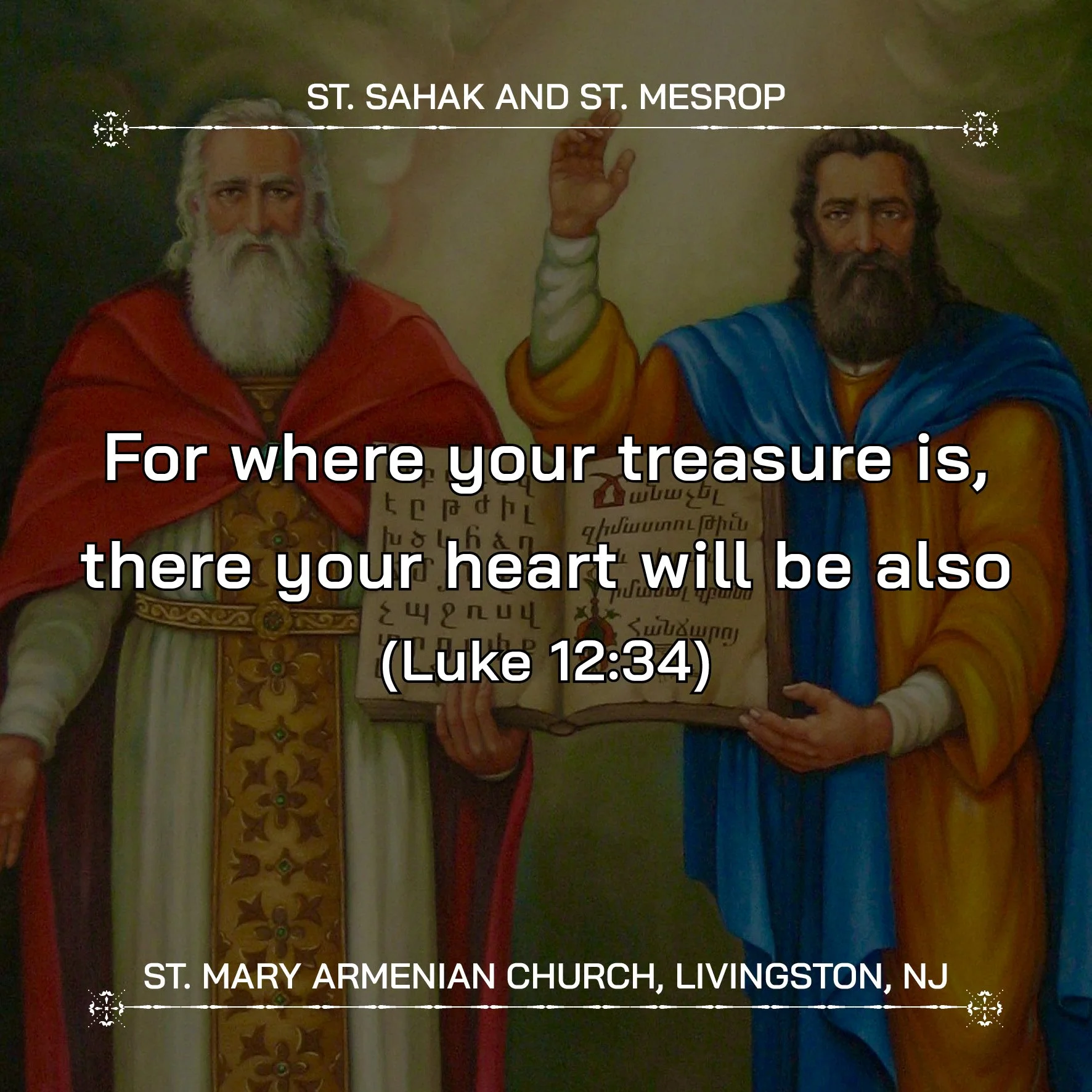
Feast of the Holy Translators:
Saint Sahak and Saint Mesrop
Saint Sahak the Catholicos
The life and works of Saint Sahak are rich with significant events and remarkable accomplishments. Here we focus primarily on his holy character and enduring legacy.
Saint Sahak was the son of Catholicos Nerses the Great and Sandukht Mamikonian, and the fifth and final direct male descendant of Saint Gregory the Illuminator. He was born in Caesarea in 348 AD while his parents were studying there. Orphaned of his mother at an early age, he spent his childhood in Taron among the Mamikonian family. Like his father, he received a distinguished education in Caesarea and Byzantium, becoming highly skilled in Greek language, literature, rhetoric, philosophy, Syriac, and Persian.
He was married and had one daughter, Sahakanush, whose son was the future national hero and martyr, Vardan Mamikonian. Later in life, Sahak embraced an ascetic way of living, gathering around himself a community of devoted disciples known for their strict spiritual discipline.
In 387 AD, he was elected Catholicos of All Armenians. During his patriarchate, Armenia entered one of the most important periods in its history. Working alongside Saint Mesrop Mashtots and King Vramshapuh, Sahak played a decisive role in the creation of the Armenian alphabet and the establishment of Armenian literature and education. While Mesrop conceived and developed the alphabet, Sahak provided scholarly guidance, organization, and ecclesiastical authority for the project.
Following the invention of the alphabet, Sahak and Mesrop established schools throughout Armenia. The translation of the Holy Scriptures became their foremost priority. Although initial translation efforts were undertaken by Mesrop, the complete Armenian translation of the Bible is traditionally attributed to Saint Sahak. Under his leadership, numerous liturgical texts and the writings of the Greek and Syriac Church Fathers were translated into Armenian, laying the foundation for Armenia's Golden Age of literature.
Sahak also worked tirelessly to strengthen church order, education, and national identity. Through his efforts, Armenian became the language of worship, learning, and public life throughout both Eastern and Western Armenia. As contemporary historians observed, the entire nation was filled with the knowledge of God through his ministry.
The final years of his life were marked by political turmoil. Following the fall of the Armenian Arsacid Kingdom in 428 AD, Sahak was temporarily deposed and exiled. Yet even in adversity he remained the spiritual leader of the Armenian people, continuing to guide and comfort them. He accepted the decisions of the Third Ecumenical Council of Ephesus (431 AD) and oversaw the final revision of the Armenian Bible using authoritative Greek manuscripts.
Saint Sahak spent his last years in prayer, teaching, and pastoral care. Before his death, he blessed those around him and urged them to remain faithful to the teachings handed down by Saint Gregory the Illuminator and to worship the one true God, Jesus Christ. He reposed peacefully in 438 AD at the age of ninety. His body was buried at Ashtishat, though the exact location of his tomb is no longer known.
Today, Saint Sahak is honored as one of the greatest fathers of the Armenian Church—a saint, scholar, statesman, and shepherd whose influence shaped Armenian Christianity and culture for centuries.
Saint Mesrop Mashtots
Saint Mesrop Mashtots stands among the greatest figures in Armenian history. Born in the village of Hatsik in Taron around the middle of the fourth century, he received an excellent education and became proficient in Greek, Syriac, and Persian. His abilities earned him a position in the royal chancery of King Khosrov III, where he drafted official documents in the languages then used throughout the region.
Despite a successful public career, Mesrop felt called to a higher vocation. He left royal service, entered the clergy, and embraced an ascetic life devoted to prayer, fasting, study, and missionary work. His preaching in the province of Goghtn brought many pagans and heretics to the Christian faith. Yet his ministry revealed a major obstacle: Armenians lacked an alphabet capable of expressing their language, and Scripture and liturgical texts remained inaccessible to much of the population.
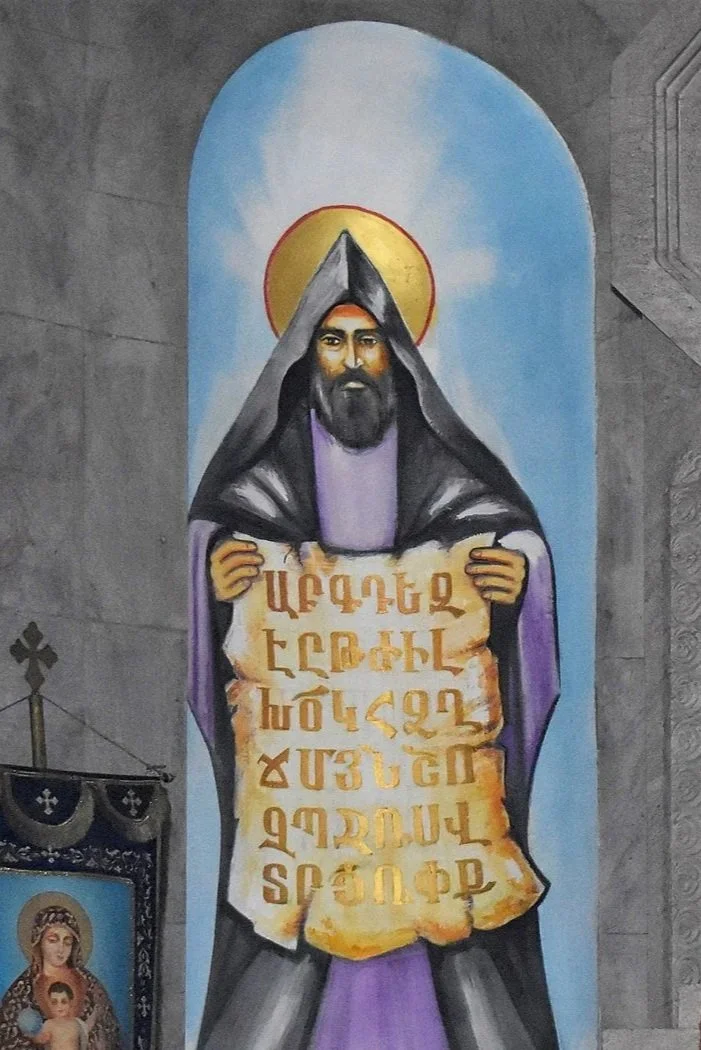
Determined to solve this problem, Mesrop undertook the creation of a national alphabet. Supported by Saint Sahak and King Vramshapuh, he consulted scholars and clergy throughout the region. Around 405–406 AD, his efforts culminated in the invention of the Armenian alphabet, consisting originally of thirty-six letters. This achievement marked the beginning of Armenian literature and became one of the defining moments in the nation's history.
The new alphabet transformed Armenian culture. Schools were founded across the country, and generations of students learned to read and write in their native tongue. Mesrop extended his educational mission beyond Armenia, helping to develop alphabets and educational systems for neighboring peoples, including the Georgians and Caucasian Albanians. Wherever he preached the Gospel, he established schools and appointed teachers to continue the work.
Under his leadership, Armenian scholars traveled to great centers of learning such as Edessa, Constantinople, Antioch, Athens, and Alexandria. They returned with manuscripts that were translated into Armenian. The Bible, liturgical texts, and numerous works of the Church Fathers became available in Armenian, creating a literary heritage of immense value. Some Greek originals have since been lost, making the Armenian translations indispensable witnesses to early Christian thought.
Mesrop's contemporaries remembered him not only for his scholarship but also for his extraordinary character. He was praised for his humility, gentleness, wisdom, perseverance, and unwavering devotion to Christ. His disciple Koryun described him as a man who tirelessly traveled through Armenia, Georgia, and Albania, preaching the Gospel, educating the young, freeing the oppressed, and bringing hope to the suffering.
In his final days, sensing that his earthly mission was ending, Mesrop gathered his disciples, blessed them, and entrusted them to God's care. Witnesses reported a radiant cross-shaped light appearing above his dwelling as he peacefully surrendered his soul to Christ. He died around 440–441 AD and was buried in the village of Oshakan, where his tomb remains a cherished pilgrimage site to this day.
The Armenian Church commemorates Saint Mesrop twice each year: together with Saint Sahak after Pentecost, and again with the Holy Translators in October. He is revered as the creator of the Armenian alphabet, the father of Armenian literature, and one of the greatest spiritual teachers in Armenian history.
Commemoration in the Armenian Church
The Armenian Church celebrates Saint Sahak and Saint Mesrop together as the Holy Translators, honoring their monumental contribution to Armenian Christianity, education, literature, and national identity. Through their labors, the Armenian people received the Scriptures in their own language, a national alphabet, a flourishing literary tradition, and a strengthened Christian faith that has endured through the centuries.
SCRIPTURE READINGS
~ Wisdom of Solomon 8:7-10 ~
And if anyone loves righteousness, her labors are virtues, for she teaches self-control and prudence, justice and courage; nothing in life is more profitable for mortals than these. And if anyone longs for wide experience, she knows the things of old and infers the things to come; she understands turns of speech and the solutions of riddles; she has foreknowledge of signs and wonders and of the outcome of seasons and times. Therefore I determined to take her to live with me, knowing that she would give me good counsel and encouragement in cares and grief. Because of her I shall have glory among the multitudes and honor in the presence of the elders, though I am young.
~ Isaiah 61:6-9 ~
But you shall be called priests of the Lord, you shall be named ministers of our God; you shall enjoy the wealth of the nations, and in their riches you shall glory. Because their shame was double, and dishonor was proclaimed as their lot, therefore they shall possess a double portion; everlasting joy shall be theirs. For I the Lord love justice, I hate robbery and wrongdoing; I will faithfully give them their recompense, and I will make an everlasting covenant with them. Their descendants shall be known among the nations, and their offspring among the peoples; all who see them shall acknowledge that they are a people whom the Lord has blessed.
~ 1 Corinthians 12:4-11 ~
Now there are varieties of gifts, but the same Spirit; and there are varieties of services, but the same Lord; and there are varieties of activities, but it is the same God who activates all of them in everyone. To each is given the manifestation of the Spirit for the common good. To one is given through the Spirit the utterance of wisdom, and to another the utterance of knowledge according to the same Spirit, to another faith by the same Spirit, to another gifts of healing by the one Spirit, to another the working of miracles, to another prophecy, to another the discernment of spirits, to another various kinds of tongues, to another the interpretation of tongues. All these are activated by one and the same Spirit, who allots to each one individually just as the Spirit chooses.
~ Holy Gospel of St. Luke 12:32-40 ~
"Do not be afraid, little flock, for it is your Father's good pleasure to give you the kingdom. Sell your possessions, and give alms. Make purses for yourselves that do not wear out, an unfailing treasure in heaven, where no thief comes near and no moth destroys. For where your treasure is, there your heart will be also. "Be dressed for action and have your lamps lit; be like those who are waiting for their master to return from the wedding banquet, so that they may open the door for him as soon as he comes and knocks. Blessed are those slaves whom the master finds alert when he comes; truly I tell you, he will fasten his belt and have them sit down to eat, and he will come and serve them. If he comes during the middle of the night, or near dawn, and finds them so, blessed are those slaves. "But know this: if the owner of the house had known at what hour the thief was coming, he would not have let his house be broken into. You also must be ready, for the Son of Man is coming at an unexpected hour."