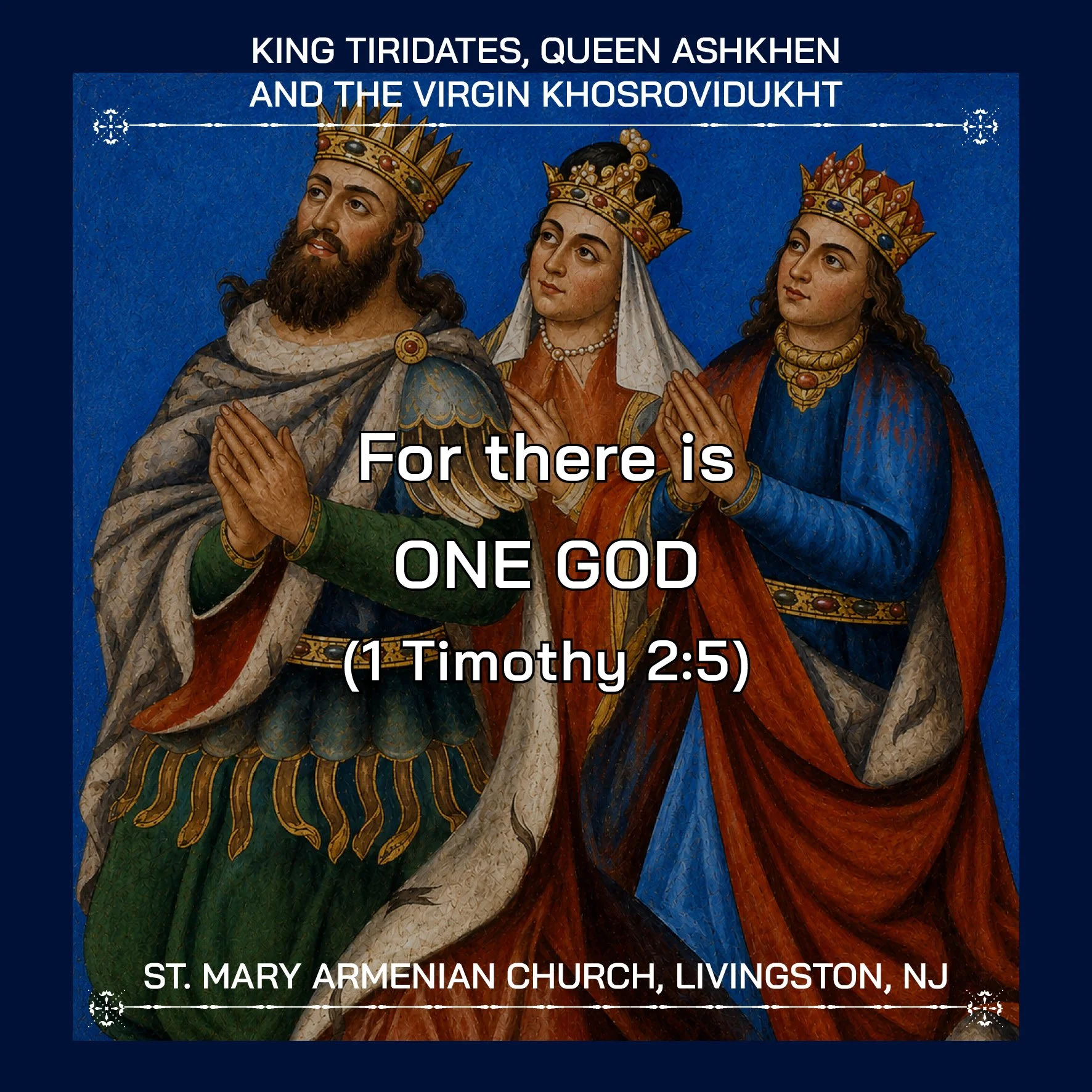
Commemoration Day of
King Tiridates,
Queen Ashkhen,
and the Virgin Khosrovidukht
Saint King Tiridates (Trdat III)
King Tiridates III is the true and historical first Christian king. While there may have been individual rulers or nobles who secretly accepted Christianity before him, the undeniable honor belongs to Tiridates as the first monarch openly to profess Christ and to proclaim Christianity as the official religion of a nation.
Tiridates was the son of King Khosrov II of Armenia. In 240 AD, his father was assassinated through a plot orchestrated by the Persian king and carried out by the Parthian prince Anak. Following the assassination, Persia invaded Armenia. Tiridates' sister, Khosrovidukht, was hidden in the fortress of Ani (modern Kemah), while the young prince Tiridates was smuggled to the Roman Empire by loyal Armenian nobles.
Tiridates spent his youth in the Roman army, receiving military training and earning great renown for his bravery. Among his celebrated feats was defeating the king of the Goths in single combat and bringing him captive to Rome. In recognition of his valor, the Roman emperor granted him a crown and an army to reclaim his ancestral throne. He finally secured the Armenian kingdom in 287 AD.
The historian Agathangelos describes him as: “Strong and mighty, with powerful bones, a large stature, broad shoulders, and great prowess in battle.”
Tiridates married Ashkhen, daughter of the king of the Alans.
Persecutor of Christians
Before his conversion, Tiridates was a fierce persecutor of Christianity. He imprisoned his secretary and advisor, Saint Gregory the Illuminator, in the dungeon of Khor Virap and issued decrees ordering the persecution of Christians throughout Armenia.
During this period, a group of Christian virgins known as the Holy Hripsimian Martyrs arrived in Armenia. Tiridates became infatuated with their leader, Saint Hripsime, but she steadfastly rejected him. Enraged by her refusal and by their refusal to renounce Christ, he ordered their brutal torture and execution.
According to Armenian tradition, these crimes were followed by divine punishment. Tiridates was driven into a state of madness and bestial behavior. Agathangelos compares him to a wild boar and describes how he abandoned all human dignity, roaming like a beast and losing his reason. Several of his courtiers who had participated in the persecution suffered a similar fate.
Gregory's Return and Tiridates' Conversion
During this dark period, Tiridates' sister Khosrovidukht received a vision. A radiant figure appeared to her and declared: “No one can heal the afflicted except Gregory.”
At first, no one believed her. Everyone assumed Gregory had died long ago in the pit of Khor Virap. But after the vision repeated itself five times, Khosrovidukht persuaded the court to investigate.
To everyone's amazement, Gregory was found alive after years of imprisonment and brought to Vagharshapat. Through his prayers, Tiridates and the afflicted courtiers were restored to their senses.
For sixty-six days Gregory instructed them in the Gospel. Clothed in sackcloth and sitting in ashes, the king and his nobles listened attentively, repented of their sins, and accepted the Christian faith.
At the end of this period Gregory prayed for them, and they were completely healed. Filled with gratitude, they accepted Christ as their Savior and experienced profound spiritual renewal.
The Destruction of Paganism
Following his conversion, Tiridates worked closely with Gregory to eradicate pagan worship throughout Armenia.
Gregory urged the king to destroy the temples and idols that had led the people astray. Tiridates willingly agreed.
Accompanied by his army, he traveled throughout the country demolishing pagan shrines and replacing them with crosses. Treasures taken from the temples were distributed to the poor, while temple lands were dedicated to the Church.
The king publicly confessed his former errors and shared his personal testimony, recounting God's mercy and healing in his life.
His goal was not merely to change the people's religion but to transform their way of life and lead them into the light of the Gospel.
Baptism of the Armenian Nation
Tiridates then proposed that Gregory be consecrated as the spiritual shepherd of Armenia. At the king's initiative, Gregory was sent to Caesarea, where he was ordained bishop.
Upon Gregory's return, preparations were made for the baptism of the nation.
After a month of preaching and repentance, Tiridates, Queen Ashkhen, Princess Khosrovidukht, the royal court, and multitudes of Armenians were baptized in the waters of the Aratsani River near Bagavan on January 6, 303 AD, the Feast of the Nativity and Theophany of Christ.
According to tradition, Tiridates received the Christian name John, in honor of Saint John the Baptist.
Agathangelos records that approximately 150,000 people were baptized on that occasion, while later traditions speak of hundreds of thousands receiving baptism through Saint Gregory's ministry.
Following these events, Tiridates formally proclaimed Christianity as the religion of the Armenian kingdom, making Armenia the first nation officially to adopt Christianity as its state religion.
Builder of Churches and Defender of the Faith
Tiridates actively participated in constructing the shrines of the Holy Hripsimian Martyrs and the Mother Cathedral of Etchmiadzin.
Tradition recounts that he personally carried enormous stones from Mount Ararat for the construction of churches.
He also defended Armenia against the anti-Christian emperor Maximinus Daia, whose invasion failed when Armenian forces drove his armies from the country.
As his faith matured, Tiridates adopted an increasingly humble and devout life. Agathangelos portrays him as a ruler who embraced fasting, prayer, repentance, and service to God. He became a powerful supporter of the Gospel and worked tirelessly to strengthen Christianity throughout Armenia.
The historian Malachia Ormanian observes: “Whatever credit belongs to Gregory for Armenia's conversion must also be given to Tiridates, for he truly became Gregory's partner in enlightening the nation.”
Tiridates lived approximately ninety years and reigned for about fifty-six years, making him one of the longest-lived and longest-reigning kings of Armenia. According to Armenian tradition, he died in 330 AD, possibly poisoned by rebellious nobles, and was buried at Thordan near Saint Gregory the Illuminator.
The Armenian Church commemorates him together with Queen Ashkhen and Princess Khosrovidukht on the Saturday before the fifth Sunday after Pentecost.
Saint Queen Ashkhen and the Virgin Khosrovidukht
Queen Ashkhen and Princess Khosrovidukht are inseparable from the story of Armenia's conversion to Christianity. One was Tiridates' queen, the other his devoted sister, and both played important roles in the spiritual transformation of the Armenian nation.
Saint Queen Ashkhen
Ashkhen was the daughter of Ashkhadar, king of the Caucasian Alans.
To obtain her hand in marriage, Tiridates sent the Armenian noble Smbat Bagratuni as an ambassador to the Alan court. Ashkhen was renowned for her beauty and noble bearing, well matched to the imposing stature of Tiridates himself.
After formally investing her as an Arsacid princess, Tiridates married her and proclaimed her Queen of Armenia. The royal couple had one son.
Although historical records preserve relatively little about her personal life, Ashkhen appears throughout the accounts of Armenia's conversion as a faithful supporter of Gregory's mission and of her husband's transformation.
Saint Khosrovidukht
Khosrovidukht was the daughter of King Khosrov II and the sister of Tiridates.
After her father's assassination and the Persian conquest of Armenia, she was placed under the protection of the Armenian noble Ota Amatuni and hidden in the fortress of Ani until Tiridates regained the throne.
Later she joined the royal court in Vagharshapat, where she remained unmarried and devoted herself to a life of chastity and prayer.
Khosrovidukht played a decisive role in the liberation of Saint Gregory from Khor Virap. Having witnessed some of Gregory's sufferings and heard of his steadfast faith, she had developed a deep respect for him and for Christianity.
When Tiridates fell into madness, she became the instrument through which God revealed the path to healing. Her repeated visions led to Gregory's release and ultimately to the conversion of the king and the nation.
Their Role in Armenia's Conversion
After Gregory instructed the royal family to honor the martyred virgins by building memorial shrines, Tiridates undertook the hard labor of digging their burial places as an act of repentance.
Remarkably, Queen Ashkhen and Khosrovidukht joined him. Dressed in their royal garments, they willingly carried away the excavated earth, performing work usually reserved for servants.
Their names also appear alongside Tiridates in correspondence sent to the Archbishop of Caesarea concerning Gregory's consecration.
When Gregory returned from Caesarea, both women accompanied Tiridates to Bagavan, where they received baptism together with the king and the Armenian people.
Agathangelos describes the newly baptized multitude returning clothed in white garments, carrying candles and singing psalms, rejoicing as newly adopted children of God and partakers of the Holy Mysteries.
Final Years and Legacy
After Armenia's baptism, historical sources say little more about Ashkhen and Khosrovidukht.
Tradition holds that both spent their later years in prayer, charity, and quiet devotion. They likely withdrew from courtly life and lived in relative seclusion at the fortress of Garni.
The Armenian Synaxarion describes Queen Ashkhen as abandoning worldly pleasures and embracing an ascetic life until her death. Likewise, Khosrovidukht, the royal virgin, lived in holiness and purity until she departed to be with Christ.
Just as they had been inseparable from Tiridates during their earthly lives, they remain united with him in the memory of the Armenian Church.
Today, the Armenian Church commemorates Saint King Tiridates, Saint Queen Ashkhen, and Saint Khosrovidukht together on the Saturday before the Fifth Sunday after Pentecost, honoring them as the royal saints who helped lead Armenia into the light of Christianity.
SCRIPTURE READINGS
~ Wisdom of Solomon 6:1-10 ~
Listen therefore, O kings, and understand; learn, O judges of the ends of the earth. Give ear, you who rule over multitudes and boast of many nations. For your dominion was given you from the Lord and your sovereignty from the Most High; he will search out your works and inquire into your plans. Because as servants of his kingdom you did not rule rightly or keep the law or walk according to the purpose of God, he will come upon you terribly and swiftly, because severe judgment falls on those in high places. For the lowliest may be pardoned in mercy, but the mighty will be mightily tested. For the Lord of all will not stand in awe of anyone or show deference to greatness, because he himself made both small and great, and he takes thought for all alike. But a strict inquiry is in store for the mighty. To you then, O monarchs, my words are directed, so that you may learn wisdom and not transgress. For they will be made holy who observe holy things in holiness, and those who have been taught them will find a defense.
~ Isaiah 45:1-3 ~
Thus says the Lord to his anointed, to Cyrus, whose right hand I have grasped to subdue nations before him and strip kings of their robes, to open doors before him— and the gates shall not be closed: I will go before you and level the mountains, I will break in pieces the doors of bronze and cut through the bars of iron, I will give you the treasures of darkness and riches hidden in secret places, so that you may know that it is I, the Lord, the God of Israel, who call you by your name.
~ 1 Timothy 2:1-7 ~
First of all, then, I urge that supplications, prayers, intercessions, and thanksgivings be made for everyone, for kings and all who are in high positions, so that we may lead a quiet and peaceable life in all godliness and dignity. This is right and is acceptable in the sight of God our Savior, who desires everyone to be saved and to come to the knowledge of the truth. For there is one God; there is also one mediator between God and humankind, Christ Jesus, himself human, who gave himself a ransom for all —this was attested at the right time. For this I was appointed a herald and an apostle (I am telling the truth, I am not lying), a teacher of the Gentiles in faith and truth.
~ Holy Gospel of St. Luke 11:14-23 ~
Now he was casting out a demon that was mute; when the demon had gone out, the one who had been mute spoke, and the crowds were amazed. But some of them said, "He casts out demons by Beelzebul, the ruler of the demons." Others, to test him, kept demanding from him a sign from heaven. But he knew what they were thinking and said to them, "Every kingdom divided against itself becomes a desert, and house falls on house. If Satan also is divided against himself, how will his kingdom stand? —for you say that I cast out the demons by Beelzebul. Now if I cast out the demons by Beelzebul, by whom do your exorcists cast them out? Therefore they will be your judges. But if it is by the finger of God that I cast out the demons, then the kingdom of God has come to you. When a strong man, fully armed, guards his castle, his property is safe. But when one stronger than he attacks him and overpowers him, he takes away his armor in which he trusted and divides his plunder. Whoever is not with me is against me, and whoever does not gather with me scatters.