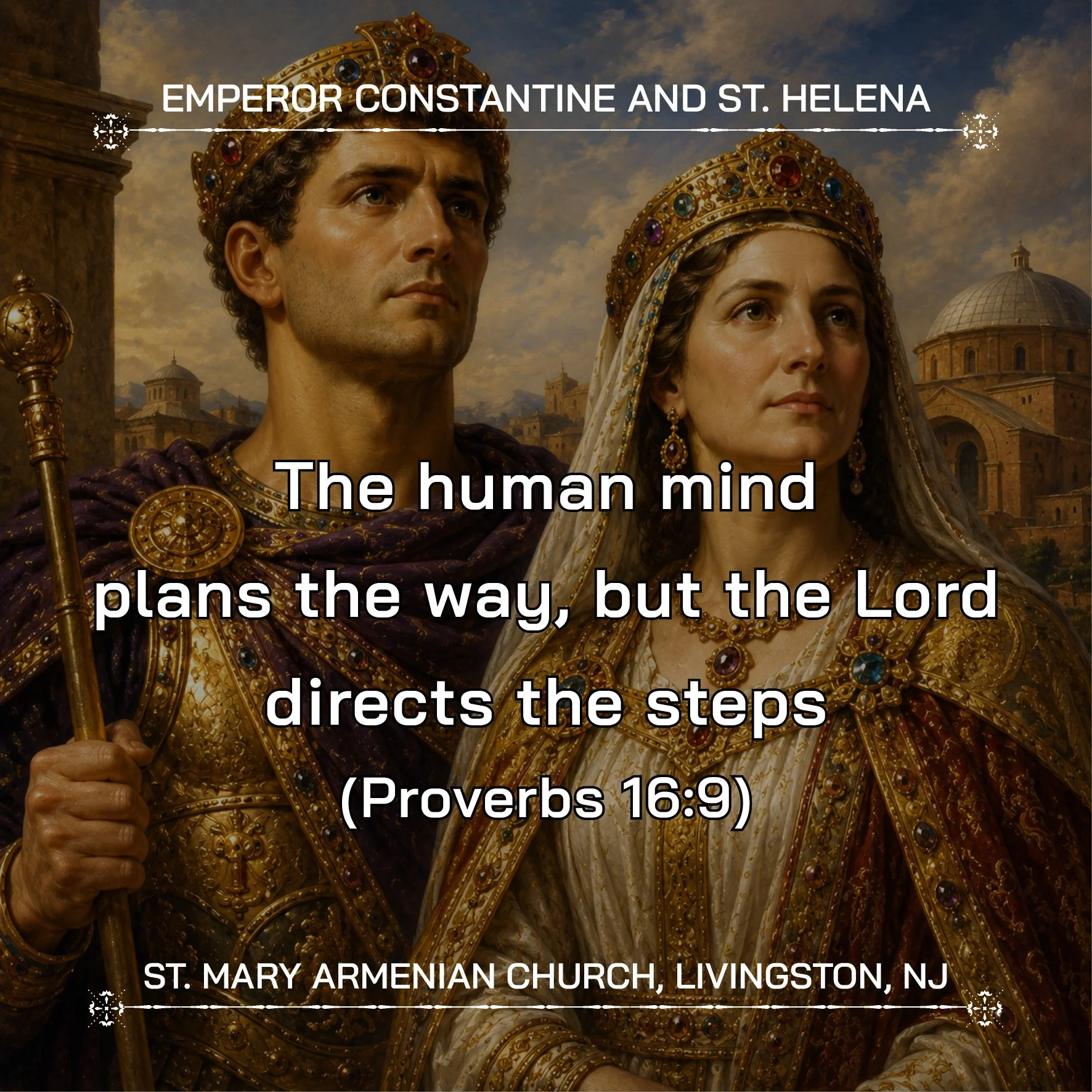
Commemoration Day of
Emperor Constantine
and His Mother Helena
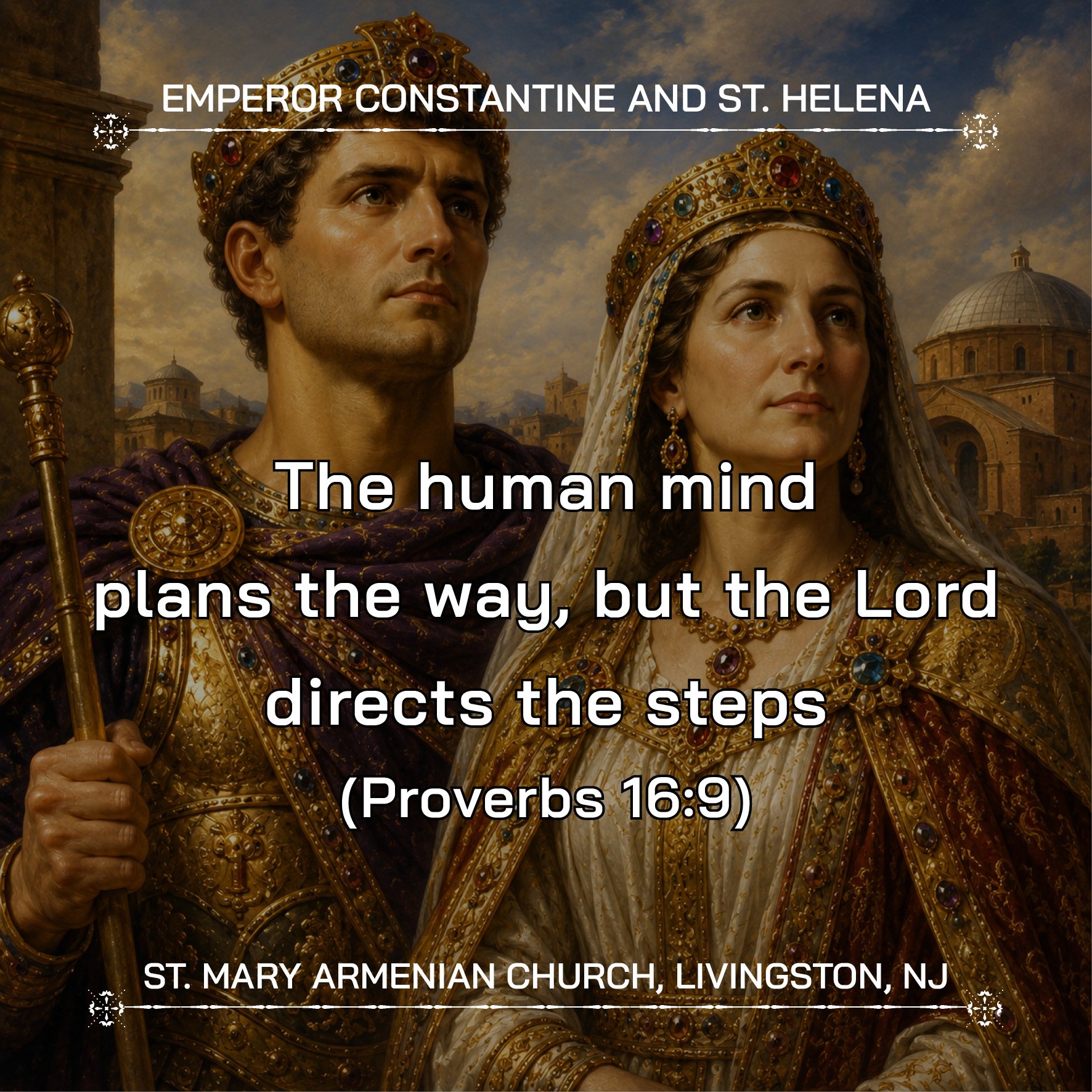
Emperor Constantine
Perhaps the Christian Church owes more to Emperor Constantine than to almost any other individual. It was he who finally freed the Church from more than 250 years of persecution, which had reached its fiercest intensity by the year of his proclamation as emperor in 306 AD under his immediate predecessors and rivals. He not only liberated the Church from persecution but also became its patron, protector, and supporter, elevating it, unofficially, to an almost state-level status.
Apart from his service to Christianity, Constantine is regarded as one of history's greatest figures. By giving history a new direction, he rescued the Roman Empire from collapse and laid the foundations of the Byzantine Christian Empire, extending its life for more than a thousand years. Having suffered virtually no defeats in war, Constantine ranks among the world's great military commanders. He was also a capable statesman who enacted numerous laws and reforms that improved the lives of his subjects. He fully deserves the title "the Great."
Constantine is believed to have been born around 275 AD in the city of Naissus (modern Niš, Serbia). His father, Constantius, later proclaimed Caesar, was a renowned Roman general. His mother, Helena, though of humble origin, was a woman of exceptional ability.
As a young man, Constantine was sent to the court of Emperor Diocletian in Nicomedia to gain experience in state administration. Later, as a military commander, he was dispatched to subdue barbarian tribes along the Danube frontier. When his father grew old, he summoned Constantine to Britain. There, after his father's death in 306, Constantine was proclaimed emperor by his troops in the city of York.
For a time, he ruled his western territories peacefully and refrained from involvement in the struggles among the eastern emperors. However, when Maxentius declared himself emperor in Rome, Constantine was compelled to confront him. After defeating two armies sent by the tyrant, he advanced toward Rome for the decisive battle.
As he approached Rome, Constantine saw the sign of the Cross in the sky and heard a voice saying: "By this sign you shall conquer."
He immediately ordered the sign of the Cross to be placed on his military standards and marched toward Rome. Near the entrance known as the Milvian Bridge, the two armies met. Despite its numerical superiority, Maxentius's army was defeated, and the tyrant himself perished after falling into the Tiber River.
Constantine became sole ruler of the western half of the empire and abolished the persecution of Christians there. He invited the eastern emperor Licinius, gave him his sister in marriage, and promised support against Maximinus Daia, the last major enemy of Christianity. Maximinus was defeated and died in 313.
Together with Licinius, Constantine issued the Edict of Milan in 312–313, bringing an end to the persecution of Christians throughout the Roman Empire. However, Licinius pursued a double policy, plotted against Constantine, revoked the Edict, and resumed persecuting Christians. War became inevitable.
The decisive conflict took place near Adrianople. Licinius fled and fortified himself in Byzantium. Constantine besieged the city from the west and, with a fleet entering through the Dardanelles, crushed Licinius's forces near Scythia and Chalcedon. Licinius eventually surrendered, and Constantine generously pardoned him. When Licinius later resumed his intrigues, the Roman Senate condemned him to death. Thus, in 324, Constantine became both legally and practically the sole ruler of the vast Roman Empire.
After unifying the empire, Constantine turned his attention to preserving the unity of the Church. Around 320, a priest of Alexandria named Arius, a gifted preacher and ascetic originally from Libya, began teaching doctrines concerning Christ that differed from the Church's faith. While acknowledging Christ's pre-existence and supernatural character, Arius denied His true divinity. He taught that Christ was a created being and therefore neither eternal nor equal to the Father.
The Patriarch of Alexandria condemned this teaching. Constantine, desiring unity within his empire, sent Bishop Hosius to mediate, but reconciliation proved impossible. Consequently, in 325, Constantine convened all the bishops at Nicaea and presided over the council himself.
After extensive debate, Arius and his teachings were condemned, and Arius was exiled for refusing to recant.
To clarify the relationship between the Father and the Son, the Council rejected Arius's term "created" and adopted the term "begotten", expressed in the Creed as: "Begotten, not made."
To explain that the Son shares the same divine nature as the Father, the Council adopted the term "consubstantial" (of one essence with the Father).
Constantine became a strong defender of the Council of Nicaea and its decisions. Yet over time, seeing the considerable influence of the Arians, he sought reconciliation and at times favored them, even exiling some of their opponents, including Athanasius.
Despite these developments, Constantine remained throughout his life a protector and benefactor of the Church. Through his support, magnificent churches were built, including the great churches of the Holy Sepulchre, the Ascension, and the Upper Room in Jerusalem, as well as the Basilica of the Nativity in Bethlehem.
By infusing Roman law with Christian principles, he introduced significant reforms. He improved conditions for prisoners, established state support for poor and abandoned children, exempted clergy from taxation, and declared Sunday a day of rest. Alongside political and economic development, he sought to elevate the moral standards of the empire.
Although Constantine lived and acted as a Christian, he postponed his baptism, hoping to be baptized in the Jordan River like Christ. Circumstances prevented this, and he was finally baptized on his deathbed in 337.
His memory is commemorated on the third Tuesday after Pentecost, together with his mother Helena.
Queen Helena
Helena was the mother of Emperor Constantine the Great and his closest collaborator and encourager in all his pious undertakings.
The discovery of Christ's Holy Cross in Jerusalem is traditionally attributed to her. In 326, after receiving a vision, Helena traveled to Jerusalem and undertook the search for the Cross.
On this occasion, she sponsored the construction of numerous chapels and convents for consecrated virgins in and around the Holy City. Despite her royal status, she personally served others with the humility of a servant.
Helena died in 330 AD.
The Church commemorates her together with her son, Emperor Constantine the Great.
SCRIPTURE READINGS
~ Proverbs 16:9-17 ~
The human mind plans the way, but the Lord directs the steps. Inspired decisions are on the lips of a king; his mouth does not sin in judgment. Honest balances and scales are the Lord's; all the weights in the bag are his work. It is an abomination to kings to do evil, for the throne is established by righteousness. Righteous lips are the delight of a king, and he loves those who speak what is right. A king's wrath is a messenger of death, and whoever is wise will appease it. In the light of a king's face there is life, and his favor is like the clouds that bring the spring rain. How much better to get wisdom than gold! To get understanding is to be chosen rather than silver. The highway of the upright avoids evil; those who guard their way preserve their lives.
~ Baruch 3:31-4:4 ~
No one knows the way to her, nor is anyone concerned with the path to her. However, he who knows all things knows her; by his understanding he has discovered her. He it is who established the earth for all time and filled it with four-footed creatures. He who sends forth the light and it takes flight, summons it and, trembling, it obeys. Before him the stars in their designated places shine and rejoice; he summons them, and they reply, “Here we are,” and shine with delight for the one who made them. This is our God; no other can compare to him. He has discerned the entire path to wisdom and revealed her to Jacob, his servant, and to Israel, whom he loved. After that, she appeared on earth and lived with humankind.
She is the book of God’s commandments, the law that endures forever. All who adhere to her will live, but those who forsake her will die. Return, O Jacob, and lay hold of her; approach the radiance of her light. Do not yield your glory to another or your privileges to a foreign people. Blessed are we, O Israel, for what is pleasing to God has been revealed to us.
~ 1 Timothy 2:1-7 ~
First of all, then, I urge that supplications, prayers, intercessions, and thanksgivings be made for everyone, for kings and all who are in high positions, so that we may lead a quiet and peaceable life in all godliness and dignity. This is right and is acceptable in the sight of God our Savior, who desires everyone to be saved and to come to the knowledge of the truth. For there is one God; there is also one mediator between God and humankind, Christ Jesus, himself human, who gave himself a ransom for all —this was attested at the right time. For this I was appointed a herald and an apostle (I am telling the truth, I am not lying), a teacher of the Gentiles in faith and truth.
~ Holy Gospel of St. Luke 7:1-10 ~
After Jesus had finished all his sayings in the hearing of the people, he entered Capernaum. A centurion there had a slave whom he valued highly, and who was ill and close to death. When he heard about Jesus, he sent some Jewish elders to him, asking him to come and heal his slave. When they came to Jesus, they appealed to him earnestly, saying, "He is worthy of having you do this for him, for he loves our people, and it is he who built our synagogue for us." And Jesus went with them, but when he was not far from the house, the centurion sent friends to say to him, "Lord, do not trouble yourself, for I am not worthy to have you come under my roof; therefore I did not presume to come to you. But only speak the word, and let my servant be healed. For I also am a man set under authority, with soldiers under me; and I say to one, "Go,' and he goes, and to another, "Come,' and he comes, and to my slave, "Do this,' and the slave does it." When Jesus heard this he was amazed at him, and turning to the crowd that followed him, he said, "I tell you, not even in Israel have I found such faith." When those who had been sent returned to the house, they found the slave in good health.