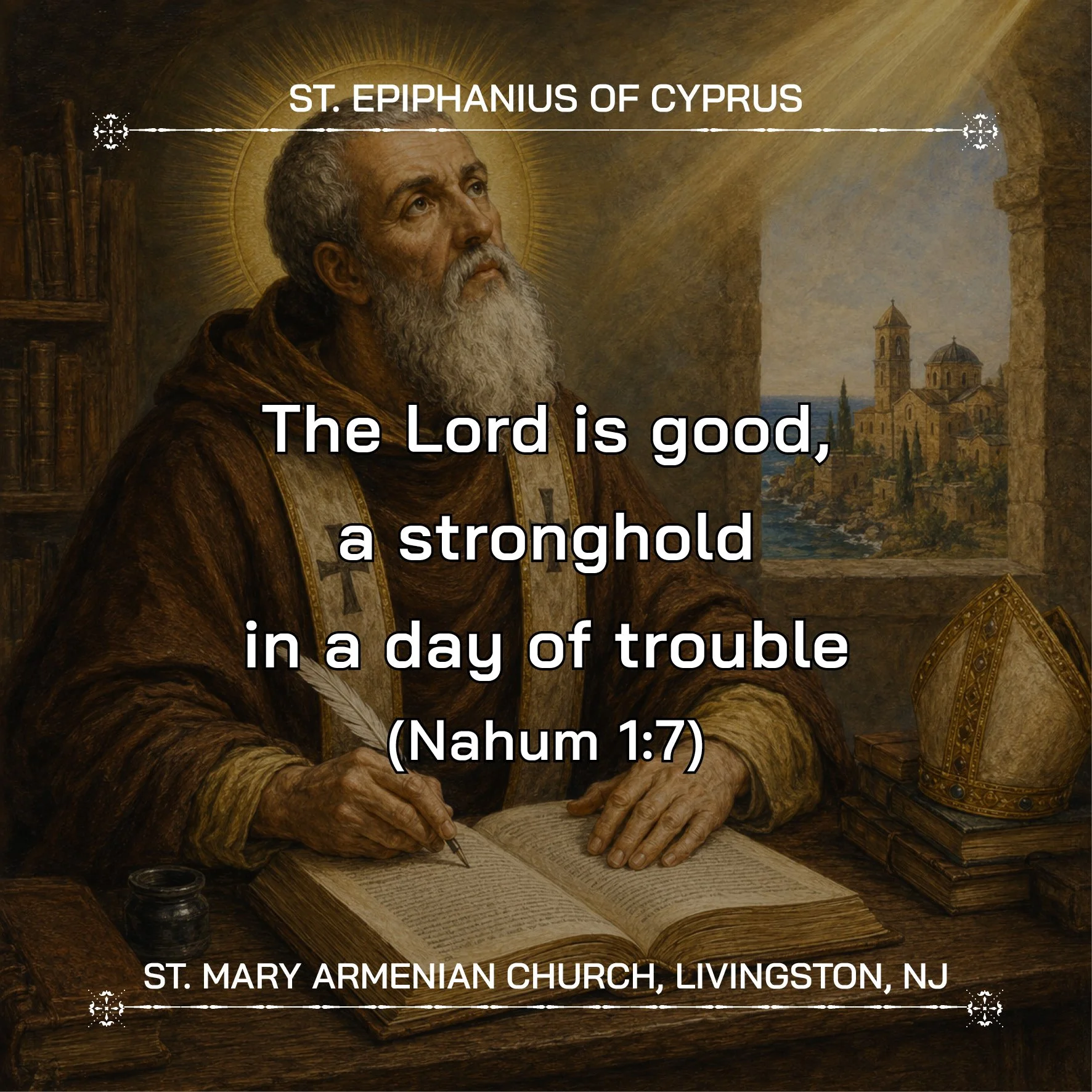
Commemoration Day of
Saint Epiphanius of Cyprus,
Patriarch Babylas,
and His Three Disciples
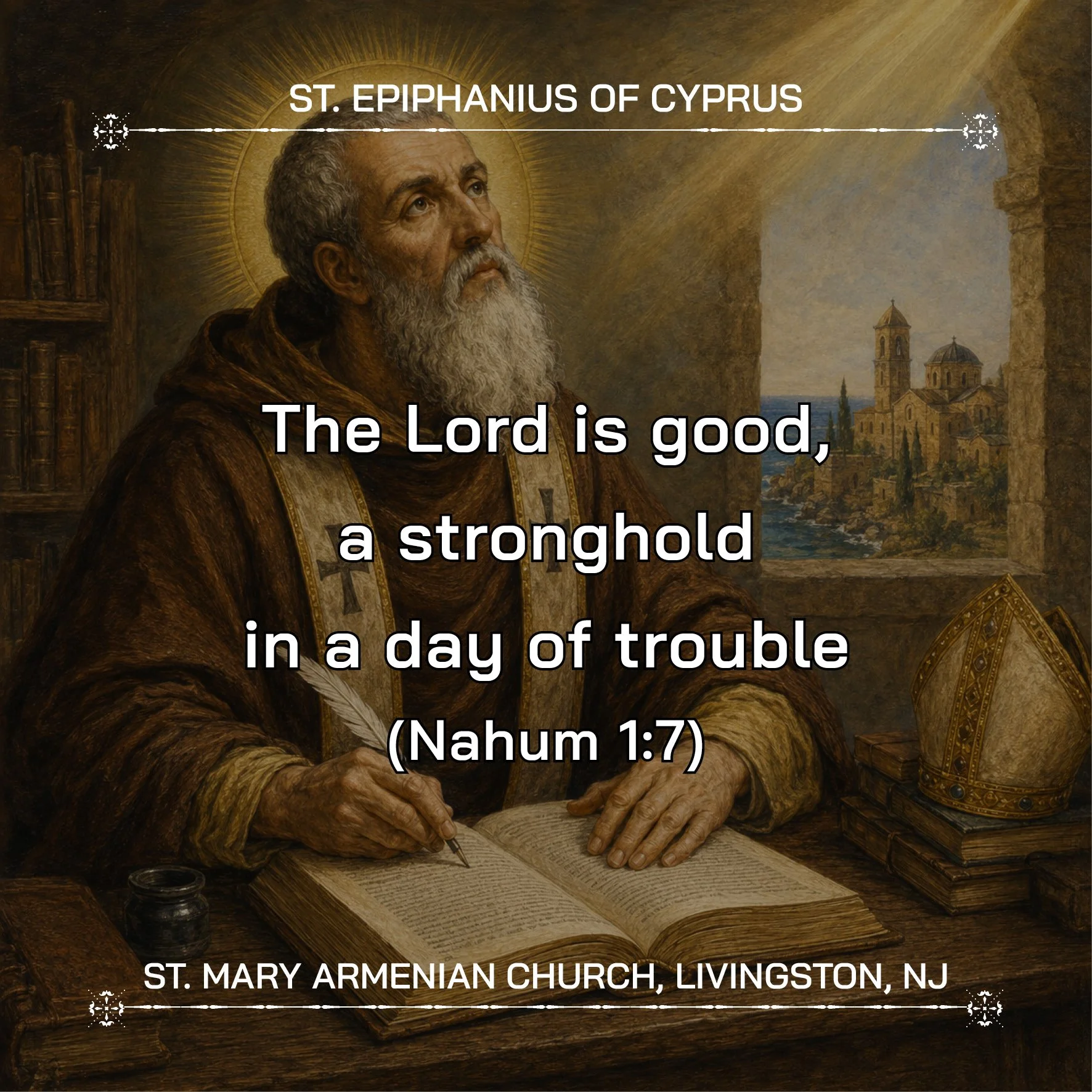
St. Epiphanius of Cyprus
Saint Epiphanius was born in Palestine around 315 AD, probably into a Jewish family. He spent many years in the Holy Land and became one of the prominent figures of the monastic movement. He himself founded a monastery in Eleutheropolis, likely near his birthplace. His reputation as an organizer and conscientious churchman became so widespread that in 367, when a council of bishops was convened in Cyprus to elect a new bishop, Epiphanius was unanimously chosen.
Throughout his life, he was a fervent defender of the Nicene faith and therefore a fierce opponent of the Arians, as well as of all kinds of heretics and schismatics. For this reason, his literary masterpiece is the work “Refutation of All Heresies” (Panarion). In this work, he lists and refutes one by one all the heresies known up to his time that had arisen within the Church.
During the final years of his life, he played an active role in controversies that arose within the orthodox camp itself, particularly the Apollinarian and Meletian disputes. The former, proposed by Apollinaris (310–390), was a Christological heresy claiming that a human being consists of body, soul, and mind; according to Apollinaris, Christ assumed only the body and soul from human nature, while the Divine Logos took the place of the human mind. Thus, although Christ was fully God, He could not be fully human. Epiphanius opposed this teaching.
In 391, while in Rome, Epiphanius met Jerome and joined him in rejecting certain teachings of the great theologian Origen, namely:
That souls pre-exist in a manner similar to Plato’s “ideas.”
That the bodies we will receive in the resurrection are entirely different from our mortal earthly bodies.
That Holy Scripture should be understood and interpreted only allegorically.
From Rome he visited Jerusalem and then traveled to Constantinople to combat heresy. In 403, while returning from Constantinople to his episcopal see in Salamis, Cyprus, he died aboard ship during the journey.
Besides his famous “Refutation of Heresies,” Epiphanius wrote numerous biblical commentaries and homilies, many of which were translated into Armenian. Around 85 Armenian works are attributed to him, though a significant portion is probably not authentic. By temperament, Epiphanius was uncompromising and defended the Nicene faith with near-fanatical zeal, showing little tolerance toward heretical movements.
Patriarch Babylas
Although Western sources state that Babylas was Bishop of Antioch during the reign of Emperor Gordian III (238–244), Greek and Armenian synaxaria place him during the reign of the impious Emperor Numerian (283–284).
When Numerian was in Antioch, he first visited pagan temples and offered sacrifices to idols. Afterwards, he desired to enter the Christian church and disrespect the sacred worship. When the faithful learned that the emperor was coming to their church, they became alarmed and wanted to flee. Babylas calmed them and forbade anyone from leaving the church.
He himself went to the church entrance and blocked the emperor's way, saying: “You are not worthy to enter the church with your impure hands, stained with the blood of sacrifices offered to idols.”
Enraged by these words, the emperor ordered that Babylas's feet and neck be chained, that he be dragged through the city, and then thrown into prison.
While in prison, Babylas was visited by his three young disciples, whom he had been raising in devotion to God. They refused to abandon their teacher. When Numerian heard this, he ordered the children and their mother to be brought before him. He attempted to persuade them through flattery and promises to return to pagan worship. He even promised the mother that he would personally care for the children if they complied.
However, both the mother and the children firmly declared their loyalty to their faith and to their patriarch. The emperor then ordered that each child be flogged according to his age, but even this failed to break their resolve.
Finally, Babylas himself was brought before the emperor. Threatening him with even more terrible tortures and death if necessary, Numerian tried to force him to sacrifice to the idols. Babylas courageously confessed his faith in Christ and denounced the pagan religion as false and empty.
All four were subjected to prolonged torture and were eventually beheaded: Babylas and his three disciples alike.
Their feast is celebrated on the Monday following the Third Sunday after Pentecost.
SCRIPTURE READINGS
~ Wisdom of Solomon 8:7-10 ~
And if anyone loves righteousness, her labors are virtues, for she teaches self-control and prudence, justice and courage; nothing in life is more profitable for mortals than these. And if anyone longs for wide experience, she knows the things of old and infers the things to come; she understands turns of speech and the solutions of riddles; she has foreknowledge of signs and wonders and of the outcome of seasons and times. Therefore I determined to take her to live with me, knowing that she would give me good counsel and encouragement in cares and grief. Because of her I shall have glory among the multitudes and honor in the presence of the elders, though I am young.
~ Nahum 1:7-9 ~
The Lord is good, a stronghold in a day of trouble; he protects those who take refuge in him, even in a rushing flood. He will make a full end of his adversaries, and will pursue his enemies into darkness. Why do you plot against the Lord? He will make an end; no adversary will rise up twice.
~ 1 Corinthians 12:4-11 ~
Now there are varieties of gifts, but the same Spirit; and there are varieties of services, but the same Lord; and there are varieties of activities, but it is the same God who activates all of them in everyone. To each is given the manifestation of the Spirit for the common good. To one is given through the Spirit the utterance of wisdom, and to another the utterance of knowledge according to the same Spirit, to another faith by the same Spirit, to another gifts of healing by the one Spirit, to another the working of miracles, to another prophecy, to another the discernment of spirits, to another various kinds of tongues, to another the interpretation of tongues. All these are activated by one and the same Spirit, who allots to each one individually just as the Spirit chooses.
~ Holy Gospel of St. Matthew 6:45-52 ~
Immediately he made his disciples get into the boat and go on ahead to the other side, to Bethsaida, while he dismissed the crowd. After saying farewell to them, he went up on the mountain to pray. When evening came, the boat was out on the sea, and he was alone on the land. When he saw that they were straining at the oars against an adverse wind, he came towards them early in the morning, walking on the sea. He intended to pass them by. But when they saw him walking on the sea, they thought it was a ghost and cried out; for they all saw him and were terrified. But immediately he spoke to them and said, "Take heart, it is I; do not be afraid." Then he got into the boat with them and the wind ceased. And they were utterly astounded, for they did not understand about the loaves, but their hearts were hardened.