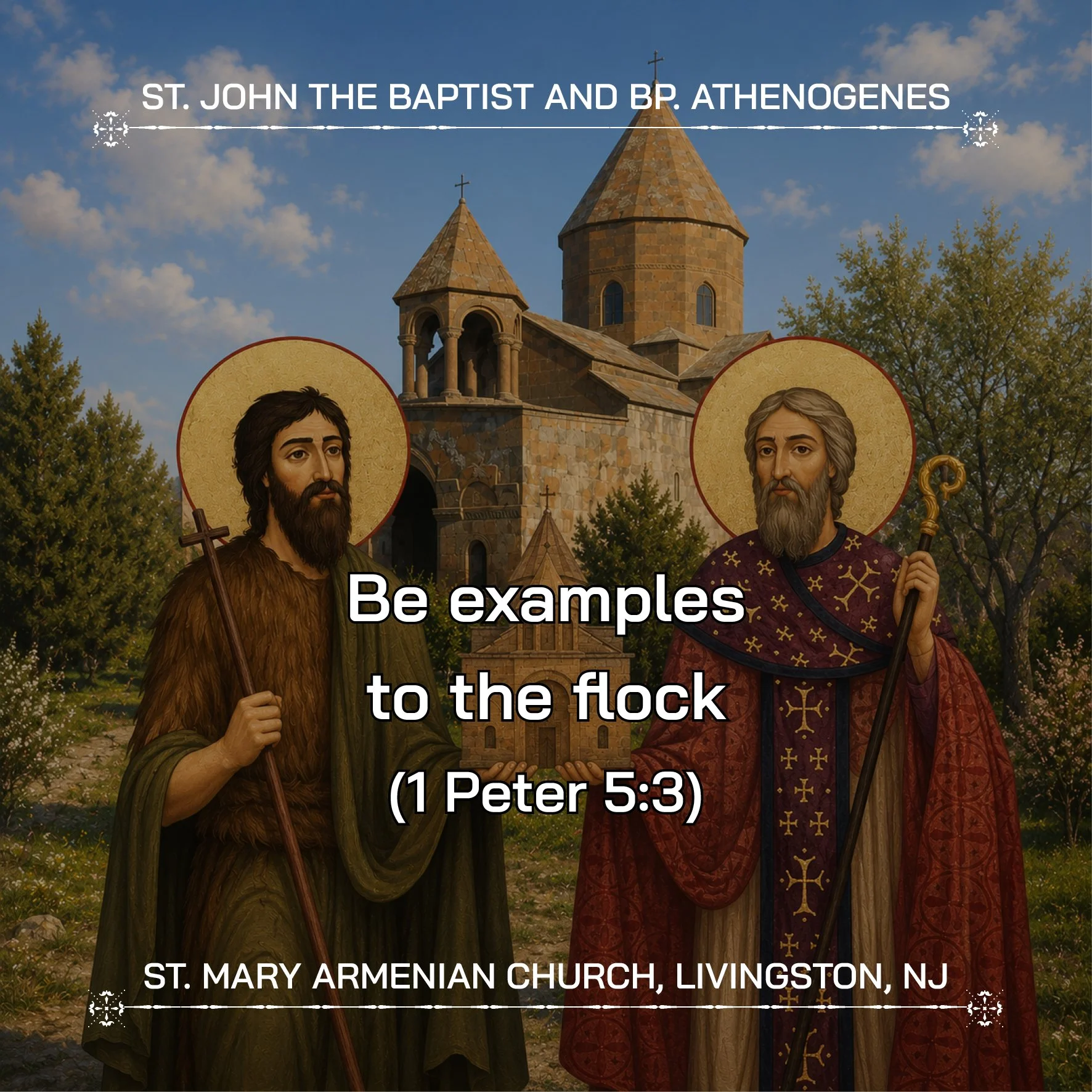
Commemoration Day of
St. John the Baptist
and
Bishop Athenogenes
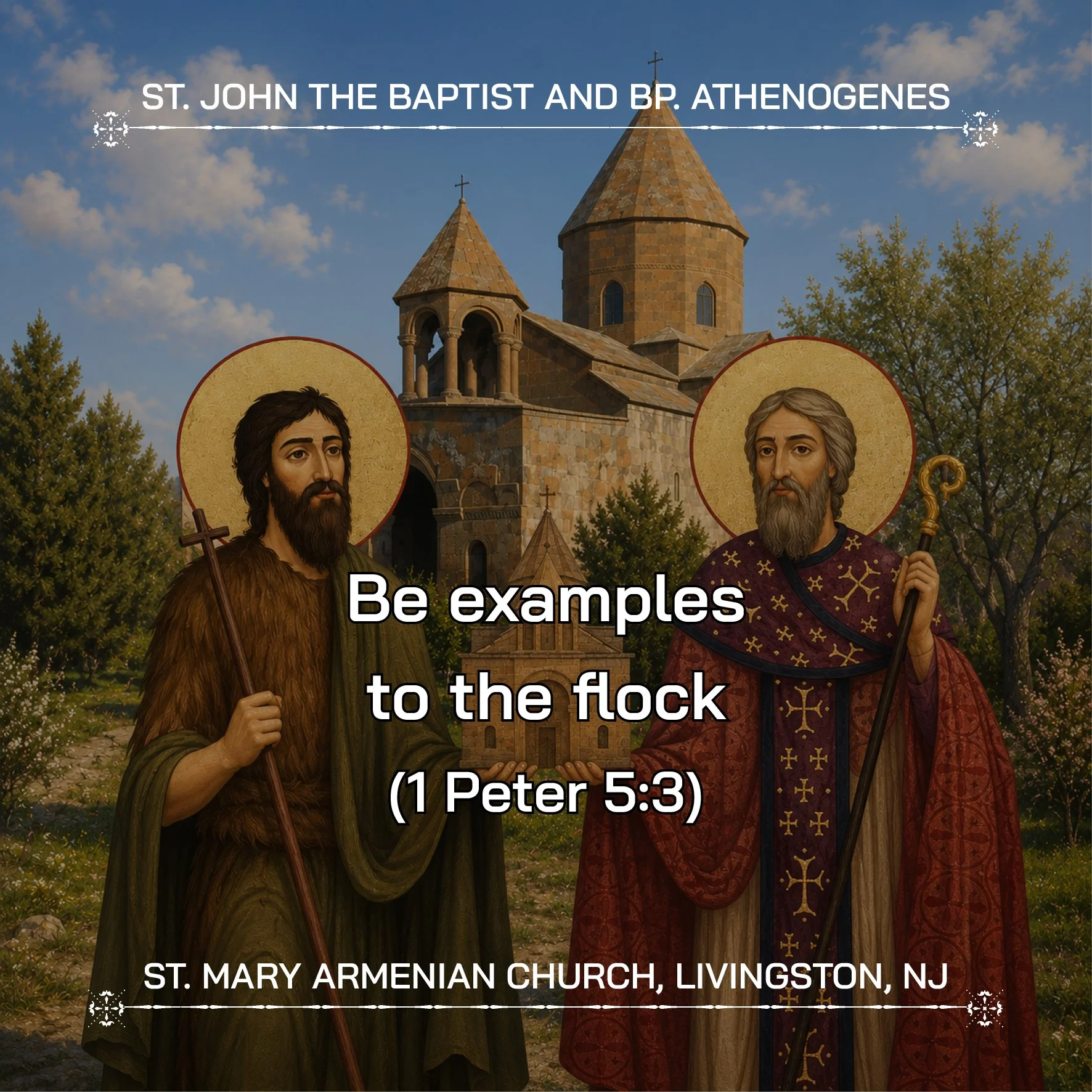
St. John the Baptist
In the Gospels, after Jesus Christ, John the Baptist is the greatest figure and the central character of the opening chapters of the New Testament. He became the official herald of the “Kingdom of God,” that is, the beginning of the Christian era.
As is well known, John was a child of promise, and his birth took place under miraculous circumstances. His future mission was carefully described by the angel who announced his birth to his father: “For he will be great in the sight of the Lord. He shall drink neither wine nor strong drink, and he will be filled with the Holy Spirit even from his mother’s womb. He will turn many of the children of Israel to the Lord their God. He will go before Him in the spirit and power of Elijah, to turn the hearts of the fathers to the children and the disobedient to the wisdom of the righteous, to make ready a people prepared for the Lord.” (Luke 1:15–17)
John spent his childhood and youth away from people, in solitude, under the presence and grace of God.
He began his public ministry at the age of thirty, “in the fifteenth year of the reign of Tiberius Caesar” (Luke 3:1). His place of preaching was the Jordan Valley. In the Gospels, John is identified with the prophecy of Isaiah as “the voice of one crying in the wilderness,” saying: “Prepare the way of the Lord; make His paths straight. Every valley shall be filled, every mountain and hill shall be brought low; the crooked places shall be made straight, and the rough ways smooth.” (Luke 3:4–5)
John’s preaching was as simple and austere as his clothing, food, spirit, and way of life. It can be summarized in two words: repentance and righteousness.
“Repent, for the kingdom of heaven is at hand… Bear fruits worthy of repentance… Even now the axe is laid to the root of the trees; every tree that does not bear good fruit is cut down and thrown into the fire.” (Matthew 3:2; Luke 3:8–9)
He also taught: “Whoever has two tunics should share with the one who has none, and whoever has food should do likewise.” (Luke 3:11)
Seeing John’s bold preaching and great influence, some wondered whether he might be the Messiah. John answered: “I baptize you with water for repentance, but He who comes after me is mightier than I, whose sandals I am not worthy to carry. He will baptize you with the Holy Spirit and fire.” (Matthew 3:11)
The climax of John’s ministry was the baptism of Jesus and his proclamation that Jesus was the promised Messiah. When he saw Jesus approaching for baptism among the crowds, he recognized Him through his prophetic spirit and tried to prevent Him, saying: “I need to be baptized by You, and do You come to me?” (Matthew 3:14)
After Jesus insisted, John baptized Him and proclaimed: “Behold, the Lamb of God, who takes away the sin of the world!” (John 1:29)
He further testified: “I saw the Spirit descend from heaven like a dove and remain upon Him… And I have seen and borne witness that this is the Son of God.” (John 1:30–34)
After baptizing Jesus and proclaiming Him as the Messiah, John’s mission was essentially complete. Soon afterward, King Herod imprisoned him because John had rebuked him for taking his brother’s wife. Later, under tragic circumstances, Herod ordered John’s beheading.
Christ Himself held John in the highest regard. On one occasion He described him as: “More than a prophet.”
He identified him with the messenger foretold by the prophet Malachi and declared: “Among those born of women there has not risen anyone greater than John the Baptist. Yet the least in the kingdom of heaven is greater than he… For all the prophets and the Law prophesied until John. And if you are willing to accept it, he is Elijah who was to come.” (Matthew 11:11–14)
Like the great rabbis and teachers of his time, John had disciples.
The Jewish historian Josephus, who lived during John’s lifetime, also mentions him and confirms that he was executed by Herod.
In the Armenian Church, after the Holy Mother of God, John the Baptist is regarded as the greatest saint. He is closely connected with the history of Armenia and the Armenian Church. When Saint Gregory the Illuminator returned from Caesarea after his consecration during the conversion of Armenia, he brought relics of John the Baptist and placed them near the city of Mush, at one of the earliest known Armenian shrines. Later, the famous Monastery of Saint Karapet was built there, becoming one of the most renowned pilgrimage centers of the Armenian Church.
The Armenian Church has established four annual feasts in his honor:
The Feast of his Nativity, eight days after Christmas.
The Feast of his Beheading, on the Saturday following Easter.
The Feast commemorating the transfer of his relics together with those of Bishop Athenogenes, on the Thursday of the Feast of Holy Etchmiadzin.
A feast celebrated together with Job, on the Thursday of the third week after the Feast of the Assumption.
Many hymns and spiritual songs have been composed in his honor, especially the hymns of the Blessing of Water service, in which John the Baptist occupies a central role.
Bishop Athenogenes
The Greek form of his name is Athenogenes. He was born to Christian parents in Sebastia during the reign of Emperor Diocletian.
He was married and had children. Later he was ordained a priest and became the chorepiscopus (rural bishop) of his native city. Saint Gregory the Illuminator, before entering the service of King Tiridates, had married Athenogenes’ sister Mary during his youth.
According to tradition, Athenogenes killed a terrifying dragon through his prayers and pastoral staff. In gratitude, the Metropolitan of Sebastia consecrated him Bishop of the city of Pitakos.
Later, the governor of the region summoned him and his ten disciples before a tribunal. When they refused to offer sacrifices to idols, all were beheaded and received the crown of martyrdom.
Saint Gregory the Illuminator later brought Athenogenes’ relics to Armenia together with those of Saint John the Baptist and placed them in the Monastery of Glak in the district of Taron.
The Armenian Church celebrates his feast twice each year:
On the Thursday following the First Sunday after Easter, together with Saint John the Baptist, commemorating the transfer of their relics to Armenia.
On the Tuesday following the second Sunday after the Feast of the Transfiguration (Vardavar), together with his ten disciples, corresponding to July 16.
This feast honors both his episcopal ministry and his martyrdom for the Christian faith.
SCRIPTURE READINGS
~ Proverbs 15:21-26 ~
Folly is a joy to one who has no sense, but a person of understanding walks straight ahead. Without counsel, plans go wrong, but with many advisers they succeed. To make an apt answer is a joy to anyone, and a word in season, how good it is! For the wise the path of life leads upward, in order to avoid Sheol below. The Lord tears down the house of the proud, but maintains the widow's boundaries. Evil plans are an abomination to the Lord, but gracious words are pure.
~ Isaiah 22:20-24 ~
On that day I will call my servant Eliakim son of Hilkiah, and will clothe him with your robe and bind your sash on him. I will commit your authority to his hand, and he shall be a father to the inhabitants of Jerusalem and to the house of Judah. I will place on his shoulder the key of the house of David; he shall open, and no one shall shut; he shall shut, and no one shall open. I will fasten him like a peg in a secure place, and he will become a throne of honor to his ancestral house. And they will hang on him the whole weight of his ancestral house, the offspring and issue, every small vessel, from the cups to all the flagons.
~ 1 Peter 5:1-7~
Now as an elder myself and a witness of the sufferings of Christ, as well as one who shares in the glory to be revealed, I exhort the elders among you to tend the flock of God that is in your charge, exercising the oversight, not under compulsion but willingly, as God would have you do it —not for sordid gain but eagerly. Do not lord it over those in your charge, but be examples to the flock. And when the chief shepherd appears, you will win the crown of glory that never fades away. In the same way, you who are younger must accept the authority of the elders. And all of you must clothe yourselves with humility in your dealings with one another, for "God opposes the proud, but gives grace to the humble." Humble yourselves therefore under the mighty hand of God, so that he may exalt you in due time. Cast all your anxiety on him, because he cares for you.
~ Holy Gospel of St. Matthew 11:2-14 ~
When John heard in prison what the Messiah was doing, he sent word by his disciples and said to him, "Are you the one who is to come, or are we to wait for another?" Jesus answered them, "Go and tell John what you hear and see: the blind receive their sight, the lame walk, the lepers are cleansed, the deaf hear, the dead are raised, and the poor have good news brought to them. And blessed is anyone who takes no offense at me." As they went away, Jesus began to speak to the crowds about John: "What did you go out into the wilderness to look at? A reed shaken by the wind? What then did you go out to see? Someone dressed in soft robes? Look, those who wear soft robes are in royal palaces. What then did you go out to see? A prophet? Yes, I tell you, and more than a prophet. This is the one about whom it is written, "See, I am sending my messenger ahead of you, who will prepare your way before you.' Truly I tell you, among those born of women no one has arisen greater than John the Baptist; yet the least in the kingdom of heaven is greater than he. From the days of John the Baptist until now the kingdom of heaven has suffered violence, and the violent take it by force. For all the prophets and the law prophesied until John came; and if you are willing to accept it, he is Elijah who is to come.