The Feast of
the Transfiguration
of Our Lord Jesus Christ
(Vardavar)
Vardavar is the Feast of the Transfiguration (or Glorious Transformation) of Christ. It is the third of the five major feast days of the Armenian Apostolic Holy Church and is celebrated on the Sunday that falls seven weeks after Pentecost. As a movable feast, it occurs between June 28 and August 1.
The account of Christ's Transfiguration is found in the Holy Gospels of Matthew (17:1–9), Mark (9:2–9), and Luke (9:28–36).
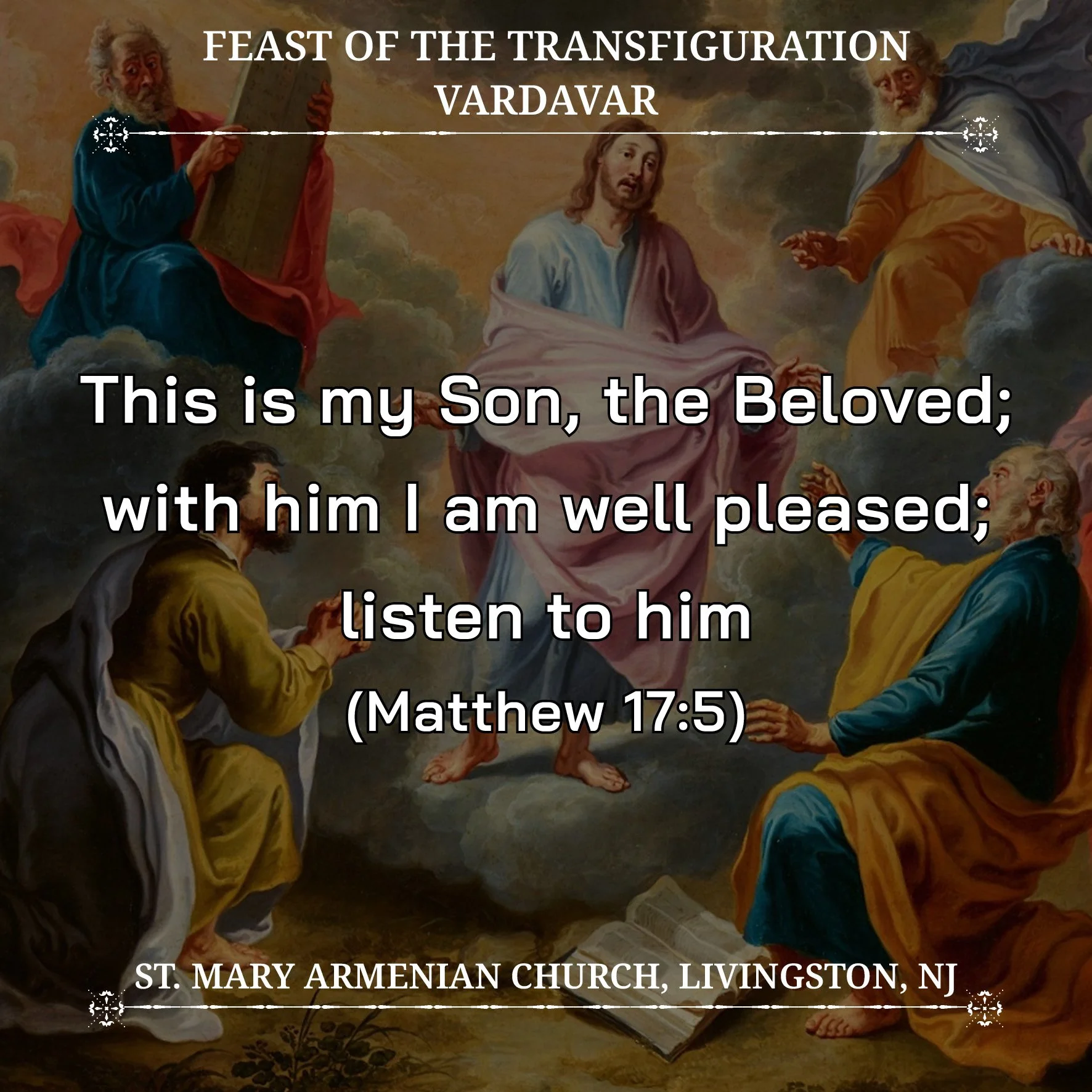
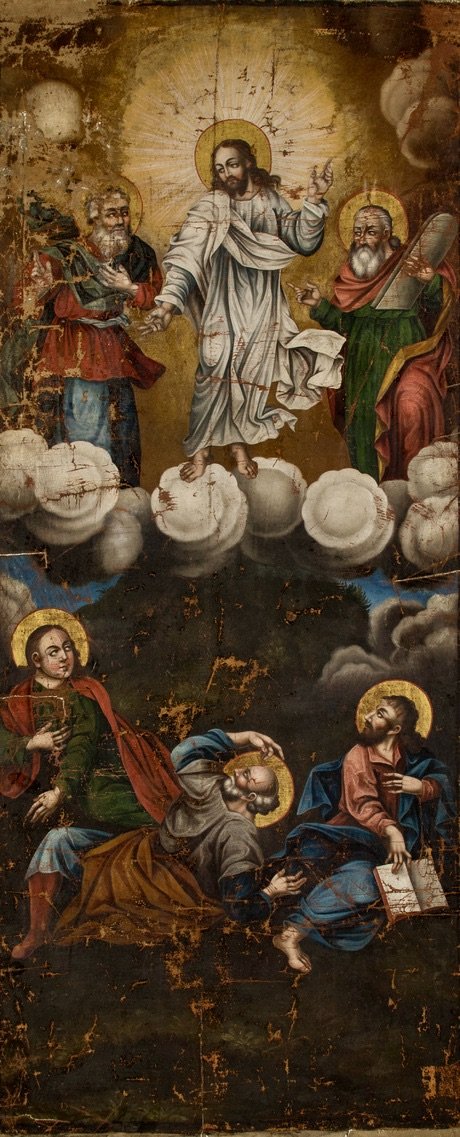
Jesus took with Him the Apostles Peter, James, and John and ascended Mount Tabor. There, before them, He was transfigured: His face shone like the sun, and His garments became white as light. At that moment, Moses and the Prophet Elijah appeared beside Him, enveloped in heavenly glory, and spoke with the Lord about His approaching suffering and death by crucifixion.
Moses, the prophet and lawgiver of the Jewish people who had lived approximately fifteen hundred years before Christ's birth, and Elijah, who about a thousand years before Christ had been taken up into heaven in a fiery chariot with horses of fire, appeared to bear witness that Christ is the true Messiah foretold by the prophets from ancient times—the Savior of the world.
Jesus brought Moses from the realm of the dead and Elijah from among the living, for, as recorded in the Fourth Book of Kings (2 Kings), Elijah was taken bodily into heaven in a heavenly chariot and remains alive there. Thus, according to the Fathers of the Church, within the mystery of the Transfiguration Elijah and Moses represent heaven and earth, the living and the dead. Standing beside Jesus, they testify that He is the Lord "of the living and the dead," the God "of heaven and earth," the Creator of new life, and the One who unites and sanctifies both the visible and invisible worlds.
Moses symbolizes the Law, while Elijah represents the Prophets. Christ brought them forth to reveal that He Himself is the fulfillment of both the Law and the Prophets.
Overwhelmed and filled with wonder at this marvelous vision, the Apostle Peter exclaimed:
"Lord, it is good for us to be here. If You wish, let us make three tabernacles: one for You, one for Moses, and one for Elijah."
Then a radiant cloud overshadowed them, and from the cloud came the voice of God the Father, just as at Christ's baptism:
"This is My beloved Son, in whom I am well pleased. Listen to Him."
Hearing this voice, the disciples were filled with fear and fell facedown to the ground. Jesus approached them and said:
"Rise, and do not be afraid."
When they lifted up their eyes, they saw no one except Jesus alone.
As they descended the mountain, Jesus commanded them to tell no one about what they had seen until after His Resurrection from the dead.
In ancient times, the Armenian Church celebrated the Feast of the Transfiguration for only one day. Later, the celebration was extended to three days and was preceded by a week of fasting and a pre-festal observance. In later centuries, the beautiful and spiritually uplifting hymn in honor of Vardavar was composed by St. Nerses Shnorhali.
Although Christ's Transfiguration took place before His Resurrection and Ascension, the Church celebrates Vardavar after those feasts because Christ Himself instructed His disciples not to speak of what they had witnessed until after He had risen from the dead.
The feast is called Vardavar because the Lord is compared to a rose. Just as a rose remains hidden within its bud until it blossoms and reveals its beauty to all, so Christ concealed the glory of His divinity until His Transfiguration, when He revealed His divine nature. Likewise, just as a rose grows among thorns, Christ appeared among the Jewish people, who ultimately crucified Him.
By revealing His glory on Mount Tabor before His Passion, Christ showed His disciples His divine power and majesty so that they would understand that He was not crucified because of weakness, but willingly, in order to save the world.
As with Vardavar and the other four major feast days of the Armenian Church, the day following the feast is Merelots (Commemoration of the Departed). On this day, the Divine Liturgy is offered for the souls of the faithful departed, and memorial prayers (Hokehankist) are celebrated on their behalf.
SCRIPTURE READINGS
~ Wisdom of Solomon 7:25-8:4 ~
For she is a breath of the power of God and a pure emanation of the glory of the Almighty; therefore nothing defiled gains entrance into her. For she is a reflection of eternal light, a spotless mirror of the working of God, and an image of his goodness. Although she is but one, she can do all things, and while remaining in herself, she renews all things; in every generation she passes into holy souls and makes them friends of God and prophets, for God loves nothing so much as the person who lives with wisdom. She is more beautiful than the sun and excels every constellation of the stars. Compared with the light she is found to be more radiant, for it is succeeded by the night, but against wisdom evil does not prevail.
She reaches mightily from one end of the earth to the other, and she orders all things well. I loved her and sought her from my youth; I desired to take her for my bride and became enamored of her beauty. She glorifies her noble birth by living with God, and the Lord of all loves her. For she is an initiate in the knowledge of God and an associate in his works.
~ Zechariah 14:16-21 ~
Then all who survive of the nations that have come against Jerusalem shall go up year after year to worship the King, the Lord of hosts, and to keep the festival of booths. If any of the families of the earth do not go up to Jerusalem to worship the King, the Lord of hosts, there will be no rain upon them. And if the family of Egypt do not go up and present themselves, then on them shall come the plague that the Lord inflicts on the nations that do not go up to keep the festival of booths. Such shall be the punishment of Egypt and the punishment of all the nations that do not go up to keep the festival of booths. On that day there shall be inscribed on the bells of the horses, "Holy to the Lord." And the cooking pots in the house of the Lord shall be as holy as the bowls in front of the altar; and every cooking pot in Jerusalem and Judah shall be sacred to the Lord of hosts, so that all who sacrifice may come and use them to boil the flesh of the sacrifice. And there shall no longer be traders in the house of the Lord of hosts on that day.
~ 1 John 1:1-7 ~
We declare to you what was from the beginning, what we have heard, what we have seen with our eyes, what we have looked at and touched with our hands, concerning the word of life— this life was revealed, and we have seen it and testify to it, and declare to you the eternal life that was with the Father and was revealed to us— we declare to you what we have seen and heard so that you also may have fellowship with us; and truly our fellowship is with the Father and with his Son Jesus Christ. We are writing these things so that our joy may be complete. This is the message we have heard from him and proclaim to you, that God is light and in him there is no darkness at all. If we say that we have fellowship with him while we are walking in darkness, we lie and do not do what is true; but if we walk in the light as he himself is in the light, we have fellowship with one another, and the blood of Jesus his Son cleanses us from all sin.
~ Holy Gospel according to St. Matthew 16:13-17:13 ~
Now when Jesus came into the district of Caesarea Philippi, he asked his disciples, "Who do people say that the Son of Man is?" And they said, "Some say John the Baptist, but others Elijah, and still others Jeremiah or one of the prophets." He said to them, "But who do you say that I am?" Simon Peter answered, "You are the Messiah, the Son of the living God." And Jesus answered him, "Blessed are you, Simon son of Jonah! For flesh and blood has not revealed this to you, but my Father in heaven. And I tell you, you are Peter, and on this rock I will build my church, and the gates of Hades will not prevail against it. I will give you the keys of the kingdom of heaven, and whatever you bind on earth will be bound in heaven, and whatever you loose on earth will be loosed in heaven." Then he sternly ordered the disciples not to tell anyone that he was the Messiah. From that time on, Jesus began to show his disciples that he must go to Jerusalem and undergo great suffering at the hands of the elders and chief priests and scribes, and be killed, and on the third day be raised. And Peter took him aside and began to rebuke him, saying, "God forbid it, Lord! This must never happen to you." But he turned and said to Peter, "Get behind me, Satan! You are a stumbling block to me; for you are setting your mind not on divine things but on human things." Then Jesus told his disciples, "If any want to become my followers, let them deny themselves and take up their cross and follow me. For those who want to save their life will lose it, and those who lose their life for my sake will find it. For what will it profit them if they gain the whole world but forfeit their life? Or what will they give in return for their life? "For the Son of Man is to come with his angels in the glory of his Father, and then he will repay everyone for what has been done. Truly I tell you, there are some standing here who will not taste death before they see the Son of Man coming in his kingdom."
Six days later, Jesus took with him Peter and James and his brother John and led them up a high mountain, by themselves. And he was transfigured before them, and his face shone like the sun, and his clothes became dazzling white. Suddenly there appeared to them Moses and Elijah, talking with him. Then Peter said to Jesus, "Lord, it is good for us to be here; if you wish, I will make three dwellings here, one for you, one for Moses, and one for Elijah." While he was still speaking, suddenly a bright cloud overshadowed them, and from the cloud a voice said, "This is my Son, the Beloved; with him I am well pleased; listen to him!" When the disciples heard this, they fell to the ground and were overcome by fear. But Jesus came and touched them, saying, "Get up and do not be afraid." And when they looked up, they saw no one except Jesus himself alone. As they were coming down the mountain, Jesus ordered them, "Tell no one about the vision until after the Son of Man has been raised from the dead." And the disciples asked him, "Why, then, do the scribes say that Elijah must come first?" He replied, "Elijah is indeed coming and will restore all things; but I tell you that Elijah has already come, and they did not recognize him, but they did to him whatever they pleased. So also the Son of Man is about to suffer at their hands." Then the disciples understood that he was speaking to them about John the Baptist.