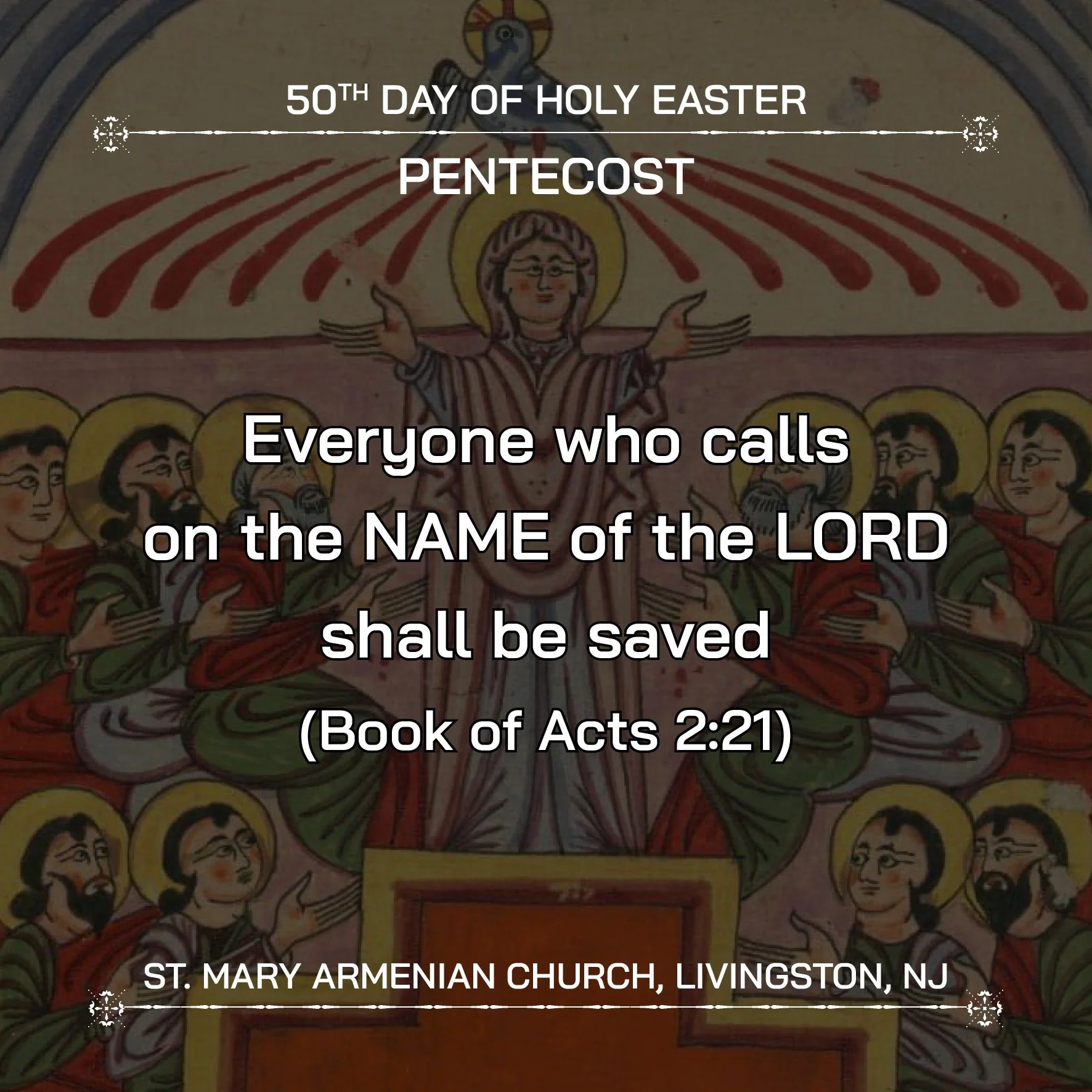
PENTECOST
Fifty days after His glorious Resurrection, on the day of the Jewish feast of Pentecost, Jesus Christ sent upon His apostles the promised Gift — the Holy Spirit. Pentecost was one of the three great feasts of the Old Covenant, commemorating the giving of the Ten Commandments to the people of Israel through the Prophet Moses on Mount Sinai. To celebrate the feast, Jews from many nations journeyed to Jerusalem and offered gifts to God in the Temple.
The miraculous descent of the Holy Spirit upon the disciples took place in Jerusalem, in the upper room where they had gathered according to the command of the Lord. As they prayed together in one spirit, suddenly a sound came from heaven like the rushing of a mighty wind, filling the entire house. The Holy Spirit did not come secretly or invisibly, but as a powerful heavenly presence that filled them all. Tongues of fire appeared and rested upon each of them. Then all were filled with the Holy Spirit and began to speak in other languages as the Spirit gave them utterance (Acts 2:1–4).
At that time Jerusalem was filled with devout Jews from every nation who had come to celebrate Pentecost. The heavenly sound was heard not only by the apostles but by much of the city, drawing a great multitude to the apostolic house. Seeing the gathered crowd, the disciples came forth offering prayers of thanksgiving and glorification to God for the heavenly gift they had received.
The people were astonished. The apostles, simple Galileans without formal learning, began speaking in the languages of many nations. Among the crowd were Greeks, Armenians, Parthians, Arabs, Medes, Assyrians, and others, and each heard the wonders and praises of God proclaimed in his own native tongue. Amazed and perplexed, they asked one another, “What does this mean?” Others mocked them, saying, “They are filled with new wine” (Acts 2:12–13).
On that day, strengthened by the power of the Holy Spirit, the Apostle Peter preached before the multitude, and about three thousand people were baptized and joined the newly established Church.
Filled with the Holy Spirit, Peter proclaimed the first Christian sermon: “Men of Judea and all who dwell in Jerusalem, let this be known to you… God testified to you through Jesus of Nazareth by miracles, wonders, and signs… According to God’s determined plan and foreknowledge, He was delivered into your hands, and you crucified and killed Him by the hands of lawless men. But God raised Him up, freeing Him from the agony of death… Exalted at the right hand of God, and having received from the Father the promise of the Holy Spirit, He has poured out what you now see and hear. Therefore repent, and let every one of you be baptized in the name of Jesus Christ for the forgiveness of sins; and you shall receive the gift of the Holy Spirit” (Acts 2:14–39).
In remembrance of this wondrous event, the feast became known as Pentecost, or Hokekalust — “The Coming of the Holy Spirit.”
According to Saint Augustine, the Feast of the Descent of the Holy Spirit is of apostolic origin, established in the days of the apostles themselves and solemnly celebrated by all churches from the earliest times.
On Pentecost, the Holy Spirit enlightened the disciples with tongues of fire while they were united in love and prayer. Speaking in many languages, they became proclaimers of God’s Word among the nations and united divided peoples through the Cross of Christ. Strengthened and emboldened, they began speaking the languages of the lands where they would preach Christianity. According to St. Nerses Lambronatsi, Peter spoke Latin, Philip Arabic, Thomas Ethiopian, Thaddeus Armenian, and so forth. The apostles carried the renewing and life-giving fire of the Holy Spirit throughout the world.
The Apostle Paul writes: “For we are to God the fragrance of Christ among those who are being saved and among those who are perishing” (2 Corinthians 2:15).
The Holy Spirit — The Third Person of the Holy Trinity
The Holy Spirit is eternal, uncreated, timeless, and perfect. He is not begotten, but proceeds from God the Father. He is consubstantial with the Father and glorified together with the Son.
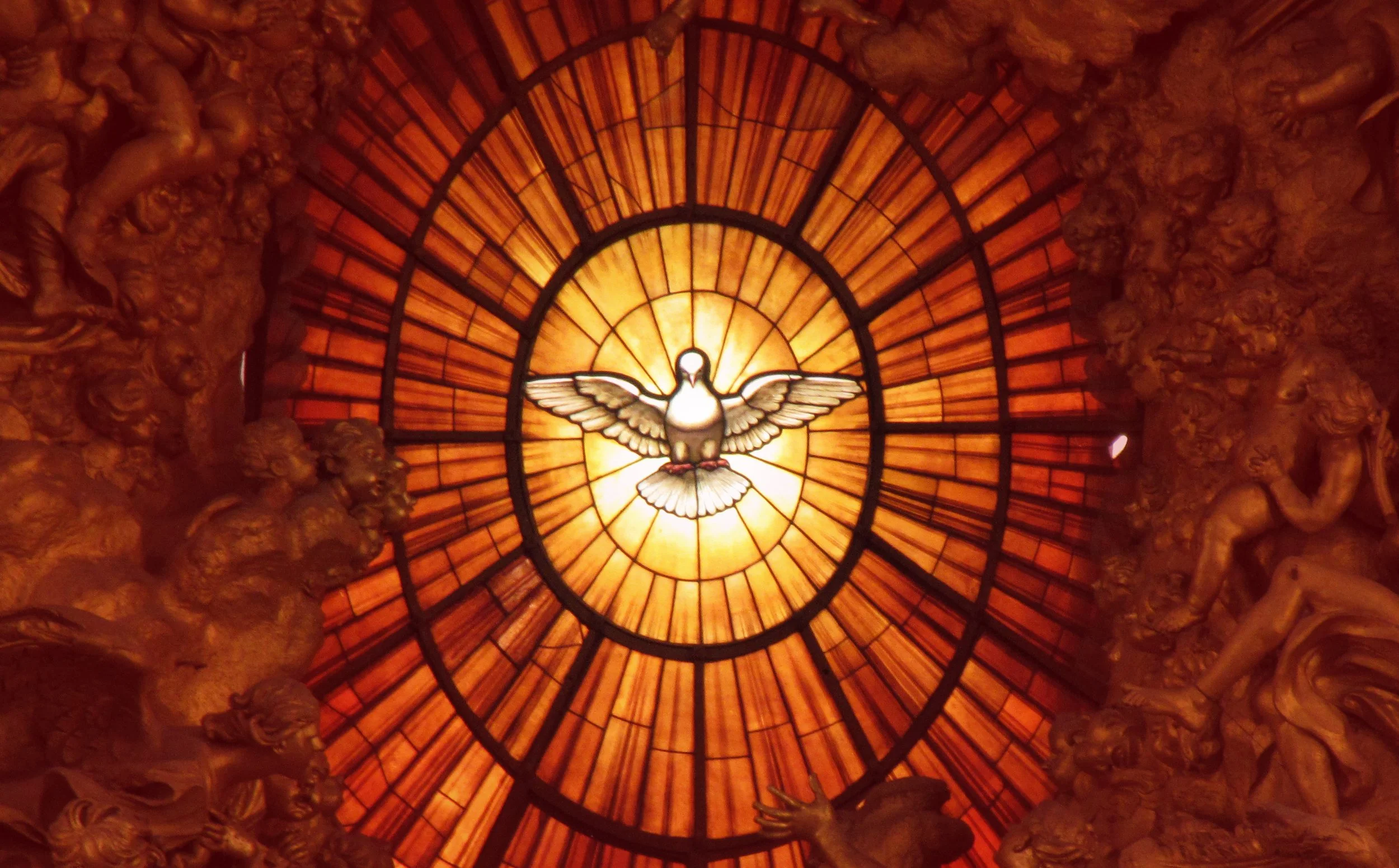
In the Gospel, the Holy Spirit is revealed as a divine power acting in many ways among humanity. At times He is symbolized as breath or wind, at other times as a dove, tongues of fire, or a cloud. These images describe not His essence, but His divine activity. As perfect God, He is equal to the Father and the Son.
The Creator Holy Spirit, who moved over the waters at creation, opened and closed the heavens and divided the languages at the Tower of Babel. He led Israel out of Egypt into the Promised Land, filled Moses, and rested upon the seventy-two elders. He transformed shepherds into prophets, the unlearned into evangelists, fishermen into preachers, and pagans into teachers of the faith.
The Holy Spirit restores unity among divided peoples and grants spiritual rebirth. Through Him the deaf hear, the mute speak, the foolish gain wisdom, and children are strengthened in faith. Through His grace humanity is continually renewed and cleansed from the weakness of sin. Through Him will come the universal resurrection, and through Him eternal places are prepared for both the righteous and the sinful.
Just as God once guarded Paradise with a flaming sword, so today the Holy Spirit protects and preserves the Holy Church with divine fire, so that Satan may not enter and bring destruction, for the evil one greatly fears the fire of the Holy Spirit.
The Holy Spirit descended upon the apostles seven weeks after the Resurrection of Christ, symbolizing the sevenfold gifts granted to them: wisdom, knowledge, strength, understanding, counsel, godliness, and holy fear.
The Feast of Pentecost in the Armenian Church
The Feast of Pentecost is the fulfillment of the Lord’s feasts. It is a feast of liberation and grace, for through it humanity was freed from the bondage of corruption and restored to its heavenly inheritance — Paradise.
The feast is also called Pentecost, from the Greek word meaning “fiftieth,” because it takes place on the fiftieth day after the Resurrection of Jesus Christ.
In the early Church, the celebration lasted three days and was also known as the Feast of the Holy Trinity. In the 12th century, Catholicos St. Nerses Shnorhali established it as a seven-day observance, declaring the entire week a period of fasting. This fast is also known as Elijah’s Fast because on the Sunday following Pentecost the story of the Prophet Elijah is read (4 Kings 1–5). St. Nerses Shnorhali enriched the liturgical celebration with hymns and scriptural readings.
In the Armenian Church, Pentecost is a movable feast observed between May 10 and June 13, depending on the date of Easter.
Through the coming of the Holy Spirit, the Church of Christ was expanded and embraced by nations throughout the world. With this feast, the Easter season in the Armenian Church comes to its completion.
SCRIPTURE READINGS
~ Book of Acts 2:1-21 ~
When the day of Pentecost had come, they were all together in one place. And suddenly from heaven there came a sound like the rush of a violent wind, and it filled the entire house where they were sitting. Divided tongues, as of fire, appeared among them, and a tongue rested on each of them. All of them were filled with the Holy Spirit and began to speak in other languages, as the Spirit gave them ability. Now there were devout Jews from every nation under heaven living in Jerusalem. And at this sound the crowd gathered and was bewildered, because each one heard them speaking in the native language of each. Amazed and astonished, they asked, "Are not all these who are speaking Galileans? And how is it that we hear, each of us, in our own native language? Parthians, Medes, Elamites, and residents of Mesopotamia, Judea and Cappadocia, Pontus and Asia, Phrygia and Pamphylia, Egypt and the parts of Libya belonging to Cyrene, and visitors from Rome, both Jews and proselytes, Cretans and Arabs—in our own languages we hear them speaking about God's deeds of power." All were amazed and perplexed, saying to one another, "What does this mean?" But others sneered and said, "They are filled with new wine." But Peter, standing with the eleven, raised his voice and addressed them, "Men of Judea and all who live in Jerusalem, let this be known to you, and listen to what I say. Indeed, these are not drunk, as you suppose, for it is only nine o'clock in the morning. No, this is what was spoken through the prophet Joel: "In the last days it will be, God declares, that I will pour out my Spirit upon all flesh, and your sons and your daughters shall prophesy, and your young men shall see visions, and your old men shall dream dreams. Even upon my slaves, both men and women, in those days I will pour out my Spirit; and they shall prophesy. And I will show portents in the heaven above and signs on the earth below, blood, and fire, and smoky mist. The sun shall be turned to darkness and the moon to blood, before the coming of the Lord's great and glorious day. Then everyone who calls on the name of the Lord shall be saved.'
~ Holy Gospel of St. John 14:25-31 ~
"I have said these things to you while I am still with you. But the Advocate, the Holy Spirit, whom the Father will send in my name, will teach you everything, and remind you of all that I have said to you. Peace I leave with you; my peace I give to you. I do not give to you as the world gives. Do not let your hearts be troubled, and do not let them be afraid. You heard me say to you, "I am going away, and I am coming to you.' If you loved me, you would rejoice that I am going to the Father, because the Father is greater than I. And now I have told you this before it occurs, so that when it does occur, you may believe. I will no longer talk much with you, for the ruler of this world is coming. He has no power over me; but I do as the Father has commanded me, so that the world may know that I love the Father. Rise, let us be on our way.